To fall asleep faster tonight, take a warm bath or shower 1 to 2 hours before bed, keep the bedroom a few degrees cooler, dim the lights once the sun goes down, and stop caffeine by early afternoon. Those are the core of Andrew Huberman's Sleep Toolkit episode, and the warm bath, with its 1 to 2 hour window, comes from a meta-analysis. Below are the timings, what the research shows, and what to do if you're still awake 20 minutes after lights out.
How to fall asleep faster tonight: the short version
Huberman's 2021 newsletter lists 12 sleep tips, and his 2022 Sleep Toolkit episode covers levers: light, temperature, caffeine, supplements and NSDR. With the studies added, this is what you can still do tonight:
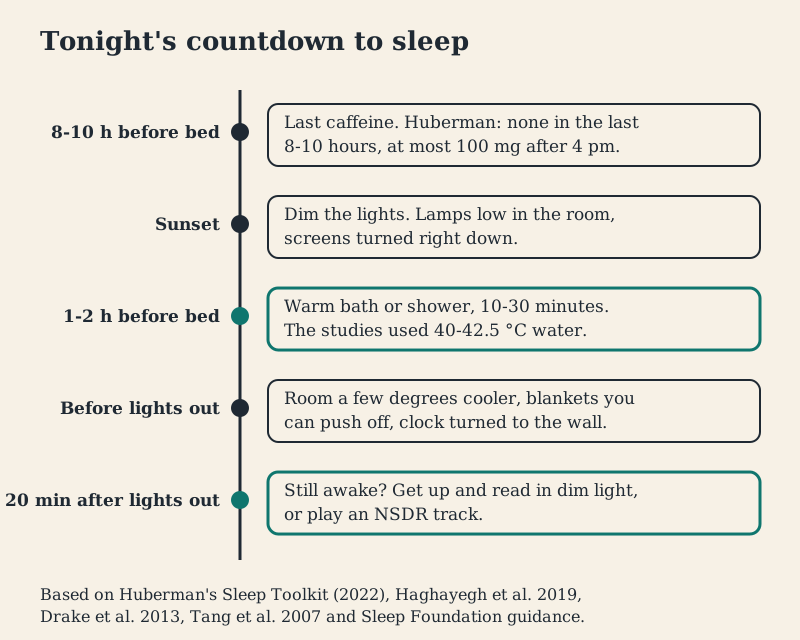
- Warm bath or shower, 1 to 2 hours before bed. In the studies, as little as 10 minutes was enough. Huberman's limit is 20 to 30 minutes.
- A cooler bedroom. Turn it down a few degrees and use blankets you can push off.
- Dim, low lights after sunset. Lamps instead of ceiling lights, screens turned right down.
- No caffeine in the last 8 to 10 hours. For a 10 pm bedtime, that means your last coffee is somewhere between noon and 2 pm.
- Clock turned away. If you're still awake after 20 minutes, get up, or play an NSDR track.
Morning sunlight matters too, but it sets up the following night (see the light section below).
Why cooling down helps you fall asleep
In the Sleep Toolkit episode Huberman says the body drops "by one to three degrees" each night and that the drop is required. "It's like a gate that your body has to go through in order for you to get into sleep." He gives no unit.
Most heat leaves through your palms, the soles of your feet and the upper half of your face.
Cool the room
Huberman's instruction is to "drop the temperature in that sleeping environment by at least three degrees and you'll be happy that you did." A fan or an open window will do it. Use as many blankets as you need. If you get too warm, you'll push a hand or foot out, which he says is easier than cooling a room that's too hot. For a specific number, see how to find your ideal bedroom temperature.
Socks depend on your feet
Huberman skips socks because they cover the soles, but says they suit people whose cold feet wake them. Skip them if you wake up hot. If your feet run cold, try them (see the FAQ for the one small study).
Save cold showers for the morning
One to three minutes of cold water raises your core temperature, which is why Huberman uses it to wake up. For the same reason he calls a cold shower late at night "probably a bad idea".
The warm bath or shower, step by step
The timing comes from a 2019 meta-analysis (Haghayegh et al., 17 studies, 13 of them pooled). With water at 40 to 42.5 °C (104 to 108.5 °F), people rated their sleep better. When the bath or shower came 1 to 2 hours before bed and lasted as little as 10 minutes, they also fell asleep faster.
Huberman says to stay in no more than 20 or 30 minutes, then rinse with a cool-ish or warm shower. Afterwards, he says, "your body temperature will drop by one to three degrees and it will make it much easier to get into sleep."
The authors think warm water sends blood to your palms and soles, which helps you shed heat afterwards. They say the research is thin, especially on timing and duration.
If you only do one thing tonight, make it the bath. Of the steps above on how to fall asleep faster tonight, it's the only one backed by a meta-analysis.
Light: dim it tonight, get sunlight tomorrow morning
Tonight
Once the sun goes down, dim the lights in your home. Huberman's rule is to use lamps set low in the room and avoid overhead lights. He explains that the cells in your eye that signal time of day sit mainly in the lower part of the retina, which looks up, so ceiling lights hit them hardest. Turn screens "way, way down".
Brightness matters more than colour: bright blue, yellow and red light all wake the brain. Avoid bright artificial light between 10 pm and 4 am, and use red light if you have to be up.
Tomorrow morning
Go outside within 30 to 60 minutes of waking. In the 2022 episode Huberman suggests about 5 minutes on a clear day, about 10 under cloud, and 20 to 30 when it's heavily overcast. His 2021 newsletter gives longer times: 10, 20 and 30 to 60 minutes. Glasses and contacts are fine; sunglasses aren't. Never look at light so bright it hurts.
Light through a window "takes far too long", so use one only as a last resort. Morning light, he says, sets "a timer for you to be able to fall asleep about 16 hours later". There's more on this in why morning sunlight helps you sleep. He also says to keep your wake-up time within about an hour every day, weekends included.
Caffeine: the cutoff that matters tonight
Adenosine builds up the longer you're awake and is part of why you feel sleepy at night. Caffeine blocks it.
The usual advice is no caffeine for at least 6 hours before bed. In a 2013 study, 12 good sleepers took 400 mg of caffeine 6 hours before bed and still lost more than an hour of sleep on a home monitor.
Huberman sets the limit further back. His newsletter says to avoid caffeine within 8 to 10 hours of bedtime. In the episode he says no more than 100 mg after 4 pm, and ideally none after 2 or 3 pm. He adds that late caffeine can disrupt the structure of your sleep even if you think you're sleeping well.
After a late coffee, a hot bath may not be enough "if you have a ton of caffeine in your system," Huberman says.
The supplements Huberman takes (and what the evidence says)
Huberman's order is behaviour first, then nutrition, then supplements, then prescription drugs from a doctor. So start with the steps above.
He takes these 30 to 60 minutes before bed:
| Supplement | His dose | What he says it does | Evidence found for this review |
|---|---|---|---|
| Magnesium threonate (or bisglycinate) | 145 mg (bisglycinate: 200 mg) | Mild drowsiness, faster and deeper sleep | One trial: 80 adults took 1 g of magnesium threonate a day for 21 days and scored better than placebo on deep and REM sleep scores from a ring tracker. Three of the six authors work for AIDP, the company that holds the paper's copyright. |
| Apigenin | 50 mg | Lowers anxiety and rumination before sleep | None found for this review |
| L-theanine | 100-400 mg | Helps you get drowsy | His caution: skip it if you have very intense dreams, sleepwalk or have night terrors |
| Myo-inositol | 900 mg | Helps him fall back asleep after waking in the night | His own experience |
Add one at a time, for about a week each, changing nothing else. He says about 5% of people get an upset stomach from magnesium. Check with a doctor or pharmacist before taking any supplement, especially if you take medication, are pregnant or have a health condition. For more, see Huberman's full supplement list and what the magnesium threonate research shows.
If you can't fall asleep: clocks, the 20-minute rule and NSDR
Expect an alert patch
Huberman's newsletter tells you to "Expect to feel really alert ~1 hour before your natural bedtime." It passes. His advice is to go to bed when you first feel sleepy, not push through it.
Turn the clock away
In a 2007 study, people told to watch a clock while trying to sleep worried more and took longer to fall asleep, whether they were good or poor sleepers. In a second experiment with 38 people with insomnia, those told to watch a clock overestimated how long they took to fall asleep more than those given a neutral display to watch. Turn the clock to the wall and put your phone face down.
Get up at 20 minutes
If you're still awake after about 20 minutes, the Sleep Foundation advises getting out of bed. Go to another room, avoid screens and bright lights, and read or do something calm. Go back to bed once you feel drowsy.
Or try NSDR
Huberman's other option is a non-sleep deep rest (NSDR) or yoga nidra recording. He points to free ones on YouTube; dim the screen first. He does NSDR or a sleep hypnosis app "almost every day" in the early afternoon, and suggests it for falling back asleep at night.
The few trials that use the NSDR name haven't tested it as a way to fall asleep. The nearest evidence is from yoga nidra. In a 2023 study, 30 healthy young men had their sleep recorded overnight before and after four weeks of 20-minute yoga nidra sessions. Afterwards they spent 20 fewer minutes awake during the night. There was no control group. See NSDR protocols for sleep for how to use a session at bedtime.
NSDR.co's sessions are free, and there will always be a free plan.
If trouble sleeping goes on for weeks, or makes your days hard to get through, see a doctor.
FAQ
How long should it take to fall asleep?
It should take about 15 to 20 minutes to fall asleep, according to the Sleep Foundation. If you regularly lie awake much longer, use the 20-minute rule above, and talk to a doctor if it keeps happening.
Does a hot shower before bed help you fall asleep faster?
Yes, a hot shower or bath can help if you time it right. In a 2019 meta-analysis, people fell asleep faster when the water was 40 to 42.5 °C and they got in 1 to 2 hours before bed, even for just 10 minutes. The research on the best timing is still thin. Even so, it's the first step to try if you're working out how to fall asleep faster.
Should you wear socks to bed?
Wear socks to bed if your feet run cold, and skip them if you tend to wake up hot. In one small study, six young men in a cool room fell asleep 7.5 minutes faster with bed socks. Huberman skips socks because they cover the skin on the soles that sheds heat.
Does Huberman recommend melatonin?
No, Huberman prefers other supplements to melatonin for regular use. He says store doses are far above what your body makes, and melatonin interacts with other hormones. He thinks occasional use for jet lag is probably fine. In a meta-analysis of 19 trials in people with primary sleep disorders, melatonin cut the time to fall asleep by about 7 minutes on average.
What does Huberman suggest if you wake up at 3am?
For a 3am wake-up, Huberman's newsletter suggests an NSDR protocol if you can't fall back asleep, and he keeps the lights as dim as possible when he's up. He also says 900 mg of myo-inositol helps him fall back asleep, which is his experience, not a trial.
Sources
- Haghayegh S, Khoshnevis S, Smolensky MH, Diller KR, Castriotta RJ (2019). Before-bedtime passive body heating by warm shower or bath to improve sleep: a systematic review and meta-analysis. Sleep Medicine Reviews. https://pubmed.ncbi.nlm.nih.gov/31102877/
- Drake C, Roehrs T, Shambroom J, Roth T (2013). Caffeine effects on sleep taken 0, 3, or 6 hours before going to bed. Journal of Clinical Sleep Medicine. https://pubmed.ncbi.nlm.nih.gov/24235903/
- Tang NK, Schmidt DA, Harvey AG (2007). Sleeping with the enemy: clock monitoring in the maintenance of insomnia. Journal of Behavior Therapy and Experimental Psychiatry. https://pubmed.ncbi.nlm.nih.gov/16793001/
- Ko Y, Lee JY (2018). Effects of feet warming using bed socks on sleep quality and thermoregulatory responses in a cool environment. Journal of Physiological Anthropology. https://pubmed.ncbi.nlm.nih.gov/29699592/
- Hausenblas HA et al. (2024). Magnesium-L-threonate improves sleep quality and daytime functioning in adults with self-reported sleep problems: a randomized controlled trial. Sleep Medicine: X. https://pubmed.ncbi.nlm.nih.gov/39252819/
- Ferracioli-Oda E, Qawasmi A, Bloch MH (2013). Meta-analysis: melatonin for the treatment of primary sleep disorders. PLoS ONE. https://pubmed.ncbi.nlm.nih.gov/23691095/
- Datta K et al. (2023). Improved sleep, cognitive processing and enhanced learning and memory task accuracy with yoga nidra practice in novices. PLoS ONE. https://pubmed.ncbi.nlm.nih.gov/38091317/
- Huberman A (2022). Sleep Toolkit: Tools for Optimizing Sleep & Sleep-Wake Timing. Huberman Lab podcast. https://www.hubermanlab.com/episode/sleep-toolkit-tools-for-optimizing-sleep-and-sleep-wake-timing (video: https://www.youtube.com/watch?v=h2aWYjSA1Jc)
- Huberman A (2021). Toolkit for Sleep. Huberman Lab Neural Network newsletter. https://www.hubermanlab.com/newsletter/toolkit-for-sleep
- Huberman Lab Clips. Best Supplements for Improving Sleep | Dr. Andrew Huberman. YouTube. https://www.youtube.com/watch?v=Se151brgGSM
- Sleep Foundation (2026). How to Fall Asleep Fast. https://www.sleepfoundation.org/sleep-hygiene/how-to-fall-asleep-fast