Yoga nidra, or "yogic sleep", is a deep relaxation practice, usually done lying on your back with a guide. A voice moves your attention through your body, your breath and a few images while you stay awake at the edge of sleep. A 2025 meta-analysis of 73 studies found benefits for stress, anxiety and depression, though the authors say low study quality likely inflated the effects. This guide covers where it comes from, its 8 stages, what the dopamine and sleep studies measured, and a 10-minute way to try it.
What is yoga nidra?
The short answer
Yoga nidra is a state of consciousness between waking and sleeping, usually reached through a guided practice you follow lying on your back. A traditional session moves through a personal resolve called a sankalpa, a body scan, breath awareness, feelings and sensations, visualization, and the resolve again.
You stay awake. In a 2022 EEG study, people who had practiced for 2 weeks were scored as awake for the whole session.
You need no poses or flexibility. You lie in savasana and listen.
Yoga nidra vs meditation
Meditation is usually done sitting with a straight spine. Yoga nidra is done lying down, and where other schools of yoga stress concentration, its goal is complete relaxation.
One randomized trial has put them head to head. In 2018, researchers randomly assigned 60 college professors aged 30-55 to yoga nidra, seated meditation or a control group for 3 months. Both practices beat the control on stress and anxiety but not depression, and the trend favored yoga nidra for anxiety. The EEG studies cited here measured yoga nidra on its own, not side by side with meditation.
A simple rule: if you want to lie down and be guided into rest, or anxiety is your main concern, start with yoga nidra; if you'd rather sit upright, start with meditation. The full comparison of NSDR, meditation and yoga nidra goes further.
Yoga nidra and NSDR
NSDR, or non-sleep deep rest, is an umbrella term coined by Andrew Huberman, a professor of neurobiology and ophthalmology at Stanford School of Medicine. It covers yoga nidra and some forms of meditation. His site says he uses it "so that the name of a more specific practice doesn't serve as a barrier".
In his episode "Leverage Dopamine to Overcome Procrastination & Optimize Effort", he calls NSDR "very similar although different" to yoga nidra. His 10-minute script uses long exhales and a "spotlight" body scan that starts at the feet and widens to the whole body. Traditional yoga nidra moves awareness part by part, starting with the right-hand thumb. His script also has no intention-setting and no Sanskrit. Read more on what NSDR is.
The history of yoga nidra
The answer to "what is yoga nidra?" has changed over time. The idea is ancient, but the guided method most recordings follow took shape in the 1960s and 1970s.
In old texts, a state rather than a technique
Yoga nidra is thought to first appear in the Upanishads, around 600 BCE. The Mandukya Upanishad describes turiya, a fourth state beyond waking, dreaming and deep sleep. The Yoga Taravali, a text traditionally credited to Adi Shankara, later uses the term yoga nidra for a deep meditative state.
In these texts yoga nidra is a state of consciousness. None describes the guided technique people use today.
The modern method: Boyes, Satyananda and Western relaxation
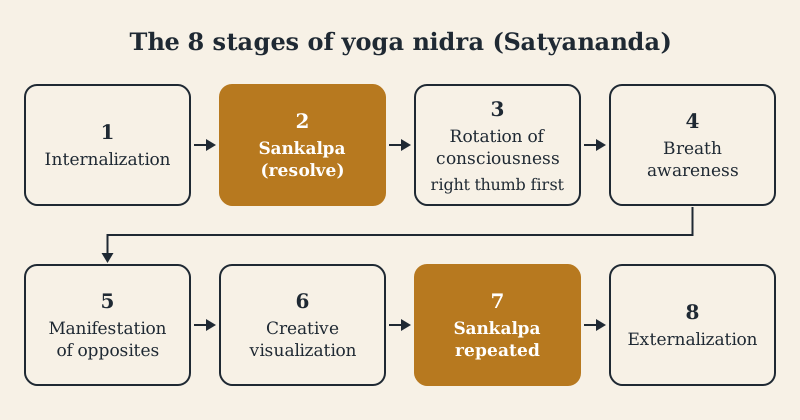
The first known modern use of the term is Le Yoga du sommeil éveillé, a 1973 book by the French yoga advocate Dennis Boyes. Swami Satyananda Saraswati founded the Bihar School of Yoga in 1963 and taught a systematized practice from the 1960s. His 1976 book Yoga Nidra made the practice widely known, and the form he taught has 8 stages.
Satyananda linked the method to nyasa, a tantric practice of mentally placing mantras on parts of the body. His multi-stage technique doesn't appear in ancient or medieval texts. It also draws on Western relaxation methods: Annie Payson Call's Power through Repose (1891) and You Must Relax! (1934) by Edmund Jacobson, who created progressive muscle relaxation.
From the Bihar School to iRest and NSDR
Swami Rama, Richard Miller and others spread it further. Miller, a psychologist, developed iRest (Integrative Restoration) and took it to Walter Reed Army Medical Center and the US Department of Defense. In 2010 the US Army Surgeon General endorsed yoga nidra as a complementary therapy for chronic pain.
Brain imaging began with a 1999 PET study of blood flow in 9 experienced yoga teachers. In 2002, Kjaer's team measured dopamine. They called their study "the first in vivo demonstration of an association between endogenous neurotransmitter release and conscious experience." Later, Huberman coined NSDR as an umbrella term that includes yoga nidra.
What happens in your brain and body during yoga nidra
You stay awake, with patches of slow waves in parts of the brain. Small studies show signs of a shift toward rest-and-digest, and one 2002 study measured more dopamine release.
Brainwaves: awake, with patches of slow waves
EEG sorts brain activity into four main bands:
| Band | Frequency | Usually goes with |
|---|---|---|
| Beta | 13-30 Hz | Active thinking, focus, alertness |
| Alpha | 8-13 Hz | Relaxation, eyes closed |
| Theta | 4-7 Hz | Drowsiness, also seen in meditation |
| Delta | 0.5-4 Hz | Slow-wave (deep) sleep |
The clearest EEG data comes from Datta and colleagues in 2022. Thirty novices did 5 supervised sessions, then practiced alone. After 2 weeks, EEG scoring of 26 of them showed all 26 awake throughout, with delta power up in central brain areas and down in prefrontal areas. The authors call yoga nidra "an awake state with signs of slow waves locally, often referred to as local sleep". In Kjaer's dopamine study, covered below, the PET measure of dopamine release correlated with a rise in EEG theta activity.
Some people claim a session feels like hours of sleep. No study shows that, and local slow waves in an awake brain are a long way from deep sleep and its delta waves.
What the 2002 dopamine study measured
The famous 65% figure comes from one small study. In 2002, Kjaer and colleagues PET-scanned 8 healthy male yoga teachers, aged 31-50, twice: once during a 72-minute guided yoga nidra recording and once while listening to a speech with eyes closed. During yoga nidra, binding of the tracer 11C-raclopride in the ventral striatum fell by 7.9%. The tracer competes with the brain's own dopamine for D2 receptors, and the authors calculated that the drop corresponds to a 65% increase in dopamine release.
Two limits matter. The study measured release during the session only, so it says nothing about baseline levels or what happened afterwards. And no other study has measured dopamine during yoga nidra, so the result hasn't been repeated.
Huberman describes it as raising the dopamine in your "reserves" by up to 65%. That is his interpretation, and the study didn't test it. Read about baseline dopamine with that in mind.
The nervous system shift
Small studies point toward the parasympathetic nervous system, the rest-and-digest branch. In a 2012 lab trial of 20 adults, a yoga nidra session changed heart rate and heart rate variability, which the authors describe as a favorable shift toward the parasympathetic branch. A 2025 single-arm trial found higher heart rate variability after one session in adults with hypertension.
A 2024 meta-analysis of 8 trials, most at high or serious risk of bias, found lower blood pressure than in controls. Cortisol results from a 2025 trial, covered below, were mixed.
One proposed explanation is sensory withdrawal. A 2022 review calls yoga nidra a form of pratyahara, the withdrawal of the senses. A 2024 review says it relies mainly on interoception, your sense of what's happening inside your body, and that understanding of how it works is still evolving.
What the research says about yoga nidra's benefits
The results lean positive, and the studies are mostly small. A 2026 meta-analysis pooled 73 studies with 5,201 participants and found benefits for stress, anxiety and depression. But 17 of its 22 randomized trials were at high risk of bias, and the authors say the effects "likely reflect inflated estimates".
Stress, anxiety and mood
In a 2020 online study by Moszeik and colleagues, 341 people did an 11-minute yoga nidra recording for 30 days and reported lower stress, better well-being and better sleep than 430 waitlist controls. The effects were very small to small.
The same team's 2025 randomized trial ran for 2 months. The 11-minute version (101 people) reduced stress, anxiety, depression and rumination against a waitlist (107 people), with effect sizes of d = 0.08-0.16. Those effects are small too. Regular practice went with lower total salivary cortisol and steeper daily slopes. The 30-minute group (80 people) had mixed results, and among people who practiced it more often, total cortisol went up. The authors say the findings need replicating.
A weaker study, reported in a 2022 review, had 50 first-year nursing students do 48-minute sessions for about 3 weeks. Their average stress score fell from 28.82 to 17.8. With no control group, some of that drop could have other causes.
Sleep
The overnight sleep-lab data comes from one pilot. The other sleep results are self-reported. In a 2023 PLoS ONE study, 41 healthy young novices enrolled to practice for 4 weeks. Overnight recordings in 30 of them, all young men, then showed sleep efficiency up 3.6%, about 20 fewer minutes awake after falling asleep, and more delta power in deep sleep. There was no control group. Slow-wave sleep is linked to attention, learning and memory, so the delta result is worth a proper trial.
Dr. Jamie Zeitzer, co-director of the Center for Sleep and Circadian Sciences at Stanford University and a sleep advisor to Rise Science, told Rise Science: "As far as we understand (and there is limited data), there are certain aspects of sleep that can be replaced with yoga nidra, but most cannot."
Blood pressure and blood sugar
In one uncontrolled study, reported in a 2022 review, 40 people with mild hypertension did 30 minutes of yoga nidra daily for 15 days, and their blood pressure fell. A 2024 meta-analysis of 8 trials found larger drops than in controls, but most trials were at high or serious risk of bias.
In a small 2009 study, 20 people with type 2 diabetes added 30 minutes of daily yoga nidra to their medication, with 21 on medication alone as the comparison. After 90 days their fasting glucose had fallen by 21.3 mg/dL, from 159 to 137.7.
Focus and memory
In the 2023 pilot, reaction times improved on every cognition task after practice, and accuracy rose on several. Again, the pilot had no control group.
Huberman's site cites a 2019 NYU study from Wendy Suzuki's lab as NSDR evidence. Its 13-minute daily guided meditation beat a podcast on attention and memory after 8 weeks, but it tested meditation, not yoga nidra.
Huberman suggests NSDR to speed up learning, arguing that the brain rewires during sleep and NSDR, not during the study session itself. No trial has tested that.
How to practice yoga nidra
Lie on your back, follow a guided voice, and stay awake. Satyananda's method has 8 stages; a home version takes 10 minutes.
The 8 stages of Satyananda's method
- Internalization: settling into stillness.
- Sankalpa (resolve): a short personal resolve, said silently.
- Rotation of consciousness: awareness moves part by part, right-hand thumb first, down the right side, then the left.
- Breath awareness: attention rests on the breath.
- Manifestation of opposites: feeling opposite sensations in turn.
- Creative visualization: images the guide names.
- Sankalpa repeated: the same resolve, near the end.
- Externalization: coming back to the room.
Most recordings shorten this, and iRest uses its own steps.
A simple 10-minute session
- Lie on your back with a pillow under your knees and a blanket over you. Close your eyes.
- Set a sankalpa, one short sentence such as "I allow myself to rest". Say it silently.
- Move your attention from the right thumb through each finger, the palm, the wrist, and on down the right side to the little toe of the right foot. Then do the left side.
- Watch your breath without changing it.
- Repeat your sankalpa in the same words.
- Notice the room. Move your fingers and toes, then open your eyes.
Why 10 minutes? Huberman's site says even 10 minutes helps and suggests 20-30 when you can. The 2020 trial used an 11-minute recording. Start short.
Huberman's version opens with deep nose inhales and long exhales through pursed lips, then moves a "spotlight" up from the feet (Huberman-style NSDR walkthrough). If you'd rather follow a voice than remember steps, NSDR.co is free and has guided yoga nidra and NSDR sessions.
Common mistakes
Fighting sleep. If you doze off, don't worry about it. The research tested people who stayed awake, though, so no one knows whether the benefits still apply if you fall asleep.
Skipping the body scan. It's the core of traditional yoga nidra. Pick a guide that includes it.
Starting uncomfortable. It's hard to relax when you're cold or achy. Use a pillow or bolster under your knees, a blanket and an eye pillow.
Judging it after one session. The trials ran for 30 days and 2 months, and even then the effects were small. Give it a few weeks.
This is general information, not medical advice. If you have high blood pressure, diabetes, a heart condition or a mental health condition, talk to your doctor before using yoga nidra alongside treatment.
FAQ
What is yoga nidra in simple terms?
In simple terms, yoga nidra is guided deep relaxation, usually done lying on your back. A voice moves your attention through a resolve, your body, your breath and a few images while you stay awake.
Is yoga nidra the same as meditation?
No, yoga nidra is not the same as meditation. Meditation is usually done sitting upright with a straight spine. Yoga nidra is done lying down, usually led by a guide's voice, and its goal is complete relaxation.
Is it okay to fall asleep during yoga nidra?
Yes, it's okay to fall asleep during yoga nidra. The studies tested people who stayed awake, so no one knows whether the benefits still apply if you sleep through it.
How long should a yoga nidra session be?
Yoga nidra sessions in studies have run 11 minutes (Moszeik 2020), 30 minutes (Kumar, Amita, and Moszeik 2025's long form), 48 minutes (the nursing students) and 72 minutes (Kjaer). Huberman's site says even 10 minutes helps. Start with 10 to 20.
Can yoga nidra replace sleep?
No, yoga nidra can't replace sleep. Dr. Chester Wu, double board certified in psychiatry and sleep medicine, told Rise Science: "We're still learning about yoga nidra, but one thing we do know is it's not a replacement for sleep." Huberman suggests NSDR to partly offset short sleep and to help you fall back asleep at night, but no trial has tested either use.
What is a sankalpa?
A sankalpa is a short personal resolve you say silently near the start of a yoga nidra practice and again near the end. Something like "I am safe" or "I allow myself to rest" works.
Is yoga nidra safe?
A 2024 review of hypertension trials calls yoga nidra safe and easy to access. You lie still, with no movement or fitness needed. If you have a mental health condition, especially one involving trauma or dissociation, check with your clinician first. If a session leaves you more anxious, stop or try a shorter one.
Sources
- Kjaer TW, Bertelsen C, Piccini P, et al. (2002). Increased dopamine tone during meditation-induced change of consciousness. Cognitive Brain Research 13(2):255-259. https://pubmed.ncbi.nlm.nih.gov/11958969/ (news coverage with participant and session details: AuntMinnie, "Strike a pose: PET sheds light on benefits of yoga", Dec 2002, https://www.auntminnie.com/clinical-news/molecular-imaging/article/15563882/strike-a-pose-pet-sheds-light-on-benefits-of-yoga)
- Lou HC, Kjaer TW, Friberg L, et al. (1999). A 15O-H2O PET study of meditation and the resting state of normal consciousness. Human Brain Mapping 7(2):98-105. https://pubmed.ncbi.nlm.nih.gov/9950067/
- Datta K, Mallick HN, Tripathi M, Ahuja N, Deepak KK (2022). Electrophysiological evidence of local sleep during yoga nidra practice. Frontiers in Neurology 13:910794. https://pubmed.ncbi.nlm.nih.gov/35903117/
- Datta K, Bhutambare A, V L M, et al. (2023). Improved sleep, cognitive processing and enhanced learning and memory task accuracy with Yoga nidra practice in novices. PLoS ONE 18(12):e0294678. https://pubmed.ncbi.nlm.nih.gov/38091317/ (news coverage: Nature India, 31 Jan 2024, https://www.nature.com/articles/d44151-024-00012-y)
- Moszeik EN, von Oertzen T, Renner KH (2020). Effectiveness of a short Yoga Nidra meditation on stress, sleep, and well-being in a large and diverse sample. Current Psychology 41:5272-5286. https://link.springer.com/article/10.1007/s12144-020-01042-2
- Moszeik EN, Rohleder N, Renner KH (2025). The effects of an online Yoga Nidra meditation on subjective well-being and diurnal salivary cortisol: a randomised controlled trial. Stress and Health 41(3):e70049. https://pubmed.ncbi.nlm.nih.gov/40373021/
- Ghai S, Odyniec P, Ghai I (2026). Effects of Yoga Nidra on stress, anxiety, and depression: a systematic review and meta-analysis. Annals of the New York Academy of Sciences 1556(1):e70149 (online Dec 2025). https://pubmed.ncbi.nlm.nih.gov/41327816/
- Ferreira-Vorkapic C, Borba-Pinheiro CJ, Marchioro M, Santana D (2018). The impact of Yoga Nidra and seated meditation on the mental health of college professors. International Journal of Yoga 11(3):215-223. https://pubmed.ncbi.nlm.nih.gov/30233115/
- Markil N, Whitehurst M, Jacobs PL, Zoeller RF (2012). Yoga Nidra relaxation increases heart rate variability and is unaffected by a prior bout of Hatha yoga. Journal of Alternative and Complementary Medicine 18(10):953-958. https://pubmed.ncbi.nlm.nih.gov/22866996/
- Ahuja N, Bhardwaj P, Pathania M, et al. (2024). Yoga Nidra for hypertension: a systematic review and meta-analysis. Journal of Ayurveda and Integrative Medicine 15(2):100882. https://pubmed.ncbi.nlm.nih.gov/38484438/
- Ahuja N, Pathania M, Mohan L, et al. (2025). The effect of Yoga Nidra intervention on blood pressure and heart rate variability among hypertensive adults: a single-arm intervention trial. Cureus 17(1):e77717. https://pubmed.ncbi.nlm.nih.gov/39974253/
- Amita S, Prabhakar S, Manoj I, et al. (2009). Effect of yoga-nidra on blood glucose level in diabetic patients. Indian Journal of Physiology and Pharmacology 53(1):97-101. https://pubmed.ncbi.nlm.nih.gov/19810584/
- Pandi-Perumal SR, Spence DW, Srivastava N, et al. (2022). The origin and clinical relevance of yoga nidra. Sleep and Vigilance 6(1):61-84. https://pubmed.ncbi.nlm.nih.gov/35496325/ (source for the Rani 2013 nursing-student and Kumar 2005 hypertension studies)
- Basso JC, McHale A, Ende V, Oberlin DJ, Suzuki WA (2019). Brief, daily meditation enhances attention, memory, mood, and emotional regulation in non-experienced meditators. Behavioural Brain Research 356:208-220. https://pubmed.ncbi.nlm.nih.gov/30153464/
- Huberman Lab. Non-Sleep Deep Rest (NSDR). https://www.hubermanlab.com/nsdr
- Huberman Lab. Leverage Dopamine to Overcome Procrastination & Optimize Effort (podcast episode). https://www.hubermanlab.com/episode/leverage-dopamine-to-overcome-procrastination-and-optimize-effort
- Huberman Lab Clips. 10 Minute Non-Sleep Deep Rest (NSDR) (YouTube). https://www.youtube.com/watch?v=KHIbgSN2qAU
- Rise Science. Yoga Nidra: Can It Help You Sleep? (Zeitzer and Wu quotes). https://www.risescience.com/blog/yoga-nidra
- Wikipedia. Yoga nidra (history, stages, iRest). https://en.wikipedia.org/wiki/Yoga_nidra
- Wikipedia. Bihar School of Yoga (founding date). https://en.wikipedia.org/wiki/Bihar_School_of_Yoga
- Wikipedia. Electroencephalography (EEG frequency bands). https://en.wikipedia.org/wiki/Electroencephalography