The NSDR protocol is guided rest you do lying down and awake: slow breathing, a body scan, and 10 to 30 minutes of going slack. This guide covers the six steps, the length and timing for five goals, and which of those a study has tested.
TL;DR
- Lie down, cut the inputs, press play.
- Breathe slowly, exhale longer, follow the body scan, stay awake.
- Start with 10 minutes. Go to 20 or 30 when you have time, and 30 to 60 after a bad night or in bed.
- Pick the session by goal: the afternoon slump, stress, skill practice, a poor night or bedtime.
- Most research is on yoga nidra. Four small trials use the NSDR name; the two newest found small, short-lived effects or none.
What is the NSDR protocol?
NSDR is deep relaxation while you stay awake. The protocol is the order you run it in.
What counts as NSDR
Andrew Huberman, a Stanford neuroscientist, coined the term for practices that lead to "a state of deep relaxation without falling asleep completely, including yoga nidra and some forms of meditation." Huberman Lab's guide also lists body scans, sleep hypnosis and sleep meditation. All use an audio script that guides you through a body scan and deep breathing. See what non-sleep deep rest is.
NSDR versus meditation
They overlap, but Huberman Lab's guide says NSDR aims to de-focus the mind.
Where the evidence comes from
Most studies test yoga nidra. Four trials use the NSDR label. A 2024 trial of 65 active adults found a single 10-minute session improved reaction time and self-rated stress, and a 2024 pilot in heart patients paired NSDR with virtual reality therapy. Two 2026 follow-ups by the 2024 team, both testing 10 minutes in active young adults, found smaller or no effects. A 2026 meta-analysis of 73 yoga nidra studies (5,201 participants) found less stress, anxiety and depression, but Shashank Ghai's team says the effects "likely reflect inflated estimates" from low-quality studies.
How the NSDR protocol works (nervous system mechanics)
Your nervous system has a stress-ready sympathetic side and a "rest and digest" parasympathetic side. NSDR aims at the second.
Heart rate and breathing
In a 2012 yoga nidra study of 20 adults, heart rate and heart rate variability (HRV) changed from baseline, which the authors read as a shift toward the parasympathetic side. In the 102-person 2026 NSDR trial, heart rate dropped more than in controls, but the La Trobe University authors say the "physiological findings were modest and should be interpreted cautiously". A 2025 meta-analysis of 28 mostly weak yoga nidra studies found lower blood pressure and heart rate.
In a 2014 lab study of 30 people, a longer exhale than inhale went with more high-frequency HRV, but only at 6 breaths a minute.
The 65% dopamine figure
The figure comes from one study (Kjaer et al., 2002), which took PET scans of eight experienced male yoga teachers during a 72-minute yoga nidra session. Raclopride binding in the ventral striatum fell 7.9%, an estimated 65% more dopamine release than while listening to speech. All eight reported less desire to act but didn't rate themselves more relaxed. The study didn't test short NSDR scripts, and the figure isn't a change in baseline dopamine.
Brain waves: awake, with local slow waves
In a small 2022 sleep-lab study of yoga nidra, with 26 novices analysed, sleep scoring rated them awake throughout, while parts of their brains showed slow waves. This is called local sleep.
The NSDR protocol step by step
To do NSDR, run these six steps in order.
Step 1: Lie down, or sit back
Lie on your back with your arms by your sides and a pillow under your knees if you need one. Huberman Lab's guide says sitting is fine where you can't lie down. Avoid bed unless sleep is the goal.
Step 2: Cut the inputs
Silence your phone, dim the lights, and set an alarm if you're due somewhere.
Step 3: Press play on a guided track
Use a guided track at first, so the voice gives you each step in order.
Step 4: Slow the breath, lengthen the exhale
Breathe in for 4 seconds and out for 6. That comes to about 6 breaths a minute, the rate the 2014 study used.
Step 5: Follow the body scan
Notice each body part the voice names, without forcing anything. If your mind drifts, pick up again at the next part it names.
Step 6: Stay awake, then come back slowly
If you drift off, you've had a nap instead. At the end, move your hands and feet, open your eyes, and wait a minute before you check your phone.
Which NSDR session length should you use?
Start with 10 minutes. Scripts run from about 10 minutes to an hour, and no study has compared lengths.
| Length | Best for | What the evidence says |
|---|---|---|
| 10 min | First sessions, a reset after stress, an afternoon break | Small drops in sleepiness, fatigue and stress in one NSDR trial (102 people); none in another (60) |
| 20 to 30 min | The afternoon slump, with time | Huberman Lab's suggestion; untested against 10 minutes |
| 30 to 60 min | After a poor night; in bed | Huberman's advice, untested; doesn't replace lost sleep |
Start with 10 minutes
The three Boukhris trials used 10 minutes; the heart-patient pilot used 20. Expect a subtle effect.
A 10-minute session, minute by minute
No study has tested this split. If you go without a track, it fits the breathing, body scan and wake-up into 10 minutes.
- Minutes 0 to 2: lie down, breathe in for 4 seconds and out for 6.
- Minutes 2 to 8: move your attention from your toes to your scalp, about 20 seconds per part.
- Minutes 8 to 9: stop scanning and lie still.
- Minutes 9 to 10: move your hands and feet, open your eyes, sit up slowly.
Go to 20 or 30 when you have time
Huberman Lab's NSDR guide says: "Even a brief NSDR script of 10 minutes will have benefits, but aim for 20-30 minutes if possible." It also suggests two 15-minute sessions if a long one isn't relaxing. No study has tested either.
Go longer after a bad night
Huberman suggests 30 to 60 minutes. That is his advice, and it doesn't make up for lost sleep.
When to use NSDR: best times by goal
Match the time of day to the goal.
Afternoon slump
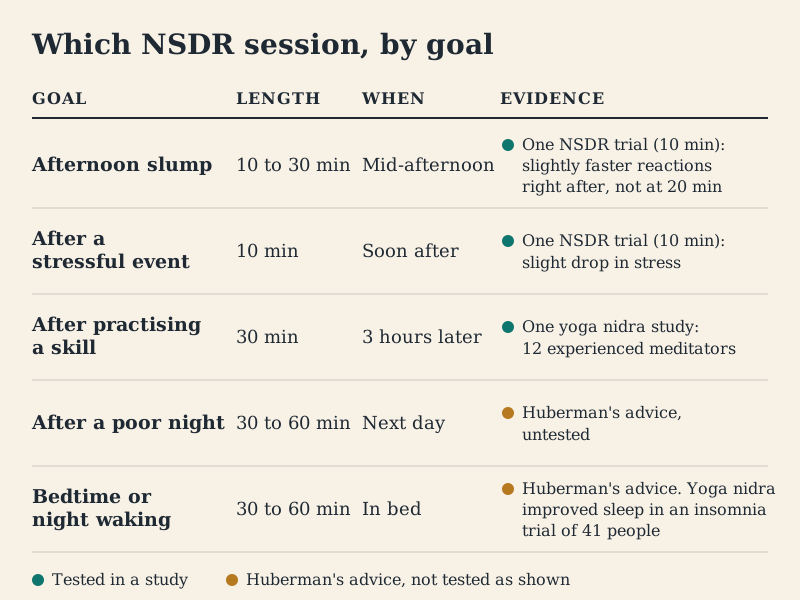
Some people's performance dips mid-afternoon, along with a rise in sleepiness, and it can happen even without lunch. Huberman Lab's guide puts the dip at roughly 2 to 5pm. A 10-minute session is a way to ease it without caffeine, or 20 to 30 minutes if you have the time. In the 102-person 2026 NSDR trial, reaction times were a little faster right after 10 minutes, but not at the 20-minute check.
After a stressful event
Ten minutes is a reasonable reset. In the 102-person 2026 trial, self-rated stress fell slightly more with 10 minutes of NSDR than in controls.
After practising a skill
In one small 2016 study, 12 experienced meditators learned a key-pressing sequence. Three hours after training, one group did 30 minutes of yoga nidra and the other light work. At a later test, the yoga nidra group did better on the trained sequence only. The evidence is early, but it's cheap to try. See NSDR after learning.
At bedtime or when you wake at night
Huberman Lab's guide advises a 30 to 60 minute session started in bed, or NSDR when you wake at night and can't get back to sleep. In a 2021 trial of 41 people with chronic insomnia, yoga nidra (21) and CBT for insomnia (20) both improved sleep, and yoga nidra added deep (N3) sleep. See using NSDR for sleep.
Common NSDR mistakes (and how to fix them)
Most problems with the NSDR protocol are timing problems.
Falling asleep every time
It can mean you're short on sleep, or that you're in the afternoon dip. In a 2004 study, a week of restricted sleep made people fall asleep faster during the day.
Fix: go earlier in the day, or sit propped up.
Mind wandering the whole session
Some drift is normal.
Fix: use a guided track and return to the next body part the voice names.
Going straight into something demanding
Waking from a doze can leave you groggy for a while, an effect called sleep inertia.
Fix: if you slept, allow a few minutes before anything high-stakes.
Judging it after one session
The effect of one session is subtle.
Fix: give it two weeks of daily practice, as in the 2022 yoga nidra study, where sleep diaries improved. If a session leaves you wired, try a shorter one or another voice.
NSDR is a relaxation practice, not a treatment. If you have a sleep disorder, chronic pain or a mental health condition, keep your usual care and talk to your doctor before relying on it.
FAQ
How is NSDR different from a nap?
NSDR is different from a nap because you aim to stay awake, while a nap means sleep, and waking from it can leave you groggy. Still, in a 2026 trial of 60 active young adults, a 25-minute nap beat 10 minutes of NSDR for feeling ready to perform 40 minutes later. So if you have time to shake off grogginess, try a short nap. If you need to get straight back to work without the risk of grogginess, use NSDR. See NSDR vs napping.
How is NSDR different from meditation?
NSDR is different from meditation in that you lie down, follow a voice through a body scan and slow breathing, and aim to de-focus. The two still overlap.
How often should I do NSDR?
No study has tested how often to run the NSDR protocol. In one 2022 yoga nidra study, people practised daily for two weeks and reported better sleep, so try a short daily session.
Is 10 minutes of NSDR enough?
Yes, 10 minutes of NSDR is enough to start. In the 2024 trial of 65 active adults, one 10-minute session beat 10 minutes of sitting on grip strength, reaction time and self-rated stress. The two 2026 trials found small, short-lived effects or none, so expect something subtle.
Can you do NSDR sitting up?
Yes, you can do NSDR sitting up in a comfortable chair. Huberman Lab's guide says sitting comfortably works where you can't lie down.
Can NSDR replace sleep?
No, NSDR doesn't replace sleep. No study shows it makes up for lost sleep or lowers how much you need.
What if I don't feel anything?
If you don't feel anything, that matches the two newest NSDR trials. One found small, short-lived effects and the other found none. Give it a couple of weeks, then try a longer session or a different voice.
Sources
- Huberman Lab. Non-Sleep Deep Rest (NSDR). https://www.hubermanlab.com/nsdr
- Stanford Profiles. Andrew Huberman, PhD. https://profiles.stanford.edu/andrew-huberman
- Boukhris O, Suppiah H, Halson S, Russell S, Clarke A, Geneau MC, et al. (2024). The acute effects of nonsleep deep rest on perceptual responses, physical, and cognitive performance in physically active participants. Applied Psychology: Health and Well-Being. https://pubmed.ncbi.nlm.nih.gov/38953770/
- Wrzeciono A, Cieślik B, Kiper P, Szczepańska-Gieracha J, Gajda R (2024). Non-sleep deep rest relaxation and virtual reality therapy for psychological outcomes in patients with coronary artery disease: a pilot randomized controlled trial. Journal of Clinical Medicine. https://pubmed.ncbi.nlm.nih.gov/39685636/
- Boukhris O, Suppiah H, Kerkeni M, Holt A, Driller M (2026). Time course of perceptual, cognitive, physical and physiological responses to a single non-sleep deep rest session in physically active young adults. Applied Psychology: Health and Well-Being. https://pubmed.ncbi.nlm.nih.gov/42383502/
- Boukhris O, Suppiah H, Driller M (2026). Comparing the effects of a short nap and non-sleep deep rest on perceptual, cognitive, and physical performance in active adults. Clocks & Sleep. https://pubmed.ncbi.nlm.nih.gov/42783005/
- Ghai S, Odyniec P, Ghai I (2026). Effects of yoga nidra on stress, anxiety, and depression: a systematic review and meta-analysis. Annals of the New York Academy of Sciences. https://pubmed.ncbi.nlm.nih.gov/41327816/
- Markil N, Whitehurst M, Jacobs PL, Zoeller RF (2012). Yoga nidra relaxation increases heart rate variability and is unaffected by a prior bout of hatha yoga. Journal of Alternative and Complementary Medicine. https://pubmed.ncbi.nlm.nih.gov/22866996/
- Ghai S, Ghai I (2025). Yoga nidra for cardiovascular health: a systematic review and meta-analysis of between- and within-group effects. Complementary Therapies in Medicine. https://pubmed.ncbi.nlm.nih.gov/40840566/
- Van Diest I, Verstappen K, Aubert AE, Widjaja D, Vansteenwegen D, Vlemincx E (2014). Inhalation/exhalation ratio modulates the effect of slow breathing on heart rate variability and relaxation. Applied Psychophysiology and Biofeedback. https://pubmed.ncbi.nlm.nih.gov/25156003/
- Kjaer TW, Bertelsen C, Piccini P, Brooks D, Alving J, Lou HC (2002). Increased dopamine tone during meditation-induced change of consciousness. Cognitive Brain Research. https://pubmed.ncbi.nlm.nih.gov/11958969/
- AuntMinnie (2002). Strike a pose: PET sheds light on benefits of yoga (study participant details). https://www.auntminnie.com/clinical-news/molecular-imaging/article/15563882/strike-a-pose-pet-sheds-light-on-benefits-of-yoga
- Datta K, Mallick HN, Tripathi M, Ahuja N, Deepak KK (2022). Electrophysiological evidence of local sleep during yoga nidra practice. Frontiers in Neurology. https://pubmed.ncbi.nlm.nih.gov/35903117/ (full text: https://pmc.ncbi.nlm.nih.gov/articles/PMC9315270/)
- Monk TH (2005). The post-lunch dip in performance. Clinics in Sports Medicine. https://pubmed.ncbi.nlm.nih.gov/15892914/
- Immink MA (2016). Post-training meditation promotes motor memory consolidation. Frontiers in Psychology. https://pubmed.ncbi.nlm.nih.gov/27847492/
- Datta K, Tripathi M, Verma M, Masiwal D, Mallick HN (2021). Yoga nidra practice shows improvement in sleep in patients with chronic insomnia: a randomized controlled trial. National Medical Journal of India. https://pubmed.ncbi.nlm.nih.gov/34825538/
- Vgontzas AN, Zoumakis E, Bixler EO, et al. (2004). Adverse effects of modest sleep restriction on sleepiness, performance, and inflammatory cytokines. Journal of Clinical Endocrinology and Metabolism. https://pubmed.ncbi.nlm.nih.gov/15126529/
- Hilditch CJ, Dorrian J, Banks S (2017). A review of short naps and sleep inertia: do naps of 30 min or less really avoid sleep inertia and slow-wave sleep? Sleep Medicine. https://pubmed.ncbi.nlm.nih.gov/28366332/