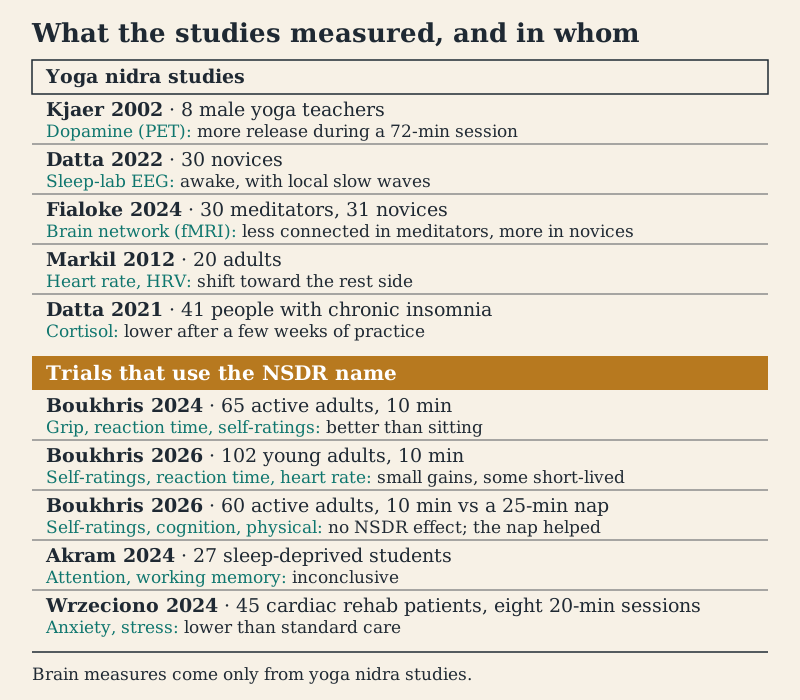
The science of NSDR comes in two parts. Studies of yoga nidra, the older practice NSDR grew out of, found more dopamine release, sleep-like slow waves in a brain that stayed awake, and a calmer heart. Trials of NSDR itself, the first published in 2024, measured mood, reaction time and heart rate, with mixed results. This article covers what 10 key studies measured, in whom, and what nobody knows yet, starting with the famous 65% figure.
What is NSDR? The science in 30 seconds
NSDR, short for non-sleep deep rest, means lying or sitting still with your eyes closed while a recorded voice guides you through long-exhale breathing and a body scan, awake throughout. Andrew Huberman, a neuroscientist at Stanford School of Medicine, coined the name by January 2021 for practices that bring deep relaxation without sleep, including yoga nidra. In the opening of his 20-minute video, he says: "Non-sleep deep rest is a powerful tool that can allow you to control the relaxation state of your nervous system and your overall state of mind." The how-to is in a practical guide to non-sleep deep rest.
The three findings people quote:
- Dopamine. One 2002 PET study of 8 yoga teachers estimated 65% more dopamine release during a 72-minute yoga nidra session than during a listening task.
- Brainwaves. EEG during yoga nidra records more slow-wave activity while people stay awake.
- Nervous system. Heart rate drops a little more during NSDR than in a control group, and in yoga nidra, heart rate variability (HRV) shifts toward the rest side.
Brain chemistry and EEG come from yoga nidra. NSDR trials have so far measured heart rate, mood and performance.
The dopamine effect: what the 65% study found
The 65% figure is real but narrow. It measured dopamine release during one long yoga nidra session in 8 experienced teachers, compared with listening to speech.
The study design
Kjaer and colleagues, 2002, in Cognitive Brain Research, used PET scans with 11C-raclopride, a tracer that competes with the brain's own dopamine for D2 receptors. More dopamine released means less tracer binds. The volunteers were 8 experienced yoga teachers, all men, aged 31 to 50, scanned twice: once listening to speech with eyes closed, once during a guided 72-minute yoga nidra session.
The results
During yoga nidra, raclopride binding in the ventral striatum, a hub of the brain's reward circuit, fell 7.9% against the listening scan, which the authors calculated as a 65% increase in dopamine release.
The drop tracked a rise in EEG theta. Oddly, the men felt less urge to act as dopamine release rose. Their imagery grew more vivid, but they didn't rate themselves more relaxed than in the listening scan.
What it doesn't show
It is one study of eight people. It can't show whether baseline dopamine rises, how long any effect lasts, how fast it builds, or whether a 10-minute NSDR script does the same thing.
Where the "baseline dopamine" idea comes from
The Huberman Lab site says "an hour-long NSDR session increased baseline dopamine levels in the brain by as much as 65%". In his clip "Improve Your Baseline Dopamine for Motivation & Drive", Huberman talks of dopamine "reserves", and on Jay Shetty's podcast in 2024 he cited a "60% increase in baseline dopamine levels". The study measured neither baseline nor reserves. It measured release during the session.
The claim fits his argument that motivation needs enough baseline dopamine to start with. His analogy is a wave pool: "If we are going to feel motivated at all ... we are going to have to have enough dopamine in the wave pool ... before we can generate any waves or peaks in dopamine."
He also says there is "very little evidence" that traditional seated meditation raises dopamine, though Kjaer's own team called yoga nidra a form of meditation.
Theta waves and the NSDR brain state
EEG studies of yoga nidra show an awake brain with patches of sleep-like slow waves, and a brain-scan study found changes in a network linked to mind-wandering. No NSDR-labeled study has recorded EEG yet.
The brainwave bands in one line each
The ranges are approximate and follow a 2023 review (Ingendoh and colleagues).
- Beta, about 13 to 30 Hz: alert.
- Alpha, about 9 to 12 Hz: relaxed, awake.
- Theta, about 5 to 8 Hz: drowsiness and light sleep, also linked with memory processing.
- Delta, about 1 to 4 Hz: deep sleep.
What EEG shows during yoga nidra
Kjaer's yoga nidra study found more theta. In Datta and colleagues (2022), 30 novices learned yoga nidra and practiced it for 2 weeks. The researchers recorded them with 19-channel sleep-lab EEG. Sleep scoring rated the 26 analyzed participants awake throughout, yet delta power rose in central areas and fell in prefrontal ones. The authors called it "an awake state with signs of slow waves locally, often referred to as local sleep".
No study has shown that these slow waves produce any benefit.
Inside the scanner: the default mode network
The default mode network is active during mind-wandering and self-referential thought. In a 2024 fMRI study (Fialoke and colleagues, Scientific Reports), the network became less connected in 30 experienced meditators during yoga nidra, and more connected in 31 novices. The more hours of practice people reported, the bigger the drop. The authors read it as the brain basis of being "restful yet aware".
What the state feels like
Huberman describes the aim of the practice: "With non-sleep deep rest, you can shift your brain state from one of thinking, stress, planning, from anticipation of any kind, positive or negative, to one of pure sensation and deep relaxation."
Your nervous system on NSDR: the autonomic shift
Heart rate falls slightly more during NSDR than in controls, and yoga nidra studies show a small shift toward the rest side.
Two branches of the nervous system
The autonomic nervous system has a sympathetic "fight-or-flight" side and a parasympathetic "rest-and-digest" side.
What has been measured
Three studies, one of NSDR and two of yoga nidra, point the same way.
In a 2026 NSDR trial of 102 young adults (Boukhris and colleagues), heart rate fell a little more during a 10-minute session than in controls. The authors wrote that "physiological findings were modest and should be interpreted cautiously". In a 2012 yoga nidra study of 20 adults (Markil and colleagues), heart rate dropped and HRV shifted toward the parasympathetic branch. In a 2021 yoga nidra trial in 41 people with chronic insomnia, salivary cortisol was lower after a few weeks of practice.
The breathing component
Huberman's protocol opens with deep inhales through the nose and long exhales through thinly pursed lips, which he says "is known to slow your heart rate down and relax your nervous system". A 2018 review (Zaccaro and colleagues) found that slow breathing raises HRV, a sign of parasympathetic activity. In a Stanford trial (Balban and colleagues, 2023), exhale-focused breathing lowered breathing rate and lifted mood.
NSDR vs sleep vs meditation: the brain differences
NSDR and meditation keep you awake, and sleep doesn't. Past that, few studies compare them.
| NSDR | Sleep | Meditation | |
|---|---|---|---|
| Awareness | Awake | Lost | Awake, focused |
| Dopamine | One yoga nidra PET study: more release during practice | Not compared | Little studied |
| Brainwaves | Awake, with more slow waves (yoga nidra data) | Cycles through all stages | More alpha and theta |
| Typical length | 10 to 30 min | About 90 min per cycle (70 to 120) | 13 min a day in one trial |
| Time to benefit | Within the session in some trials, none in others | A 10-minute nap helps right away | 8 weeks, not 4, in one trial |
| Grogginess | Unlikely, since you stay awake | A 30-minute nap can bring it | Unlikely, since you stay awake |
Why not just nap?
If you can nap, a short nap may do more. After a short night, a 10-minute afternoon nap improved alertness straight away in a sleep-lab study (Brooks and Lack, 2006). A 20-minute nap's benefit appeared about 35 minutes later, and a 30-minute nap brought grogginess first. A 2026 head-to-head found a 25-minute nap helped where 10 minutes of NSDR didn't.
NSDR fits when you can't nap or tend to wake up groggy. More in NSDR vs napping.
Why not just meditate?
Meditation trains attention. In an NYU trial (Basso and colleagues, 2019), 13 minutes a day improved it after 8 weeks, not 4. Huberman says meditation is "not known to increase dopamine", and no study has compared the brain effects of NSDR and focused meditation.
The NSDR trials: what the 2024 to 2026 studies show
Four trials and one thesis so far use the NSDR name, mostly in healthy, active young adults, and the results are mixed.
Boukhris 2024: the first trial
At La Trobe University, 65 physically active adults did either 10 minutes of NSDR or 10 minutes of passive sitting. The researchers tested them before and 10 minutes after. The NSDR group beat controls on handgrip strength, median reaction time on a vigilance test and Simon-task accuracy. They also rated their readiness, recovery, stress and tension better. Countermovement jump didn't improve.
Boukhris 2026: a bigger trial, smaller effects
The follow-up tested 102 young adults (half doing NSDR) before, immediately after, and 20 and 40 minutes after. NSDR slightly reduced sleepiness, fatigue and stress, and improved ratings of mental performance and recovery. Reaction time improved immediately afterwards only. Grip and jump didn't change, so the 2024 grip result didn't repeat.
Boukhris 2026: NSDR vs a 25-minute nap
Boukhris, Suppiah and Driller split 60 active young adults into three groups of 20: a 25-minute nap opportunity, 10 minutes of NSDR, or control. At 40 minutes, the nap group reported less fatigue than controls and more readiness to perform than both other groups. On self-rated, cognitive and physical measures, "NSDR did not elicit significant effects under the present conditions".
The Harvard thesis
A 2024 Harvard Extension master's thesis (Akram) tested NSDR online in 27 sleep-deprived students aged 18 to 25, against podcast listening. It found no significant effect on attention or working memory and described its results as "inconclusive". The thesis is small and unpublished, but it still leaves NSDR unproven for thinking after short sleep.
Cardiac rehab pilot
Wrzeciono and colleagues (2024) split 45 cardiac rehab patients into three groups of 15: eight 20-minute NSDR sessions, VR therapy, or standard care. NSDR lowered anxiety and stress scores more than standard care, with no significant difference from VR. Depression scores fell, but not significantly more than in controls.
So the science of NSDR splits two ways. Yoga nidra studies show real changes in the brain, and the NSDR trials are mixed. Nobody claims either replaces sleep.
NSDR vs yoga nidra: is there a difference?
The difference is small. Huberman calls NSDR "very similar, although different to what's sometimes called yoga nidra". NSDR drops the intention-setting and uses less of the chakra language. A generic name, his site says, keeps a practice's name from being a barrier. In a 2024 interview he said the design had no purpose beyond adapting it for the lab.
| Yoga nidra | NSDR | |
|---|---|---|
| Language | Intentions, chakras | Physiology-focused |
| Typical length | Varies; Kjaer's was 72 min | Huberman's: 10, 20 or 30 min |
| Research | Most studies, including all brain imaging | A handful of trials since 2024 |
It is a reasonable guess that a shorter NSDR script works like a long yoga nidra session. Only a few trials have tested it, with mixed results. More on what yoga nidra is and how a session works.
The neuroplasticity connection: NSDR and learning
No NSDR trial has tested memory yet. Huberman's view is that learning is the trigger, and much of the rewiring happens afterwards, during sleep and NSDR. Studies of quiet rest support part of that.
In Dewar and colleagues (2012), 10 minutes of wakeful rest after hearing a story improved memory of it 7 days later, compared with a spot-the-difference game. In Immink (2016), 12 experienced meditators learned a key-pressing sequence. Those who did 30 minutes of yoga nidra 3 hours later did better on that sequence than a light-work group. More on using NSDR after a study or practice session.
When to use NSDR for different brain goals
For timing across the day, see the best times to practice NSDR.
After learning
Do a session soon after a study or practice block. If you can't lie down, sit quietly for 10 minutes instead, the kind of wakeful rest that helped memory in Dewar's study.
Afternoon slump
Some people hit a mid-afternoon dip in alertness, partly circadian and present even without lunch (Monk 2005). Try a 10-minute session when the dip arrives. NSDR keeps you awake, so there's no grogginess to shake off. If you'd rather nap, keep it to about 10 minutes.
After a poor night
Huberman says NSDR "can even partially offset the negative consequences of getting too little sleep." The one test, in 27 sleep-deprived students, was inconclusive. If you can, nap for 10 minutes, which helped straight away after a short night in Brooks and Lack's study. Don't count on NSDR to make up lost sleep.
Before you need to perform
The results are mixed. One trial found sharper reaction time and accuracy afterwards, a second found a short-lived gain, and a third found nothing. If you try it, finish close to the task, since the second trial's gain was gone by the 20-minute test. Test it on a practice day first.
What NSDR won't fix
It doesn't replace sleep, and it isn't a treatment for anything. If short nights are the norm, see your doctor.
What the science of NSDR still can't tell you
The first limit is sample size. The dopamine study had 8 people, and the largest NSDR trial so far had 102. A 2026 meta-analysis of 73 yoga nidra studies and 5,201 participants (Ghai, Odyniec and Ghai) found benefits for stress, anxiety and depression. Because study quality was low, the authors said those benefits "likely reflect inflated estimates".
Still open:
- Does baseline dopamine change at all?
- Can 10 minutes of NSDR match 72 minutes of yoga nidra in experienced teachers?
- What changes in the brain during NSDR itself? No NSDR study has used EEG or imaging.
- Which session length and frequency work best? Nobody has compared them.
- The 2026 trials only partly repeated the 2024 results.
Not everyone takes to it. If NSDR still feels like a chore after a couple of weeks, try a different script or voice, or a different tool.
How to practice NSDR (protocol overview)
- Start a 10-minute guided recording, lie on your back with your arms by your sides, and close your eyes. A chair works too.
- Inhale deeply through your nose, then exhale completely through pursed lips, two or three times.
- Move your attention up from the feet through the legs, torso, arms and head.
- Let each part go slack, and stay awake.
- When the recording ends, open your eyes and lie still for a few breaths before you get up.
The three Boukhris trials used 10 minutes and the cardiac rehab pilot used 20; Huberman Lab suggests 20 to 30 when you have time. More in NSDR session options by goal and length.
This is general information, not medical advice. NSDR is a relaxation practice, not a treatment. If you have a sleep disorder, a heart condition or a mental health condition, keep your usual care and talk to your doctor.
FAQ
Does NSDR increase dopamine by 65%?
NSDR has not been shown to increase dopamine by 65%. The figure comes from one 2002 PET study of 8 yoga teachers, comparing a 72-minute yoga nidra session with a listening task. It measured release, with no baseline reading, and a shorter NSDR script hasn't been tested.
How quickly does NSDR affect the brain?
How quickly NSDR acts depends on the measure. Heart rate starts dropping during a 10-minute session, and in one trial reaction time was sharper straight afterwards. Nobody knows how quickly any dopamine change happens.
Can NSDR replace sleep?
NSDR can't replace sleep. Huberman says it can "partially offset" a short night, but the one test, in sleep-deprived students, was inconclusive. In a 2026 trial, a 25-minute nap left people more ready to perform than 10 minutes of NSDR did.
How long should an NSDR session be?
An NSDR session lasted 10 minutes in the three Boukhris trials and 20 minutes in the cardiac rehab pilot. Huberman Lab suggests 20 to 30 minutes when you have time, and Huberman's free recordings run 10, 20 or 30 minutes. Nobody has compared lengths.
How often should you do NSDR?
How often to do NSDR hasn't been tested, and no study sets an optimal frequency. Huberman says he does it daily. In the yoga nidra EEG study, novices practiced for 2 weeks.
Does NSDR work for everyone?
NSDR doesn't seem to work for everyone. One thesis was inconclusive, and the science of NSDR so far is a handful of small, mixed trials. A different script or voice may suit you better.
Sources
- Kjaer TW, Bertelsen C, Piccini P, Brooks D, Alving J, Lou HC (2002). Increased dopamine tone during meditation-induced change of consciousness. Cognitive Brain Research, 13(2), 255-259. https://pubmed.ncbi.nlm.nih.gov/11958969/
- AuntMinnie (2002). Strike a pose: PET sheds light on benefits of yoga (participant details for Kjaer 2002). https://www.auntminnie.com/clinical-news/molecular-imaging/article/15563882/strike-a-pose-pet-sheds-light-on-benefits-of-yoga
- Haber SN, Knutson B (2010). The reward circuit: linking primate anatomy and human imaging. Neuropsychopharmacology. https://pubmed.ncbi.nlm.nih.gov/19812543/
- Ingendoh RM, Posny ES, Heine A (2023). Binaural beats to entrain the brain? A systematic review of the effects of binaural beat stimulation on brain oscillatory activity, and the implications for psychological research and intervention. PLoS One, 18, e0286023. https://pubmed.ncbi.nlm.nih.gov/37205669/
- Datta K, Mallick HN, Tripathi M, Ahuja N, Deepak KK (2022). Electrophysiological evidence of local sleep during yoga nidra practice. Frontiers in Neurology. https://pubmed.ncbi.nlm.nih.gov/35903117/
- Fialoke S, Tripathi V, Thakral S, Dhawan A, Majahan V, Garg R (2024). Functional connectivity changes in meditators and novices during yoga nidra practice. Scientific Reports, 14, 12957. https://pubmed.ncbi.nlm.nih.gov/38839877/
- Markil N, Whitehurst M, Jacobs PL, Zoeller RF (2012). Yoga nidra relaxation increases heart rate variability and is unaffected by a prior bout of hatha yoga. Journal of Alternative and Complementary Medicine. https://pubmed.ncbi.nlm.nih.gov/22866996/
- Datta K, Tripathi M, Verma M, Masiwal D, Mallick HN (2021). Yoga nidra practice shows improvement in sleep in patients with chronic insomnia: a randomized controlled trial. National Medical Journal of India, 34(3), 143-150. https://pubmed.ncbi.nlm.nih.gov/34825538/
- Zaccaro A, Piarulli A, Laurino M, Garbella E, Menicucci D, Neri B, Gemignani A (2018). How breath-control can change your life: a systematic review on psycho-physiological correlates of slow breathing. Frontiers in Human Neuroscience, 12, 353. https://pubmed.ncbi.nlm.nih.gov/30245619/
- Balban MY, Neri E, Kogon MM, et al. (2023). Brief structured respiration practices enhance mood and reduce physiological arousal. Cell Reports Medicine. https://pubmed.ncbi.nlm.nih.gov/36630953/
- Lomas T, Ivtzan I, Fu CH (2015). A systematic review of the neurophysiology of mindfulness on EEG oscillations. Neuroscience and Biobehavioral Reviews. https://pubmed.ncbi.nlm.nih.gov/26441373/
- Cahn BR, Polich J (2006). Meditation states and traits: EEG, ERP, and neuroimaging studies. Psychological Bulletin. https://pubmed.ncbi.nlm.nih.gov/16536641/
- Brooks A, Lack L (2006). A brief afternoon nap following nocturnal sleep restriction: which nap duration is most recuperative? Sleep. https://pubmed.ncbi.nlm.nih.gov/16796222/
- Basso JC, McHale A, Ende V, Oberlin DJ, Suzuki WA (2019). Brief, daily meditation enhances attention, memory, mood, and emotional regulation in non-experienced meditators. Behavioural Brain Research. https://pubmed.ncbi.nlm.nih.gov/30153464/
- Boukhris O, Suppiah H, Halson S, Russell S, Clarke A, Geneau MC, Stutter L, Driller M (2024). The acute effects of nonsleep deep rest on perceptual responses, physical, and cognitive performance in physically active participants. Applied Psychology: Health and Well-Being, 16(4), 1967-1987. https://pubmed.ncbi.nlm.nih.gov/38953770/
- Boukhris O, Suppiah H, Kerkeni M, Holt A, Driller M (2026). Time course of perceptual, cognitive, physical and physiological responses to a single non-sleep deep rest session in physically active young adults. Applied Psychology: Health and Well-Being. https://pubmed.ncbi.nlm.nih.gov/42383502/
- Boukhris O, Suppiah H, Driller M (2026). Comparing the effects of a short nap and non-sleep deep rest on perceptual, cognitive, and physical performance in active adults. Clocks & Sleep. https://pubmed.ncbi.nlm.nih.gov/42783005/
- Akram G (2024). Testing Non-Sleep Deep Rest (NSDR) protocol to counter the cognitive consequences of short sleep in young adult students. ALM thesis, Harvard University Division of Continuing Education. https://dash.harvard.edu/entities/publication/68e0b583-681d-4143-b56b-4e214ca855a7
- Wrzeciono A, Cieślik B, Kiper P, Szczepańska-Gieracha J, Gajda R (2024). Non-sleep deep rest relaxation and virtual reality therapy for psychological outcomes in patients with coronary artery disease: a pilot randomized controlled trial. Journal of Clinical Medicine, 13(23), 7178. https://pubmed.ncbi.nlm.nih.gov/39685636/
- Dewar M, Alber J, Butler C, Cowan N, Della Sala S (2012). Brief wakeful resting boosts new memories over the long term. Psychological Science. https://pubmed.ncbi.nlm.nih.gov/22829465/
- Immink MA (2016). Post-training meditation promotes motor memory consolidation. Frontiers in Psychology. https://pubmed.ncbi.nlm.nih.gov/27847492/
- Monk TH (2005). The post-lunch dip in performance. Clinics in Sports Medicine. https://pubmed.ncbi.nlm.nih.gov/15892914/
- Ghai S, Odyniec P, Ghai I (2026). Effects of yoga nidra on stress, anxiety, and depression: a systematic review and meta-analysis. Annals of the New York Academy of Sciences. https://pubmed.ncbi.nlm.nih.gov/41327816/
- Sleep Foundation. What is non-sleep deep rest (NSDR)? https://www.sleepfoundation.org/meditation-for-sleep/what-is-non-sleep-deep-rest
- Sleep Foundation. Stages of sleep. https://www.sleepfoundation.org/stages-of-sleep
- Huberman Lab. Non-Sleep Deep Rest (NSDR). https://www.hubermanlab.com/nsdr
- Huberman Lab podcast (11 Jan 2021). Master Your Sleep & Be More Alert When Awake. https://www.hubermanlab.com/episode/master-your-sleep-and-be-more-alert-when-awake
- Huberman A. 20 Minute Non-Sleep Deep Rest (NSDR) to Restore Mental & Physical Energy. Huberman Lab Clips, YouTube. https://youtube.com/watch?v=hEypv90GzDE
- Huberman A. Improve Your Baseline Dopamine for Motivation & Drive. Huberman Lab Clips, YouTube. https://youtube.com/watch?v=35lS7gJVTyA
- On Purpose with Jay Shetty (23 Sep 2024). Andrew Huberman: How to Increase Your Dopamine by 60% & Optimize Your Brain's Response to Stress (transcript). https://podscripts.co/podcasts/on-purpose-with-jay-shetty/andrew-huberman-how-to-increase-your-dopamine-by-60-optimize-your-brains-response-to-stress