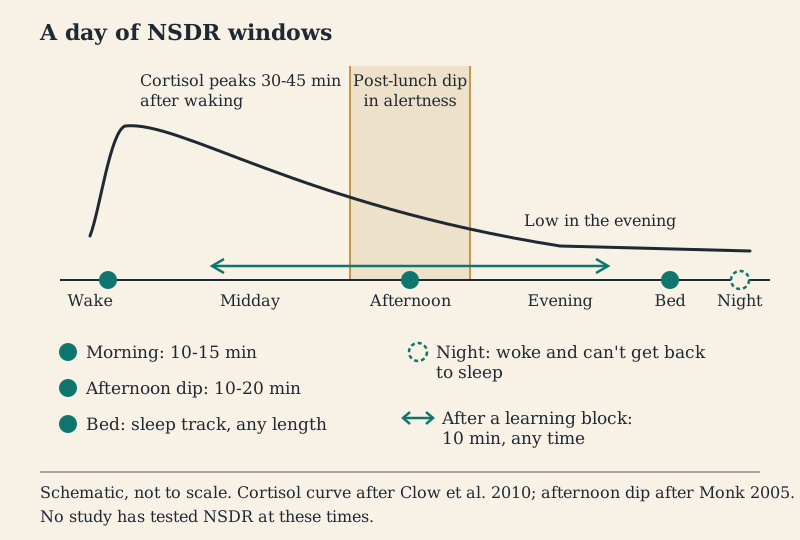
If you only pick one slot, the best time to do NSDR is the early-to-mid afternoon, during the post-lunch dip in alertness. The other three windows do different jobs: soon after waking for a calmer start, straight after a learning session to help it stick, and in bed when you want to fall asleep. Below are all 4, with how long to go and how strong the evidence is for each.
No trial has tested NSDR timing, so the studies here are of yoga nidra, quiet rest, meditation and naps. Huberman describes NSDR as yoga nidra with the intention-setting removed. New to it? Start with what NSDR is and how a session works.
The best time to do NSDR (quick answer)
| Goal | When | Length to start | How good the evidence is |
|---|---|---|---|
| Calmer start, less anxiety | Soon after waking | 10-15 min | A yoga nidra teacher's recommendation; no timing study |
| Remember what you just learned | Straight after a study or practice block | 10 min | Lab studies of 10 minutes of quiet rest, not NSDR |
| Get through the afternoon dip | Early-to-mid afternoon | 10-20 min | The dip is well documented; NSDR not tested for it |
| Fall asleep | In bed, lights out | Any length; a sleep track with no wake-up cue | A teacher's recommendation; the yoga nidra sleep study used 20 minutes of morning practice |
Woken in the night and can't get back to sleep? Huberman suggests a session then (see Evening).
Morning NSDR: for stress and a calmer start
For stress, Rosalie, a yoga nidra teacher, puts the morning first:
“"If you're looking to reduce stress and anxiety, then I'd highly recommend practicing in the morning ... wake up, go to the loo, drink a glass of water and then lie back down and practice for 10 to 15 minutes."
RosalieYoga, Best Time to Practice NSDR (0:27-0:48)
“
Cortisol typically peaks 30-45 minutes after waking (Clow et al. 2010), but no study has tested NSDR in that window.
Morning protocol
- Wake up.
- Go to the bathroom and drink a glass of water.
- Lie back down somewhere comfortable.
- Play a 10-15 minute track.
- Get outside for daylight, which Huberman recommends within 30-60 minutes of waking (Toolkit for Sleep).
Coffee first? Caffeine blocks adenosine receptors, which dulls the feeling of fatigue (Leng et al. 2026).
Choose the morning if you wake with racing thoughts, or dread the day ahead.
After learning: rest that helps new memories stick
Straight after a study session or a practice block, do 10 minutes of NSDR before you start the next task. A 2019 review concluded that brief rest after learning helps new memories consolidate (Wamsley 2019).
In a 2012 Edinburgh study, people remembered more of a story a week later when it was followed by 10 minutes of quiet rest than when it was followed by a spot-the-difference game (Dewar et al. 2012). The evidence comes from lab studies of quiet rest, not NSDR.
When to use it
- After language study
- After a lecture or course module
- After learning a new software tool
- After practising a physical skill, such as an instrument or a sport technique. In a lab study of early skill learning, the gains came during rests of a few seconds between practice bouts (Bönstrup et al. 2019). Nobody has tested a full session afterwards.
How long
Ten minutes, the length the memory study used. The hard part is not jumping straight into the next task. More in using NSDR after study sessions.
Afternoon NSDR: for the post-lunch dip
For an afternoon slump, the best time to do NSDR is when you feel the dip start. A short session lets you rest through it, usually without the grogginess of a nap.
Why the dip happens
The dip has its roots in human biology and may be linked to the circadian system, the body's roughly 24-hour clock. It doesn't hit everyone (Monk 2005). It can arrive even if you skip lunch, though a big carb-heavy meal makes it worse.
Rosalie's second use is energy:
“"...could be to boost your energy level or your productivity or maybe even your creativity ... I'd recommend practicing when you start to notice that you need that little boost, maybe that 3pm slump."
RosalieYoga (0:53-1:13)
“
Coffee or NSDR?
In a sleep study, 400 mg of caffeine taken even 6 hours before bed disrupted sleep (Drake et al. 2013). NSDR is a way to rest without caffeine. Whether it clears sleepiness the way a short nap does hasn't been tested.
Lie down if you can, or recline at your desk. Set a gentle alarm for when the track ends, so a session that tips into sleep doesn't become a long nap. More on why the afternoon slump happens.
Ten minutes is enough to start, and NSDR.co's sessions are free.
Evening NSDR: for falling asleep
At night you let the session run into sleep instead of coming back up alert:
“"If you're looking to fall asleep quicker or to improve the quality of your sleep, then I'd suggest practicing in bed when you're ready for sleep. Just make sure that there's nothing at the end of the track that will wake you up and bring you back."
RosalieYoga (1:35-1:52)
“
In a 2023 study with no control group, 30 healthy young men did 20 minutes of daytime yoga nidra for four weeks. Overnight recordings showed more efficient sleep (+3.6%) and about 20 fewer minutes awake at night (Datta et al. 2023). A chronic insomnia trial found more deep sleep and less total time awake after yoga nidra (Datta et al. 2021), but a 2026 meta-analysis rated the sleep evidence very low certainty (Singh et al. 2026).
Evening protocol
- Get into bed at your usual time.
- Pick a track designed for sleep, with no wake-up cue at the end.
- Any length works. The yoga nidra sleep study used 20 minutes a day, but in the morning, not in bed.
- Let yourself drift off.
If you wake in the night
Huberman suggests an NSDR session if you wake and can't get back to sleep, and notes that waking once or so a night is normal (Toolkit for Sleep).
NSDR can help you rest, but it doesn't treat insomnia or other sleep disorders. If poor sleep keeps going, see a doctor. More in NSDR protocols for sleep.
NSDR vs napping: when to choose each
In a sleep-lab recording of yoga nidra, 26 of 30 people stayed awake, though parts of the brain showed sleep-like slow waves (Datta et al. 2022). So you usually come out without nap grogginess. Naps are real sleep and can leave you groggy for a while, as a 30-minute nap did in one lab study (Brooks & Lack 2006; Hilditch et al. 2017).
NSDR, nap or coffee
| Option | Time | Alertness after | Night-sleep impact | Best for |
|---|---|---|---|---|
| NSDR | 10-20 min | Usually no grogginess, since you mostly stay awake | None reported; yoga nidra studies found night sleep improved | Getting straight back to work |
| 10-minute nap | 10 min, plus time to drop off | Immediate benefits in one lab study | Late or long naps can make it harder to sleep for some people | Short on sleep |
| 30-minute nap | About 30 min | Groggy at first | As above | Bigger sleep debt, time to recover |
| Coffee | A few minutes | Caffeine peaks in the blood 30-90 min after | Can disrupt sleep within about 6 hours of bed (Drake 2013); Huberman says to avoid it within 8-10 hours of bed | A one-off, time-critical task |
Choose NSDR when
- You need to get straight back to work without nap grogginess.
- It's late in the afternoon.
- Naps usually leave you feeling worse.
- You have trouble sleeping at night.
Choose a nap when
You slept badly last night. In one lab study, a 10-minute nap helped 24 young adults whose sleep had been cut to about 5 hours (Brooks & Lack 2006). Keep it short and earlier in the afternoon. The full comparison of NSDR and napping has more.
How long should your NSDR session be?
| Length | Good for |
|---|---|
| 10 min | A quick reset (the rest period in the memory study) |
| 20 min | The length used in the yoga nidra sleep study |
| 30+ min | A wind-down before bed |
No study has compared session lengths. Huberman has said it can be done for 10, 20 or 30 minutes or an hour, and that he does 10 to 30 (On Purpose with Jay Shetty).
The 65% dopamine figure comes from a 2002 Danish PET study of eight male yoga teachers doing 72 minutes of guided yoga nidra (AuntMinnie report). Compared with listening to speech, a tracer signal in the ventral striatum dropped 7.9%, which the authors estimated as a 65% increase in dopamine release during the practice (Kjaer et al. 2002). It's one small study, untested with NSDR scripts, and it doesn't show dopamine staying higher afterwards. See how yoga nidra affected dopamine release in one small PET study.
Start with 10 minutes.
The science: why timing matters (cortisol and circadian rhythms)
Two daily rhythms make some windows more sensible than others. The first is cortisol, which runs on a roughly 24-hour cycle. It peaks 30-45 minutes after waking, which may help you become fully alert (Clow et al. 2010), and should be low in the evening.
Huberman, a Stanford neuroscientist, says the same in a clip about light, exercise and caffeine rather than NSDR:
“"You want high levels of cortisol, yes, high upon waking, and in the first hours after waking ... your cortisol levels are very low in the evening, or they should be."
Tools to Set Your Cortisol Rhythm (0:21-1:45)
“
The second rhythm is the afternoon dip, which may be linked to the circadian system too (Monk 2005).
The link to NSDR is thinner. Huberman notes in the same clip that caffeine extends how long cortisol stays active. In one lab study, repeated doses raised cortisol across the day (Lovallo et al. 2006). Salivary cortisol fell after a course of yoga nidra in an insomnia trial (Datta 2021), but nobody has tested an evening session against the nightly drop, or NSDR against the morning rise.
A 2026 meta-analysis of 73 yoga nidra studies (5,201 participants) found stress and anxiety benefits, though its authors say the effects likely reflect inflated estimates (Ghai et al. 2026).
If you're choosing one slot, the best time to do NSDR is the early-to-mid afternoon. The dip there is well documented, and 10 minutes of awake rest fits a working day without leaving you groggy. If falling asleep is the bigger problem, do it in bed with a sleep track instead.
FAQ
Is it better to do NSDR in the morning or at night?
It depends on the goal. For sleep, the best time to do NSDR is at night in bed, with a sleep track that has no wake-up cue. For a calmer start to the day, try the morning. No study has compared the two.
Can I do NSDR more than once a day?
Yes, you can do NSDR more than once a day. Huberman has described using it in the morning when he isn't rested and when he wakes in the night (On Purpose with Jay Shetty).
What if I fall asleep during NSDR?
Falling asleep during NSDR at night is fine. In the daytime, regularly dropping off can be a sign you're short on sleep. If it keeps happening in afternoon sessions, try reclining instead of lying flat, or use a shorter session.
Can NSDR make up for lost sleep?
No, NSDR can't make up for lost sleep, because it's awake rest and most people stay awake through it. If you slept badly, a short nap is likely to help more. In one lab study, a 10-minute nap helped people whose sleep had been cut to about 5 hours (Brooks & Lack 2006). An earlier night helps too.
Is there a bad time to do NSDR?
There's no bad time to do NSDR, and nothing suggests an afternoon session hurts night sleep. The one caution is what comes next. Leave yourself a few minutes afterwards before anything that needs you sharp, such as a meeting or a drive.
How long before I notice benefits?
How long it takes to notice benefits depends on which benefit. Huberman says it works the first time (On Purpose with Jay Shetty), but the studies measured benefits after weeks of practice. In an NYU guided meditation study led by Julia Basso with Wendy Suzuki, 13 minutes a day improved attention and memory at 8 weeks, with no effect at 4 (Basso et al. 2019). A yoga nidra study measured sleep changes after 4 weeks.
Does NSDR work if I can't clear my mind?
Yes, NSDR works even if you can't clear your mind. You follow spoken cues, such as moving your attention through the body and noticing your breath, and when a thought pulls you away you go back to the next cue. Huberman describes the goal as staying awake while deliberately relaxing the body (On Purpose with Jay Shetty).
Sources
- Kjaer TW, Bertelsen C, Piccini P, Brooks D, Alving J, Lou HC (2002). Increased dopamine tone during meditation-induced change of consciousness. Brain Research. Cognitive Brain Research. https://pubmed.ncbi.nlm.nih.gov/11958969/
- AuntMinnie (2002). Strike a pose: PET sheds light on benefits of yoga (study participant details for Kjaer et al. 2002). https://www.auntminnie.com/clinical-news/molecular-imaging/article/15563882/strike-a-pose-pet-sheds-light-on-benefits-of-yoga
- Basso JC, McHale A, Ende V, Oberlin DJ, Suzuki WA (2019). Brief, daily meditation enhances attention, memory, mood, and emotional regulation in non-experienced meditators. Behavioural Brain Research. https://pubmed.ncbi.nlm.nih.gov/30153464/
- Datta K, Bhutambare A, V L M, Narawa Y, Srinath R, Kanitkar M (2023). Improved sleep, cognitive processing and enhanced learning and memory task accuracy with Yoga nidra practice in novices. PLoS One. https://pubmed.ncbi.nlm.nih.gov/38091317/
- Datta K, Mallick HN, Tripathi M, Ahuja N, Deepak KK (2022). Electrophysiological Evidence of Local Sleep During Yoga Nidra Practice. Frontiers in Neurology. https://pubmed.ncbi.nlm.nih.gov/35903117/
- Datta K, Tripathi M, Verma M, Masiwal D, Mallick HN (2021). Yoga nidra practice shows improvement in sleep in patients with chronic insomnia: a randomized controlled trial. The National Medical Journal of India. https://pubmed.ncbi.nlm.nih.gov/34825538/
- Singh S, Dhanlika D, Singh U, Haldar P, Sharma G (2026). Effect of yoga Nidra (yogic sleep) in sleep disturbances and insomnia: systematic review and metanalysis. Sleep and Breathing. https://pubmed.ncbi.nlm.nih.gov/42043659/
- Ghai S, Odyniec P, Ghai I (2026). Effects of Yoga Nidra on Stress, Anxiety, and Depression: A Systematic Review and Meta-Analysis. Annals of the New York Academy of Sciences. https://pubmed.ncbi.nlm.nih.gov/41327816/
- Monk TH (2005). The post-lunch dip in performance. Clinics in Sports Medicine. https://pubmed.ncbi.nlm.nih.gov/15892914/
- Drake C, Roehrs T, Shambroom J, Roth T (2013). Caffeine effects on sleep taken 0, 3, or 6 hours before going to bed. Journal of Clinical Sleep Medicine. https://pubmed.ncbi.nlm.nih.gov/24235903/
- Leng J, Yu J, Li Z, Zhang Y, Cui J (2026). Caffeine and human performance: from molecular mechanisms to exercise and recovery. Frontiers in Physiology. https://pubmed.ncbi.nlm.nih.gov/42495705/
- Lovallo WR, Farag NH, Vincent AS, Thomas TL, Wilson MF (2006). Cortisol responses to mental stress, exercise, and meals following caffeine intake in men and women. Pharmacology, Biochemistry and Behavior. https://pubmed.ncbi.nlm.nih.gov/16631247/
- Clow A, Hucklebridge F, Thorn L (2010). The cortisol awakening response in context. International Review of Neurobiology. https://pubmed.ncbi.nlm.nih.gov/20970005/
- Dewar M, Alber J, Butler C, Cowan N, Della Sala S (2012). Brief wakeful resting boosts new memories over the long term. Psychological Science. https://pubmed.ncbi.nlm.nih.gov/22829465/
- Wamsley EJ (2019). Memory Consolidation during Waking Rest. Trends in Cognitive Sciences. https://pubmed.ncbi.nlm.nih.gov/30683602/
- Bönstrup M, Iturrate I, Thompson R, Cruciani G, Censor N, Cohen LG (2019). A Rapid Form of Offline Consolidation in Skill Learning. Current Biology. https://pubmed.ncbi.nlm.nih.gov/30930043/
- Brooks A, Lack L (2006). A brief afternoon nap following nocturnal sleep restriction: which nap duration is most recuperative? Sleep. https://pubmed.ncbi.nlm.nih.gov/16796222/
- Hilditch CJ, Dorrian J, Banks S (2017). A review of short naps and sleep inertia: do naps of 30 min or less really avoid sleep inertia and slow-wave sleep? Sleep Medicine. https://pubmed.ncbi.nlm.nih.gov/28366332/
- Huberman A. Toolkit for Sleep. Huberman Lab newsletter. https://www.hubermanlab.com/newsletter/toolkit-for-sleep
- Huberman A. Tools to Set Your Cortisol Rhythm. Huberman Lab (YouTube). https://youtube.com/watch?v=oeVfCqlHn_I
- Huberman A. Interview on On Purpose with Jay Shetty (episode transcript). https://podcasts.happyscribe.com/on-purpose-with-jay-shetty/andrew-huberman-how-to-increase-your-dopamine-by-60-optimize-your-brain-s-response-to-stress
- RosalieYoga. Best Time to Practice NSDR (YouTube). https://youtube.com/watch?v=sRENd8lNZk4