Andrew Huberman's NSDR advice fits in a few lines. Lie down, play a guided track for 10 to 30 minutes, and do it daily, at whatever time suits you. After a bad night he goes longer, 30 to 60 minutes, and he recommends a session after hard learning. He coined the name as an umbrella for yoga nidra, hypnosis and similar practices. Below is his routine in his own words, linked to the episodes and posts it comes from, with what the studies he cites measured.
NSDR Huberman protocol in brief
- Length. 10 to 30 minutes. His NSDR page says 10 minutes helps and 20 to 30 is better.
- How often. Daily. In 2022 he said he'd done it daily for about 10 years.
- When. Any time of day. He uses it after lunch and at night if he can't get back to sleep, and recommends it after learning.
- After a bad night. Stretch it to 30 or 60 minutes.
- Format. A guided audio script: lying down, a body scan, long exhales.
- Recordings. His own 10, 20 and 30-minute recordings are linked from hubermanlab.com/nsdr.
What Huberman means by NSDR (and why he coined the term)
NSDR stands for non-sleep deep rest. In his Daily Tools episode, Huberman calls it "an acronym that I coined as an umbrella term to encompass many protocols", and names three: meditation, yoga nidra and hypnosis. His site defines it as practices that lead to "a state of deep relaxation without falling asleep completely."
Why he dropped the name "yoga nidra"
Yoga nidra, "yogic sleep", is the older practice he most often equates with NSDR. The Sleep Foundation says he wanted to reach a wider audience "that might be turned off by the spiritual connotations of its name." In an interview with Tim Ferriss, quoted by Fatherly, he put it more simply: "NSDR is my attempt to create a more friendly language."
One umbrella: yoga nidra, hypnosis and some meditation
He describes yoga nidra as lying down for 10 to 30 minutes, sometimes 60, while an audio script takes you through a body scan and long exhales. He calls hypnosis a state where you are "deeply focused and yet deeply relaxed," and uses it toward a set goal, such as better focus or falling back asleep. He counts both as NSDR. See how hypnosis compares with NSDR.
How it differs from meditation
In his Focus Toolkit episode he says that in focus meditation "you're actively trying to refocus and focus, whereas during NSDR and yoga nidra, you're actually trying to defocus." Meditation trains attention, and NSDR lets it go slack. That's his framing of the difference, and it comes from his description of the two practices rather than from a study comparing them.
When the term appeared
Some sites date NSDR to 2022, but Huberman was already saying "what I call non-sleep deep rest" in a February 2021 episode. It got much wider attention in 2022, when Google's CEO said he used it.
Who is Andrew Huberman?
Huberman is an associate professor of neurobiology and ophthalmology at Stanford School of Medicine. His lab studies how the visual system develops and how damaged visual circuits might be repaired. He has hosted the Huberman Lab podcast since 2021. Some scientists have criticised him for promoting supplements and making poorly evidenced health claims, which is one reason this page links every quote and checks the studies behind them.
Huberman's personal NSDR protocol
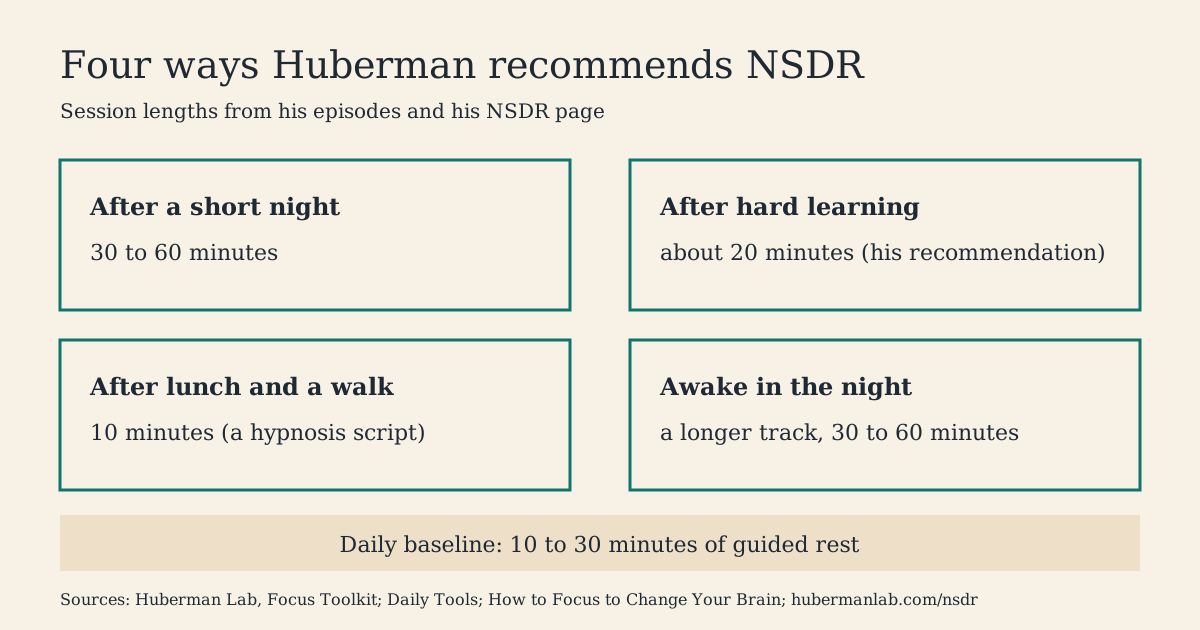
Duration: 10 to 30 minutes, longer after poor sleep
In the Focus Toolkit episode he sums up his own routine in one line: "I do NSDR for 10 to 30 minutes per day every single day, not just on days where I'm sleep-deprived."
Short nights change the dose. "When I haven't slept well, what I'll try and do is find a quiet place where I can do NSDR for 30 or ideally 60 minutes." He adds that he sometimes falls back asleep during it and that this is fine.
His NSDR page gives the same scale for everyone else: even a 10-minute script helps, aim for 20 to 30 if you can, and go to 30 to 60 minutes or more after poor sleep.
Timing: after lunch, after learning, and at night
The fixed slot in his day is early afternoon. In Daily Tools he describes a walk after lunch, then "a brief 10-minute hypnosis script" from the Reveri app, which he counts as NSDR. He says he comes out of it with "no brain fog, there's no grogginess", and starts his next work block around 2:30 or 3pm. He credits that session, along with delaying his morning coffee by 90 minutes to two hours, for getting through the afternoon without a dip. Reveri's research comes from his Stanford colleague David Spiegel, and Huberman says he isn't associated with that scientific work.
His other slot is the middle of the night. "I'll sometimes do that in the middle of the night if I happen to wake up and need to get back to sleep," he says in the Focus Toolkit episode. At night, his page suggests choosing a longer track, 30 to 60 minutes, to ease the worry of not falling asleep before the audio ends. For a fuller breakdown by goal, see the best times of day to practise NSDR.
Frequency: daily, for over a decade
In March 2022 he posted on X: "I personally have been using NSDR daily for ~10 years and find them to be among the more powerful tools out there for recovering lost sleep, focus (after) & neuroplasticity." A follow-up post added: "And these are accessible at zero cost on YouTube and various apps."
Where NSDR sits in his priorities
NSDR isn't one of his foundations. In a January 2023 post he wrote: "Pillars of mental & physical health & "performance": 1) Sleep 2) Sunlight 3) Movement, 4) Nutrients 5) Relationships (all kinds, incl. w/self). Amplifiers: Cold exposure (1-5 min, circa-waking & BEFORE exercise). Non-Sleep-Deep-Rest (NSDR); done at any time."
Sleep comes first on that list, and he says NSDR doesn't stand in for it. "I would never want anyone to try and use NSDR as a total replacement for sleep." He does say it can make up for lost sleep "at least to some degree."
How to copy it
Lie on your back somewhere quiet and play a guided track. Start with 10 minutes in the early afternoon. Move to 20 or 30 when you have the time, and use a 30 to 60-minute track after a short night or when you wake at night. The NSDR protocol by goal and session length has the step-by-step version.
The science Huberman cites (and what it means)
The 65% dopamine study
He cites this study in more than one episode. In his dopamine episode he says NSDR practices "have been shown to increase the amount of dopamine in your dopamine reserves by up to 65%, which is a remarkable number."
The figure comes from one 2002 PET study (Kjaer et al.). Eight male yoga teachers did a 72-minute guided yoga nidra session. Tracer binding in the ventral striatum fell by 7.9%, which the authors estimated as 65% more dopamine released during the session than during a control session of listening to speech with eyes closed. It measured release during one session, not baseline levels or reserves, and it studied yoga nidra, not NSDR. Nobody has repeated it with a 10-minute track. More on what the brain studies on NSDR measured.
The 2024 brain-scan study he shared
In October 2024 Huberman shared a study on X, saying it shows NSDR "aka Yoga Nidra is not just a light nap" and calling it a smaller study.
The study (Fialoke et al., Scientific Reports) scanned 30 experienced meditators and 31 novices with fMRI during yoga nidra and during plain awake rest. In the meditators, the default mode network, a set of brain regions active when the mind wanders, became less connected during yoga nidra. Novices showed the opposite. Nobody napped in the study, so it can't say how NSDR compares with a nap.
What trials using the NSDR name found
Four trials use the NSDR name: Boukhris 2024 (65 active adults, 10 minutes), Wrzeciono 2024 (45 heart patients, eight 20-minute sessions), Boukhris 2026a (102 adults, 10 minutes) and Boukhris 2026b (60 adults, 10 minutes against a 25-minute nap). The first found better reaction time and grip strength afterwards. The 2026a trial found a faster reaction time straight after the session that had gone at later checks. In 2026b, the nap group felt more ready to perform, and NSDR showed no effect.
That's a thin base, and all four trials are small. Sara Mednick, a cognitive neuroscientist at UC Irvine, told Fatherly that NSDR is a "repackaging" of older practices. Most of the evidence Huberman leans on is yoga nidra research, and it should be read as that.
NSDR in Huberman's neuroplasticity super protocol
Focus first, then rest
His learning advice comes in two steps. In a 2023 post: "Self-Directed Neuroplasticity: your ability to change your nervous system in specific ways= 2 steps: 1) Deliberate focus (the more intense the better) on the thing you're trying to learn 2) Sleep & Non-Sleep Deep Rest (NSDR) states, which are when actual neural rewiring occurs."
In his model, intense focus "marks those synapses neurochemically and metabolically so that those synapses are more biased to change," and without the deep sleep that follows, "you probably won't get those changes." He says NSDR can stand in for that deep sleep "at least partially." For NSDR, the direct evidence is thin.
The 20-minute session after learning
In How to Focus to Change Your Brain, Huberman describes a Cell Reports study in which people learned a hard sequence of lights. Those who did "a 20-minute non-sleep deep rest protocol or took a shallow nap" straight afterwards learned faster, he says, than if they had relied on that night's sleep. He doesn't name the paper, and no matching paper could be traced.
The closest published test is small. In a 2016 study, 12 yoga-centre residents with about 9 years of meditation practice learned a key-pressing sequence. Three hours later, one group did 30 minutes of yoga nidra and the other did 30 minutes of light work. The yoga nidra group did better on the trained sequence, though not on new ones (Immink 2016).
Huberman also says the rest doesn't have to be NSDR. A walk, a run, or sitting with your eyes closed and letting your thoughts drift after a learning bout counts too.
Pairing it with 90-minute focus bouts
He suggests focus sessions of up to about 90 minutes, based on what he calls ultradian cycles, roughly 90-minute cycles he says run through both sleep and waking. The waking version of that cycle has weak support. A 1995 study that tested 60 people every 10 minutes for nine hours found no 90-minute rhythm in their performance. Treat 90 minutes as a rough guide, not a biological limit.
Who else uses it: Sundar Pichai
In a February 2022 interview with the Wall Street Journal, as reported by Business Insider, Google CEO Sundar Pichai said: "While I find it difficult to meditate, I can go to YouTube, find an NSDR video. They're available in 10, 20, or 30 minutes, so I do that occasionally."
Huberman replied on X a few days later with the post about his own 10 years of daily practice.
FAQ
What does Andrew Huberman say about NSDR?
Andrew Huberman says NSDR is one of his daily tools. He does 10 to 30 minutes of guided rest at any time of day, and longer after poor sleep. He coined the term as an umbrella for yoga nidra, hypnosis and some meditation, and he lists it as an "amplifier" on top of sleep, sunlight, movement, nutrients and relationships.
How long should you do NSDR according to Huberman?
Huberman recommends 10 to 30 minutes of NSDR, which is also what he does daily. His page says even 10 minutes helps, 20 to 30 is better, and 30 to 60 minutes makes sense after a short night. Two 15-minute sessions, it says, work as well as one 30-minute session.
Is NSDR the same as yoga nidra?
Yoga nidra is one kind of NSDR. Huberman's umbrella also covers hypnosis and some meditation. Huberman Lab describes yoga nidra as the more specific form, with yogic language and sometimes an intention-setting step.
Can NSDR replace sleep?
No. Sleep is first on Huberman's list, and he says he'd "never want anyone to try and use NSDR as a total replacement for sleep." He uses it to make up for lost sleep "at least to some degree." NSDR is a relaxation practice, not a treatment, so ongoing insomnia or daytime sleepiness is worth raising with a doctor.
Where can I find Huberman's free NSDR recordings?
Huberman's own 10, 20 and 30-minute NSDR recordings are linked from hubermanlab.com/nsdr, and his NSDR page calls the practice a zero-cost tool. In his dopamine episode he points to a free 10-minute NSDR on YouTube, where searching "NSDR Huberman" brings up his sessions.
Did Andrew Huberman invent NSDR?
Andrew Huberman invented the name, not the practice. NSDR is his label for older methods, including yoga nidra, hypnosis and some forms of meditation. He was using the term on his podcast by February 2021, and it reached a wide audience in 2022.
Sources
- Huberman Lab. What is non-sleep deep rest? (NSDR). https://www.hubermanlab.com/nsdr
- Huberman Lab (2022, 5 Sep). Focus Toolkit: Tools to Improve Your Focus & Concentration. https://www.hubermanlab.com/episode/focus-toolkit-tools-to-improve-your-focus-and-concentration
- Huberman Lab. Maximizing Productivity, Physical & Mental Health with Daily Tools. https://www.hubermanlab.com/episode/maximizing-productivity-physical-and-mental-health-with-daily-tools
- Huberman Lab (2021, 8 Feb). How to Focus to Change Your Brain. https://www.hubermanlab.com/episode/how-to-focus-to-change-your-brain
- Huberman Lab. Leverage Dopamine to Overcome Procrastination & Optimize Effort. https://www.hubermanlab.com/episode/leverage-dopamine-to-overcome-procrastination-and-optimize-effort
- Huberman A, @hubermanlab (2022, 5 Mar). Post on Sundar Pichai and daily NSDR. https://x.com/hubermanlab/status/1500227031283372032
- Huberman A, @hubermanlab (2022, 5 Mar). Follow-up post on free recordings. https://x.com/hubermanlab/status/1500227280005570566
- Huberman A, @hubermanlab (2023, Jan). Post on pillars and amplifiers. https://x.com/hubermanlab/status/1617218306934722564
- Huberman A, @hubermanlab (2023). Post on self-directed neuroplasticity. https://x.com/hubermanlab/status/1626999119255580672
- Huberman A, @hubermanlab (2024, Oct). Post on the yoga nidra connectivity study. https://x.com/hubermanlab/status/1845556865180340423
- Kjaer TW, Bertelsen C, Piccini P, Brooks D, Alving J, Lou HC (2002). Increased dopamine tone during meditation-induced change of consciousness. Cognitive Brain Research, 13(2), 255-259. https://pubmed.ncbi.nlm.nih.gov/11958969/
- AuntMinnie (2002). Strike a pose: PET sheds light on benefits of yoga (participant details for Kjaer 2002). https://www.auntminnie.com/clinical-news/molecular-imaging/article/15563882/strike-a-pose-pet-sheds-light-on-benefits-of-yoga
- Fialoke S, Tripathi V, Thakral S, Dhawan A, Majahan V, Garg R (2024). Functional connectivity changes in meditators and novices during yoga nidra practice. Scientific Reports, 14, 12957. https://pubmed.ncbi.nlm.nih.gov/38839877/
- Immink MA (2016). Post-training meditation promotes motor memory consolidation. Frontiers in Psychology, 7, 1698. https://pubmed.ncbi.nlm.nih.gov/27847492/
- Boukhris O, Suppiah H, Halson S, Russell S, Clarke A, Geneau MC, et al. (2024). The acute effects of nonsleep deep rest on perceptual responses, physical, and cognitive performance in physically active participants. Applied Psychology: Health and Well-Being. https://pubmed.ncbi.nlm.nih.gov/38953770/
- Wrzeciono A, Cieślik B, Kiper P, Szczepańska-Gieracha J, Gajda R (2024). Non-sleep deep rest relaxation and virtual reality therapy for psychological outcomes in patients with coronary artery disease: a pilot randomized controlled trial. Journal of Clinical Medicine. https://pubmed.ncbi.nlm.nih.gov/39685636/
- Boukhris O, Suppiah H, Kerkeni M, Holt A, Driller M (2026). Time course of perceptual, cognitive, physical and physiological responses to a single non-sleep deep rest session in physically active young adults. Applied Psychology: Health and Well-Being. https://pubmed.ncbi.nlm.nih.gov/42383502/
- Boukhris O, Suppiah H, Driller M (2026). Comparing the effects of a short nap and non-sleep deep rest on perceptual, cognitive, and physical performance in active adults. Clocks & Sleep. https://pubmed.ncbi.nlm.nih.gov/42783005/
- Neubauer AC, Freudenthaler HH (1995). Ultradian rhythms in cognitive performance: no evidence for a 1.5-h rhythm. Biological Psychology. https://pubmed.ncbi.nlm.nih.gov/7669837/
- Sleep Foundation. What Is Non-Sleep Deep Rest (NSDR)? https://www.sleepfoundation.org/meditation-for-sleep/what-is-non-sleep-deep-rest
- Quaglia S (2023, updated 2024). NSDR is an overhyped health hack, that doesn't mean you shouldn't try it. Fatherly. https://www.fatherly.com/health/the-hype-behind-non-sleep-deep-rest-nsdr-explained
- Business Insider (2022, Mar). Google CEO uses 'non-sleep deep rest' to relax: here's how it works. https://www.businessinsider.com/google-ceo-sundar-pichai-non-sleep-deep-rest-nsdr-relax-2022-3
- Pichai S, interviewed in the Wall Street Journal (2022, Feb). https://www.wsj.com/articles/google-ceo-sundar-pichais-vision-for-return-to-work-11646055640
- Wikipedia. Andrew Huberman. https://en.wikipedia.org/wiki/Andrew_Huberman