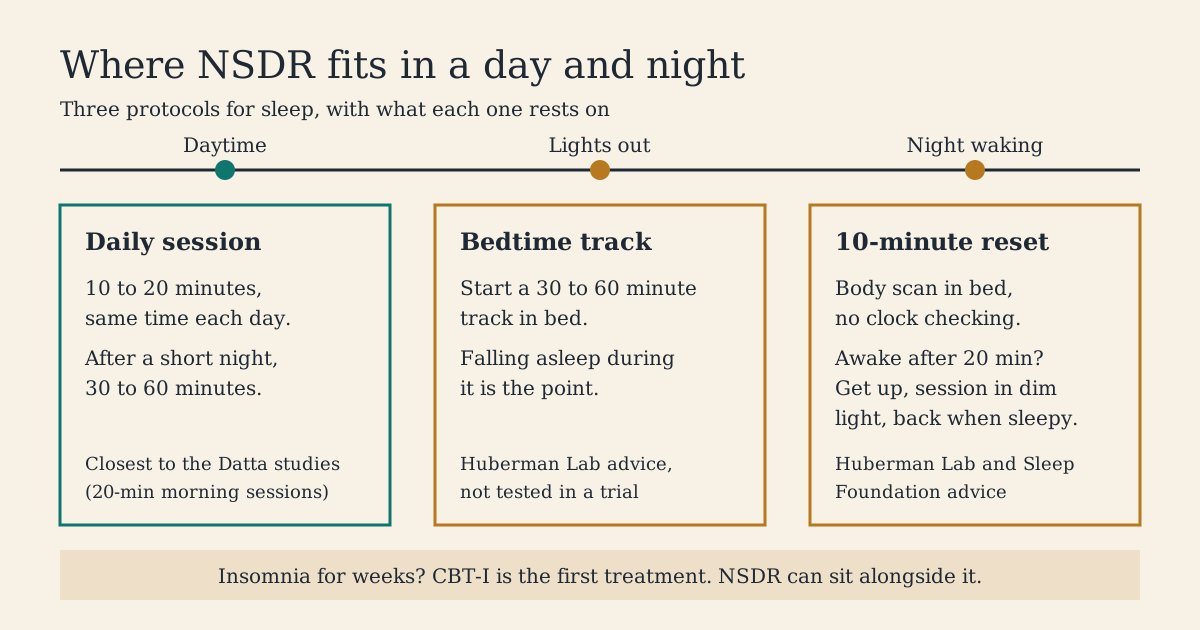
NSDR for sleep comes down to three habits. Start a 30 to 60 minute guided track in bed at lights out. Run a short body scan when you wake at 3am and can't settle. And do a daily session in the daytime, which is how the two best-known sleep studies used it. NSDR (non-sleep deep rest) won't replace sleep, and the evidence so far is small and mostly from yoga nidra, the older practice it's drawn from. Below are the timings for each protocol and what the research does and doesn't show.
TL;DR
- At bedtime, start a guided track in bed. Huberman Lab suggests a 30 to 60 minute version so you don't worry about it ending before you're asleep.
- If you wake in the night, stay in bed and do a 10-minute body scan. Still awake after about 20 minutes? Get up, play a session somewhere dim, and go back when you feel sleepy.
- After a bad night, a longer daytime session is a calm way to rest. It won't pay back lost sleep. A nap does that better.
- The sleep data comes from yoga nidra studies. They're small, one had no control group, and people practised in the morning.
- If poor sleep has lasted weeks, CBT-I is the recommended first treatment. NSDR can sit alongside it.
Why NSDR works for sleep (the nervous system explanation)
NSDR may help you sleep by quieting a busy mind at the point your body is already tired. Huberman Lab's NSDR guide puts the idea this way: "NSDR quiets the mental chatter and anxious thoughts that can inhibit the ability to notice and embrace these naturally occurring sleep signals."
A guided session gives your attention one simple job. A voice moves it slowly around your body and stretches out your breathing. If you want the basics first, start with what non-sleep deep rest is and where the name came from.
What happens in your brain
As you fall asleep, brain activity slows. Nobody has recorded brainwaves during a short NSDR track, so the closest evidence comes from yoga nidra.
Two small studies point the same way. In a 2002 PET study of 8 male yoga teachers, EEG theta activity rose during a 72-minute yoga nidra session. In a 2022 study of 30 newcomers to yoga nidra, 26 were scored as awake for the whole session, yet slow delta waves increased in the central part of the brain. The researchers called this "local sleep", meaning slow waves in some brain areas while the rest of the brain stays awake.
Both are small studies of a longer, different practice.
Cortisol and the evening wind-down
Cortisol, a stress hormone, normally runs high in the morning and falls through the day to its lowest point in the late evening. Huberman Lab's guide links it to insomnia and waking in the night.
Two yoga nidra studies suggest regular practice may nudge cortisol down. In a 2021 trial of people with chronic insomnia, salivary cortisol fell after a course of yoga nidra. In a 2025 German trial, 362 adults were given an 11- or 30-minute yoga nidra recording, music, or nothing, for 2 months. People who practised more often had lower total cortisol, but that link is correlational, and all the effects were small. Neither study tested NSDR.
What a session feels like
Early sessions can feel like nothing is happening. Then you notice you've lost the thread of the voice for a minute, or your arms feel heavy. That's normal and it isn't a failure. At night, drifting off before the end is the point.
The change in the body is small. In the largest NSDR trial, with 102 young adults, heart rate dropped a little more during a 10-minute session than in the control group, and the researchers called the physical effects modest.
How to use NSDR before bed (the nighttime protocol)
This is Protocol 1. None of the four NSDR trials tested a bedtime session, so the timings below are practical advice. The best-known yoga nidra sleep study, Datta 2023, used 20-minute sessions in the morning.
Timing and session length
Start it in bed at lights out. This is what Huberman Lab suggests. Choose a 30 to 60 minute track, because a short one can leave you lying there waiting for it to end. Falling asleep partway through is fine.
Do it on the sofa first. Play a 10 to 20 minute session 30 to 60 minutes before bed, then go straight to bed. This suits people who get tense when they try to fall asleep in bed, because the session happens somewhere with no pressure attached.
Pick one and use it for a week. Falling asleep usually takes 15 to 20 minutes, according to the Sleep Foundation, so don't judge a night by the first ten.
Set up the room
Dark or dim, cool, quiet. Put the phone face down with the screen off once the track is playing. If you use a track to fall asleep, Huberman Lab suggests a platform with no ads.
Step by step
- Set tomorrow's alarm first, so you're not thinking about it later.
- Dim the lights about an hour before your target bedtime.
- Lie on your back. A pillow under your knees helps if your lower back is tight.
- Start a guided track. A voice sets the pace, so there's nothing to remember.
- Follow the body scan and breath cues. If your mind wanders, come back to the next body part the voice names.
- When it ends, or if you used the sofa option, go straight to bed. No phone.
- If you're still awake about 20 minutes after lights out, use the 20-minute rule in Protocol 2.
NSDR for middle-of-the-night wakeups
This is Protocol 2, for when you wake at 2am or 3am and start thinking about the day ahead.
Waking in the night is normal
Sleep runs in cycles of about 90 minutes on average, four to six a night. Waking once or twice is normal, Huberman Lab's guide notes. If you can't get back to sleep, it suggests an NSDR session. It costs nothing to try. The causes of regular early waking are covered in why you wake at 3am.
The 10-minute reset
- Don't check the time. In a 2007 study, people told to watch a clock while trying to sleep worried more and took longer to fall asleep, good and poor sleepers alike.
- Stay in bed with your eyes closed. Leave the light off.
- Scan your body from the feet up, two or three slow breaths at each stop: feet, calves, thighs, hips, lower back, belly, chest, hands, arms, shoulders, neck, face.
- Let each area go slack on the out-breath. Notice it and move on.
- When your mind starts solving problems, go to the next body part. You don't need to argue with the thought.
If you'd rather be guided, play a sleep track with the phone face down and the screen off. At 3am a voice is often easier to follow than your own count.
The body scan gives your attention somewhere to go other than tomorrow's worries.
If you're still awake after 20 minutes
Get up. The Sleep Foundation advises getting out of bed if you can't sleep after 20 minutes, and Rise Science suggests pairing that with an NSDR session in another room. Keep the lights low, play a session there, and go back to bed when you feel sleepy. This keeps bed linked with sleep, and it's the same advice given for sleep anxiety.
The day after a bad night: a daytime session
This is Protocol 3, and it's the closest to how the best-known studies were run. In the two Datta studies of yoga nidra, people practised in the morning, and their night-time sleep was measured afterwards.
Why daytime counts
In the 2022 study, sleep diaries improved after 2 weeks of practice. In the 2023 study, participants did 20-minute sessions in the morning, and their sleep was recorded overnight before and after four weeks.
So a daily session at a regular time is a fair way to use NSDR for sleep, even if you never play a track at night. Twenty minutes matches the studies, and ten is a fine place to start. For a fuller plan by session length, see the NSDR protocol by session length.
After a short night: NSDR or a nap?
After a poor night, Huberman Lab suggests a longer session, 30 to 60 minutes, while saying that nothing completely replaces sleep. No trial has tested that use.
If you're short on sleep and have the time, a nap does more. Sleep relieves sleep pressure, the build-up that makes you drowsy, and NSDR doesn't, because you stay awake. In the one trial that compared them, people felt more ready to perform 40 minutes after a 25-minute nap opportunity than after a 10-minute NSDR session. NSDR's advantage is that there's no grogginess to shake off. The full comparison is in NSDR vs napping.
The research on NSDR and sleep quality
Most of what's written about NSDR for sleep borrows from yoga nidra research.
NSDR trials haven't measured sleep yet
Four trials use the NSDR name: Boukhris 2024 (65 people, 10 minutes), Wrzeciono 2024 (45 heart patients split into three groups, about 15 doing NSDR, eight 20-minute sessions), Boukhris 2026a (102 people, 10 minutes) and Boukhris 2026b (60 people, 10 minutes against a 25-minute nap; the nap won on readiness, and NSDR showed no effect). None of them measured night-time sleep.
What the yoga nidra sleep studies found
The best-known result is from Datta and colleagues (2023, PLoS ONE). They recorded the sleep of 30 healthy young men overnight, before and after four weeks of 20-minute yoga nidra sessions. Afterwards, sleep efficiency (the share of time in bed spent asleep) was 3.6 percentage points higher, and the men spent about 20 fewer minutes awake after first falling asleep. Delta power during deep sleep was also higher. Deep sleep is linked to attention, learning and memory, though this study didn't test whether the extra delta made a difference to those.
There was no control group, and everyone was a healthy young man. Treat it as a promising pilot.
In the 2025 German trial above, the 30-minute yoga nidra group reported fewer sleep disturbances than people on the waitlist. The effect was small.
Other small yoga nidra trials, most of them from India, also report better sleep scores. A 2026 review found six randomised trials with 244 people in total, and a 2026 meta-analysis found no clear pooled improvement and rated the certainty of the evidence very low.
Yoga nidra and CBT-I for insomnia
Cognitive behavioural therapy for insomnia (CBT-I) is the first treatment the American College of Physicians recommends for chronic insomnia in adults.
A 2021 trial in the National Medical Journal of India randomised 41 people with chronic insomnia to CBT-I or yoga nidra. Both groups slept better. The yoga nidra group also gained deep sleep and had lower salivary cortisol. It's one small trial, and the repeat sleep recordings only included volunteers, so it can't show the two are equal.
If poor sleep has gone on for weeks, ask about CBT-I first, and use NSDR alongside it. There's more on CBT-I in CBT-I and other sleep methods.
NSDR is a relaxation practice, not a treatment. If you have insomnia, a sleep disorder or another health condition, keep your usual care and talk to your doctor.
FAQ
Is NSDR as good as sleep?
NSDR isn't as good as sleep, and it isn't meant to be. You stay awake, so it doesn't relieve sleep pressure. Stanford sleep researcher Jamie Zeitzer, an adviser to Rise Science, told Rise that "one cannot mistake an energy boost for relief of sleep pressure." Use NSDR for sleep as a way into sleep and back into it.
How long should an NSDR session be before bed?
For a session before bed, 30 to 60 minutes if you start it in bed, as Huberman Lab suggests, or 10 to 20 minutes if you do it on the sofa first. The two Datta studies used 20-minute morning sessions, and no study has tested a track started in bed at lights out.
Can I do NSDR in bed?
Yes, doing NSDR in bed is what Huberman Lab recommends at night, and falling asleep partway through is fine. If lying in bed trying to relax makes you more alert, do the session on the sofa and go to bed when it ends.
Should I do NSDR every night?
Doing NSDR every night isn't required, but regular practice is how the studies used it. The 2025 German trial asked people to practise daily for 2 months. In the two Datta studies, people kept practising on their own for weeks: sleep diaries improved after two, and overnight recordings after four. A daily slot, by day or at bedtime, is the closest match.
What's the difference between NSDR and just listening to relaxing sounds?
The main difference is that relaxing sounds like rain or brown noise mostly mask other noise, while NSDR gives you something to follow. A voice moves your attention through your body and slows your breathing. No study has compared them for sleep.
Sources
- Huberman Lab. Non-Sleep Deep Rest (NSDR). https://www.hubermanlab.com/nsdr
- Rise Science. NSDR Can't Replace Sleep, But It May Help You Sleep Better. https://www.risescience.com/blog/nsdr
- Sleep Foundation. How to Fall Asleep Fast. https://www.sleepfoundation.org/sleep-hygiene/how-to-fall-asleep-fast
- Sleep Foundation. Stages of Sleep. https://www.sleepfoundation.org/how-sleep-works/stages-of-sleep
- Kjaer TW, Bertelsen C, Piccini P, Brooks D, Alving J, Lou HC (2002). Increased dopamine tone during meditation-induced change of consciousness. Cognitive Brain Research 13(2):255-259. https://pubmed.ncbi.nlm.nih.gov/11958969/
- Datta K, Mallick HN, Tripathi M, Ahuja N, Deepak KK (2022). Electrophysiological evidence of local sleep during yoga nidra practice. Frontiers in Neurology 13:910794. https://pubmed.ncbi.nlm.nih.gov/35903117/
- Datta K, Bhutambare A, V L M, Narawa Y, Srinath R, Kanitkar M (2023). Improved sleep, cognitive processing and enhanced learning and memory task accuracy with yoga nidra practice in novices. PLoS ONE 18(12):e0294678. https://pubmed.ncbi.nlm.nih.gov/38091317/
- Datta K, Tripathi M, Verma M, Masiwal D, Mallick HN (2021). Yoga nidra practice shows improvement in sleep in patients with chronic insomnia: a randomized controlled trial. National Medical Journal of India 34(3):143-150. https://pubmed.ncbi.nlm.nih.gov/34825538/
- Moszeik EN, Rohleder N, Renner KH (2025). The effects of an online yoga nidra meditation on subjective well-being and diurnal salivary cortisol: a randomised controlled trial. Stress and Health 41(3):e70049. https://pmc.ncbi.nlm.nih.gov/articles/PMC12080877/
- Dutta A, Mooventhan A, Nivethitha L, Dharani E (2026). Efficacy of yoga nidra in managing sleep disorders: a systematic review of randomized controlled trials. Journal of Integrative and Complementary Medicine 32(3):235-241. https://pubmed.ncbi.nlm.nih.gov/41144325/
- Singh S, Dhanlika D, Singh U, Haldar P, Sharma G (2026). Effect of yoga nidra (yogic sleep) in sleep disturbances and insomnia: systematic review and metanalysis. Sleep and Breathing 30(2):144. https://pubmed.ncbi.nlm.nih.gov/42043659/
- Tang NK, Schmidt DA, Harvey AG (2007). Sleeping with the enemy: clock monitoring in the maintenance of insomnia. Journal of Behavior Therapy and Experimental Psychiatry 38(1):40-55. https://pubmed.ncbi.nlm.nih.gov/16793001/
- Qaseem A, Kansagara D, Forciea MA, Cooke M, Denberg TD (2016). Management of chronic insomnia disorder in adults: a clinical practice guideline from the American College of Physicians. Annals of Internal Medicine 165(2):125-133. https://pubmed.ncbi.nlm.nih.gov/27136449/
- Boukhris O, Suppiah H, Halson S, Russell S, Clarke A, Geneau MC, et al. (2024). The acute effects of nonsleep deep rest on perceptual responses, physical, and cognitive performance in physically active participants. Applied Psychology: Health and Well-Being 16(4):1967-1987. https://pubmed.ncbi.nlm.nih.gov/38953770/
- Wrzeciono A, Cieślik B, Kiper P, Szczepańska-Gieracha J, Gajda R (2024). Non-sleep deep rest relaxation and virtual reality therapy for psychological outcomes in patients with coronary artery disease: a pilot randomized controlled trial. Journal of Clinical Medicine 13(23):7178. https://pmc.ncbi.nlm.nih.gov/articles/PMC11642233/
- Boukhris O, Suppiah H, Kerkeni M, Holt A, Driller M (2026). Time course of perceptual, cognitive, physical and physiological responses to a single non-sleep deep rest session in physically active young adults. Applied Psychology: Health and Well-Being 18(4):e70180. https://pubmed.ncbi.nlm.nih.gov/42383502/
- Boukhris O, Suppiah H, Driller M (2026). Comparing the effects of a short nap and non-sleep deep rest on perceptual, cognitive, and physical performance in active adults. Clocks & Sleep 8(3):52. https://pubmed.ncbi.nlm.nih.gov/42783005/