An NSDR script is the exact set of words a guide reads during a non-sleep deep rest session: breathing cues, a body scan, a stretch of silence and a slow return. Below are three complete scripts, at 10, 20 and 30 minutes, that you can follow silently, read aloud or record in your own voice. Each uses the same five phases, with minute-by-minute timings and the silences marked.
TL;DR
- An NSDR script is the spoken text of a non-sleep deep rest session: breathing cues, a body scan, a settling line, silence and a slow return.
- The three scripts below share the same 5 phases. Most of the extra time goes to the rest period, which runs 3, 7 and 14 minutes.
- Use 10 minutes for a midday reset, 20 as the daily default and 30 for recovery days or sleep prep.
- Each script opens with long, slow exhales, which a 30-person lab study linked to more relaxation and more high-frequency heart rate variability.
- In a 2024 trial, one 10-minute guided NSDR session improved reaction time and self-rated stress in active adults; later studies found the reaction-time gain was brief or absent.
- Read silently to learn the structure, then record it or use a guided track so your eyes can stay closed.
- NSDR doesn't replace sleep and isn't a treatment for insomnia.
What is an NSDR script?
An NSDR script is the written form of a guided non-sleep deep rest session: every cue for breathing, body awareness, stillness and coming back, in order.
What a script contains
Any guided NSDR protocol is someone reading one of these. The words slow your breath, move your attention around your body, then bring you back without a jolt.
Andrew Huberman, a neuroscientist at the Stanford School of Medicine, coined the term. At the start of his video "20 Minute Non-Sleep Deep Rest (NSDR) to Restore Mental & Physical Energy", he says, "Non-sleep deep rest is a powerful tool that can allow you to control the relaxation state of your nervous system and your overall state of mind."
Why use a written script
Audio locks you into someone else's pacing. Text lets you shorten the body scan, stretch the rest, or record it in your own voice. Seeing the words also shows you what each phase is for.
Where NSDR scripts come from
NSDR is Huberman's name for practices based on yoga nidra, chosen so the spiritual connotations of the old name wouldn't put people off. Most of the research behind NSDR studied yoga nidra.
That includes the famous "65% more dopamine" figure. In a 2002 PET study of eight experienced yoga teachers, Kjaer and colleagues estimated a 65% rise in dopamine release during yoga nidra, compared with lying with eyes closed listening to speech. It was one small study. It measured release during the session and says nothing about baseline levels.
The 5 phases of an NSDR script
The three scripts below share the same five-phase structure. Only the lengths change.
In a Sleep Foundation explainer, sleep physician Brandon R. Peters, MD, says "NSDR may slow the brain's electrical waves, inducing a state of relaxation with measurable benefits." That describes the state but doesn't show what any single phase does.
- Induction (2 to 4 minutes). Slow breathing with exhales longer than inhales. In a 30-person lab study (Van Diest, 2014), people reported more relaxation when they breathed with a long exhale than with a short one. During slow breathing, the long exhale also raised high-frequency heart rate variability, a marker of vagal activity. The counted patterns in the scripts are cues; no study tested those exact ratios.
- Body scan (3 to 6 minutes). Attention moves through the body part by part, softening as it goes.
- Deepening (2 to 3 minutes). Attention rests in one place, with an optional short phrase. The phrase is a short intention, a step yoga nidra uses. Huberman's 20-minute recording has no intention step, so skip it for a plain NSDR session. In the 10-minute script it is one line.
- Rest (3 to 15 minutes). You stay still and awake, with no instructions. This is the phase that grows with session length. Drifting toward sleep is fine.
- Return (1 to 3 minutes). You notice sounds and breath, make small movements, then open your eyes. Don't rush it.
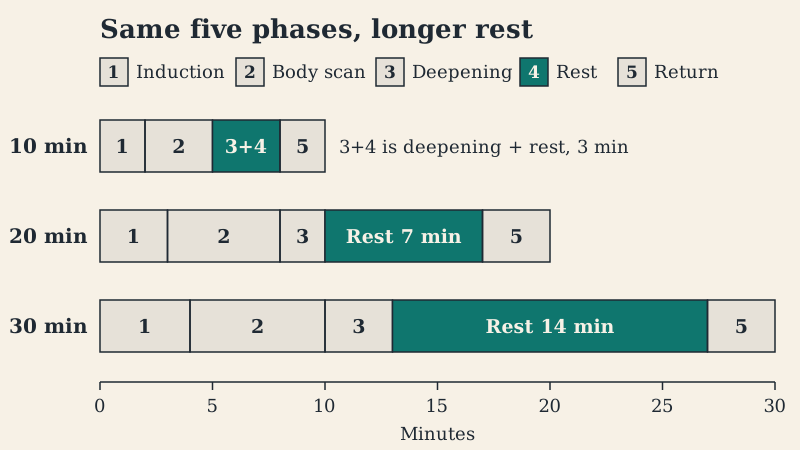
To build a session from scratch with the same ranges, see the section on writing your own script, after the three scripts below.
10-minute NSDR script (quick reset)
When to use this script
Use it between meetings, after a stressful call, or in the afternoon dip when there's no time for a full session. This is the 10-minute NSDR session for days with no slack.
In a 2024 trial, Boukhris and colleagues gave 65 physically active adults either one 10-minute guided NSDR session or 10 minutes of sitting. The NSDR group improved on handgrip strength, reaction time and cognitive accuracy, and rated their stress and tension lower.
Two 2026 follow-ups by the same group were less upbeat. In 102 adults, the reaction-time benefit appeared only immediately after the session, while gains in sleepiness, fatigue and stress were more consistent. In a second trial of 60 adults, which also tested a 25-minute nap, NSDR showed no significant effects on perceptual, cognitive or physical outcomes. Both used guided audio, not these scripts.
The full 10-minute script
Lie down or recline. Close your eyes. Arms at your sides, palms up.
Minutes 0-2 (Induction): Breathe in through your nose for 4 counts. Hold for 1. Exhale through your mouth for 6. Repeat 3 times. Then let your breathing settle naturally. No more counting.
Minutes 2-5 (Body scan): Bring attention to the top of your head. Let your forehead soften. Eyebrows drop. Eyes still behind closed lids. Jaw hanging open slightly. Move to your shoulders, let them sink. Arms, hands, each finger, all heavy. Chest rising and falling without effort. Stomach soft. Hips, legs, feet, each toe. Your entire body is supported. Nothing to hold together.
Minutes 5-8 (Deepening + rest): Silently say: "I am resting. My body is recovering." Let the thought drift. If other thoughts come, let them pass like sounds in another room. Stay here. Breathing naturally. Body heavy. Mind quiet. [2 minutes of stillness]
Minutes 8-10 (Return): Notice the sounds around you. Deepen your breath. Move your fingers, then your toes. Take one full, deep breath in. Hold. Exhale completely. Open your eyes when ready. Stay still for a few breaths before sitting up.
Adaptation
Extend the body scan by 1-2 minutes if it feels rushed. Swap the phrase for a task-specific one: "I am focused. My mind is clear." Or skip the phrase and rest on your breath, as Huberman's 20-minute recording does.
20-minute NSDR script (full recovery)
When to use this script
The daily default. Use it in the early afternoon or after a bad night. Twenty minutes leaves room for a slower body scan and a longer rest. Huberman Lab says even 10 minutes has benefits, but suggests aiming for 20 to 30 when you can.
The full 20-minute script
Lie down on a bed, couch, or floor with a blanket. Close your eyes.
Minutes 0-3 (Induction): Breathe in for 4 counts. Hold for 2. Out through your mouth for 7. Repeat 3 times. Then let breathing become effortless. No counting, no controlling. Feel the weight of your body on the surface beneath you. Notice the points of contact: head, shoulder blades, lower back, heels. Let gravity do all the work.
Minutes 3-8 (Body scan): Imagine a warm, heavy wave starting at the top of your head. It spreads across your scalp, softening everything. Forehead widens. Eyebrows drop. Eyelids heavy and still. Jaw releasing, mouth slightly open. The wave flows down your neck, shoulders melting away from your ears. Down your right arm: upper arm, elbow, forearm, wrist, palm, each finger. Heavy and warm. Left arm the same. Chest expanding and contracting without effort. Stomach completely soft. Lower back releasing. Hips sinking. Down each leg: thigh, knee, calf, ankle, foot, each toe. Your whole body is heavy, warm, and fully supported.
Minutes 8-10 (Deepening): Bring attention to the space behind your closed eyes. Just rest your awareness there. Silently say: "I am deeply resting. My nervous system is recovering. There is nothing I need to do right now." Let those words dissolve. If thoughts come, let them pass. Let them settle on their own.
Minutes 10-17 (Rest): Stay here. Breathing soft and automatic. Body heavy. If you drift toward sleep, don't fight it or chase it. Just stay in this in-between state. [6 minutes of stillness] If your mind has wandered, gently bring it back.
Minutes 17-20 (Return): Listen to the sounds in the room. Deepen your breathing. Move your fingers, then your toes. Roll your head side to side. Take a full deep breath, hold, exhale completely. Stretch if you want to. Open your eyes. Stay lying down for 30 seconds, then sit up slowly.
Adaptation
For sleep, extend rest to 10 minutes and skip the return. For focus recovery, shorten rest to 5 minutes and make the return active.
30-minute NSDR script (deep restoration)
When to use this script
Use it on weekends and recovery days, or after travel, illness or a run of bad sleep.
In the same video, Huberman gives his view on short nights: "It can even partially offset the negative consequences of getting too little sleep." Note the word "partially". It doesn't replace sleep. The 30-minute version gives you the longest rest period of the three.
The clinical evidence is small. A 2021 trial of 41 chronic insomnia patients, in the National Medical Journal of India, compared supervised yoga nidra with CBT for insomnia. Both improved sleep measures such as subjective total sleep time, and salivary cortisol fell after yoga nidra.
NSDR is a rest practice, not a treatment. If you have chronic insomnia or another ongoing sleep problem, talk to a doctor. For night-time use, see NSDR for sleep.
The full 30-minute script
Dim the lights. Phone on do-not-disturb. Lie down with a pillow under your knees if that helps. Close your eyes.
Minutes 0-4 (Induction): Take this slow. You have 30 minutes. Breathe in for 4. Hold for 2. Out through your mouth for 8. A long, slow exhale helps your body shift toward rest. Repeat for 5 rounds. Then let breathing settle naturally. Feel the surface supporting every point of contact. You are fully held.
Minutes 4-10 (Body scan): This one is thorough. Start with your scalp. Feel it soften. Forehead smooth. Eyebrows symmetrical and relaxed. Eyes still behind closed lids. Cheeks, nose, lips barely touching. Jaw hanging open, teeth separated, tongue resting on the floor of your mouth. Many people hold tension here without noticing. Throat open. Neck supported, releasing. Shoulders dropping away from your ears. Right arm: upper arm, elbow, forearm, wrist, palm, each finger. All heavy. Left arm the same. Chest expanding effortlessly. Upper back softening against the surface. Stomach completely soft. Lower back releasing. Breathe into any tension there. Hips settling deeper. Right leg: thigh, knee, calf, ankle, foot, each toe. Left leg the same. Feel your body as a single whole. Heavy. Warm. Nothing left to release.
Minutes 10-13 (Deepening): Bring awareness to the center of your chest. Silently say: "I am in deep rest. My body is repairing. My mind is clearing." Hold that loosely. Let the words fade. [1 minute of stillness]
Minutes 13-27 (Rest): This is the core. You don't need to do anything. If thoughts come, let them pass. If sleepiness comes, let it be. [13 minutes of stillness] If you've drifted, gently return to the sensation of your body being heavy.
Minutes 27-30 (Return): Very slowly. Listen to the room. Deepen your breath. Move your fingers, then toes. Roll your head side to side. Take a full breath, hold for 3 counts, exhale completely. Stretch if you want. Open your eyes. Look at the ceiling for a few breaths. Roll to one side, then press yourself up to sitting. Stay seated 30 seconds before standing.
Adaptation
For sleep, skip the return and drift off. After a short night, you can stretch the rest period by 5 minutes if it feels good. If you're new to NSDR, start with the 20-minute script and work up.
How to choose the right NSDR script
By time available
- Under 15 minutes: the 10-minute script.
- 15 to 25 minutes: the 20-minute script, the daily default.
- 25+ minutes with nothing pressing: the 30-minute script.
New to the practice itself? Start with how to do NSDR.
By goal
| Goal | Script | Rest window |
|---|---|---|
| Quick stress reset | 10 minutes | 3 minutes |
| Daily habit | 20 minutes | 7 minutes |
| Sleep prep or deep recovery | 30 minutes | 14 minutes |
If the rest period feels too long
If you fidget through the rest period, that's normal early on. Shorten it and build up over a few weeks.
How to write your own NSDR script
To write an NSDR script, pick a total length, split it across the five phases using the ranges above, then write each phase as short spoken instructions with the pauses marked. The tips below are writing conventions, not rules a study has tested.
Set the length first
Decide the total, then fill in induction, body scan, deepening and return from their ranges. Whatever time is left goes to the rest period.
Write cues you can follow with your eyes closed
For breathing, give counts. "In through your nose for 4, out through your mouth for 6" is something to do. Keep the exhale longer than the inhale, as in the breathing study above, and stop counting after three to five rounds.
For the body scan, name one part at a time, such as "your jaw" or "the backs of your knees", then pause. Offer options instead of telling the listener what they feel: "warmth, heaviness, tingling, or nothing at all." Pick one direction, head to feet or feet to head, and keep it. Cover fewer parts and pause after each one, rather than rushing through twenty.
Write the silences in
Mark every pause in brackets, like [5 seconds] or [6 minutes of stillness]. The rest period needs almost no words. One line to open it ("There's nothing more to do. Just rest here.") and, in a long rest, one quiet check-in is enough.
Keep the words plain
Stick to verbs the listener can act on: breathe, notice, soften, rest. An intention line or imagery like a warm wave is optional. Intention setting comes from yoga nidra, and Huberman's 20-minute NSDR recording has no intention step.
End slowly
Reverse the opening. Bring attention to sounds in the room, then cue a deeper breath, small movements in the fingers and toes, and finally opening the eyes. Give the return at least a minute. For a sleep script, skip it and end on silence.
Read it, record it or use a guided track
Reading silently or aloud
Read silently once to learn the structure. Aloud, go at about half your normal speaking speed. The bracketed silences are real silence, so time them.
Recording your own track
A quiet room and a phone voice memo are enough. Leave the silences in, so a 10-minute script takes about 10 minutes to record. Some people prefer their own voice. Try both.
When a guided track is easier
Guided audio is often easier at first, because someone else handles the pacing. NSDR.co has 50+ free guided sessions, including NSDR and yoga nidra tracks.
When to stop
If a session leaves you more wired, stop and try a shorter one. That happens, and it isn't a failure. If attention on the body brings up distress, open your eyes, move, and end the session. The breathing on its own is a fine shorter practice.
FAQ
How long should an NSDR script be?
Aim for an NSDR script 10 to 30 minutes long. Huberman's own recordings come in 10, 20 and 30-minute versions. Ten minutes is enough for a reset. In a 2024 trial, one 10-minute guided NSDR session improved reaction time and self-rated stress in active adults, though later studies found the reaction-time gain was brief or absent. For a daily habit, 10 to 20 minutes is plenty.
Is an NSDR script the same as a yoga nidra script?
An NSDR script and a yoga nidra script are close relatives. Slow breathing and a body scan are shared. Yoga nidra adds intention setting. Huberman chose the NSDR name to reach people who might be put off by the spiritual connotations of the name yoga nidra. No study has compared the two directly, and most of the research behind NSDR was done on yoga nidra.
Can I write my own NSDR script?
Yes, you can write your own NSDR script. Use the five phases and the same ranges as above. Use simple words and specific cues, pace it slowly and leave plenty of room for silence.
Do I need training to write an NSDR script?
No, you don't need training to write an NSDR script for yourself. If you write one for other people, do the session yourself first and time it out loud with the pauses in.
How often should I practice NSDR?
No long-term NSDR trial has tested daily practice yet. The closest evidence is a 2019 meditation study, in which Basso, Suzuki and colleagues found new meditators doing 13 minutes a day for 8 weeks improved on attention and memory tests and had lower anxiety under lab stress. Daily is easiest for building the habit, but any regular practice is better than none.
Can NSDR replace sleep?
No, NSDR can't replace sleep. Huberman's view, from his 20-minute video, is that it can partially offset the effects of short sleep. Ongoing sleep problems are a reason to see a doctor.
Sources
- Basso JC, McHale A, Ende V, Oberlin DJ, Suzuki WA (2019). Brief, daily meditation enhances attention, memory, mood, and emotional regulation in non-experienced meditators. Behavioural Brain Research. https://pubmed.ncbi.nlm.nih.gov/30153464/
- Boukhris O et al. (2024). The acute effects of nonsleep deep rest on perceptual responses, physical, and cognitive performance in physically active participants. Applied Psychology: Health and Well-Being. https://pubmed.ncbi.nlm.nih.gov/38953770/
- Boukhris O et al. (2026). Time course of perceptual, cognitive, physical and physiological responses to a single non-sleep deep rest session in physically active young adults. Applied Psychology: Health and Well-Being. https://pubmed.ncbi.nlm.nih.gov/42383502/
- Boukhris O, Suppiah H, Driller M (2026). Comparing the effects of a short nap and non-sleep deep rest on perceptual, cognitive, and physical performance in active adults. Clocks & Sleep. https://pubmed.ncbi.nlm.nih.gov/42783005/
- Datta K et al. (2021). Yoga nidra practice shows improvement in sleep in patients with chronic insomnia: a randomized controlled trial. National Medical Journal of India. https://pubmed.ncbi.nlm.nih.gov/34825538/
- Kjaer TW et al. (2002). Increased dopamine tone during meditation-induced change of consciousness. Cognitive Brain Research. https://pubmed.ncbi.nlm.nih.gov/11958969/
- Van Diest I et al. (2014). Inhalation/exhalation ratio modulates the effect of slow breathing on heart rate variability and relaxation. Applied Psychophysiology and Biofeedback. https://pubmed.ncbi.nlm.nih.gov/25156003/
- Huberman Lab. 20 Minute Non-Sleep Deep Rest (NSDR) to Restore Mental & Physical Energy. YouTube. https://www.youtube.com/watch?v=hEypv90GzDE
- Huberman Lab. Non-Sleep Deep Rest (NSDR). https://www.hubermanlab.com/nsdr
- Sleep Foundation. What Is Non-Sleep Deep Rest? https://www.sleepfoundation.org/meditation-for-sleep/what-is-non-sleep-deep-rest