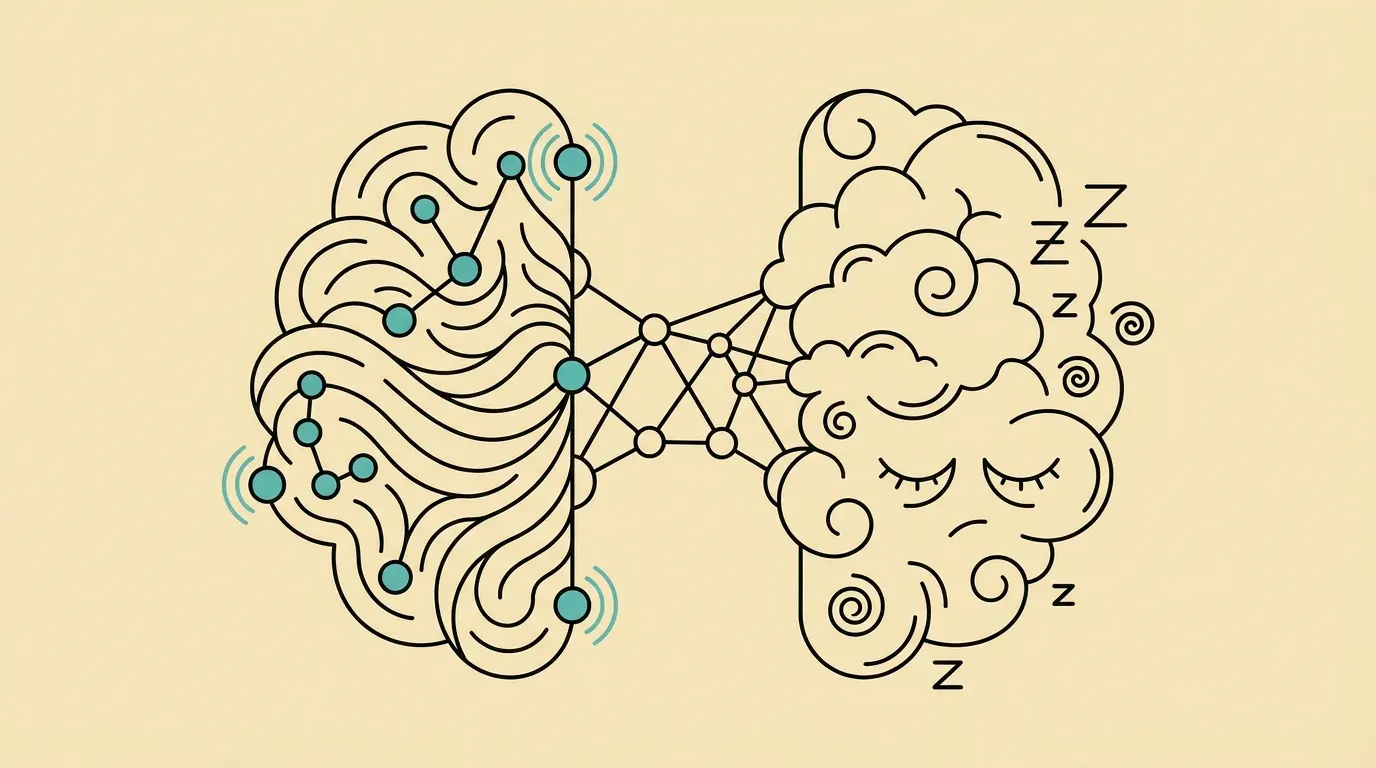
In the only trial to put NSDR vs nap head to head, the nap won. People who took a short afternoon nap felt more ready to perform 40 minutes later, while 10 minutes of NSDR made no measurable difference. So nap if you're short on sleep and have 20 to 30 minutes somewhere quiet before about 3 pm. Use NSDR if you can't nap, it's late in the day, or you need to get straight back to work without nap grogginess. Below are the 5 differences that matter and a simple rule for choosing.
NSDR vs nap: the short answer
The core difference
NSDR is designed to be done awake. In a sleep-lab study of yoga nidra, 26 of 30 beginners stayed awake the whole session after two weeks of practice. A nap is sleep, and a short one is mostly light sleep.
Stanford neuroscientist Andrew Huberman backed both in a 2023 LinkedIn post: "A 10-20 min nap or non-sleep deep rest (NSDR) have both been shown to replenish physical energy and increase cognitive function. NSDR, however, also increases striatal dopamine and improves one's self-directed relaxation ability, which in turn improves sleep."
The nap part is well backed. For NSDR, three small trials of 10-minute sessions gave mixed results, and the dopamine finding comes from a single 2002 yoga nidra study.
Quick comparison
| Dimension | NSDR | Nap |
|---|---|---|
| Time required | 10 minutes to an hour or more (the Boukhris trials used 10) | 10-30 minutes, or about 90 for a full cycle |
| Grogginess risk | Low, as long as you stay awake | Low for ~10-minute naps; longer naps, 90-minute ones included, can leave you groggy, usually for up to 30 minutes, sometimes an hour or more |
| Head-to-head result | 10 minutes had no measurable effect | A 25-minute nap opportunity left people more ready to perform 40 minutes later |
| Dopamine | One 2002 PET study of yoga nidra (8 experienced yoga teachers) | Not studied |
| Sleep debt | Doesn't replace sleep | After about 5 hours' sleep, a 10-minute nap helped straight away, with some gains lasting up to 155 minutes |
| Flexibility | Sitting or lying, any time of day; Huberman says several times a day is fine | Best before about 3 pm, in a quiet, dark place |
| Nighttime sleep | Not tested after a single session; in one study, 2 weeks of yoga nidra practice improved self-reported sleep | Naps of 25 or 90 minutes ending at 3 pm didn't disrupt night sleep in one small study; Mayo Clinic says later naps can |
| How much evidence | Three small 10-minute trials, mixed results | A meta-analysis of 54 studies |
The decision rule
After a short night, a nap is the better bet. In a lab study, even 10 minutes of sleep helped people who'd slept about 5 hours. If you slept fine and need to get straight back to work, NSDR avoids nap grogginess.
So if you're short on sleep and have 20 to 30 minutes somewhere quiet before about 3 pm, take a short nap. If you can't nap, it's late in the day, or you need to get straight back to work without grogginess, use NSDR.
What NSDR does to your brain
NSDR is Huberman's term for practices that bring deep relaxation without falling fully asleep, including yoga nidra and some forms of meditation. See what NSDR is and where it comes from.
Awake, with patches of sleep-like slow waves
You mostly stay awake, but parts of the brain can look briefly sleep-like. EEG studies of yoga nidra are small. Theta activity rises, and slow delta waves appear in parts of the brain while sleep scoring still reads "awake". Researchers call it "local sleep".
Sleep physician Dr. Brandon Peters, medical reviewer of the Sleep Foundation's NSDR article, puts it this way: "NSDR may slow the brain's electrical waves, inducing a state of relaxation with measurable benefits. Some of the slowing noted in NSDR overlaps with what would be recognized as sleep, including a lack of responsiveness to the environment."
Most people stay awake, but not everyone does. More in the yoga nidra studies behind NSDR.
The 65% dopamine figure, in context
The figure comes from a 2002 PET study by Kjaer and colleagues. Eight experienced yoga teachers did a 72-minute yoga nidra session. A tracer signal in the ventral striatum fell 7.9%, which the authors estimated as a 65% increase in dopamine release versus listening to speech with eyes closed.
The study measured this during the practice, and participants felt less driven to act. So it doesn't show NSDR tops up motivation, and short NSDR scripts haven't been tested this way.
Stress, heart rate and the 10-minute trials
Yoga nidra studies point to calmer states. In one small 2012 study, heart rate fell and the body shifted toward "rest and digest" during a single session. In a 2025 trial of 362 adults, two months of 30-minute online sessions, ideally daily, brought slightly less reported stress.
All three NSDR-labelled trials come from one La Trobe team and used 10-minute sessions. In 2024, 65 active adults improved on reaction time, accuracy and handgrip strength versus sitting quietly. In 2026, 102 people had small drops in sleepiness, fatigue and stress, but the reaction-time gain was gone by 20 minutes. A second 2026 trial, the 60-person head-to-head study, found NSDR had no significant effect. That's one positive result, one short-lived and one null.
What happens when you nap (and why it's not always ideal)
The 20-minute rule
Keep a nap under about 20 minutes and you'll wake before deeper sleep, so any grogginess is likely to be milder and clear faster. Nap longer and you head into deep (slow-wave) sleep, which you reach in about an hour, or sooner if you're very short on sleep.
Sleep inertia: how long the fog lasts
That grogginess is sleep inertia, and waking from deep sleep makes it worst. It usually clears within about 30 minutes (per CDC NIOSH guidance and a major review), but can last an hour or more after deep sleep or when you're sleep-deprived.
In one small study of 17 active adults, grogginess after a 25-minute nap opportunity took at least an hour to clear, and performance improved after that. In Brooks and Lack's 2006 study, a 30-minute nap left people groggy at first, then brought improvements lasting up to 155 minutes. See how to nap without waking up groggy.
When napping wins
After a bad night, nap. In Brooks and Lack's 2006 study, after nights cut to about 5 hours, a 10-minute nap gave immediate improvements in sleepiness, fatigue, vigour and cognitive performance, some lasting up to 155 minutes.
A 2022 meta-analysis of 54 studies found naps help both fact and skill memory, with small-to-medium benefits regardless of age and nap length.
The timing problem
Mayo Clinic warns: "Napping after 3 p.m. can make it harder for you to sleep soundly at night." In a small study of student athletes, naps of 25 or 90 minutes ending at 3 pm didn't disrupt that night's sleep. And if you have trouble sleeping at night, napping might make it worse.
The one trial that compared NSDR and a nap
What the study did
Until this trial, the Sleep Foundation could say the two had never been directly compared. Then Boukhris, Suppiah and Driller ran the first NSDR vs nap study. Sixty active young adults (20 per group) had a 25-minute nap opportunity, 10 minutes of NSDR, or a control at about 3 pm, after about 7 hours of sleep.
What it found
Nappers slept about 10 minutes, nearly all light sleep, and at 40 minutes felt less fatigued than control and more ready to perform than both other groups. NSDR had no significant effect on any perceptual, cognitive or physical outcome. The authors concluded that "a short nap can enhance perceived readiness and reduce fatigue after a brief latency period, whereas NSDR did not elicit significant effects under the present conditions."
What it can't tell you
The authors list the limits: session lengths differed (25 minutes against 10), so did posture and setup, there was no true baseline, and nobody monitored sleep during NSDR. Their explanation is that only the nap involved real sleep.
It's one small trial, but it's the only direct evidence, and it favours the nap.
NSDR vs napping: 5 key differences
1. Grogginess and recovery time
You stay awake, so there's normally no grogginess. In the 10-minute NSDR trials, people's reaction times were no slower straight afterwards. Edge: NSDR.
2. Dopamine and motivation
The only dopamine data is the yoga nidra study above, and nobody has measured it after a nap. On readiness to perform, the head-to-head trial favoured the nap. Edge: no evidence either way on dopamine; the nap on readiness.
3. Flexibility and repeatability
NSDR works sitting or lying, any time of day, and Huberman says several times a day is fine. Edge: NSDR.
4. Sleep debt
After about 5 hours of sleep, a 10-minute nap improved alertness and performance. NSDR eased sleepiness a little in one trial and had no effect in the head-to-head one. Because you stay awake, it can't replace deep or REM sleep. Edge: the nap.
5. Learning and memory
The Huberman Lab newsletter recommends a short NSDR session or a 20-minute nap within an hour of learning. The one yoga nidra test is small. In it, 12 experienced meditators learned a key-press sequence. Those who then did 30 minutes of yoga nidra performed it better hours later than those who did light work. Naps have far more evidence, so try NSDR after studying only when you can't nap. Edge: the nap.
When to choose NSDR vs napping
The default is a short nap, if you have the time and the place. NSDR covers the afternoons when you don't, and that settles most NSDR vs nap choices.
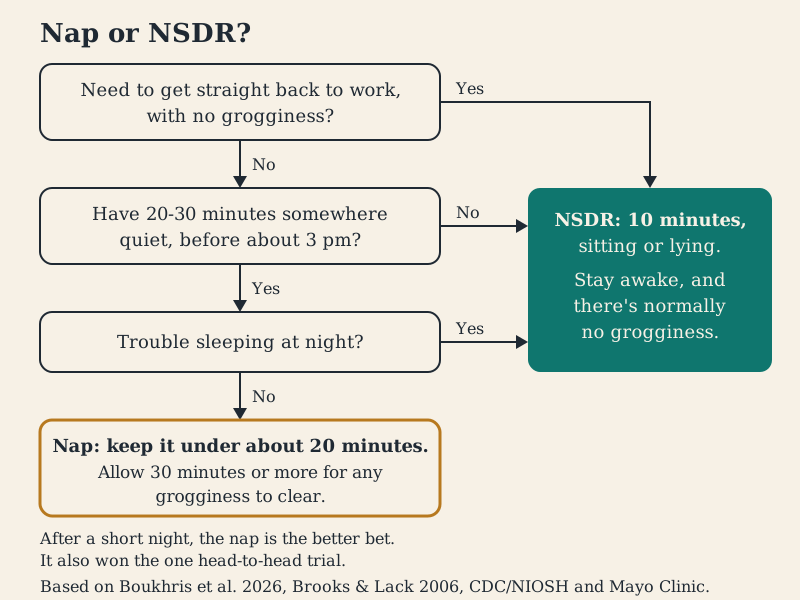
Choose a nap when
- You're short on sleep.
- You have 20 to 30 minutes, including time to fall asleep, somewhere quiet.
- It's before about 3 pm.
- You don't need to get straight back to work, since grogginess can take 30 minutes or more to clear.
- You sleep well at night.
Keep it under about 20 minutes.
Choose NSDR when
- You need to get straight back to work without grogginess.
- You can't or don't want to sleep, or there's nowhere to lie down.
- It's after about 3 pm.
- Naps leave you groggy, or you sleep badly at night.
- You've just finished studying and can't nap.
More on the best time of day for NSDR.
Using both on the same day
A short early-afternoon nap plus an NSDR session later is a reasonable combination. Huberman says NSDR doesn't hurt night sleep. That hasn't been tested, but since you stay awake, there's no reason to expect it to.
How to try NSDR instead of a nap
- Sit back or lie down somewhere you won't be interrupted.
- Play a 10-minute NSDR session. Longer is fine.
- Follow the voice and stay awake. If you drift off, you've had a nap, and the nap rules apply.
- At work, set a gentle alarm so that if you fall asleep, the session doesn't become a long nap.
- Try it after your next focus block and see how you feel.
For other lengths and goals, see NSDR session options by goal and length.
FAQ
Is NSDR better than a nap?
NSDR isn't better than a nap on the evidence so far. Naps are better studied, and in the one direct NSDR vs nap comparison a short nap beat 10 minutes of NSDR. NSDR wins on convenience: no grogginess, no need to sleep, and it works at a desk. If you can't nap, it's a reasonable alternative.
Can NSDR replace sleep?
NSDR can't replace sleep. It can't substitute for the sleep your body needs for memory and immune function, or stand in for deep or REM sleep, because you stay awake.
How long should an NSDR session be compared to a nap?
An NSDR session of 10 minutes matches most trials. Longer is fine. For a nap, common advice is under 20 minutes or about 90 (a full sleep cycle), which avoids waking at around an hour, when deep sleep is likely. In one study, though, grogginess was worse after a 90-minute nap opportunity than a 25-minute one, so allow time for it to clear. NSDR brings no sleep inertia at any length, as long as you stay awake.
Can you do NSDR and nap on the same day?
You can do NSDR and nap on the same day. Huberman says several NSDR sessions a day won't hurt night sleep. That's untested, but you stay awake, so it shouldn't reduce your sleep drive the way a late nap can.
Does NSDR work if you're severely sleep-deprived?
NSDR for severe sleep deprivation is untested. No study has tried it in sleep-deprived people. Huberman recommends it after a poor night, and it may ease stress, but a nap has the evidence. Neither NSDR nor napping treats a sleep problem. If you're tired most days, see a doctor.
What if you fall asleep during NSDR?
If you fall asleep during NSDR, you've had a nap, and the nap rules apply. Most people stay awake: 26 of 30 beginners did in a sleep-lab study of yoga nidra, after two weeks of practice. If it happens at work, set an alarm so a short session doesn't become a long nap.
Sources
- Boukhris O, Suppiah H, Driller M (2026). Comparing the effects of a short nap and non-sleep deep rest on perceptual, cognitive, and physical performance in active adults. Clocks & Sleep. https://pubmed.ncbi.nlm.nih.gov/42783005/
- Boukhris O et al. (2024). The acute effects of nonsleep deep rest on perceptual responses, physical, and cognitive performance in physically active participants. Applied Psychology: Health and Well-Being. https://pubmed.ncbi.nlm.nih.gov/38953770/
- Boukhris O et al. (2026). Time course of perceptual, cognitive, physical and physiological responses to a single non-sleep deep rest session in physically active young adults. Applied Psychology: Health and Well-Being. https://pubmed.ncbi.nlm.nih.gov/42383502/
- Boukhris O et al. (2026). The effects of sleep inertia following EEG-monitored short and long naps on perceptual, cognitive, and physical performance in recreational athletes. Chronobiology International. https://pubmed.ncbi.nlm.nih.gov/41379073/
- Boukhris O et al. (2026). The influence of 25- and 90-min afternoon nap opportunities on subsequent nighttime sleep in student athletes. Journal of Sleep Research. https://pubmed.ncbi.nlm.nih.gov/40537913/
- Brooks A, Lack L (2006). A brief afternoon nap following nocturnal sleep restriction: which nap duration is most recuperative? Sleep. https://pubmed.ncbi.nlm.nih.gov/16796222/
- Tassi P, Muzet A (2000). Sleep inertia. Sleep Medicine Reviews. https://pubmed.ncbi.nlm.nih.gov/12531174/
- Leong RLF, Lo JC, Chee MWL (2022). Systematic review and meta-analyses on the effects of afternoon napping on cognition. Sleep Medicine Reviews. https://pubmed.ncbi.nlm.nih.gov/36041284/
- Kjaer TW et al. (2002). Increased dopamine tone during meditation-induced change of consciousness. Brain Research. Cognitive Brain Research. https://pubmed.ncbi.nlm.nih.gov/11958969/
- Datta K et al. (2022). Electrophysiological evidence of local sleep during yoga nidra practice. Frontiers in Neurology. https://pubmed.ncbi.nlm.nih.gov/35903117/
- Moszeik EN et al. (2025). The effects of an online yoga nidra meditation on subjective well-being and diurnal salivary cortisol: a randomised controlled trial. Stress and Health. https://pubmed.ncbi.nlm.nih.gov/40373021/
- Markil N et al. (2012). Yoga nidra relaxation increases heart rate variability and is unaffected by a prior bout of hatha yoga. Journal of Alternative and Complementary Medicine. https://pubmed.ncbi.nlm.nih.gov/22866996/
- Immink MA (2016). Post-training meditation promotes motor memory consolidation. Frontiers in Psychology. https://pubmed.ncbi.nlm.nih.gov/27847492/
- Besedovsky L et al. (2019). The sleep-immune crosstalk in health and disease. Physiological Reviews. https://pubmed.ncbi.nlm.nih.gov/30920354/
- CDC/NIOSH. Training for Nurses on Shift Work and Long Work Hours, Module 7: Sleep inertia. https://www.cdc.gov/niosh/work-hour-training-for-nurses/longhours/mod7/03.html
- CDC/NIOSH. Training for Nurses on Shift Work and Long Work Hours, Module 7: Napping. https://www.cdc.gov/niosh/work-hour-training-for-nurses/longhours/mod7/05.html
- Mayo Clinic. Napping: Do's and don'ts for healthy adults. https://www.mayoclinic.org/healthy-lifestyle/adult-health/in-depth/napping/art-20048319
- Huberman Lab. Non-Sleep Deep Rest (NSDR). https://www.hubermanlab.com/nsdr
- Huberman Lab newsletter. Teach & Learn Better With A "Neuroplasticity Super Protocol". https://hubermanlab.com/newsletter/teach-and-learn-better-with-a-neuroplasticity-super-protocol
- Huberman A (2023). LinkedIn post on naps and NSDR. https://www.linkedin.com/posts/andrew-huberman_a-10-20-min-nap-or-non-sleep-deep-rest-nsdr-activity-7046607411725406208-mram
- Sleep Foundation (medically reviewed by Brandon Peters MD). What Is Non-Sleep Deep Rest (NSDR)? https://www.sleepfoundation.org/meditation-for-sleep/what-is-non-sleep-deep-rest