Non-sleep deep rest (NSDR) is guided rest you do lying down and awake. A voice slows your breathing and moves your attention through your body until you're deeply relaxed but not asleep, usually for 10 to 30 minutes. Because you stay awake, there's no sleep to shake off when it ends. The 4 trials that test NSDR by name found small, mostly short-lived effects, and one found none.
TL;DR
- NSDR is guided, awake rest that uses slow breathing and a body scan.
- Andrew Huberman coined the term. Yoga nidra is one form of it.
- Most research is on yoga nidra. The 4 NSDR trials found small, mostly brief effects, and one found none.
- Start with 10 minutes. Aim for 20 to 30 when you can.
- Unlike a nap, there's no sleep to wake from. Unlike most meditation, you de-focus and follow a voice.
- Huberman suggests it for the afternoon slump, after stress and at bedtime.
What is non-sleep deep rest?
Non-sleep deep rest is an umbrella term for guided practices done in a state between awake and asleep. Andrew Huberman, a neuroscientist at Stanford University School of Medicine, coined it. Huberman Lab's NSDR guide says he uses the term "so that the name of a more specific practice doesn't serve as a barrier," since some people avoid anything with "meditation" in the name. The aim is to move you toward the "rest-and-digest" side of the nervous system.
How NSDR differs from sleep
During sleep you cycle through light, deep and REM stages several times a night. NSDR aims for the "liminal state" between awake and asleep, so there's no sleep to shake off afterwards.
In a 2022 sleep-lab study of 26 people doing yoga nidra, the researchers scored participants as awake throughout, though parts of the brain showed slower waves. That's one small study, on yoga nidra.
How NSDR differs from meditation
NSDR overlaps with meditation. Many meditation styles train you to hold attention on one thing. NSDR aims the other way, to de-focus. A voice leads you through breathing and body sensations, and you follow. Some people who find sitting meditation hard find it easier to follow a voice lying down.
NSDR and yoga nidra
Yoga nidra means "yogic sleep." Swami Satyananda Saraswati's writings introduced a systematic version to the public in the 1960s, simplified from an old tantric relaxation technique. Huberman treats it as one type of NSDR. His own scripts drop the intention setting and yogic language but keep the breathing and body scan. No study has compared the two head to head.
How NSDR works
Nobody has pinned down exactly how non-sleep deep rest works. These are the likely components. Each aims to calm the "fight or flight" (sympathetic) side of the nervous system in favor of "rest and digest" (parasympathetic).
The body scan
The body scan turns your attention to your skin and the inside of your body, what Huberman calls interoception. His 20-minute script also asks you to relax your legs, hands and face. In Huberman's view, you relax the body first and the nervous system follows.
Slow breathing with a long exhale
Huberman's script asks you to make each exhale slightly longer. In a 30-person lab study, a long exhale during slow breathing (6 breaths a minute) raised high-frequency heart rate variability, a marker of vagus nerve activity.
What changes in your body
In the largest NSDR trial, heart rate fell a little more during the 10-minute session than in the control group. Over two months, a Munich yoga nidra trial linked regular practice to lower cortisol, and one small PET study found more dopamine release during a long yoga nidra session. The La Trobe University team behind that NSDR trial writes that its "physiological findings were modest and should be interpreted cautiously."
Benefits of NSDR: what the evidence shows
A PubMed search turns up 4 trials that use the non-sleep deep rest name, 3 of them testing a single 10-minute session. Their effects are small and mostly short-lived.
What's been tested on NSDR itself
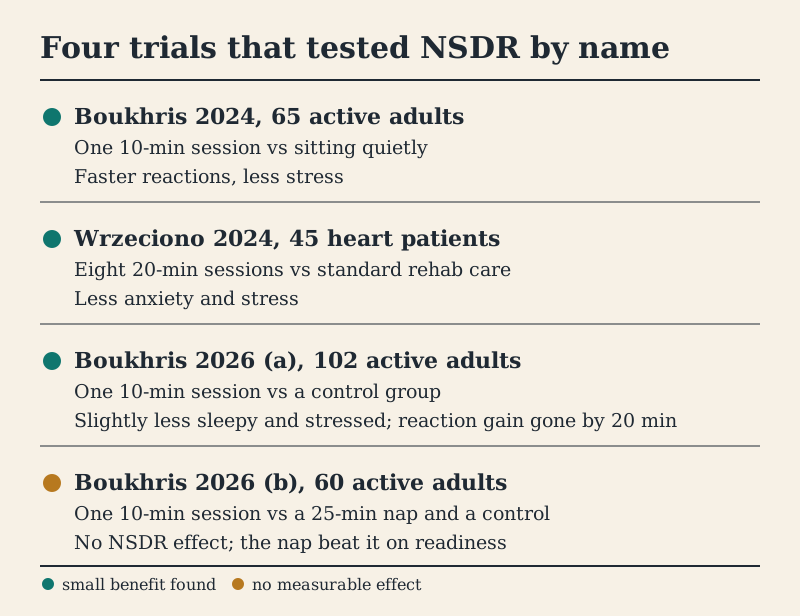
In a 2024 trial of 65 physically active adults, a single 10-minute session improved reaction time, accuracy and self-rated stress compared with sitting quietly.
A 2024 pilot trial in 45 heart patients in cardiac rehab found 8 sessions of 20 minutes lowered anxiety and stress scores more than standard care, which included autogenic training. The depression change wasn't significant.
The largest, a 2026 trial, split 102 active young adults (average age 22) between a 10-minute session and a control. Sleepiness, fatigue and stress improved slightly. The reaction-time gain had faded by 20 minutes.
A second 2026 trial assigned 60 active adults to a 25-minute nap opportunity, a 10-minute NSDR session or a control. NSDR had no significant effect on anything measured.
What comes from yoga nidra research
In a 2002 PET study, 8 experienced male yoga teachers did a 72-minute guided yoga nidra session. The researchers estimated a 65% rise in dopamine release in part of the striatum compared with listening to speech. It's one small study of experts, and nobody has repeated it with short NSDR scripts.
A 2025 Munich trial gave 362 adults an 11- or 30-minute yoga nidra recording, music, or nothing, for 2 months. People who practiced more often had lower total cortisol. The effects were small.
For sleep, a 2021 trial randomized 41 people with chronic insomnia to CBT-I or yoga nidra. Both groups slept better, and the yoga nidra group also gained deep sleep.
A 2026 meta-analysis of 73 studies and 5,201 people linked yoga nidra to less stress, anxiety and depression. Its authors say the effects "likely reflect inflated estimates" because of weak study designs.
Where the evidence is thin
The NSDR research is young. The 4 trials had between 45 and 102 people, and 3 of them tested a single 10-minute session. Most outcomes are self-reported, and there's little follow-up. Results lean positive but aren't consistent. So test it on yourself. Try 10 minutes a day for a week, then decide whether to keep it.
No NSDR study has tested focus or memory over weeks. A related 2019 meditation study (13 minutes a day) found better attention and memory after 8 weeks but not after 4.
How to do NSDR, step by step
Lie down, play a guided recording, and follow the voice for 10 to 30 minutes.
What you need
- A quiet spot for 10 to 30 minutes
- Headphones or a speaker
- Somewhere to lie down, or a comfortable chair
- A guided recording
The steps
- Lie on your back and close your eyes. A comfortable chair works too.
- Follow the breathing cues. Breathe in through the nose and out through the mouth, making each exhale a little longer. Let the voice set the pace.
- Follow the body scan. Notice what you feel in each part, and let muscles soften when asked. Don't force it.
- Stay awake if you can. Drifting off is fine.
- Come back slowly. Move your hands and feet, open your eyes, and sit up when ready.
Which session length to start with
10 minutes. This is a quick reset. In trials, one 10-minute session had small effects or none. In the Munich trial, the 30-minute version did a bit better than the 11-minute one.
20 to 30 minutes. Huberman Lab's NSDR guide says, "Even a brief NSDR script of 10 minutes will have benefits, but aim for 20-30 minutes if possible." The cardiac-rehab trial used 20-minute sessions.
30 minutes or more. Use this for bedtime, or after a short night. Huberman suggests 30 to 60 minutes for both. At bedtime, Huberman says a longer session eases worry about not falling asleep before the audio ends.
See matching session length to your goal for more. NSDR.co's guided sessions are free, and there will always be a free plan.
When to use NSDR
Huberman suggests 3 main uses: a midday energy boost, falling (and falling back) asleep, and reducing stress. NSDR trials have measured stress and sleepiness after a single session, but none has tested these uses directly. If you only pick one slot, pick the afternoon slump. A 10-minute session fits into a work break more easily than a nap, and because you stay awake, you can go straight back to your desk. There's more on the best times to do NSDR.
Afternoon slump
Some people get a mid-afternoon dip in performance, linked to a rise in sleepiness at that time of day, even without lunch. A 10 to 20 minute session is a caffeine-free option. One study found that 400 mg of caffeine taken 6 hours before bed still cut into sleep. In one trial, people felt slightly less sleepy after 10 minutes. In another, they didn't.
After a stressful event
A short session is a reasonable reset. In 2 trials, self-rated stress dropped a little after 10 minutes compared with sitting quietly.
At bedtime
Huberman recommends NSDR at bedtime to make falling asleep easier. At that time of day, falling asleep during it is fine. The small insomnia trial above is the closest test.
After a poor night's sleep
In his 20-minute NSDR video, Huberman says it "can even partially offset the negative consequences of getting too little sleep," and suggests 30 to 60 minutes after a bad night. No study has tested this yet.
Common mistakes to avoid
Doing it without a guide
Use a guided recording. NSDR is defined by following a voice, and it's easier to let go when someone else sets the pace. Or record your own with these NSDR scripts you can read or record.
Treating it like a nap
The point is to stay between awake and asleep. If you keep dropping off, sit up in a comfortable chair. Huberman says seated works fine.
Having coffee right before
Caffeine is a stimulant, so a coffee just before may make it harder to settle. Its half-life averages about 4 hours but ranges from 2 to 8, so a 3 PM coffee can still be working at 8 PM.
Judging it after one session
Some people feel a shift the first time. Others need a few sessions. In the Munich trial, people who practiced more often saw bigger changes in their cortisol rhythm.
NSDR vs naps, meditation and other methods
NSDR is the easiest of these to fit into a workday if you don't want to sleep.
| Method | Time | Guidance | Afterwards | Best for |
|---|---|---|---|---|
| NSDR | 10 to 30 min | Guided audio | You stay awake, so no sleep to wake from | A quick reset |
| Nap | 10 to 25 min, or about 90 | None | Longer naps can leave you groggy | Paying back sleep |
| Meditation | Varies | Optional | You stay awake | Training attention |
| Yoga nidra | 10 to 45 min | Guided audio | Same as NSDR | NSDR plus intention setting |
| Breathing exercises | About 5 min | None needed | You stay awake | Calming down fast |
In the one trial that compared them, people given a 25-minute nap felt more ready to perform 40 minutes later than the NSDR group, and less fatigued than the control group. The cost is a 25-minute slot and a risk of grogginess (sleep inertia). In one study, a 20-minute nap took about half an hour to pay off. NSDR keeps you awake, so you can get up and carry on. If you're short on sleep and have the time, nap. If you can't nap, or need to be back at work within minutes without grogginess, use NSDR.
For a 5-minute option, try the physiological sigh. For something longer and more structured, yoga nidra adds intention setting and yogic language.
NSDR is a relaxation practice, not a treatment. If you have a sleep disorder, an anxiety disorder or another health condition, keep your usual care and talk to your doctor before relying on it.
FAQ
Is NSDR the same as yoga nidra?
NSDR and yoga nidra are mostly the same. Yoga nidra is one form of NSDR that adds intention setting and more yogic language.
Can NSDR replace sleep?
NSDR can't replace sleep. Huberman says it can partially offset a short night, but no study has tested that, and nothing replaces the work sleep does.
How often should I do NSDR?
Do NSDR as often as daily if you can. Huberman suggests making it a daily habit of 20 to 30 minutes, and says even 10 minutes has benefits. A few times a week is a fine start. There's no research on the minimum.
How quickly do you feel the benefits of NSDR?
You can feel some benefits of NSDR after one session, but they're small and brief. In the 2024 trial of 65 active adults, a single 10-minute session left people rating their physical readiness, overall recovery and stress better than the sitting-quietly group did. In the larger 2026 trial, the reaction-time gain had faded by 20 minutes. Longer-term changes have only been seen with regular practice. The Munich cortisol changes came with regular yoga nidra over 2 months, and the cardiac-rehab results came after 8 sessions.
Can NSDR help with anxiety?
NSDR may help with anxiety. The yoga nidra meta-analysis found lower anxiety, though weak designs probably inflated that result. The 45-patient cardiac-rehab pilot also found lower anxiety than standard care. A 2022 review notes that yoga nidra's benefits haven't been shown to extend to severe anxiety. Use it as a regulation tool, and see a professional if anxiety is persistent or severe.
Is NSDR safe?
NSDR is likely safe for most people, but meditation-style practices aren't free of side effects. A 2020 review of 83 meditation studies found adverse events in 8.3% of participants overall, and 3.7% in experimental studies. Anxiety and depression were the most often reported. It didn't cover NSDR specifically. Never play a session while driving. If a session leaves you more anxious or brings up distressing memories, stop, and talk to a professional if it keeps happening.
What if I fall asleep during NSDR?
Falling asleep during NSDR is fine. You may be short on sleep, or it's a sleepy time of day. To stay awake, sit up or go earlier.
Does NSDR work?
Whether NSDR works is still open. The 4 trials of non-sleep deep rest by name found small, mostly short-lived effects, and one found none. Yoga nidra has more evidence, though that evidence is weak. It's worth 10 minutes to try, with no guaranteed effect.
Does NSDR help you learn faster?
No NSDR trial has tested whether it helps you learn faster. Huberman's NSDR guide says a focused learning session is the "trigger", and the rewiring of brain circuits happens later, during sleep and NSDR. The 2019 study that found better memory after 8 weeks used guided meditation, not NSDR. There's more in NSDR after learning.
Sources
- EFSA Panel on Dietetic Products, Nutrition and Allergies (2015). Scientific Opinion on the safety of caffeine. EFSA Journal 13(5):4102. https://www.efsa.europa.eu/en/efsajournal/pub/4102
- Huberman Lab. Dr. Andrew Huberman's Guide to NSDR. https://www.hubermanlab.com/nsdr
- Huberman Lab Clips. 20 Minute Non-Sleep Deep Rest (NSDR) to Restore Mental & Physical Energy | Dr. Andrew Huberman (YouTube). https://www.youtube.com/watch?v=hEypv90GzDE
- Stanford Profiles. Andrew Huberman, Ph.D. https://profiles.stanford.edu/andrew-huberman
- National Institute of Neurological Disorders and Stroke. Brain Basics: Understanding Sleep. https://www.ninds.nih.gov/health-information/public-education/brain-basics/brain-basics-understanding-sleep
- Boukhris O, Suppiah H, Halson S, Russell S, Clarke A, Geneau MC, et al. (2024). The acute effects of nonsleep deep rest on perceptual responses, physical, and cognitive performance in physically active participants. Applied Psychology: Health and Well-Being 16(4):1967-1987. https://iaap-journals.onlinelibrary.wiley.com/doi/10.1111/aphw.12571
- Wrzeciono A, Cieślik B, Kiper P, Szczepańska-Gieracha J, Gajda R (2024). Non-sleep deep rest relaxation and virtual reality therapy for psychological outcomes in patients with coronary artery disease: a pilot randomized controlled trial. Journal of Clinical Medicine 13(23):7178. https://pmc.ncbi.nlm.nih.gov/articles/PMC11642233/
- Boukhris O, Suppiah H, Kerkeni M, Holt A, Driller M (2026). Time course of perceptual, cognitive, physical and physiological responses to a single non-sleep deep rest session in physically active young adults. Applied Psychology: Health and Well-Being 18(4):e70180. https://pubmed.ncbi.nlm.nih.gov/42383502/
- Boukhris O, Suppiah H, Driller M (2026). Comparing the effects of a short nap and non-sleep deep rest on perceptual, cognitive, and physical performance in active adults. Clocks & Sleep 8(3):52. https://pubmed.ncbi.nlm.nih.gov/42783005/
- Kjaer TW, Bertelsen C, Piccini P, Brooks D, Alving J, Lou HC (2002). Increased dopamine tone during meditation-induced change of consciousness. Cognitive Brain Research 13(2):255-259. https://pubmed.ncbi.nlm.nih.gov/11958969/
- Moszeik EN, Rohleder N, Renner KH (2025). The effects of an online Yoga Nidra meditation on subjective well-being and diurnal salivary cortisol: a randomised controlled trial. Stress and Health 41(3):e70049. https://pmc.ncbi.nlm.nih.gov/articles/PMC12080877/
- Datta K, Tripathi M, Verma M, Masiwal D, Mallick HN (2021). Yoga nidra practice shows improvement in sleep in patients with chronic insomnia: a randomized controlled trial. National Medical Journal of India 34(3):143-150. https://pubmed.ncbi.nlm.nih.gov/34825538/
- Datta K, Mallick HN, Tripathi M, Ahuja N, Deepak KK (2022). Electrophysiological evidence of local sleep during yoga nidra practice. Frontiers in Neurology 13:910794. https://pubmed.ncbi.nlm.nih.gov/35903117/
- Ghai S, Odyniec P, Ghai I (2026). Effects of Yoga Nidra on stress, anxiety, and depression: a systematic review and meta-analysis. Annals of the New York Academy of Sciences 1556(1):e70149. https://pubmed.ncbi.nlm.nih.gov/41327816/
- Farias M, Maraldi E, Wallenkampf KC, Lucchetti G (2020). Adverse events in meditation practices and meditation-based therapies: a systematic review. Acta Psychiatrica Scandinavica 142(5):374-393. https://pubmed.ncbi.nlm.nih.gov/32820538/
- Pandi-Perumal SR, Spence DW, Srivastava N, et al. (2022). The origin and clinical relevance of yoga nidra. Sleep and Vigilance 6(1):61-84. https://pubmed.ncbi.nlm.nih.gov/35496325/
- Van Diest I, Verstappen K, Aubert AE, Widjaja D, Vansteenwegen D, Vlemincx E (2014). Inhalation/exhalation ratio modulates the effect of slow breathing on heart rate variability and relaxation. Applied Psychophysiology and Biofeedback 39(3-4):171-180. https://pubmed.ncbi.nlm.nih.gov/25156003/
- Brooks A, Lack L (2006). A brief afternoon nap following nocturnal sleep restriction: which nap duration is most recuperative? Sleep 29(6):831-840. https://pubmed.ncbi.nlm.nih.gov/16796222/
- Hilditch CJ, Dorrian J, Banks S (2017). A review of short naps and sleep inertia: do naps of 30 min or less really avoid sleep inertia and slow-wave sleep? Sleep Medicine 32:176-190. https://pubmed.ncbi.nlm.nih.gov/28366332/
- Monk TH (2005). The post-lunch dip in performance. Clinics in Sports Medicine 24(2):e15-e23. https://pubmed.ncbi.nlm.nih.gov/15892914/
- Drake C, Roehrs T, Shambroom J, Roth T (2013). Caffeine effects on sleep taken 0, 3, or 6 hours before going to bed. Journal of Clinical Sleep Medicine 9(11):1195-1200. https://pubmed.ncbi.nlm.nih.gov/24235903/
- Elmenhorst D, Meyer PT, Matusch A, Winz OH, Bauer A (2012). Caffeine occupancy of human cerebral A1 adenosine receptors: in vivo quantification with 18F-CPFPX and PET. Journal of Nuclear Medicine 53(11):1723-1729. https://pubmed.ncbi.nlm.nih.gov/22966134/
- Balban MY, Neri E, Kogon MM, Weed L, Nouriani B, Jo B, et al. (2023). Brief structured respiration practices enhance mood and reduce physiological arousal. Cell Reports Medicine 4(1):100895. https://pubmed.ncbi.nlm.nih.gov/36630953/
- Basso JC, McHale A, Ende V, Oberlin DJ, Suzuki WA (2019). Brief, daily meditation enhances attention, memory, mood, and emotional regulation in non-experienced meditators. Behavioural Brain Research 356:208-220. https://pubmed.ncbi.nlm.nih.gov/30153464/