The quickest answer to how to relax is to start with your body. Slow your breathing so the out-breath is longer than the in-breath, or tense a muscle group and let it go. Then pick a longer method that fits the time you have.
TL;DR
- Start with the physiological sigh. It takes a few seconds to learn, and 5 minutes a day beat meditation on mood in a Stanford trial.
- Use slow belly breathing, 4 seconds in and 6 out, for steadier calm over 5 to 10 minutes.
- Use progressive muscle relaxation when the tension is in your shoulders, jaw or back.
- Try a guided NSDR session when you have 10 to 20 minutes and want to follow a voice.
- Do a body scan to find tension you didn't know you were holding.
- Play nature sounds or steady noise in the background, quietly.
- Walk, ideally somewhere green, when you've been sitting too long.
Why you can't relax (it's your nervous system)
Relaxing on command is hard because the stress response runs through your body. Telling yourself to relax while your body is braced is like telling a car to slow down with the accelerator floored.
Your body is stuck in sympathetic mode
Your autonomic nervous system has two main branches. The sympathetic branch makes your heart beat faster and harder and widens your pupils. The parasympathetic branch works the brake and slows your heart. When you're stressed, an NHS Lothian leaflet notes, your breathing "tends to become fast and shallow". Your muscles tense too.
Both branches run at the same time, so "stuck" is a figure of speech. Under stress the balance tips toward the accelerator, which helps you dodge a car and hurts at 11 PM in bed.
The parasympathetic shift
Most of the methods below press the brake harder, which you can see as a slower heart rate. Much of that braking runs through the vagus nerve, which carries the signal that slows the heart.
Cleveland Clinic psychologist Susan Albers, PsyD, puts it this way. "Relaxation is like shifting into a lower gear and cruising for a while, letting your body regenerate and recover."
Why "just relax" doesn't work
Telling yourself to calm down rarely works. Stanford neuroscientist Andrew Huberman goes further and says it "tends to just exacerbate stress". The quicker levers are physical. Breathing is the obvious one, because you can take it over whenever you choose. As Stanford psychiatrist David Spiegel put it, "What's interesting about the breath is that it's right on the edge of conscious control."
How to relax: 7 methods ranked by evidence
The ranking is rough, because the studies measure different things. The first three have the most direct evidence. Slow breathing has the biggest research base, a review of 46 studies backs progressive muscle relaxation, and the physiological sigh has the most direct trial. NSDR and the body scan rest on a few small trials. Nature sounds and walking outside have small studies too.
1. Physiological sigh (fastest reset)
Best for a stressful moment you need to get through, or a 5-minute daily practice.
The best-known trial is Balban and colleagues, published in Cell Reports Medicine in 2023, with Spiegel and Huberman as senior authors. 108 adults did 5 minutes of breathwork or mindfulness meditation a day for a month. Cyclic sighing, the 5-minute version of this breath, "produces greater improvement in mood (p < 0.05) and reduction in respiratory rate (p < 0.05) compared with mindfulness meditation." Its mood benefit also grew the more days people practised.
The limits matter. Box breathing gave almost the same daily mood boost, 1.84 points against 1.89 for cyclic sighing. Anxiety fell in every group, meditation included, and heart rate variability didn't change. People managed about 20 of the 28 days, and the authors call the study exploratory.
How to do it.
- Breathe in slowly through your nose.
- At the top, sip in a second, shorter breath through your nose to fill your lungs.
- Breathe out slowly through your mouth until your lungs feel empty.
- Repeat for 5 minutes as a daily practice, or do one to three in the moment.
The second inhale reopens tiny air sacs in the lungs, and the long exhale slows the heart. Which of the two does the calming hasn't been tested.
Use it before a meeting or after bad news. Huberman's advice for those moments is one to three sighs, a dose the trial didn't test. The physiological sigh guide covers the study in more detail.
2. Slow belly breathing
Best for steadier calm over 5 to 10 minutes.
Slow breathing has the biggest evidence base on this list. A 2022 meta-analysis of 223 studies found it raises heart rate variability, a marker of vagus nerve activity on the heart. The rise showed up during a session, straight after it, and after programmes of several sessions.
How to do it.
- Sit or lie down.
- Put one hand on your chest and one on your belly.
- Breathe in through your nose for 4 seconds and let your belly rise. Your chest stays fairly still.
- Breathe out through your mouth for 6 seconds.
- Keep going for 5 to 10 minutes.
Four in and six out works out to 6 breaths a minute, the pattern Cleveland Clinic suggests. The longer exhale helps. In a small lab study of 30 people, breathing out for longer than they breathed in felt more relaxing, and at 6 breaths a minute it also raised the high-frequency part of heart rate variability.
3. Progressive muscle relaxation (PMR)
Best for physical tension you can't shake, especially in your shoulders, jaw or back.
Tensing a muscle on purpose first makes the release easier to feel. A 2024 review of 46 studies covering more than 3,400 adults found PMR programmes reduced stress, anxiety and depression.
How to do it.
- Start with your feet. Curl your toes and squeeze for 5 seconds.
- Let go and notice the difference for 10 seconds.
- Move to your calves. Flex for 5 seconds, then release.
- Work upward through your thighs, glutes, belly, fists, upper arms, shoulders and face.
- Finish by tensing your whole body for 5 seconds, then letting go.
The full sequence takes about 15 minutes. Short on time? Do three areas: shrug your shoulders up to your ears and drop them, clench and release your jaw, make fists and open them.
Use it when your body feels tight and breathing alone isn't shifting it, such as at the end of a workday.
4. Non-sleep deep rest (NSDR)
Best for a deeper reset in 10 to 20 minutes, without a nap.
NSDR is a guided practice of slow breathing and moving your attention around your body, done lying down and awake. Sessions usually run 10 to 30 minutes. People sometimes mistake it for napping, but you stay awake, so there's no grogginess afterwards and you can use it in the middle of the day.
The research is early. Only four trials use the NSDR name. In the largest, 102 active young adults did one 10-minute session. Sleepiness, fatigue and stress fell more than after a control session, and heart rate fell slightly more. The authors called the physiological effects modest. In another, a 25-minute nap beat a 10-minute NSDR session on readiness, and NSDR showed no effect.
How to do it.
- Lie down or recline somewhere quiet.
- Put on a guided NSDR protocol. A voice to follow matters here.
- Follow it through breathing, then attention to each part of your body.
- Start with 10 minutes.
Use it after a stressful morning or in the early-afternoon slump, when you'd rather follow a voice than count breaths.
5. Body scan
Best for finding tension you didn't know you were holding.
You move your attention through your body and register where you're tight. Once you've noticed a clenched jaw, you can let it go.
How to do it.
- Lie down or sit comfortably.
- Start at the top of your head. Notice any tightness, warmth or pressure.
- Move slowly down through your forehead, eyes, jaw, neck, shoulders, arms, chest, belly, hips, legs and feet.
- Spend 10 to 15 seconds on each area. Notice the feeling without trying to change it.
- Finish with 30 seconds on your body as a whole.
The scan takes 10 to 15 minutes. The direct evidence is small. In a trial of 55 people with chronic pain, a 10-minute recorded body scan eased pain-related distress in the clinic compared with a control recording, but not when they repeated it at home.
Use it when you feel tense all over but can't say where, or in bed.
6. Nature sounds
Best for background calm while you work, read or fall asleep.
The studies are small. A 2021 PNAS meta-analysis of 18 studies linked natural sounds to lower stress and annoyance and to better health and mood. In one brain-imaging study, 17 healthy adults showed a shift toward "rest and digest" while hearing nature sounds, but only those whose "rest and digest" activity started out low.
What to play:
- For sleep. Rain sounds or brown noise, mainly because they mask sudden noises. Keep the volume low. In one lab study, pink noise alone at 50 dB cut REM sleep by about 19 minutes.
- For focus. Whatever you can ignore. The focus research is mostly on white noise in young people with ADHD, and the benefit is small.
- For winding down. Ocean, birdsong or forest recordings.
7. Walking or light movement
Best for restlessness after sitting too long.
When you're restless, moving can be easier than sitting still. In a study of 36 city dwellers, time somewhere that felt like nature lowered cortisol beyond its normal daily fall. 20 to 30 minutes gave the most for the time spent, and whether people walked or sat made no difference to the cortisol drop.
How to do it.
- Walk at an easy pace.
- Leave your phone in your pocket and look at what's around you.
- Aim for 20 to 30 minutes if you can get outside, or 10 minutes around the office if you can't.
Use it after hours at a desk, or when breathing drills feel forced.
How to pick the right method
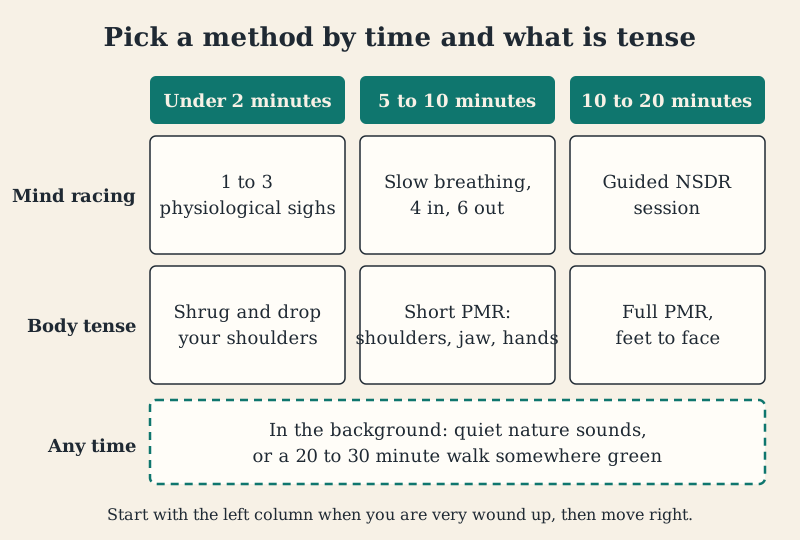
How to relax well depends on how much time you have and where the stress sits.
When you need to calm down in under 2 minutes
Do one to three physiological sighs. If the tension is in your body, shrug your shoulders up to your ears and drop them. For more fast options, see how to calm down fast.
When you have 10 to 20 minutes
NSDR suits this window if you'd rather follow a voice than count. Pick PMR if the tension is mostly in your shoulders, jaw or back, and belly breathing if you want no audio at all.
When it's a recurring problem
If you struggle to relax most days, practise daily rather than now and then. The NHS Lothian leaflet makes the case plainly: "Practice the relaxation every day so that you are able to do it when you are in a stressful situation."
It also helps to know that relaxation isn't the same as recovery. An evening on the sofa can relax you while your head stays on the thing that's stressing you.
When relaxation doesn't work
If the methods above aren't helping, check these three things.
You're too activated to start
When you're panicking or wound tight, slow techniques like belly breathing can feel impossible. Start with something short and physical. One to three physiological sighs is one option. Cold on your face is another. In a lab study of 10 healthy volunteers, an ice-cold compress on the face for 60 seconds slowed heart rate, most likely through the vagus nerve. Blood pressure rose too, so skip it if you have a heart condition. Once the edge is off, move to something longer like NSDR or PMR.
The technique doesn't match the problem
No trial has matched techniques to symptoms, but a rule of thumb helps. If your body is tight, use PMR or a walk. If your mind is racing, try sighs followed by NSDR. If you just feel wired, put on nature sounds and go for a walk.
You may need professional support
If you can't relax despite trying several methods, or you have panic attacks, ongoing anxiety or insomnia, talk to your GP. These tools help with everyday stress. They aren't a substitute for treatment. Check with your GP before starting a daily breathing practice if you have a heart condition, glaucoma, a history of seizures, a serious psychiatric condition, or are pregnant. The Stanford trial left those groups out, and 10% of its participants reported a negative experience with the exercises.
Build a daily relaxation practice
A minimal routine takes under 20 minutes spread across the day.
Morning: 2 to 3 minutes
Do a few rounds of the physiological sigh, or 2 to 3 minutes of slow breathing, before you check your phone.
Afternoon: 10 minutes
Some people hit a dip in alertness in the early afternoon, linked to a rise in sleepiness at that time of day, even when they skip lunch. A 10-minute NSDR session fits there. Shut the door, put in headphones and lie back. You get up without the grogginess a nap can leave.
Evening: wind down
Play nature sounds at a low volume in the hour before bed. Once you're lying down, do a 5-minute body scan.
You don't need all seven methods. Pick two or three that fit your day, and keep them up, since doing them daily matters more than doing them for long.
FAQ
How long does it take to learn to relax?
You can learn to relax well enough to feel a difference in one session. In the Stanford trial, mood rose after each 5-minute breathing session, and in an NSDR trial a single 10-minute session cut sleepiness and stress. Making it feel natural takes longer. No study sets a number of weeks, but the benefit of daily sighing kept growing over a month.
What's the fastest way to relax?
The fastest way to calm down is the physiological sigh: two inhales through the nose, then one long exhale through the mouth. One to three sighs is Huberman's advice in the moment, though that dose is untested. In the Stanford trial, 5 minutes a day of it beat mindfulness meditation on mood, about level with box breathing.
Can you train yourself to relax?
Yes, you can train yourself, and practice is what does it. In a meta-analysis of 223 studies, slow-breathing programmes of several sessions raised heart rate variability, and in the Stanford trial the benefit of cyclic sighing grew with each extra day. An NHS Lothian leaflet says it may feel strange at first and gets easier with practice.
Why do I feel worse when I try to relax?
Feeling worse when you try to relax has a name: relaxation-induced anxiety, first described in the 1980s. It shows up more in people with generalised anxiety or depression. One explanation, with some lab support, is that worry keeps people braced against a sudden drop in mood, so letting go of it feels risky. In a trial of 41 people with generalised anxiety, everyone improved with treatment that included relaxation training, and those with smaller anxiety spikes late in treatment did best. Start with short sessions and physical methods like PMR or walking, and build up.
How do I relax before sleep?
Play quiet nature sounds in the last hour, do a 5-minute body scan once you're lying down, and use a few physiological sighs if your mind is racing. Keep coffee to at least 8.8 hours before bed, the cutoff a 2023 meta-analysis found protected total sleep.
Sources
- Balban MY, Neri E, Kogon MM, et al. (2023). Brief structured respiration practices enhance mood and reduce physiological arousal. Cell Reports Medicine. https://pubmed.ncbi.nlm.nih.gov/36630953/
- Stanford Medicine (2023). Cyclic sighing can help breathe away anxiety. https://med.stanford.edu/news/insights/2023/02/cyclic-sighing-can-help-breathe-away-anxiety.html
- Huberman Lab (2021). Tools for Managing Stress & Anxiety. https://www.hubermanlab.com/episode/tools-for-managing-stress-and-anxiety
- Laborde S, Allen MS, Borges U, et al. (2022). Effects of voluntary slow breathing on heart rate and heart rate variability: a systematic review and a meta-analysis. Neuroscience & Biobehavioral Reviews. https://pubmed.ncbi.nlm.nih.gov/35623448/
- Van Diest I, Verstappen K, Aubert AE, et al. (2014). Inhalation/Exhalation ratio modulates the effect of slow breathing on heart rate variability and relaxation. Applied Psychophysiology and Biofeedback. https://pubmed.ncbi.nlm.nih.gov/25156003/
- Berntson GG, Cacioppo JT, Quigley KS (1991). Autonomic determinism: the modes of autonomic control, the doctrine of autonomic space, and the laws of autonomic constraint. Psychological Review. https://pubmed.ncbi.nlm.nih.gov/1660159/
- McCorry LK (2007). Physiology of the autonomic nervous system. American Journal of Pharmaceutical Education. https://pubmed.ncbi.nlm.nih.gov/17786266/
- Muhammad Khir S, Wan Mohd Yunus WMA, Mahmud N, et al. (2024). Efficacy of Progressive Muscle Relaxation in Adults for Stress, Anxiety, and Depression: A Systematic Review. Psychology Research and Behavior Management. https://pubmed.ncbi.nlm.nih.gov/38322293/
- Boukhris O, Suppiah H, Kerkeni M, Holt A, Driller M (2026). Time course of perceptual, cognitive, physical and physiological responses to a single non-sleep deep rest session in physically active young adults. Applied Psychology: Health and Well-Being. https://pubmed.ncbi.nlm.nih.gov/42383502/
- Boukhris O, Suppiah H, Driller M (2026). Comparing the effects of a short nap and non-sleep deep rest on perceptual, cognitive, and physical performance in active adults. Clocks & Sleep. https://pubmed.ncbi.nlm.nih.gov/42783005/
- Ussher M, Spatz A, Copland C, et al. (2014). Immediate effects of a brief mindfulness-based body scan on patients with chronic pain. Journal of Behavioral Medicine. https://pubmed.ncbi.nlm.nih.gov/23129105/
- Buxton RT, Pearson AL, Allou C, Fristrup K, Wittemyer G (2021). A synthesis of health benefits of natural sounds and their distribution in national parks. PNAS. https://pubmed.ncbi.nlm.nih.gov/33753555/
- Gould van Praag CD, Garfinkel SN, Sparasci O, et al. (2017). Mind-wandering and alterations to default mode network connectivity when listening to naturalistic versus artificial sounds. Scientific Reports. https://pubmed.ncbi.nlm.nih.gov/28345604/
- Hunter MR, Gillespie BW, Chen SY (2019). Urban Nature Experiences Reduce Stress in the Context of Daily Life Based on Salivary Biomarkers. Frontiers in Psychology. https://pubmed.ncbi.nlm.nih.gov/31019479/
- Stemper B, Hilz MJ, Rauhut U, Neundörfer B (2002). Evaluation of cold face test bradycardia by means of spectral analysis. Clinical Autonomic Research. https://pubmed.ncbi.nlm.nih.gov/12102454/
- Monk TH (2005). The post-lunch dip in performance. Clinics in Sports Medicine. https://pubmed.ncbi.nlm.nih.gov/15892914/
- Heide FJ, Borkovec TD (1983). Relaxation-induced anxiety: paradoxical anxiety enhancement due to relaxation training. Journal of Consulting and Clinical Psychology. https://pubmed.ncbi.nlm.nih.gov/6341426/
- Kim H, Newman MG (2019). The paradox of relaxation training: Relaxation induced anxiety and mediation effects of negative contrast sensitivity in generalized anxiety disorder and major depressive disorder. Journal of Affective Disorders. https://pubmed.ncbi.nlm.nih.gov/31450137/
- Newman MG, Lafreniere LS, Jacobson NC (2018). Relaxation-induced anxiety: Effects of peak and trajectories of change on treatment outcome for generalized anxiety disorder. Psychotherapy Research. https://pubmed.ncbi.nlm.nih.gov/27855541/
- Basner M, Smith MG, Cordoza M, et al. (2026). Efficacy of pink noise and earplugs for mitigating the effects of intermittent environmental noise exposure on sleep. Sleep. https://pubmed.ncbi.nlm.nih.gov/41627391/
- Nigg JT, Bruton A, Kozlowski MB, et al. (2024). Systematic review and meta-analysis: do white noise or pink noise help with task performance in youth with attention-deficit/hyperactivity disorder or with elevated attention problems? Journal of the American Academy of Child and Adolescent Psychiatry. https://pubmed.ncbi.nlm.nih.gov/38428577/
- Gardiner C, Weakley J, Burke LM, et al. (2023). The effect of caffeine on subsequent sleep: A systematic review and meta-analysis. Sleep Medicine Reviews. https://pubmed.ncbi.nlm.nih.gov/36870101/
- Cleveland Clinic (2025). How To Relax: 7 Techniques To Try (with Susan Albers, PsyD). https://health.clevelandclinic.org/how-to-relax
- Cleveland Clinic. How To Reset Your Vagus Nerve Naturally (with Dr Emad Estemalik). https://health.clevelandclinic.org/vagus-nerve-reset
- NHS Lothian. Relaxation: Information for patients. https://policyonline.nhslothian.scot/wp-content/uploads/2025/10/Relaxation-A-guide-for-patients.pdf