NSDR after learning means taking about 10 minutes of guided, awake rest when a study or practice session ends, before you pick up your phone or start the next task. Lab studies of quiet rest straight after learning find a small-to-moderate memory boost, and a smaller one is still there a week later. No study has tested NSDR by name for memory, so think of a session as a structured way to take that rest.
TL;DR
- Rest straight after learning helps a little. Across 37 studies, quiet rest after learning improved memory compared with control conditions, and a smaller edge was still there after a week.
- Ten minutes is enough. The best-known studies used 8 to 15 minutes, and across studies the length of the rest didn't seem to matter.
- NSDR is one way to take that rest. It hasn't been tested for memory itself.
- Timing is flexible. Straight after is the best-studied slot. Huberman now says NSDR can wait an hour or a few hours.
- Afterwards, test yourself. Recalling the material beats rereading it.
- Sleep does most of the work. NSDR after learning is a small extra on top of a good night's sleep.
Why rest after learning matters
What happens in the minutes after you stop
In two 2012 Edinburgh experiments with 33 adults aged 61 to 87 in total, each person listened to two short stories. After one, they rested with their eyes closed for 10 minutes. After the other, they played a spot-the-difference game. In the first experiment, they remembered more of the rested story 15 to 30 minutes later and again a week later (Dewar 2012).
The authors concluded that how much prose people keep after 7 days depends on what they do shortly after learning it. People kept less after a demanding task than after rest. Nobody has tested scrolling a phone, but it's an easy demanding task to reach for.
Huberman frames the study session as the trigger and the rewiring as something that happens afterwards, during sleep and NSDR. Sleep research backs the general idea. In a major 2013 review, Björn Rasch and Jan Born describe the waking brain as set up for taking information in, and sleep as the state that consolidates it.
How big the effect is
The effect is modest. In 2019, Erin Wamsley's lab at Furman University pooled 10 studies of eyes-closed rest after learning verbal material, such as word lists and stories. The benefit came out at d = 0.38, which the authors called small but significant. Their own repeat of an earlier study, run in the same paper, didn't reach significance (Humiston 2019).
A larger 2025 meta-analysis pulled together 37 studies and found a small-to-moderate effect (g = 0.45) that was smaller but still present after 7 days (g = 0.27). It showed up more on recall than on recognition tests (Weng 2025).
Age matters. Older adults gained more than younger ones in that analysis. In a 2019 Innsbruck study, 8 minutes of rest after a word list helped older adults, while younger adults remembered about the same whether they rested or solved puzzles (Martini 2019). Young adults still gained something in a 2018 study, where 10 minutes of quiet rest helped them tell pictures they'd studied from near-identical ones (Craig & Dewar 2018).
Does rest rival sleep?
Some earlier studies suggested that quiet rest gives a benefit similar to sleep for some memory tasks. When the Wamsley lab tested it head to head in 2020, 83 students spent 30 minutes after learning either asleep, resting with their eyes closed, or playing a video game. About 4 hours later, all three groups did about the same (Tucker 2020). The authors point to the short interval and the tasks as possible reasons.
A full night is a different matter. In Matthew Walker's 2002 study, people who slept after practising a finger-tapping sequence were about 20% faster the next session with no loss of accuracy, while the same stretch of time awake gave no significant gain.
Where the "50%" and "10x" figures come from
Neither belongs to rest after learning. In his 2021 Neuroplasticity Super Protocol newsletter, Huberman writes: "Two studies (on humans) published in the last 2 years show that shallow naps and/or NSDR can enhance the rate and depth of learning." He doesn't name the studies or give a percentage. On his 2022 memory episode he referred to two Cell Reports papers on naps of about 20 to 90 minutes. The "50% better memory" figure on many pages isn't in either.
The "10x faster" replay in the same newsletter refers to 10-second pauses taken during study. The closest human evidence is a 2021 NIH study of a typing-style skill, where people practised in 10-second bursts with 10-second rests. During the rests, the brain replayed the sequence about 20 times faster than it was typed, and people with more replay improved more (Buch 2021). So take short pauses while you study, and a proper rest after.
How NSDR works for memory consolidation
What NSDR adds to plain rest
Non-sleep deep rest is guided rest done awake. You lie still, follow a voice that moves your attention around your body, and let your breathing slow. Brandon R. Peters, MD, a board-certified sleep physician, puts it this way in a Sleep Foundation explainer: "NSDR may slow the brain's electrical waves, inducing a state of relaxation with measurable benefits."
The EEG work comes from yoga nidra, the practice NSDR is based on. A 2002 study found more theta activity during a session (Kjaer 2002). In a 2022 study of 30 beginners, all 26 recordings that were analysed scored as awake throughout, yet parts of the brain showed slow waves, which the authors call local sleep (Datta 2022).
Whether that state helps memory more than plain rest is untested. The Wamsley lab concluded that the rest benefit needs the mind free of both outside tasks and its own wandering thoughts. A voice guiding your attention asks less of you than a task, but it isn't empty rest either. The practical case for NSDR is that a voice gives you something to follow, which can make it easier to leave your phone alone.
The yoga nidra and NSDR studies
One study has tested a yoga nidra session after learning. Twelve experienced meditators, with 9 years of practice on average, learned a key-pressing sequence. Three hours later, one group did 30 minutes of yoga nidra and the other did light work. At the test, the yoga nidra group was better on the sequences they'd trained, and no better on new ones (Immink 2016). It's a small study in practised meditators.
The trials that use the NSDR name didn't test memory. In the first, 65 active adults did 10 minutes of NSDR or sat quietly; the NSDR group had faster reaction times and better accuracy on a thinking task 10 minutes later (Boukhris 2024). A larger follow-up with 102 people found the reaction-time edge gone by 20 minutes, and a third trial, against a 25-minute nap, found no effect from NSDR.
You'll also see the "65% more dopamine" figure. One small PET study (Kjaer 2002: 8 male yoga teachers, one 72-minute yoga nidra session) estimated 65% more dopamine released during the session than at rest. It never measured baseline levels, memory, or anything after the session.
What types of learning benefit most
Word lists and stories have the most evidence, since most rest studies use them. There's some evidence for physical skill sequences. In a 2018 study, 15 minutes of eyes-closed rest after practising a finger-tapping sequence improved performance compared with a distractor task, though a group tested 4 hours later showed no rest effect (Humiston & Wamsley 2018). Concept learning, such as sorting dot patterns into categories, showed no rest effect in a 2020 study, where sleep didn't help either (Tucker 2020).
For real life, that points to vocabulary, lecture material, and instrument practice as the closest matches. The skill studies used finger-tapping on a keyboard, so sports and lifting are a stretch.
The post-learning NSDR protocol: 6 steps
Huberman's 2021 protocol puts NSDR as step 8, after the learning bout: "Within 1 hour of completing a learning bout, do a short NSDR protocol." In May 2022 he revised the timing. Straight after learning he now suggests a short spike in alertness and adrenaline, and he says the NSDR or nap "can be performed some hours later, even an hour later, it can be performed two hours later, four hours later." There's more on Huberman's NSDR advice in a separate guide.
The quiet-rest studies all started the rest straight after learning, so that's still the best-supported slot. Use the steps below either way.
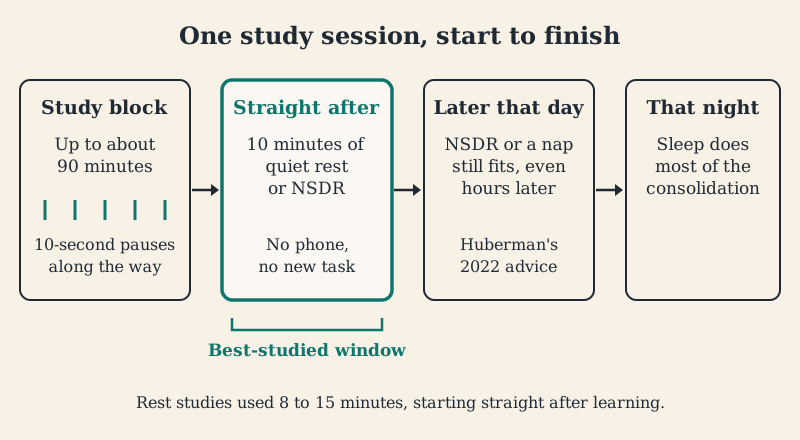
Step 1: Keep the study block to about 90 minutes
Huberman caps an intense learning bout at around 90 minutes, then takes a break. Within the block, try his 10-second pauses: stop, do nothing, then carry on.
Step 2: Stop, and don't start anything demanding
This is the part the evidence supports best. Close the book, put the phone face down, and don't open email or a game. In Dewar's study, people who played a spot-the-difference game remembered less than when they rested.
Step 3: Sit back or lie down with a guided track
Posture, eyes open or closed and room lighting didn't seem to change the rest effect (Weng 2025), so a desk chair with headphones is a reasonable setup. Huberman's newsletter suggests a 10-minute yoga nidra, a longer 30-minute one, or a 20-minute nap if you'd rather sleep. NSDR.co has free 10-minute sessions you can start as soon as you close the book.
Step 4: Give it 10 minutes
The best-known rest studies used 8 to 15 minutes, and the 2025 meta-analysis found that the length of the rest didn't seem to change the effect. Follow the body scan, and when your mind drifts to what you just studied, go back to the next body part the voice names. If you're new to it, see how to do an NSDR session.
Step 5: Stay awake if you have work afterwards
The clear advantage of NSDR over a nap is that you don't wake up groggy, because you never fell asleep. If you drift off, you've had a short nap. That's fine for memory, but give yourself a few minutes before anything that needs a clear head.
Step 6: Later, test yourself instead of rereading
When you come back to the material, write down what you remember before you look at your notes. In a 2006 study, students who practised recalling a passage kept more of it days later than students who reread it, even though rereading made them feel more confident (Roediger & Karpicke 2006). There's more in this guide to memory habits with the strongest evidence.
NSDR vs napping vs sleep after learning
When NSDR is the better choice
NSDR fits when you need to get straight back to work. You can do 10 minutes at a desk with headphones, and as long as you stay awake, there's no sleep inertia to wait out. It also suits people who can't nap on demand, since it doesn't ask you to fall asleep.
When a nap makes more sense
Naps have the stronger memory evidence. A 2022 meta-analysis of 54 studies found small-to-medium gains for both fact memory (d = 0.38) and skill memory (d = 0.49), and longer naps didn't do better than shorter ones (Leong 2022). Nobody has compared a nap with NSDR for memory.
The cost is grogginess. Waking after about 20 minutes, before deeper sleep sets in, tends to keep it mild. The longer you sleep, the more likely you are to wake from deep sleep, and that fog usually clears within about 30 minutes, though it can last an hour or more, especially after a short night, according to CDC guidance and a major review. If you're short on sleep and have the time, nap. For a fuller comparison, see NSDR vs napping.
Sleep is still the heavyweight
During deep sleep, the brain reactivates newly learned memories and helps fold them into long-term memory (Rasch & Born 2013). NSDR after learning is a small, cheap addition on study days. Protect the night's sleep first.
Common mistakes when using NSDR after learning
Jumping straight into something demanding
The one mistake the studies can measure is following a study session with a task that grabs your attention. If you only change one habit, leave the 10 minutes after studying empty.
Treating "within an hour" as a hard deadline
Huberman's 2021 one-hour window is often repeated as a rule. His own 2022 advice says a session two or four hours later still fits, and the yoga nidra study above did its session three hours after training. Straight after is best supported for quiet rest. Later is still worth doing. See the best times to practise NSDR for how this fits with the rest of your day.
Falling asleep during the session
It happens. In the sleep-lab study of yoga nidra, all 26 beginners analysed were scored awake for the whole session, so dozing off isn't inevitable. An occasional doze turns the session into a nap. If you nod off every time, you may be short on sleep, and that's worth fixing first.
Using NSDR before learning instead of after
NSDR before studying has some short-lived evidence for alertness. In one trial, reaction times were faster 10 minutes after NSDR, though a larger trial found the edge gone by 20 minutes. For memory, the rest has to come after the material is in. If you only have time for one session, do it after, since every memory result here came from rest after learning.
FAQ
How long should NSDR be after studying?
Ten minutes of NSDR after studying is enough. The best-known rest-after-learning studies used 8 to 15 minutes, and a 2025 meta-analysis found that the length of the rest didn't seem to change the effect. Go longer if you enjoy it, but there's no evidence it helps memory more.
Does NSDR help with all types of learning?
NSDR itself hasn't been tested on any type of learning. Quiet rest after learning helps most with word lists and stories, somewhat with finger-tapping skill sequences, and showed no effect on concept learning in a 2020 study that tried it. The benefit is also larger in older adults.
Is NSDR better than a nap after learning?
A nap has more evidence than NSDR after learning: a 2022 meta-analysis of 54 studies found small-to-medium memory gains. NSDR's advantage is no grogginess, which matters if you need to get back to work. No study has compared the two for memory.
Can I do NSDR before studying instead?
You can do NSDR before studying, and one trial found faster reaction times 10 minutes afterwards. But the memory benefit in the rest studies comes from resting after learning. Huberman's protocol puts NSDR after the learning bout, so if you only have time for one session, do NSDR after learning.
What if I fall asleep during NSDR?
Falling asleep during NSDR turns it into a short nap, and naps help memory too. The cost is that you may wake up groggy for a while. If you fall asleep in most sessions, you may be short on sleep, and fixing that matters more than the session.
Sources
- Boukhris O, Suppiah H, Halson S, Russell S, Clarke A, Geneau MC, Stutter L, Driller M (2024). The acute effects of nonsleep deep rest on perceptual responses, physical, and cognitive performance in physically active participants. Applied Psychology: Health and Well-Being. https://pubmed.ncbi.nlm.nih.gov/38953770/
- Boukhris O et al. (2026). Time course of perceptual, cognitive, physical and physiological responses to a single non-sleep deep rest session in physically active young adults. Applied Psychology: Health and Well-Being. https://pubmed.ncbi.nlm.nih.gov/42383502/
- Boukhris O, Suppiah H, Driller M (2026). Comparing the effects of a short nap and non-sleep deep rest on perceptual, cognitive, and physical performance in active adults. Clocks & Sleep. https://pubmed.ncbi.nlm.nih.gov/42783005/
- Buch ER, Claudino L, Quentin R, Bönstrup M, Cohen LG (2021). Consolidation of human skill linked to waking hippocampo-neocortical replay. Cell Reports. https://pubmed.ncbi.nlm.nih.gov/34107255/
- CDC/NIOSH. Training for Nurses on Shift Work and Long Work Hours, Module 7: Sleep inertia. https://www.cdc.gov/niosh/work-hour-training-for-nurses/longhours/mod7/03.html
- Craig M, Dewar M (2018). Rest-related consolidation protects the fine detail of new memories. Scientific Reports. https://pubmed.ncbi.nlm.nih.gov/29717187/
- Datta K, Mallick HN, Tripathi M, Ahuja N, Deepak KK (2022). Electrophysiological evidence of local sleep during yoga nidra practice. Frontiers in Neurology. https://pubmed.ncbi.nlm.nih.gov/35903117/
- Dewar M, Alber J, Butler C, Cowan N, Della Sala S (2012). Brief wakeful resting boosts new memories over the long term. Psychological Science. https://pubmed.ncbi.nlm.nih.gov/22829465/
- Huberman A (2021). Teach & learn better with a "Neuroplasticity Super Protocol". Huberman Lab newsletter. https://www.hubermanlab.com/newsletter/teach-and-learn-better-with-a-neuroplasticity-super-protocol
- Huberman A (2022). Understand & improve memory using science-based tools. Huberman Lab podcast. https://www.hubermanlab.com/episode/understand-and-improve-memory-using-science-based-tools
- Humiston GB, Tucker MA, Summer T, Wamsley EJ (2019). Resting states and memory consolidation: a preregistered replication and meta-analysis. Scientific Reports. https://www.nature.com/articles/s41598-019-56033-6
- Humiston GB, Wamsley EJ (2018). A brief period of eyes-closed rest enhances motor skill consolidation. Neurobiology of Learning and Memory. https://pubmed.ncbi.nlm.nih.gov/29883710/
- Immink MA (2016). Post-training meditation promotes motor memory consolidation. Frontiers in Psychology. https://www.frontiersin.org/journals/psychology/articles/10.3389/fpsyg.2016.01698/full
- Kjaer TW, Bertelsen C, Piccini P, Brooks D, Alving J, Lou HC (2002). Increased dopamine tone during meditation-induced change of consciousness. Cognitive Brain Research. https://pubmed.ncbi.nlm.nih.gov/11958969/
- Leong RLF, Lo JC, Chee MWL (2022). Systematic review and meta-analyses on the effects of afternoon napping on cognition. Sleep Medicine Reviews. https://pubmed.ncbi.nlm.nih.gov/36041284/
- Medical News Today (2012). Wakeful resting fights memory loss. Report on Dewar et al. 2012. https://www.medicalnewstoday.com/articles/248389
- Martini M, Zamarian L, Sachse P, Martini C, Delazer M (2019). Wakeful resting and memory retention: a study with healthy older and younger adults. Cognitive Processing. https://pubmed.ncbi.nlm.nih.gov/30377871/
- Peters BR (medical reviewer). What is non-sleep deep rest (NSDR)? Sleep Foundation. https://www.sleepfoundation.org/meditation-for-sleep/what-is-non-sleep-deep-rest
- Rasch B, Born J (2013). About sleep's role in memory. Physiological Reviews. https://pubmed.ncbi.nlm.nih.gov/23589831/
- Roediger HL, Karpicke JD (2006). Test-enhanced learning: taking memory tests improves long-term retention. Psychological Science. https://pubmed.ncbi.nlm.nih.gov/16507066/
- Tassi P, Muzet A (2000). Sleep inertia. Sleep Medicine Reviews. https://pubmed.ncbi.nlm.nih.gov/12531174/
- Tucker MA, Humiston GB, Summer T, Wamsley E (2020). Comparing the effects of sleep and rest on memory consolidation. Nature and Science of Sleep. https://pmc.ncbi.nlm.nih.gov/articles/PMC7007500/
- Walker MP, Brakefield T, Morgan A, Hobson JA, Stickgold R (2002). Practice with sleep makes perfect: sleep-dependent motor skill learning. Neuron. https://pubmed.ncbi.nlm.nih.gov/12123620/
- Weng L, Yu J, Lv Z, Yang S, Jülich ST, Lei X (2025). Effects of wakeful rest on memory consolidation: a systematic review and meta-analysis. Psychonomic Bulletin & Review. https://pubmed.ncbi.nlm.nih.gov/40087245/