An afternoon energy crash starts in your body clock more than in your lunch. Huberman Lab puts the dip at roughly 2 to 5pm. By then sleep pressure has been building for hours, and your body clock's alerting signal hasn't yet ramped up to cancel it out. The dip is common but not universal, and a heavy, high-carb lunch or short nights make it worse.
Below are 7 ways to soften it, from the best-studied (a short nap, caffeine timing) to the more experimental, with what each one was tested on.
The short version:
- The dip starts in your body clock and can happen even if you skip lunch.
- Sleep pressure builds from waking, and early in the afternoon the body clock hasn't yet countered it.
- A big, high-carb lunch or short nights make it worse.
- Caffeine hides sleep pressure. Stop about 9 hours before bed, so 2pm for an 11pm bedtime.
- A 10-minute nap worked best of the lengths tested in one lab study. Keep naps to 30 minutes at most, and early.
- NSDR is reasonable if naps leave you groggy, but the one head-to-head favoured a nap.
- Daylight, a brisk walk and a cold splash help some people. Tired most days for over two weeks despite sleeping well? See a doctor.
Why you crash in the afternoon (it goes beyond lunch)
Lunch gets the blame for the afternoon energy crash, and a big, high-carb lunch does make it worse. The bigger causes are your body clock and the sleep pressure from 6 to 8 hours awake, which is why the dip can turn up even on days you skip lunch.
The body clock dip
It's called the post-lunch or postprandial dip, yet it shows up in people who've had no lunch and don't know the time (Monk 2005).
It's real but not universal, and the timing varies. Huberman Lab's NSDR guide puts it at roughly 2 to 5pm. It may be linked to a roughly 12-hour rhythm in the body clock (Monk 2005), which Broughton's model ties to an afternoon "nap zone" (Broughton 1998).
Sleep pressure has been building since you woke
Adenosine is an important chemical signal behind sleep pressure. Levels rise the longer you're awake and fall during sleep (Reichert 2016), though the direct measurements come from cats (Porkka-Heiskanen 1997). By early afternoon you've usually been awake for 6 to 8 hours, and sleepiness builds as those hours add up (Hilditch & McHill 2019).
In Broughton's model, the body clock's alerting signal reverses that rising pressure. Early in the afternoon it hasn't ramped up yet. By late afternoon it has, and the dip lifts.
A heavy lunch and short nights make it worse
A big, high-carb lunch deepens the dip (Monk 2005). A week of shortened sleep also left lab volunteers measurably sleepier by day (Vgontzas 2004), and Cleveland Clinic's Dr. Roxanne Sukol says chronic sleep deprivation worsens the afternoon slump.
What about cortisol?
Cortisol rises in the morning and peaks about 30 to 45 minutes after waking, and it may play a part in waking up fully (Clow 2010). Then it falls to its evening low (Oster 2017). A steady decline can't explain a dip that lifts by late afternoon.
Why caffeine after 2pm can make it worse
Coffee is the default answer to an afternoon energy crash, but it can cost you sleep that night.
Caffeine hides sleep pressure, it doesn't clear it
Caffeine blocks adenosine receptors. The adenosine doesn't go away, and caffeine can't replace sleep (McLellan 2016; Urry & Landolt 2015). When it wears off, the tiredness is still there, and regular users can get rebound sleepiness too (Roehrs & Roth 2008).
The half-life problem
In healthy adults, caffeine's half-life averages about 4 hours but ranges from 2 to 8 (EFSA 2015). One liver enzyme, CYP1A2, handles 95% of it, and its activity varies between people (Nehlig 2018).
So half of a 2pm coffee is typically still in you at around 6pm, or 10pm for slow metabolisers. More on how long caffeine stays in your system.
What late caffeine does to your sleep
In a 2023 meta-analysis, caffeine cut total sleep by 45 minutes, sleep efficiency by 7% and deep sleep by 11.4 minutes. It also added 9 minutes to the time it took to fall asleep and 12 minutes of time awake after falling asleep (Gardiner 2023). Regular use is also linked to worse sleep and more daytime sleepiness (Roehrs & Roth 2008). That could turn into a loop of worse nights and more afternoon coffee, though no study has shown the loop directly.
Better caffeine timing
Gardiner's team worked out that you'd need to finish a standard 107 mg coffee at least 8.8 hours before bed to avoid losing total sleep time. Call it 9 hours, so for an 11pm bedtime that's a 2pm cut-off.
Neuroscientist Andrew Huberman suggests waiting 90 to 120 minutes after waking for your first coffee, and avoiding caffeine within 8 to 10 hours of bed. In Using Caffeine to Optimize Mental & Physical Performance, he explains the delay. If you drink coffee as soon as you wake, he says, "there's an accumulation, a sort of glut of adenosine that hangs around. And then in the afternoon, when the effects of that caffeine start to wear off, you will experience the so-called afternoon crash." It's his protocol and his explanation, and trials haven't tested either.
NSDR or a short nap: the 10-minute afternoon reset
A short nap and NSDR both fit into about 10 minutes.
What NSDR is, and the dopamine study told straight
NSDR (non-sleep deep rest) guides you into deep relaxation without falling asleep (Huberman Lab). Huberman coined the term to cover practices including yoga nidra. More on what yoga nidra is.
The famous 65% dopamine figure comes from a 2002 PET study (Kjaer 2002). Eight experienced yoga teachers did a 72-minute guided yoga nidra session, and researchers estimated a 65% rise in dopamine release in the ventral striatum during it. It's one small study, not repeated with short NSDR tracks, and it measured nothing afterwards.
What the NSDR trials found
Three small trials from one team have tested single 10-minute NSDR sessions on alertness and performance, with mixed results:
- 2024, 65 people. Better reaction time, accuracy and grip strength than controls 10 minutes after the session (Boukhris 2024).
- 2026, 102 young adults. Slightly less sleepiness, fatigue and stress than controls, and faster reactions straight afterwards that had faded at later checks (Boukhris 2026a).
- 2026 head-to-head, 60 active young adults who'd slept about 7 hours. A 25-minute nap opportunity between 2:35 and 3pm left people less fatigued and more ready to perform 40 minutes later. Ten minutes of NSDR made no measurable difference. The nappers slept only about 10 minutes, and the sessions differed in length (Boukhris 2026b).
NSDR or a nap: how to choose
In a lab study of people whose sleep was cut to about 5 hours, a 10-minute afternoon nap helped straight away, with some benefits lasting about 2.5 hours. A 30-minute nap helped only after a groggy spell (Brooks & Lack 2006). Cleveland Clinic's Alicia Roth, PhD, recommends 30 minutes or less. She adds, "The later you nap in the day, the more detrimental it's going to be to your nighttime sleep."
Grogginess typically clears within 30 minutes, sometimes within 15. It can last longer after a long nap and is worse after a short night (Hilditch & McHill 2019).
NSDR is meant to keep you awake, so there's no deep sleep to wake out of. Huberman suggests it if naps leave you groggy or hurt your night's sleep. People do sometimes nod off during NSDR. More in NSDR vs napping.
- Nap if you slept badly or the dip is heavy and you can lie down. Aim for 10 minutes, 30 at most, with an alarm, earlier rather than later (see how to nap without waking up groggy).
- Choose NSDR if naps leave you groggy, you can't sleep at work, or it's late in the afternoon.
How to do a 10-minute afternoon session
- Start when you feel the dip arrive.
- Lie down or recline, and close your eyes.
- Play a guided NSDR track, which takes you through a body scan and slower breathing.
- Set a gentle alarm in case you drift off.
- Give yourself a minute before going back to work.
Huberman says even 10 minutes helps, though he suggests 20 to 30. Nobody has studied the best length.
You may feel drowsy or even drift off partway through, and how alert you feel afterwards varies between people. In his Daily Tools episode, Huberman describes a 10-minute hypnosis script he does after lunch. He says it lets him "lean into my afternoon in an alert way ... So there's no brain fog, there's no grogginess."
To try it tomorrow, pick a 10-minute session on NSDR.co and play it when the early-afternoon dip arrives, lying down or reclined, with an alarm set for when it ends. NSDR.co is free, will always have a free plan, and has more than 50 guided sessions. For other slots and lengths, see the best time of day for an NSDR session and NSDR session options by goal and length.
4 more fixes, and how strong the evidence is
Each of these four has less direct evidence against the afternoon energy crash than caffeine timing or a short nap. Add them on top of those two.
Get daylight, in the morning and after lunch
Light is the strongest signal your body clock gets. First on Huberman's Toolkit for Sleep is going outside within 30 to 60 minutes of waking, for about 10 minutes when it's bright, 20 when it's cloudy and 30 to 60 when it's very overcast. Those doses are his own advice. They don't come from a study.
Nobody has tested morning light against the afternoon dip. In a small lab study, though, 48 minutes of dim (40 lux) red light near the post-lunch dip lowered EEG markers of drowsiness compared with darkness. Blue light of the same brightness also lowered some of these markers, but not by a statistically significant amount (Sahin & Figueiro 2013). More in Huberman's light exposure protocol.
Take a brisk 10-minute walk
In a small 1987 study of 18 volunteers, a brisk 10-minute walk lifted self-rated energy for up to 2 hours, while a candy bar gave a short lift and left people more tired an hour later (Thayer 1987). The study used self-ratings only and didn't test walks after lunch specifically. As Dr. Sukol puts it, "Too busy to get to the gym or yoga studio? Take a walk, it improves blood flow to your head."
Build a lighter, less sugary lunch
A meta-analysis found that carbohydrates left people more tired and less alert than a placebo within the first hour (Mantantzis 2019). Cleveland Clinic explains that stripped carbs and sugar spike blood sugar, which then plummets and leaves you tired and hungry. Build lunch around whole foods, protein and healthy fats (Cleveland Clinic 2020), and expect some dip anyway, since food is only part of it.
Splash cold water on your face (the least studied)
Putting your face in very cold water (2 to 3°C in one study) triggers the dive reflex, which slows your heart rate (Konishi 2016). Nobody has studied whether a splash wakes you up. An hour sitting neck-deep in 14°C water raised noradrenaline more than fivefold in young men (Šrámek 2000). A splash is far milder.
Reset your afternoon: a simple day plan
The plan below puts the fixes in order, from waking to the dip.
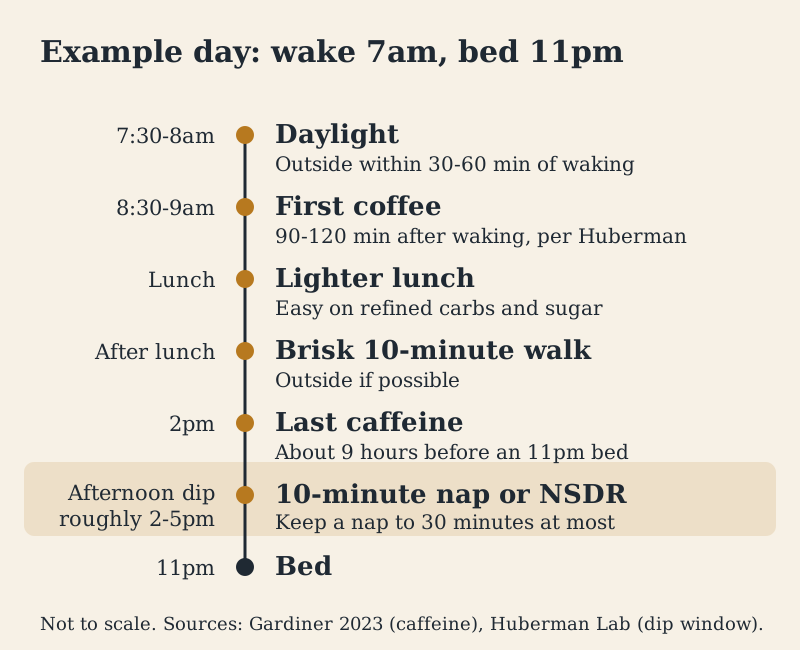
- On waking. Daylight within 30 to 60 minutes.
- First coffee. 90 to 120 minutes after waking, per Huberman.
- Last coffee. About 9 hours before bed (2pm for an 11pm bedtime).
- Lunch. Whole foods, protein and healthy fats, light on refined carbs and sugar.
- After lunch. A brisk 10-minute walk, outside if possible.
- When the dip hits. A 10-minute nap (30 at most) or 10 minutes of NSDR.
When afternoon tiredness is more than a dip
A normal dip lifts by late afternoon. If you're tired most afternoons for more than two weeks despite sleeping well, see your doctor. Cleveland Clinic notes that an underlying condition, such as a thyroid problem, iron deficiency or autoimmune disease, can cause fatigue. NSDR and naps can help you rest, but they don't treat a medical cause of fatigue.
FAQ
Is the afternoon energy crash normal?
Yes, for many people. The afternoon energy crash starts in the body clock and can show up even without lunch, though not everyone gets it and the timing varies. A heavy lunch or short nights deepen it.
How long does the afternoon slump last?
There's no standard length. Huberman Lab puts the afternoon slump at roughly 2 to 5pm, and the window varies between people. Alertness tends to pick up by late afternoon, once the body clock's alerting signal catches up with the day's sleep pressure.
Why do I get tired in the afternoon even if I skip lunch?
You can still get tired in the afternoon because the dip doesn't come from food alone. It comes from your body clock plus the sleep pressure built since you woke, and Monk's 2005 review notes it can occur in people who've had no lunch. Skipping lunch may not prevent it, and a heavy lunch only makes it worse.
Does NSDR help with the afternoon slump?
Maybe a little, but the evidence is thin. Two small trials of 10-minute NSDR sessions found some gains shortly afterwards, such as faster reactions, though neither looked at the afternoon dip specifically. In the one trial that compared it with an afternoon nap, NSDR had no measurable effect and the nap came out ahead. It's worth trying for the afternoon slump if naps leave you groggy.
Should I nap or do NSDR in the afternoon?
Nap if you're short on sleep and can lie down, for 10 minutes and 30 at most, early in the afternoon. Do NSDR if naps leave you groggy, you can't sleep at work, or it's late in the afternoon.
What should I eat to avoid an afternoon crash?
Eat a lighter lunch built around whole foods, protein and healthy fats, with fewer refined carbs and less sugar. A big, high-carb lunch deepens the dip. Even a well-built lunch may not prevent an afternoon crash, though, because the dip starts in your body clock.
Sources
- Monk TH (2005). The post-lunch dip in performance. Clinics in Sports Medicine. https://pubmed.ncbi.nlm.nih.gov/15892914/
- Broughton RJ (1998). SCN controlled circadian arousal and the afternoon "nap zone". Sleep Research Online. https://pubmed.ncbi.nlm.nih.gov/11382874/
- Reichert CF et al. (2016). Sleep-wake regulation and its impact on working memory performance: the role of adenosine. Biology (Basel). https://pubmed.ncbi.nlm.nih.gov/26861410/
- Porkka-Heiskanen T et al. (1997). Adenosine: a mediator of the sleep-inducing effects of prolonged wakefulness. Science. https://pubmed.ncbi.nlm.nih.gov/9157887/
- Hilditch CJ, McHill AW (2019). Sleep inertia: current insights. Nature and Science of Sleep. https://pubmed.ncbi.nlm.nih.gov/31692489/
- Vgontzas AN et al. (2004). Adverse effects of modest sleep restriction on sleepiness, performance, and inflammatory cytokines. Journal of Clinical Endocrinology and Metabolism. https://pubmed.ncbi.nlm.nih.gov/15126529/
- Clow A et al. (2010). The cortisol awakening response in context. International Review of Neurobiology. https://pubmed.ncbi.nlm.nih.gov/20970005/
- Oster H et al. (2017). The functional and clinical significance of the 24-hour rhythm of circulating glucocorticoids. Endocrine Reviews. https://pubmed.ncbi.nlm.nih.gov/27749086/
- McLellan TM et al. (2016). A review of caffeine's effects on cognitive, physical and occupational performance. Neuroscience & Biobehavioral Reviews. https://pubmed.ncbi.nlm.nih.gov/27612937/
- Urry E, Landolt HP (2015). Adenosine, caffeine, and performance. Current Topics in Behavioral Neurosciences. https://pubmed.ncbi.nlm.nih.gov/24549722/
- Roehrs T, Roth T (2008). Caffeine: sleep and daytime sleepiness. Sleep Medicine Reviews. https://pubmed.ncbi.nlm.nih.gov/17950009/
- EFSA (2015). Caffeine: EFSA explains risk assessment. European Food Safety Authority. https://www.efsa.europa.eu/sites/default/files/corporate_publications/files/efsaexplainscaffeine150527.pdf
- Nehlig A (2018). Interindividual differences in caffeine metabolism. Pharmacological Reviews. https://pubmed.ncbi.nlm.nih.gov/29514871/
- Gardiner C et al. (2023). The effect of caffeine on subsequent sleep: a systematic review and meta-analysis. Sleep Medicine Reviews. https://pubmed.ncbi.nlm.nih.gov/36870101/
- Kjaer TW et al. (2002). Increased dopamine tone during meditation-induced change of consciousness. Brain Research. Cognitive Brain Research. https://pubmed.ncbi.nlm.nih.gov/11958969/
- Boukhris O et al. (2024). The acute effects of nonsleep deep rest on perceptual responses, physical, and cognitive performance in physically active participants. Applied Psychology: Health and Well-Being. https://pubmed.ncbi.nlm.nih.gov/38953770/
- Boukhris O et al. (2026). Time course of perceptual, cognitive, physical and physiological responses to a single non-sleep deep rest session in physically active young adults. Applied Psychology: Health and Well-Being. https://pubmed.ncbi.nlm.nih.gov/42383502/
- Boukhris O, Suppiah H, Driller M (2026). Comparing the effects of a short nap and non-sleep deep rest on perceptual, cognitive, and physical performance in active adults. Clocks & Sleep. https://pubmed.ncbi.nlm.nih.gov/42783005/
- Brooks A, Lack L (2006). A brief afternoon nap following nocturnal sleep restriction: which nap duration is most recuperative? Sleep. https://pubmed.ncbi.nlm.nih.gov/16796222/
- Sahin L, Figueiro MG (2013). Alerting effects of short-wavelength (blue) and long-wavelength (red) lights in the afternoon. Physiology & Behavior. https://pubmed.ncbi.nlm.nih.gov/23535242/
- Thayer RE (1987). Energy, tiredness, and tension effects of a sugar snack versus moderate exercise. Journal of Personality and Social Psychology. https://pubmed.ncbi.nlm.nih.gov/3820066/
- Mantantzis K et al. (2019). Sugar rush or sugar crash? A meta-analysis of carbohydrate effects on mood. Neuroscience & Biobehavioral Reviews. https://pubmed.ncbi.nlm.nih.gov/30951762/
- Konishi M et al. (2016). Diurnal variation in the diving bradycardia response in young men. Clinical Autonomic Research. https://pubmed.ncbi.nlm.nih.gov/26795189/
- Šrámek P et al. (2000). Human physiological responses to immersion into water of different temperatures. European Journal of Applied Physiology. https://pubmed.ncbi.nlm.nih.gov/10751106/
- Cleveland Clinic (2020). Afternoon slump: 5 ways to restore your energy (infographic). https://health.clevelandclinic.org/afternoon-slump-5-ways-to-restore-your-energy-infographic
- Cleveland Clinic (2024). How long is the ideal nap? Cleveland Clinic Newsroom. https://newsroom.clevelandclinic.org/2024/03/11/how-long-is-the-ideal-nap
- Huberman A. Using Caffeine to Optimize Mental & Physical Performance. Huberman Lab podcast. https://www.hubermanlab.com/episode/using-caffeine-to-optimize-mental-and-physical-performance
- Huberman A. Maximizing Productivity, Physical & Mental Health with Daily Tools. Huberman Lab podcast. https://www.hubermanlab.com/episode/maximizing-productivity-physical-and-mental-health-with-daily-tools
- Huberman Lab. Dr. Andrew Huberman's Guide to NSDR. https://www.hubermanlab.com/nsdr
- Huberman A. Toolkit for Sleep. Huberman Lab newsletter. https://www.hubermanlab.com/newsletter/toolkit-for-sleep