The simplest answer to how to increase baseline dopamine is sleep, morning daylight and exercise you enjoy. They're free, and they have at least some human dopamine evidence behind them. Huberman's toolkit adds cold showers, caffeine, NSDR and L-tyrosine, but the big numbers behind those come from small studies that measured something narrower than your baseline, such as blood dopamine after an hour in cold water. Below are the seven tools, what each study measured, and a daily routine.
What baseline dopamine is
Dopamine drives pursuit more than pleasure. As Stanford psychiatrist Anna Lembke said on the Huberman Lab podcast, "Dopamine is about wanting, not about having." Huberman puts it as "dopamine is released in anticipation of what we want."
Huberman splits it into a steady background level, the baseline (tonic release), and short peaks on top (phasic release). He borrows an analogy from Dr Kyle Gillett, a podcast guest: a wave pool. Small or occasional waves leave the level alone. Big, frequent ones slosh water out, and the level drops.
In Huberman's model, a big peak is sometimes followed by a dip below where you started, which he calls a trough. How motivated you feel depends on your dopamine relative to your recent experience. It's a teaching model, not something measured in daily life, and you can't measure your own baseline at home.
The 7 tools at a glance
This is how to increase baseline dopamine with Huberman's dopamine protocol, in one table:
| Tool | Huberman's suggestion | What the study measured | Evidence |
|---|---|---|---|
| Sleep | Protect it | A lost night cut available dopamine receptors (20 adults) | Moderate |
| Morning daylight | 10-30 min early, no sunglasses | More available receptors with more sunshine (17 vs 18 people) | Weak |
| Exercise you enjoy | Move in a way you like | No change after a 30-min run (12 people); a 15-study review found effects | Mixed |
| Caffeine | 100-400 mg, none after 2 pm | One 300 mg dose: more receptors, no extra dopamine (20 people) | Moderate |
| Cold exposure | 1-3 min cold shower | Blood dopamine up 250% after an hour in 14°C water | Weak for showers |
| NSDR | A 10-minute session | Release during a 72-min yoga nidra session (8 yoga teachers) | Weak |
| L-tyrosine | 500-1000 mg, 30 min before hard work | Helps thinking mainly under stress or heavy demand | Mixed |
The first three are free and help with plenty besides dopamine. Huberman calls his list "a buffet of options".
The 7 tools, from strongest evidence to weakest
1. Sleep
In a 2012 PET study, 20 adults were scanned after a normal night and after a night without sleep. After the lost night, they had fewer available dopamine D2/D3 receptors in the ventral striatum, a reward area, and the drop went with lower alertness and more sleepiness. That was a full night lost, not a short one, but it's the clearest human link on this list. If you sleep badly, fix that first.
2. Morning daylight
Huberman suggests 10 to 30 minutes of daylight early in the day, without sunglasses and without staring at the sun, at the short end if it's clear and the long end if it's overcast. If it's still dark, his site says to put bright lights on. He says morning light releases dopamine, but cites no study.
The human evidence is thin. A 2011 scan study of 68 people compared the 17 with the most sunshine exposure to the 18 with the least: the high-sunshine group had more available dopamine receptors. That's a correlation, and it didn't test morning light. Huberman also says to keep lights dim between 10 pm and 4 am, because bright light then lowers dopamine. More in Huberman's light exposure protocol.
3. Exercise you enjoy
Huberman estimates that running about doubles dopamine in people who love it, and does less or nothing for people who don't. The human evidence is mixed. A 2000 PET study of 12 regular exercisers found no detectable change in striatal dopamine after a hard 30-minute treadmill run, while a 2021 systematic review of 15 studies reported robust effects of physical activity on dopamine. More on exercise and dopamine.
4. Caffeine, timed
Huberman's range is about 100 to 400 mg, and he avoids caffeine after 2 pm. An early cut-off makes sense. In a 2013 study, 400 mg taken 6 hours before bed still disrupted sleep. The FDA cites 400 mg a day as an amount not generally linked to negative effects in most adults.
The dopamine story is different. In a 2015 PET study of 20 adults, a single 300 mg dose didn't raise dopamine in the striatum. It made more D2/D3 receptors available, and the bigger that change, the more alert people felt. The authors read this as caffeine adjusting the receptors rather than releasing dopamine. It was one dose, so it says nothing about daily coffee over months. Skip it if caffeine makes you anxious or hurts your sleep. See caffeine timing.
5. Cold exposure
In a 2000 study, young men sat in 14°C water up to the neck for an hour, and the dopamine in their blood rose by 250%. Huberman describes it as a rise to 2.5 times baseline (a 250% rise is closer to 3.5 times) that took up to three hours to come back down. The abstract doesn't report how long it lasted, and blood dopamine isn't brain dopamine.
Huberman's own suggestion is much smaller: a 1-3 minute cold shower, as cold as you can safely tolerate. That dose hasn't been tested for dopamine. If you like it, end your shower cold anyway. Start mild, stop if you feel unwell, and check with a doctor first if you have a heart condition. To build up gradually, try a four-week cold shower plan.
6. NSDR
The "65% more dopamine" figure comes from one 2002 PET study (Kjaer et al.). Eight male yoga teachers did a 72-minute guided yoga nidra session. Tracer binding in the ventral striatum fell by 7.9%, which the authors estimated as 65% more dopamine released during the session than during a control session of listening to speech with eyes closed. All eight also reported less desire for action, hardly a motivation boost.
That's release during the practice, in experienced practitioners, and it doesn't show that baseline dopamine rises, or that a 10-minute NSDR track does the same. Huberman Lab's NSDR page says the session "increased baseline dopamine levels in the brain by as much as 65%". The study didn't measure baseline levels.
The three NSDR trials, all 10-minute sessions in physically active adults, measured how people felt and performed. One found better reaction time, accuracy and grip strength (65 people). One found small drops in sleepiness, fatigue and stress, plus a reaction-time gain that was gone 20 minutes later (102 people). In the third, a 25-minute nap opportunity made people more ready to perform and NSDR had no effect (60 people). None measured dopamine. Use NSDR as an afternoon rest instead of a second coffee, not as a dopamine refill. More on what the NSDR studies measured.
7. L-tyrosine
Tyrosine is the amino acid your body makes dopamine from. Huberman's suggested dose is 500 to 1000 mg, 30 minutes before hard work, and he uses it himself once a week, occasionally twice. He warns that anything acting as a direct dopamine precursor almost always brings a crash afterwards. A 2015 review found results vary, with the clearest benefit to thinking in short, stressful or demanding situations. His newsletter also lists tyrosine-rich foods: red meat, nuts, hard fermented cheese. If you take medication or are pregnant, check with a doctor first. More in Huberman's full supplement list.
Dopamine stacking
Huberman warns against layering pre-workout drinks, music, friends and "smart drugs" all at once. In his account, the combined peak brings a crash and wears down your longer-term drive, until you need twice as much coffee and three times as much loud music just to get out the door.
That's his model rather than a measured result, but the fix is free. Do some workouts without music, or with just caffeine. "Change it up." And don't add an extra reward every time to something you already enjoy.
What to skip or save for later
Mucuna pruriens is a bean containing L-dopa, a Parkinson's drug. In a small 2004 trial of 8 Parkinson's patients, it worked faster than standard L-dopa. Huberman doesn't take it, calling it "too intense and too much of a crash". Skip it unless a doctor is involved.
Phenylethylamine (PEA) is Huberman's occasional pre-work pick, 500 mg with 300 mg alpha-GPC, once a week or every two weeks. He says it gives "a sharp, but very transient, increase in dopamine that lasts about 30 to 45 minutes." He warns against taking these after 2 to 3 pm, and says to be very cautious if you have bipolar depression or another dopamine-sensitive condition. Do the free tools first, and if you take medication or are pregnant, ask a doctor before any of these.
A simple daily routine
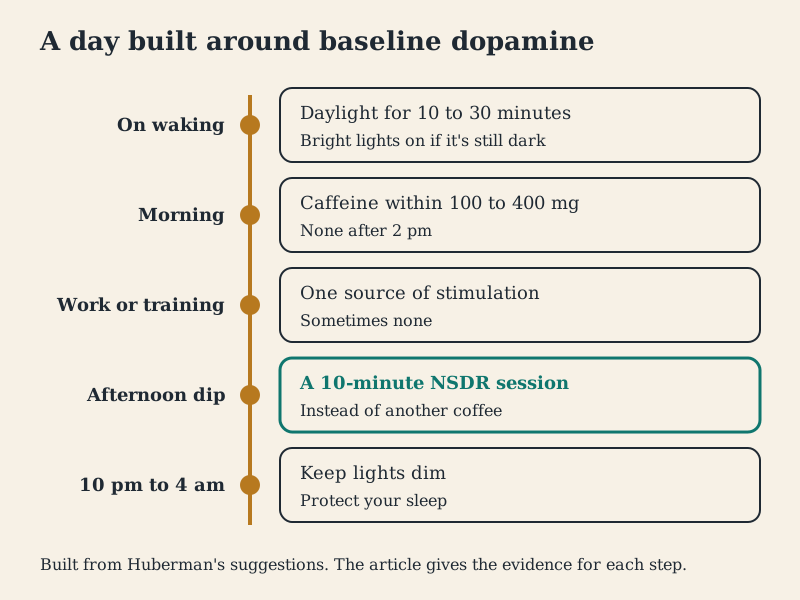
- On waking, spend 10 to 30 minutes outside, or put bright lights on if it's still dark.
- If you like cold, finish your shower with 1 to 3 minutes of it.
- If you drink caffeine, stay within 100 to 400 mg, and have none after 2 pm.
- For work or training, use one source of stimulation, and sometimes none.
- In the afternoon dip, do a 10-minute NSDR session instead of having a second coffee.
- From 10 pm to 4 am, keep lights dim.
Give it two weeks before adding anything, so you can tell what each change does.
Make the effort the reward
Huberman calls learning to get the reward from the effort itself, not only from the finish, "the holy grail of dopamine management". He links it to Carol Dweck's growth-mindset research at Stanford, which measured behaviour and performance, not dopamine, so the dopamine part is his reasoning. In practice, when you reach the hard middle of a task, tell yourself the effort is the good part, and don't celebrate every win.
FAQ
How long does a cold shower raise dopamine?
A short cold shower hasn't been tested for dopamine at all. The study behind the claim had young men sit in 14°C water for an hour, and their blood dopamine rose 250%; Huberman says it took up to three hours to fall back. The 1-3 minute shower is untested.
Does caffeine increase dopamine?
Caffeine didn't increase dopamine in the striatum in a 2015 human PET study. In that study of 20 adults, a 300 mg dose made more D2/D3 receptors available, which went with feeling more alert. The authors think caffeine changes the receptors rather than releasing dopamine.
Does NSDR increase baseline dopamine?
No study shows NSDR raising baseline dopamine. The 65% figure is dopamine released during a 72-minute yoga nidra session in 8 male yoga teachers. The three 10-minute NSDR trials didn't measure dopamine at all.
What supplements does Huberman take for dopamine?
Huberman suggests L-tyrosine (500 to 1000 mg) and uses it himself once or twice a week. His favourite pre-work stack is 500 mg PEA with 300 mg alpha-GPC, sometimes plus 500 mg L-tyrosine, and he doesn't take it every day. If you take medication, are pregnant, or have bipolar disorder or another dopamine-sensitive condition, check with a doctor first.
How do you know if your dopamine is low?
You can't measure your dopamine at home. Huberman describes low dopamine as feeling unmotivated, getting less pleasure from what you do, and feeling physically tired. Those feelings have many causes, depression and poor sleep among them, so if they don't lift, see a doctor before working on how to increase baseline dopamine yourself.
Sources
- Šrámek P et al. (2000). Human physiological responses to immersion into water of different temperatures. European Journal of Applied Physiology. https://pubmed.ncbi.nlm.nih.gov/10751106/
- Volkow ND et al. (2015). Caffeine increases striatal dopamine D2/D3 receptor availability in the human brain. Translational Psychiatry. https://pubmed.ncbi.nlm.nih.gov/25871974/
- Volkow ND et al. (2012). Evidence that sleep deprivation downregulates dopamine D2R in ventral striatum in the human brain. Journal of Neuroscience. https://pubmed.ncbi.nlm.nih.gov/22573693/
- Tsai HY et al. (2011). Sunshine-exposure variation of human striatal dopamine D2/D3 receptor availability in healthy volunteers. Progress in Neuro-Psychopharmacology & Biological Psychiatry. https://pubmed.ncbi.nlm.nih.gov/20875835/
- Wang GJ et al. (2000). PET studies of the effects of aerobic exercise on human striatal dopamine release. Journal of Nuclear Medicine. https://pubmed.ncbi.nlm.nih.gov/10945526/
- Marques A et al. (2021). Bidirectional association between physical activity and dopamine across adulthood: a systematic review. Brain Sciences. https://pubmed.ncbi.nlm.nih.gov/34201523/
- Drake C et al. (2013). Caffeine effects on sleep taken 0, 3, or 6 hours before going to bed. Journal of Clinical Sleep Medicine. https://pubmed.ncbi.nlm.nih.gov/24235903/
- Kjaer TW et al. (2002). Increased dopamine tone during meditation-induced change of consciousness. Cognitive Brain Research. https://pubmed.ncbi.nlm.nih.gov/11958969/
- Boukhris O et al. (2024). The acute effects of nonsleep deep rest on perceptual responses, physical, and cognitive performance in physically active participants. Applied Psychology: Health and Well-Being. https://pubmed.ncbi.nlm.nih.gov/38953770/
- Boukhris O et al. (2026). Time course of perceptual, cognitive, physical and physiological responses to a single non-sleep deep rest session in physically active young adults. Applied Psychology: Health and Well-Being. https://pubmed.ncbi.nlm.nih.gov/42383502/
- Boukhris O, Suppiah H, Driller M (2026). Comparing the effects of a short nap and non-sleep deep rest on perceptual, cognitive, and physical performance in active adults. Clocks & Sleep. https://pubmed.ncbi.nlm.nih.gov/42783005/
- Jongkees BJ et al. (2015). Effect of tyrosine supplementation on clinical and healthy populations under stress or cognitive demands: a review. Journal of Psychiatric Research. https://pubmed.ncbi.nlm.nih.gov/26424423/
- Katzenschlager R et al. (2004). Mucuna pruriens in Parkinson's disease: a double blind clinical and pharmacological study. Journal of Neurology, Neurosurgery & Psychiatry. https://pubmed.ncbi.nlm.nih.gov/15548480/
- Huberman Lab (2022). Tools to manage dopamine and improve motivation & drive (newsletter). https://www.hubermanlab.com/newsletter/tools-to-manage-dopamine-and-improve-motivation-and-drive
- Huberman Lab. Controlling your dopamine for motivation, focus & satisfaction (episode 39). https://www.hubermanlab.com/episode/controlling-your-dopamine-for-motivation-focus-and-satisfaction
- Huberman Lab. Leverage dopamine to overcome procrastination & optimize effort. https://www.hubermanlab.com/episode/leverage-dopamine-to-overcome-procrastination-and-optimize-effort
- Huberman Lab. Dr. Andrew Huberman's guide to NSDR. https://www.hubermanlab.com/nsdr
- US Food and Drug Administration. Spilling the beans: how much caffeine is too much? https://www.fda.gov/consumers/consumer-updates/spilling-beans-how-much-caffeine-too-much