Exercise probably raises dopamine, but the famous numbers come from animals. The "40% more dopamine" figure is from mice that ran on a wheel for a month. In people, the research on exercise and dopamine is small and split: one PET scan after a hard 30-minute run found no change, a 2024 scan during cycling did find a release, and a 2021 review found an effect in six of the seven small studies that tested exercise. Below: what each study measured, how much to do, and the habits Huberman says blunt the effect.
What dopamine is, and why exercise comes into it
Dopamine is mostly about wanting. It rises when you expect something good and pushes you to go after it. Huberman puts it as "dopamine is released in anticipation of what we want."
The main motivation pathway runs from the ventral tegmental area deep in the brain to the nucleus accumbens and on to the prefrontal cortex, which plans and decides. That's why dopamine gets linked to drive and focus.
The good feeling after a long run is different. In a 2008 PET study, 10 athletes were scanned at rest and after a two-hour run. Their brains showed signs of opioid release afterwards, and the runners who felt most euphoric showed the most. Neuroscientist David Linden links the runner's high to the brain's own opioids and, probably, endocannabinoids. He thinks dopamine may play a part too, but notes there's little human evidence for it.
You can't measure your own dopamine at home. Poor sleep, low iron and depression can all cause low drive and tiredness, so if they last for weeks, see a doctor.
How exercise increases dopamine
The evidence comes in three kinds, and they don't say the same thing.
In mice: about 40% more release, and it needs BDNF
In Bastioli 2022, from NYU, male mice had a running wheel or a locked wheel for 30 days. In slices of their brains, the runners released about 40% more dopamine in the dorsal striatum when stimulated, and had nearly 60% more BDNF, a protein that helps nerve cells grow. The boost was still there after a week without the wheel.
Mice bred with half the normal BDNF got no boost from running, and switching on BDNF's receptor raised release by itself. The authors conclude that in mice, BDNF is "necessary and sufficient" for the effect.
In people: one scan found nothing, one found a release
A 2000 PET study scanned 12 healthy, regular exercisers before and 5 to 10 minutes after a hard 30-minute treadmill run. In the authors' words, "No significant changes in synaptic DA concentration were detected, although the subjects exercised vigorously for 30 min."
A 2024 study scanned during the exercise instead. Sixteen people did a bout of cycling lying on their backs, and PET scans showed their brains released dopamine. The more they released, the more their reaction time improved. In follow-up experiments, making muscles contract with electrical stimulation alone didn't speed reactions up. The effort had to come from the brain.
The review: six of seven small studies
A 2021 systematic review by Marques and colleagues at the University of Lisbon covered 15 studies, seven of which tested exercise's effect on dopamine in adults. Six of those seven found one. They were small, 6 to 20 people each, and measured dopamine in different ways, from urine and blood samples to brain scans. The authors call the effects "robust", and suggest "health professionals should encourage engagement in PA [physical activity] as a strategy to improve dopamine levels and possibly promote mental health." They add that larger trials are needed.
| Study | Who | What it found |
|---|---|---|
| Bastioli 2022 | Mice, 30 days of running | About 40% more dopamine release, in brain slices |
| Tyler 2023 | Rats, 6 weeks of daily intervals | 16% more D2 receptor binding in one region |
| Wang 2000 | 12 regular exercisers, one 30-min run | No detectable change |
| Ando 2024 | 16 people, cycling in a scanner | Dopamine release, tied to faster reactions |
| Marques 2021 | 7 studies, 6 to 20 people each | 6 of 7 found an effect |
| Robertson 2016 | 19 adults in methamphetamine treatment | More D2/D3 receptor availability after 8 weeks |
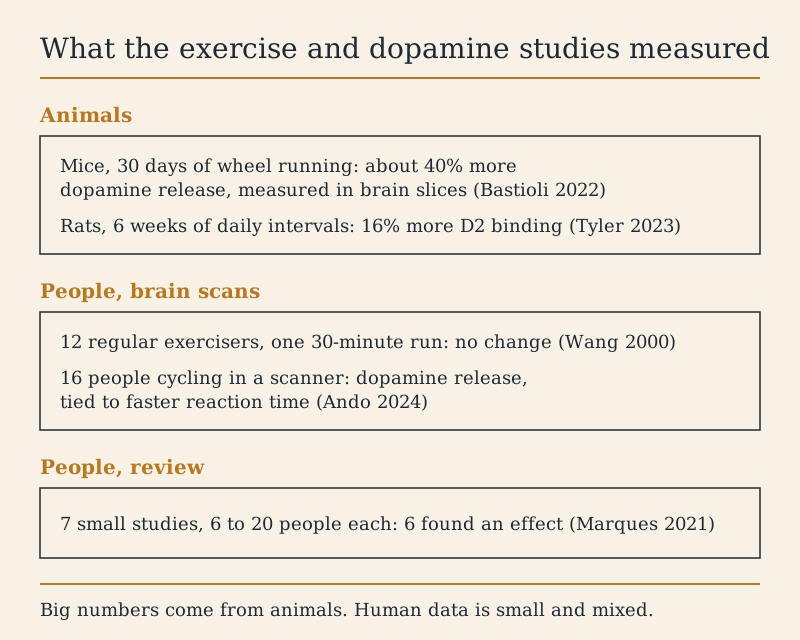
So exercise and dopamine are linked, but the human effect is less certain than the mouse numbers suggest. For raising your everyday level more broadly, see how to increase baseline dopamine.
Best types of exercise for dopamine
No study has compared exercise types head to head for dopamine, so each one is judged on its own evidence.
Aerobic exercise
Running and cycling have the most data, because the human scans above used them. Wendy Suzuki, a neuroscientist at NYU, gives a rule of thumb for exercise's brain benefits: three to four sessions a week, at least 30 minutes each, with your heart rate up. A brisk walk counts. Her rule covers mood, memory and attention. Nobody has worked out a dopamine dose, so treat it as a sensible minimum.
HIIT
The HIIT study usually cited is in rats (Tyler 2023). The rats ran treadmill intervals for 30 minutes a day, in ten 3-minute bouts, for six weeks. Afterwards they had 16% more D2-type receptor binding in the nucleus accumbens shell than sedentary rats, with no change in D1 receptors or in the enzyme that makes dopamine. The authors read it as HIIT changing dopamine signalling. It didn't compare intervals with steady cardio.
Resistance training
Strength training on its own has almost no dopamine data. The study usually quoted is Robertson 2016: 19 adults in residential treatment for methamphetamine dependence got an hour of supervised exercise training or an hour of health education, three days a week for 8 weeks. The exercise group gained striatal D2/D3 receptor availability on PET scans; the education group didn't. That's a small group recovering from drug-related dopamine deficits, so it says little about a healthy lifter.
The exercise you enjoy
Huberman estimates that running about doubles dopamine in people who love it, and does less or nothing for people who don't. That's his estimate, and none of the studies above tested enjoyment. The 2000 PET study of a hard run found no detectable change at all.
The practical point holds up anyway: the exercise you'll keep doing three times a week beats the one with the best rat data.
The dopamine traps that undermine your workouts
This section is Huberman's model, from his episode on controlling dopamine. No workout study has tested it.
Pre-workout stacking
Coffee, a pre-workout drink, an energy drink, your favourite playlist. Huberman argues that layering them for a big peak raises the bar for enjoying the next session, because you're "increasing the number of conditions required to achieve pleasure from that activity again." In his model, the workout on its own starts to feel flat.
Your phone in the gym
Huberman noticed his workouts felt flatter when he brought his phone, so he made a rule, at least for that year, of no phone in his workouts at all. That's one person's experience, but it costs nothing to try.
How to get more dopamine from exercise
- Hit the basic dose. Three to four 30-minute sessions a week, heart rate up.
- Train before focused work. Suzuki says her lab found a single workout improves your ability to shift and focus attention for at least two hours.
- Flip a coin on the extras. Huberman suggests flipping a coin before a workout: heads, bring the music in; tails, train without it. He applies the same idea to other extras, such as a pre-workout drink. He avoids a fixed schedule on purpose, because a predictable pattern isn't intermittent.
- Don't write off a missed day. The mice kept their boost after a week of rest. Nobody has tested that in people, but it's a reasonable case against all-or-nothing thinking.
After the workout: where NSDR fits
After a hard session you may still be wired when you need to sit down and think. A short guided rest is one way to come down.
No study has tested NSDR after a workout for dopamine. The closest is Boukhris 2024: 65 physically active adults did a 10-minute NSDR session or sat quietly for 10 minutes. The NSDR group rated their recovery, stress and readiness better, and did better on grip strength, reaction time and a cognitive accuracy test. More in what the NSDR studies measured.
What about the "NSDR raises dopamine" claim? One small PET study (Kjaer 2002: 8 male yoga teachers, one 72-minute yoga nidra session) estimated 65% more dopamine released during the session than at rest. It never measured baseline levels. Use NSDR to come down, not to top up dopamine. For other ways to reset your nervous system, there's a step-by-step plan.
If you're training hard and still feel drained for days, rest more, and check for overtraining.
FAQ
Does exercise increase dopamine levels?
Exercise probably increases dopamine levels, but the human evidence on exercise and dopamine is thin. The 40% figure is from mice. In people, one PET scan after a run found no change, one during cycling found a release, and a review found an effect in six of seven small studies.
How long does exercise-induced dopamine last?
How long exercise-induced dopamine lasts in people hasn't been measured. In mice, a month of running left dopamine release raised a week after they stopped. Wendy Suzuki's lab found the focus benefit of one workout lasts at least two hours, but that study measured attention, not dopamine.
What type of exercise is best for dopamine?
No type of exercise is proven best for dopamine, because no study has compared them head to head. Running and cycling have the most human data. Pick the one you enjoy and will repeat.
How much exercise do I need for dopamine benefits?
No study has set a dose of exercise for dopamine, so use the brain-health one: three to four sessions a week, at least 30 minutes each, with your heart rate up. That's Wendy Suzuki's rule of thumb for exercise's brain benefits in general.
Can exercise help with low motivation?
Exercise may help with low motivation, but the evidence is indirect. Weeks of training raised D2-type dopamine receptor measures in adults recovering from methamphetamine use, in the exercisers of a Parkinson's pilot with four patients, and in rats. That hasn't been shown in healthy adults. If low motivation lasts for weeks or comes with low mood, talk to a doctor.
Is a cold plunge better than exercise for dopamine?
A cold plunge isn't better on the evidence. In a 2000 study, young men sat in 14°C water up to the neck for an hour, and the dopamine in their blood rose by 250%. Blood dopamine isn't brain dopamine, and a short cold shower hasn't been tested for dopamine at all. If you try it, start mild and check with a doctor first if you have a heart condition. More in cold shower vs cold plunge.
Sources
- Bastioli G et al. (2022). Voluntary exercise boosts striatal dopamine release: evidence for the necessary and sufficient role of BDNF. Journal of Neuroscience. https://pubmed.ncbi.nlm.nih.gov/35577554/
- NYU Langone Health (2022). NYU Langone study in rodents shows that brain health benefits of exercise persist even after a week of rest (press release). https://nyulangone.org/news/boost-nerve-growth-protein-helps-explain-why-running-supports-brain-health
- Wang GJ et al. (2000). PET studies of the effects of aerobic exercise on human striatal dopamine release. Journal of Nuclear Medicine. https://pubmed.ncbi.nlm.nih.gov/10945526/
- Ando S et al. (2024). The neuromodulatory role of dopamine in improved reaction time by acute cardiovascular exercise. Journal of Physiology. https://pubmed.ncbi.nlm.nih.gov/38165254/
- Marques A et al. (2021). Bidirectional association between physical activity and dopamine across adulthood: a systematic review. Brain Sciences. https://pubmed.ncbi.nlm.nih.gov/34201523/
- Tyler J et al. (2023). High intensity interval training exercise increases dopamine D2 levels and modulates brain dopamine signaling. Frontiers in Public Health. https://pubmed.ncbi.nlm.nih.gov/38192549/
- Robertson CL et al. (2016). Effect of exercise training on striatal dopamine D2/D3 receptors in methamphetamine users during behavioral treatment. Neuropsychopharmacology. https://pubmed.ncbi.nlm.nih.gov/26503310/
- Fisher BE et al. (2013). Treadmill exercise elevates striatal dopamine D2 receptor binding potential in patients with early Parkinson's disease. NeuroReport. https://pubmed.ncbi.nlm.nih.gov/23636255/
- Boukhris O et al. (2024). The acute effects of nonsleep deep rest on perceptual responses, physical, and cognitive performance in physically active participants. Applied Psychology: Health and Well-Being. https://pubmed.ncbi.nlm.nih.gov/38953770/
- Kjaer TW et al. (2002). Increased dopamine tone during meditation-induced change of consciousness. Cognitive Brain Research. https://pubmed.ncbi.nlm.nih.gov/11958969/
- Šrámek P et al. (2000). Human physiological responses to immersion into water of different temperatures. European Journal of Applied Physiology. https://pubmed.ncbi.nlm.nih.gov/10751106/
- Suzuki W (2017). The brain-changing benefits of exercise (TED talk). https://www.ted.com/talks/wendy_suzuki_the_brain_changing_benefits_of_exercise/transcript
- Boecker H et al. (2008). The runner's high: opioidergic mechanisms in the human brain. Cerebral Cortex. https://pubmed.ncbi.nlm.nih.gov/18296435/
- Linden DJ (2011). Exercise, pleasure and the brain. Psychology Today. https://www.psychologytoday.com/us/blog/the-compass-of-pleasure/201104/exercise-pleasure-and-the-brain
- Huberman Lab. Controlling your dopamine for motivation, focus & satisfaction (episode 39). https://www.hubermanlab.com/episode/controlling-your-dopamine-for-motivation-focus-and-satisfaction
- Huberman Lab. Leverage dopamine to overcome procrastination & optimize effort. https://www.hubermanlab.com/episode/leverage-dopamine-to-overcome-procrastination-and-optimize-effort