The five breathing exercises for stress worth knowing are the physiological sigh, box breathing, 4-7-8 breathing, a long-exhale ratio and belly breathing. Use the sigh in the moment, box breathing when you need a count to hold onto, 4-7-8 in bed, and the last two as a daily habit. Expect a modest effect. Across 12 trials, breathwork lowered stress by a small-to-medium amount.
TL;DR: 5 breathing exercises for stress at a glance
- Physiological sigh: in the moment, one to three breaths, under 30 seconds.
- Box breathing: before a talk, 4 to 8 rounds, 1 to 2 minutes.
- 4-7-8 breathing: in bed, four breaths, a little over a minute.
- Progressive breath ratios: daily, long exhales, 5 to 10 minutes.
- Diaphragmatic (belly) breathing: the base for the rest, 5 minutes a day.
What stress does to your breathing (and why it matters)
The stress response changes how you breathe
Stress isn't only in your head. "Some people may feel their heart pounding, get a headache or feel short of breath," says Jenna Zaffino, a board-certified health and wellness coach, in an interview with the American Lung Association. Andrew Huberman calls the stress system generic: it doesn't tell physical stress from emotional stress. That's the case for using a physical tool like breathing on stress that starts as a thought.
Why the exhale is the calming half
Your heart speeds up a little each time you breathe in and slows each time you breathe out. This rhythm, respiratory sinus arrhythmia, is thought to be largely the work of the vagus nerve, whose brake on the heart is held back on the in-breath and released on the out-breath (Russo 2017). That brake belongs to the parasympathetic nervous system.
A longer out-breath gives that slowing phase more time. In a lab study of 30 people, breathing out for longer than they breathed in felt more relaxing than the reverse, and at 6 breaths a minute it also boosted the high-frequency part of heart rate variability, a marker linked to the vagus nerve (Van Diest 2014).
Regulation, not a permanent calm
"Breathwork is particularly useful to help get your body back to baseline, or a place of reconciliation," Zaffino says. A healthy nervous system revs up when it needs to and settles afterwards. In a 2018 review of 15 studies in healthy people, slow breathing went with higher heart rate variability and feeling calmer (Zaccaro 2018).
5 breathing exercises for stress (ranked by speed)
1. The physiological sigh (fastest)
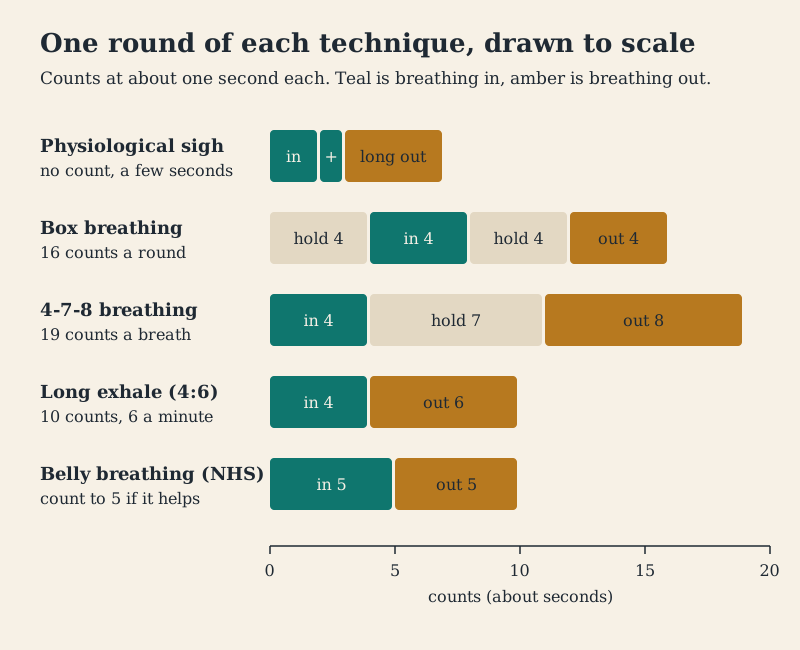
The physiological sigh is two breaths in through the nose, the second a short top-up, then one long breath out through the mouth. Your body already sighs every few minutes to reopen alveoli, the tiny air sacs in your lungs (Li 2016). The deliberate version copies that shape. Huberman's explanation, that the long exhale then clears more carbon dioxide, wasn't measured in the Stanford trial.
In a month-long Stanford trial of 108 adults, 5 minutes a day of repeated sighing, called cyclic sighing, lifted positive mood and slowed resting breathing more than mindfulness meditation did (Balban 2023). Huberman, a senior author, recommends one to three sighs in a stressful moment, a dose the Stanford trial didn't test. In a 2026 pilot of 47 university students, one minute of cyclic sighing in stressful moments of daily life was followed by a bigger drop in anxiety five minutes later than a no-breathing control (Riedl 2026).
Use it before a call or straight after bad news. One to three sighs take under 30 seconds.
- Breathe in slowly through your nose.
- At the top, sip in a second, shorter breath.
- Breathe out slowly through your mouth until your lungs feel empty.
- Repeat once or twice. All through the nose is fine too.
More in the physiological sigh guide, with a guided sigh pacer. The same trial tested cyclic hyperventilation, which flips the pattern.
2. Box breathing (when you need a count)
Box breathing is four equal counts: in for 4, hold for 4, out for 4, hold for 4. Former Navy SEAL Mark Divine teaches it starting from an empty-lung hold. Counting gives your attention something to track other than the worry. In the Stanford trial, box breathing raised daily positive mood by about as much as cyclic sighing (1.84 points against 1.89). But only cyclic sighing beat meditation (1.22) on mood by a significant margin, and only sighing slowed resting breathing more than meditation did. In the 2026 pilot, a minute of box breathing was followed by a bigger drop in anxiety than the control and fewer errors on an attention test, though reaction times were slower.
Use it before a talk or a hard conversation. Each round is 16 counts, so 4 to 8 rounds take 1 to 2 minutes at a second per count.
- Breathe out fully, then hold empty for 4.
- Breathe in through your nose for 4.
- Hold for 4.
- Breathe out for 4. Repeat 4 to 8 times, counting to 3 if the holds feel tight.
Follow the box breathing pacer.
3. 4-7-8 breathing (before sleep)
4-7-8 breathing is in for 4, hold for 7, out for 8. It comes from Andrew Weil, an integrative medicine physician at the University of Arizona, who calls it "a natural tranquilizer for the nervous system" and suggests it for falling asleep.
The out-breath is twice the in-breath. The research on it is small. In 43 healthy young adults, 22 of them sleep-deprived, heart rate and systolic blood pressure were lower straight after three sets of six breaths, but no group skipped the breathing for comparison (Vierra 2022). In a 2026 crossover study of 34 people, ten minutes of it went with less stress and negative mood in the women, and none of the conditions changed standard heart rate variability measures (Avcık 2026). The sleep evidence is thin and comes from patient groups. In 48 people with tinnitus, six weeks of 4-7-8 lowered insomnia scores compared with an information session alone (Kirazli 2026), and a dialysis trial that paired it with three other techniques found better sleep scores (Güvener 2025). Neither tested healthy people or how fast they fall asleep.
Use it in bed. Each breath is 19 counts, so four breaths take about 76 seconds.
- Rest the tip of your tongue behind your upper front teeth.
- Breathe out through your mouth with a whoosh.
- Breathe in quietly through your nose for 4.
- Hold for 7.
- Whoosh out through your mouth for 8. Repeat for four breaths.
Weil's rule is four breaths at a time for the first month, then up to eight. Use the 4-7-8 pacer, or see breathwork for sleep for more bedtime options.
4. Progressive breath ratios (daily practice)
Progressive breath ratios mean breathing out for longer than you breathe in, then stretching both over a few weeks. Yoga teacher Adriene Mishler uses the 2-in, 4-out starting count in one of her classes, with a short pause between the two.
At 4 in, 6 out you take 6 breaths a minute, roughly where heart rate variability tends to peak, though the exact point varies by person (Russo 2017). The schedule below is a suggestion, and no study has tested it. Daily slow breathing does have some support. In a single-blind trial of a branded programme, 98 paramedic students who practised twice a day for 12 weeks reported less stress, anxiety and depression than controls, though dropout rates differed between the groups (Little 2026).
Do it once a day, at a set time, for 5 to 10 minutes.
- Breathe in through your nose for 2, out for 4, for 5 minutes.
- When that feels effortless, move to 4 in, 6 out.
- Later, try 6 in, 8 out. Drop back if you feel short of air.
The extended exhale pacer keeps the count.
5. Diaphragmatic breathing (the base)
Diaphragmatic breathing is breathing led by the diaphragm, so on the in-breath your belly expands instead of your chest, and your lower ribs stay low and widen sideways (Russo 2017).
Deeper breaths and diaphragmatic breathing both make the heart's in-and-out rhythm bigger, more so at slow rates (Russo 2017). The stress evidence is thin but positive. A 2019 review found only three qualifying studies, and all three showed lower stress measures (Hopper 2019). In 40 adults, eight weeks of trained belly breathing improved sustained attention and lowered cortisol (Ma 2017). A 2020 review found it helped exercise capacity in COPD but called the studies poor quality (Hamasaki 2020).
Do it daily for at least 5 minutes, as the NHS suggests.
- Sit, stand or lie down, and loosen anything tight at your waist.
- Put one hand on your chest and one on your belly.
- Let the breath go as deep into your belly as is comfortable, without forcing it. Breathe in through your nose and out through your mouth.
- Count 1 to 5 in and 1 to 5 out if it helps. You may not reach 5 at first.
Try the diaphragmatic breathing pacer.
Do breathing exercises work for stress?
Yes, modestly. A 2023 meta-analysis of 12 randomised trials with 785 adults found breathwork went with lower self-reported stress than control conditions, a small-to-medium effect (g = 0.35), and with lower anxiety by a similar amount across 20 trials (g = 0.32). Most trials carried a moderate risk of bias, and the authors warned against "a miscalibration between hype and evidence" (Fincham 2023).
Two findings set the limits. In the Stanford trial, anxiety fell in both the breathing and meditation groups with no difference between them, and heart rate variability didn't change significantly in either. And in the largest breathwork trial so far, 400 people breathing at about 5.5 breaths a minute for 10 minutes a day did no better than people following the same routine at a normal 12 a minute (Fincham 2023, a separate trial). Both groups improved. A short daily session seems to matter more than the exact count.
Which technique should you choose?
Start with the one that fits the moment. If it makes you tenser, change it. As Zaffino puts it, "if something is not working for you or is causing more stress than you should switch to another tactic."
In a panic or right now: physiological sigh
No counting, and one sigh passes for an ordinary breath in a meeting. If it doesn't settle you, keep going for a minute. For more options, see how to calm down fast.
Before a talk or hard conversation: box breathing
One number to remember. If the holds make you tense, use a long-exhale ratio.
Lying in bed: 4-7-8
It was built for winding down. If the 7-count hold leaves you air-hungry, count faster but keep the 4:7:8 ratio, as Weil suggests.
Every day: long-exhale or belly breathing
Pick one, set a time and do 5 minutes. The trials that found benefits ran for a month or more, so give it that long before judging it.
Troubleshooting: when breathing exercises don't work
Counting makes you more anxious
Drop the count. The NHS treats counting as optional, and the sigh needs none. Adriene Mishler's line fits: "it's not about getting it right, it's about exploring."
You feel dizzy or tingly
You're probably overbreathing. Breathing too hard blows off carbon dioxide, and blood flow to the brain drops with it (Duarte 1995). Breathe normally for a minute, then try again with smaller breaths and fewer rounds. Weil notes that slight lightheadedness in the first tries of 4-7-8 passes.
You can't slow your breath down
Start with a count you can manage. If 4 out is too long, use 2. If holds make you panicky, skip them. Long-exhale and belly breathing have none.
Who should check with a doctor first
The Stanford trial left out people with heart disease, glaucoma, a seizure history, pregnancy or a serious psychiatric condition, and in an optional end-of-study debrief, 10% said they had a negative experience with the exercises. If that's you, check with your GP before a daily practice, especially the breath-hold techniques. Breathing can ease everyday stress, but it isn't a treatment for an anxiety or panic disorder. If a drill makes you more panicky, stop and breathe normally.
Best practices for daily breathwork
Short and daily
The main trials here used small, frequent doses: 5 minutes a day for a month, about 10 minutes a day for four weeks, twice a day for 12 weeks. None of them compared that with one long weekly session. The NHS says you can do it standing, sitting in a chair that supports your back, or lying down. Tie the habit to a fixed point in your day, such as before the first coffee or after you turn the light out.
Where NSDR fits
For a longer reset than breathing, NSDR (non-sleep deep rest) is 10 to 30 minutes of guided rest where you lie still and stay awake. In a 2026 trial of 102 active young adults, one 10-minute session cut sleepiness, fatigue and stress more than a control session did (Boukhris 2026). NSDR.co's sessions are free. If anxiety is the bigger issue, natural anxiety remedies covers breathing alongside exercise, sleep and more.
FAQ
What is the 4-7-8 breathing technique for stress?
The 4-7-8 technique is Andrew Weil's relaxation breath for stress: in through the nose for 4, hold for 7, out through the mouth for 8, four times. One small study without a no-breathing group found lower heart rate and systolic blood pressure straight afterwards. Small trials in tinnitus and dialysis patients found better sleep scores, but none has shown it speeds up falling asleep in healthy people.
How long should you do breathing exercises for stress relief?
Five to ten minutes a day is what the trials of breathing exercises for stress used. The Stanford trial ran 5 minutes a day, the largest trial about 10, and the NHS suggests at least 5. In the moment, one to three physiological sighs take under 30 seconds.
Does the physiological sigh work for anxiety?
Yes, the physiological sigh can ease anxiety, but in the main trial it did no better on anxiety than meditation. Cyclic sighing's edge was on positive mood and resting breathing rate. In a 2026 pilot of 47 university students, one minute of it lowered anxiety more than doing nothing.
What is the best breathing exercise for anxiety?
No single breathing exercise has been shown to be best for anxiety. Cyclic sighing and box breathing both lowered it in the 2026 pilot. Sigh in the moment and keep a daily long-exhale practice. If anxiety persists, talk to your GP.
Can breathing exercises help you focus?
Possibly, but the evidence on breathing exercises and focus is small. In 40 adults, the group trained in belly breathing for eight weeks had better sustained attention than at the start. In a pilot of 47 university students, a minute of box breathing was followed by fewer errors on an attention test, though reaction times were slower.
Sources
- Balban MY, Neri E, Kogon MM, et al. (2023). Brief structured respiration practices enhance mood and reduce physiological arousal. Cell Reports Medicine. https://pubmed.ncbi.nlm.nih.gov/36630953/ (full text: https://pmc.ncbi.nlm.nih.gov/articles/PMC9873947/)
- Fincham GW, Strauss C, Montero-Marin J, Cavanagh K (2023). Effect of breathwork on stress and mental health: A meta-analysis of randomised-controlled trials. Scientific Reports. https://pubmed.ncbi.nlm.nih.gov/36624160/
- Fincham GW, Strauss C, Cavanagh K (2023). Effect of coherent breathing on mental health and wellbeing: a randomised placebo-controlled trial. Scientific Reports. https://pubmed.ncbi.nlm.nih.gov/38092805/
- Riedl EM, Bracklo T, Wimmer K, et al. (2026). Simply breathing anxiety away? A pilot, just-in-time ecological momentary intervention study of one-minute cyclic sighing versus box breathing as tools for acute anxiety reduction and attention promotion in real life. Anxiety, Stress, & Coping. https://pubmed.ncbi.nlm.nih.gov/42002307/
- Russo MA, Santarelli DM, O'Rourke D (2017). The physiological effects of slow breathing in the healthy human. Breathe. https://pubmed.ncbi.nlm.nih.gov/29209423/
- Van Diest I, Verstappen K, Aubert AE, et al. (2014). Inhalation/Exhalation ratio modulates the effect of slow breathing on heart rate variability and relaxation. Applied Psychophysiology and Biofeedback. https://pubmed.ncbi.nlm.nih.gov/25156003/
- Zaccaro A, Piarulli A, Laurino M, et al. (2018). How breath-control can change your life: a systematic review on psycho-physiological correlates of slow breathing. Frontiers in Human Neuroscience. https://pubmed.ncbi.nlm.nih.gov/30245619/
- Li P, Janczewski WA, Yackle K, et al. (2016). The peptidergic control circuit for sighing. Nature. https://pubmed.ncbi.nlm.nih.gov/26855425/
- Vierra J, Boonla O, Prasertsri P (2022). Effects of sleep deprivation and 4-7-8 breathing control on heart rate variability, blood pressure, blood glucose, and endothelial function in healthy young adults. Physiological Reports. https://pubmed.ncbi.nlm.nih.gov/35822447/
- Avcık FE, Koç F, Aktop A (2026). Acute psychophysiological effects of 4-7-8 and Nadi Shodhana breathing: a randomized crossover study. Applied Psychophysiology and Biofeedback. https://pubmed.ncbi.nlm.nih.gov/42771122/
- Kirazli G, Baran S, Uysal GS, et al. (2026). The effect of 4-7-8 breathing exercise technique on tinnitus handicap, psychological factors, and sleep quality in tinnitus patients: a randomized controlled study. Brain and Behavior. https://pubmed.ncbi.nlm.nih.gov/41676854/
- Güvener YÖ, Koç Z (2025). The effect of breathing exercises on pain, sleep, and symptom management in patients undergoing hemodialysis: a randomized controlled trial. Sleep and Breathing. https://pubmed.ncbi.nlm.nih.gov/40279052/
- Little A, Stainer M, MacQuarrie AS, et al. (2026). Examining the effectiveness of breathwork to improve resilience and psychological wellbeing while reducing anxiety, depression, stress, and insomnia in paramedicine students: a single-blind randomised controlled trial. Stress and Health. https://pubmed.ncbi.nlm.nih.gov/41787752/
- Hopper SI, Murray SL, Ferrara LR, Singleton JK (2019). Effectiveness of diaphragmatic breathing for reducing physiological and psychological stress in adults: a quantitative systematic review. JBI Database of Systematic Reviews and Implementation Reports. https://pubmed.ncbi.nlm.nih.gov/31436595/
- Ma X, Yue ZQ, Gong ZQ, et al. (2017). The effect of diaphragmatic breathing on attention, negative affect and stress in healthy adults. Frontiers in Psychology. https://pubmed.ncbi.nlm.nih.gov/28626434/
- Hamasaki H (2020). Effects of diaphragmatic breathing on health: a narrative review. Medicines. https://pubmed.ncbi.nlm.nih.gov/33076360/
- Duarte J, Markus H, Harrison MJ (1995). Changes in cerebral blood flow as monitored by transcranial Doppler during voluntary hyperventilation and their effect on the electroencephalogram. Journal of Neuroimaging. https://pubmed.ncbi.nlm.nih.gov/7579748/
- Boukhris O et al. (2026). Time course of perceptual, cognitive, physical and physiological responses to a single non-sleep deep rest session in physically active young adults. Applied Psychology: Health and Well-Being. https://pubmed.ncbi.nlm.nih.gov/42383502/
- Weil A. 4-7-8 Breath Relaxation Exercise (patient handout). Andrew Weil Center for Integrative Medicine, University of Arizona. https://awcim.arizona.edu/file?id=138394
- NHS (2026). Breathing exercises for stress. https://www.nhs.uk/mental-health/self-help/guides-tools-and-activities/breathing-exercises-for-stress/
- American Lung Association (2024). Simple breathing exercises to help you manage stress (interview with Jenna Zaffino). https://www.lung.org/blog/stress-breathing-exercises
- Divine M (2016). The breathing technique a Navy SEAL uses to stay calm and focused. TIME. https://time.com/4316151/breathing-technique-navy-seal-calm-focused/
- Huberman Lab (2021). Tools for Managing Stress & Anxiety. https://www.hubermanlab.com/episode/tools-for-managing-stress-and-anxiety
- Yoga With Adriene. Yoga For Creativity (transcript). https://yogawithadriene.com/wp-content/uploads/2021/06/Yoga-For-Creativity-Yoga-With-Adriene.en_.txt
- Yoga With Adriene. Reunite With Your Breath (transcript). https://yogawithadriene.com/wp-content/uploads/2021/06/Reunite-With-Your-Breath-Yoga-With-Adriene.en_.txt