
Zone 2 is steady cardio at about 60 to 70% of your maximum heart rate, easy enough to hold a conversation. The best-supported zone 2 cardio benefits come from aerobic exercise in general. Fitter people tend to live longer, and endurance training lowers blood pressure and, in type 2 diabetes, blood sugar. Zone 2's own strength is that you can do a lot of it, and it feels calm. A 2025 review argues it isn't the single best intensity for your mitochondria.
What is zone 2 cardio? The 30-second answer
By heart rate, zone 2 is 60 to 70% of your maximum, the range Cleveland Clinic uses. In a lab it's more specific. A 2025 panel of 14 sport scientists and coaches put it just below your first lactate threshold, where lactate starts to build in your blood (Sitko 2025). The paper opens by noting there's no agreed definition, which helps explain why the numbers vary from site to site.
It's also roughly where fat burning peaks. In 300 healthy adults, the fat-burning rate topped out, on average, at 61.5% of maximum heart rate (Venables 2005).
Dr. Charlotte Weidenbach, a Peloton instructor who trained as a doctor, puts it simply: "Zone 2 training should be the base for everyone doing endurance and also HIIT training."
How zone 2 differs from other training zones
Most systems use five zones. Zone 1 is barely above rest; zones 3 to 5 get progressively harder. As you climb, your body leans more on carbohydrate and blood lactate rises. Fat burning increases from low to moderate effort, then falls away at high intensity (Achten 2004).
Zone 2 is the top of the range you can hold for a long time, which makes it the part of the week you can do in volume.
The talk test: simplest way to know you're in zone 2
Christopher Travers, an exercise physiologist at Cleveland Clinic, says: "You're not going to feel like you're pushing it if you're exercising in zone 2."
You should be able to carry on a light conversation. Peter Attia adds that talking "should be uncomfortable." If you can't finish a full sentence, you're past zone 2, so ease off. A lactate test is the gold standard; the talk test is free.
Zone 2 cardio benefits: what the evidence shows
Most of the strong evidence here is for aerobic exercise and fitness in general. The case for zone 2 as the best intensity comes mainly from watching elite endurance athletes, who train huge volumes at low intensity (Storoschuk 2025).
More and better mitochondria
Mitochondria turn fuel into energy in your muscle cells. Endurance training adds more of them and makes them work better. A 2018 review suggests training volume may matter most for how many you add, and intensity for how well they work (Granata 2018). Zone 2's advantage is volume, because it's easy enough to repeat for hours a week.
Professional endurance athletes burned more fat and had lower blood lactate during exercise than moderately active people or people with metabolic syndrome, in a one-off comparison (San-Millán and Brooks 2018).
Better fat burning during exercise
Endurance training raises how much fat you can burn while exercising, though the dose needed is unknown (Achten 2004). The amounts per session are modest. Peak fat burning averaged 7.8 mg per kg of lean mass per minute (Venables 2005). With 55 kg of lean mass, that's about 0.43 g a minute, or roughly 26 g of fat in an hour.
Fitness that tracks with a longer life
A Cleveland Clinic study followed 122,007 adults who'd had a treadmill test for a median of 8.4 years. After adjusting for other risks, the bottom quarter for fitness had about five times the risk of dying of the top 2.3% (Mandsager 2018). That risk was comparable to or greater than smoking or diabetes in the same data, and the study observed no upper limit to the benefit of being fitter.
That study measured fitness. Zone 2 is one sustainable way to build it.
Lower blood pressure
Endurance exercise lowers blood pressure a little, and more if yours is high. A meta-analysis of 93 trials of several exercise types (5,223 people) found endurance training lowered systolic blood pressure by 3.5 mmHg on average, and by 8.3 mmHg in people with high blood pressure (Cornelissen 2013). The trials weren't limited to zone 2 intensity.
Better blood sugar control
A meta-analysis pooled 47 trials of exercise or activity advice in 8,538 people with type 2 diabetes. In the structured aerobic training trials, HbA1c, a three-month average of blood sugar, fell by about 0.7 percentage points compared with controls, though results varied a lot between trials (Umpierre 2011). These weren't zone 2 trials either.
Faster lactate clearance after hard efforts
In 10 men recovering from hard 5-minute runs, blood lactate cleared faster with easy running than with passive rest, and fastest near the lactate threshold (Menzies 2010), close to where zone 2 tops out. For recovery between sessions, Weidenbach's view is that zone 2 sessions "don't need much recovery afterward."
Where the zone 2 hype goes too far
A 2025 narrative review by Storoschuk, Gibala and colleagues examined the claim that zone 2 is the optimal intensity for mitochondria and fat burning. They concluded that the evidence doesn't support it, and that harder exercise matters more for heart and metabolic health, especially when training time is short. Gibala advises a company whose services relate to exercise. The expert panel that defined zone 2 agreed its adaptations "might not be unique to zone 2" (Sitko 2025).
So zone 2 works. It just isn't a reason to skip the occasional hard session.
Zone 2 and your nervous system
What zone 2 does to your nervous system
Exercise doesn't flip a switch from rest-and-digest to fight-or-flight. At rest, the parasympathetic (vagal) side has about four times the sympathetic side's say over your heart rate. At maximal effort the ratio reverses, gradually, as workload rises, and the parasympathetic side stays active throughout (White and Raven 2014). Zone 2 is near the low end of that shift. More on the two branches in sympathetic vs parasympathetic.
Stress hormones track intensity too. In 12 trained men doing 30-minute sessions, cortisol didn't rise at 40% of VO2max, rose about 40% at 60%, and about 83% at 80% (Hill 2008). Peak fat burning, near the bottom of zone 2, sits at about 48% of VO2max (Venables 2005). That puts the low end of zone 2 between Hill's 40% and 60% sessions; these studies don't place the top.
That's the honest version of "calm cardio". It's real work, with less stress response than hard training.
Zone 2, mood and anxiety
In a 2019 trial, 30 of 60 adults with type 2 diabetes trained three times a week for 12 weeks, 45 to 60 minutes a session, at 60 to 70% of VO2max, well above the 48% where zone 2 starts (Gilani 2019). Compared with the 30 controls, their mental health score and an anxiety and insomnia subscale improved; depression didn't change significantly.
An overview of 97 reviews, covering 128,119 people, found medium-sized effects of exercise on depression and anxiety, with bigger improvements from higher-intensity activity, though most of the reviews were rated low quality (Singh 2023). For zone 2, the gain is that you'll do it more often. See also exercise and dopamine.
Zone 2 as active recovery
Zone 2 works well as the easy day after hard training. If a session still leaves you feeling keyed up, that's where a short rest fits.
A PubMed search on 11 Oct 2026 turned up no trial of NSDR after zone 2 exercise. The closest is Boukhris 2024: 65 physically active adults did a 10-minute NSDR session or sat quietly for 10 minutes. The NSDR group rated their recovery, stress and readiness better, and did better on grip strength and reaction time. More in what the NSDR studies measured.
How to calculate your zone 2 heart rate
Every method starts from your maximum heart rate, which is an estimate unless you've had a lab test.
The simple formula: 220 minus your age
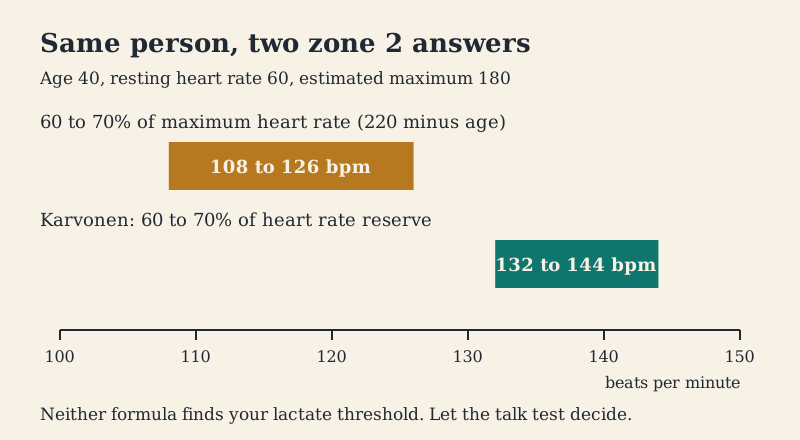
Subtract your age from 220, then take 60% and 70%. A 40-year-old gets a maximum of 180 and a zone 2 of 108 to 126 bpm.
A better-tested formula is 208 minus 0.7 times your age, from data on 18,712 people (Tanaka 2001). At 40 they agree. At 60, 220 minus age gives 160, for a zone 2 of about 96 to 112. Tanaka gives 166, for about 100 to 116. The old formula underestimates maximum heart rate in older adults.
The Karvonen method gives a different answer
Karvonen adds your resting heart rate. Subtract it from your maximum, take 60% and 70% of the difference, then add it back. With a resting rate of 60 and a maximum of 180: (120 × 0.6) + 60 = 132, and (120 × 0.7) + 60 = 144.
Same person, two zones about 20 beats apart: 108 to 126 versus 132 to 144. Sixty to seventy percent of your heart rate reserve is just a harder band than sixty to seventy percent of your maximum. Neither formula finds your lactate threshold, which is how the expert panel defines zone 2 (Sitko 2025). Pick one, then let the talk test overrule it.
When heart rate monitors mislead
On long sessions, heart rate can creep up after 10 to 20 minutes, even at the same pace. This is cardiovascular drift (Coyle 2001). Hold your speed and you may drift into zone 3; hold your heart rate and you'll slow down. Either is fine if the talk test still passes.
Beta-blockers lower heart rate, so people taking them may never reach the usual targets; Harvard Health suggests using perceived effort instead. If you have a heart condition, take medication that affects heart rate, or are starting after a long break, check with your doctor first.
How much zone 2 cardio do you need?
What the guidelines say
The World Health Organization recommends 150 to 300 minutes of moderate activity a week, or 75 to 150 minutes of vigorous activity, and says more is better (Bull 2020).
Going past 150 has some support. In the type 2 diabetes trials of structured exercise of any type, more than 150 minutes a week lowered HbA1c by 0.89 percentage points, against 0.36 for 150 minutes or less (Umpierre 2011).
Session length: 30 to 60 minutes is a good default
The American College of Sports Medicine's standard prescription is at least 30 minutes of moderate exercise on at least five days a week (Garber 2011). Longer sessions burn more fat in total, since duration is an important driver of fat burning (Achten 2004). There's no switch at minute 30, though. Shorter sessions still count, and some activity beats none (Bull 2020).
The 80/20 rule elite athletes follow
Competitive endurance athletes training 10 to 13 times a week do about 80% of their sessions at low intensity and about 20% with hard work in them (Seiler 2010). With far less training time, the Storoschuk review argues, harder work matters more for you. Keep most sessions easy and fit in some harder work each week.
Getting started with zone 2 training
The hard part is usually going slowly enough.
Best exercises for zone 2
Any cardio can be zone 2 if you control the effort. Cleveland Clinic lists brisk walking, slow running, relaxed cycling, steady swimming, the elliptical and rowing. Running works, but many people need to slow to a jog, or add walk breaks, to stay in zone 2.
Why stationary beats outdoor for true zone 2
Hills, traffic lights and wind push your heart rate up and down. A stationary bike, treadmill or rower lets you set an effort and hold it. Outdoors is fine once you know what zone 2 feels like. Indoors is the easier place to learn it.
A simple 4-week zone 2 plan
- Week 1. Three 30-minute sessions at a confirmed zone 2 effort.
- Week 2. Three 35-minute sessions.
- Week 3. Three 40-minute sessions.
- Week 4. Four 45-minute sessions, if you're recovering well.
That's 180 minutes by week 4, inside the WHO's range. Add a harder session once the routine feels settled.
FAQ
Is zone 2 cardio good for fat loss?
Zone 2 cardio helps with fat loss mainly because it's easy to do often. The burn itself is small, roughly 26 g of fat in an hour at peak for someone with 55 kg of lean mass (Venables 2005). The 2025 review concluded the evidence doesn't show zone 2 is the best intensity for raising fat-burning capacity. Treat it as one part of the plan, alongside what you eat.
Can you do zone 2 cardio every day?
Yes, many healthy people can do zone 2 cardio every day once they've built up to it. Competitive endurance athletes train 10 to 13 times a week with about 80% of sessions easy (Seiler 2010). Build up gradually, and rest if fatigue lingers or performance drops, which can be signs of overtraining.
What happens if I go above zone 2?
Go above zone 2 and your fuel mix shifts toward carbohydrate, lactate climbs and you tire sooner. That isn't wasted effort. Harder work builds fitness too, and matters more when time is short (Storoschuk 2025). It costs more recovery, so on an easy day, slow down.
How long does it take to see zone 2 benefits?
Expect weeks to months for zone 2 cardio benefits to show. The blood pressure trials that found a drop ran four weeks or more (Cornelissen 2013), and the blood sugar trials at least 12 (Umpierre 2011). Neither gives a timeline for zone 2 alone.
Is walking enough for zone 2 cardio?
Walking is enough for zone 2 for many people, especially beginners, and Cleveland Clinic lists brisk walking as a zone 2 activity. If a flat walk barely changes your breathing, add an incline or walk faster until talking takes a little effort.
Sources
- Achten J, Jeukendrup AE (2004). Optimizing fat oxidation through exercise and diet. Nutrition. https://pubmed.ncbi.nlm.nih.gov/15212756/
- Boukhris O et al. (2024). The acute effects of nonsleep deep rest on perceptual responses, physical, and cognitive performance in physically active participants. Applied Psychology: Health and Well-Being. https://pubmed.ncbi.nlm.nih.gov/38953770/
- Bull FC et al. (2020). World Health Organization 2020 guidelines on physical activity and sedentary behaviour. British Journal of Sports Medicine. https://pubmed.ncbi.nlm.nih.gov/33239350/
- Cleveland Clinic (2025). Zone 2 cardio (with Christopher Travers). https://health.clevelandclinic.org/zone-2-cardio
- Cornelissen VA, Smart NA (2013). Exercise training for blood pressure: a systematic review and meta-analysis. Journal of the American Heart Association. https://pubmed.ncbi.nlm.nih.gov/23525435/
- Coyle EF, González-Alonso J (2001). Cardiovascular drift during prolonged exercise: new perspectives. Exercise and Sport Sciences Reviews. https://pubmed.ncbi.nlm.nih.gov/11337829/
- Garber CE et al. (2011). American College of Sports Medicine position stand: quantity and quality of exercise for developing and maintaining cardiorespiratory, musculoskeletal, and neuromotor fitness in apparently healthy adults. Medicine & Science in Sports & Exercise. https://pubmed.ncbi.nlm.nih.gov/21694556/
- Gilani SRM, Feizabad AK (2019). The effects of aerobic exercise training on mental health and self-esteem of type 2 diabetes mellitus patients. Health Psychology Research. https://pubmed.ncbi.nlm.nih.gov/30997432/
- Granata C, Jamnick NA, Bishop DJ (2018). Training-induced changes in mitochondrial content and respiratory function in human skeletal muscle. Sports Medicine. https://pubmed.ncbi.nlm.nih.gov/29934848/
- Harvard Health Publishing (2019). Target heart rate on a beta blocker. https://www.health.harvard.edu/heart-health/target-heart-rate-on-a-beta-blocker
- Hill EE et al. (2008). Exercise and circulating cortisol levels: the intensity threshold effect. Journal of Endocrinological Investigation. https://pubmed.ncbi.nlm.nih.gov/18787373/
- Mandsager K et al. (2018). Association of cardiorespiratory fitness with long-term mortality among adults undergoing exercise treadmill testing. JAMA Network Open. https://pubmed.ncbi.nlm.nih.gov/30646252/
- Menzies P et al. (2010). Blood lactate clearance during active recovery after an intense running bout depends on the intensity of the active recovery. Journal of Sports Sciences. https://pubmed.ncbi.nlm.nih.gov/20544484/
- Peloton (n.d.). Zone 2 cardio (with Dr. Charlotte Weidenbach). https://www.onepeloton.com/blog/zone-2-cardio
- Peter Attia on zone 2 cardio indicators, FoundMyFitness. https://foundmyfitness.com/episodes/attia-zone2-cardio-indicators
- San-Millán I, Brooks GA (2018). Assessment of metabolic flexibility by means of measuring blood lactate, fat, and carbohydrate oxidation responses to exercise in professional endurance athletes and less-fit individuals. Sports Medicine. https://pubmed.ncbi.nlm.nih.gov/28623613/
- Seiler S (2010). What is best practice for training intensity and duration distribution in endurance athletes? International Journal of Sports Physiology and Performance. https://pubmed.ncbi.nlm.nih.gov/20861519/
- Singh B et al. (2023). Effectiveness of physical activity interventions for improving depression, anxiety and distress: an overview of systematic reviews. British Journal of Sports Medicine. https://pubmed.ncbi.nlm.nih.gov/36796860/
- Sitko S et al. (2025). What is "zone 2 training"?: experts' viewpoint on definition, training methods, and expected adaptations. International Journal of Sports Physiology and Performance. https://pubmed.ncbi.nlm.nih.gov/40010355/
- Storoschuk KL, Moran-MacDonald A, Gibala MJ, Gurd BJ (2025). Much ado about zone 2: a narrative review assessing the efficacy of zone 2 training for improving mitochondrial capacity and cardiorespiratory fitness in the general population. Sports Medicine. https://pubmed.ncbi.nlm.nih.gov/40560504/
- Tanaka H, Monahan KD, Seals DR (2001). Age-predicted maximal heart rate revisited. Journal of the American College of Cardiology. https://pubmed.ncbi.nlm.nih.gov/11153730/
- Umpierre D et al. (2011). Physical activity advice only or structured exercise training and association with HbA1c levels in type 2 diabetes: a systematic review and meta-analysis. JAMA. https://pubmed.ncbi.nlm.nih.gov/21540423/
- Venables MC, Achten J, Jeukendrup AE (2005). Determinants of fat oxidation during exercise in healthy men and women: a cross-sectional study. Journal of Applied Physiology. https://pubmed.ncbi.nlm.nih.gov/15333616/
- White DW, Raven PB (2014). Autonomic neural control of heart rate during dynamic exercise: revisited. Journal of Physiology. https://pubmed.ncbi.nlm.nih.gov/24756637/