Breathwork for sleep means slowing your breathing in bed for 10 to 15 minutes, usually with a breath out longer than the breath in. 4-7-8 is the classic bedtime pattern. Slow breathing at about six breaths a minute has the most sleep data, and the data is modest. In one randomised trial, 64 healthy young adults who breathed slowly for 15 minutes a night for 30 days rated their sleep better than a group who spent those minutes on social media. Pick one technique for your problem and give it a month.
Why breathwork helps you sleep (the science)
Breathing is the part of your nervous system you can steer
Slow your breathing and the vagal, rest-and-digest part of heart rate variability rises. A 2022 review of 223 studies found the rise during a session, straight after one, and after programmes of repeated sessions.
In a small 2015 study, people with insomnia showed less of this vagal activity than good sleepers. Slow breathing shifts the body toward the parasympathetic nervous system.
Why the breath out matters most
Your heart speeds up slightly as you breathe in and slows as you breathe out. In a lab study of 30 people, an exhale longer than the inhale felt more relaxing and, at a slow pace, raised the high-frequency part of heart rate variability. That's why sleep techniques stretch the exhale.
What the sleep studies found
The sleep studies are small, and the results are mixed.
- Tsai, 2015. 14 people with self-reported insomnia did 20 minutes of slow breathing (six breaths a minute) before bed. In a sleep lab, they fell asleep faster, woke less and slept more efficiently.
- Laborde, 2019. 64 healthy young adults, randomised. 15 minutes of slow breathing before sleep for 30 nights improved self-rated sleep quality and overnight vagal activity compared with 15 minutes of social media.
- Kuula, 2020. 20 young adults did 30 minutes of slow breathing on one night. The authors concluded that "neither condition had robust effects on sleep quality."
- Balban, 2023. In this Stanford trial, 108 adults did 5 minutes of breathing a day for a month. Cyclic sighing lifted mood and slowed resting breathing more than mindfulness meditation. Sleep didn't change in any group.
- Little, 2026. 98 paramedic students did slow breathing twice a day for 12 weeks. Stress, anxiety and depression fell compared with controls. Insomnia scores didn't change significantly.
In a 2023 trial of 400 people, 10 minutes a day of slow breathing for four weeks lowered stress no more than a matched routine at a normal pace, and both groups improved. It measured stress, but suggests the nightly habit may count as much as the rhythm. Expect a small benefit.
The 5 best breathing techniques for sleep
4-7-8 breathing (the classic sleep technique)
4-7-8 comes from Andrew Weil, an integrative medicine physician at the University of Arizona, whose handout calls it "a natural tranquilizer for the nervous system".
- Rest the tip of your tongue on the ridge behind your upper front teeth, and keep it there.
- Breathe out fully through your mouth with a whoosh.
- Breathe in quietly through your nose for 4.
- Hold for 7.
- Breathe out through your mouth, whooshing, for 8.
- That's one breath. Do four.
Weil says to stick to four breaths at a time for the first month, then build to eight. His handout suggests sitting up; in bed, lie down. If the hold is too long, it says to speed the whole breath up and keep the 4:7:8 ratio.
In a 2022 study of 43 healthy young adults, three sets of six cycles lowered heart rate and systolic blood pressure straight afterwards. There's no sleep trial of 4-7-8 itself. The 4-7-8 breathing pacer keeps the count.
Slow belly breathing (for physical tension)
The two studies that found better sleep used this pace, about six breaths a minute.
- Lie on your back, one hand on your chest and one on your belly.
- Breathe in through your nose for about 4 to 5 seconds, letting your belly rise while your chest stays still.
- Breathe out for about 5 to 6 seconds, letting your belly fall.
- Continue for 10 to 15 minutes.
The American Academy of Sleep Medicine lists belly breathing among the relaxation exercises it suggests for insomnia. It suits anyone who dislikes breath holds. The diaphragmatic breathing pacer keeps time if counting seconds keeps you awake.
The physiological sigh (for a fast calm-down)
Take two breaths in through the nose, the second one shorter, then one long breath out through the mouth. It takes seconds and needs no counting, so use it for a spike of stress at bedtime. The physiological sigh explainer covers the Stanford trial, and the guided physiological sigh paces it.
Box breathing (for racing thoughts)
- Breathe in for 4.
- Hold for 4.
- Breathe out for 4.
- Hold, lungs empty, for 4.
- Repeat for 4 to 8 rounds.
Former Navy SEAL Mark Divine teaches box breathing. Some sleep articles mix it up with the "military method", a body-relaxation routine Bud Winter taught Navy pilots in the Second World War. The claim that 96% of them fell asleep in two minutes comes from Winter's own account, not a study.
The equal counts give a racing mind something to track. Try the box breathing pacer.
Humming breath (bhramari)
- Close your eyes and breathe in slowly through your nose.
- Breathe out through your nose, lips closed, with a low, steady hum.
- Cover your ears with your thumbs if you like.
- Do 5 to 10 breaths.
The evidence is the weakest of the five. A 2018 review found six studies of humming breath, none randomised and all of very low quality. They pointed to more rest-and-digest activity, and none measured sleep. If you lose count easily, a hum may be easier to follow. There's a humming bee breath pacer.
Which breathing technique should you try first
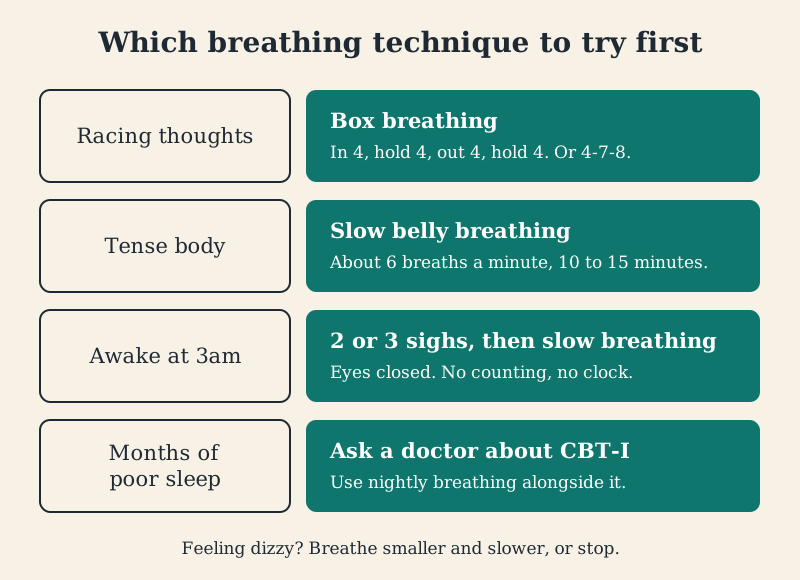
If racing thoughts keep you awake
Start with box breathing for its steady count. If holding your breath bothers you, use slow belly breathing instead. How to stop sleep anxiety covers other tools for the worry, and breathing exercises for stress covers daytime use.
If physical tension prevents sleep
Use slow belly breathing, and let each exhale drop your shoulders and unclench your jaw.
If you wake up in the middle of the night
Keep your eyes closed, do two or three sighs, then slow belly breathing without counting. Breathing for night waking hasn't been trialled, but sighs need no counting. Leave the clock alone. In one study, people who watched a clock worried more and took longer to fall asleep. If it's the same hour every night, read why you wake up at 3am.
If you have chronic insomnia
See a doctor about CBT-I (cognitive behavioural therapy for insomnia), which the American College of Physicians recommends as the first treatment. Breathing exercises count as relaxation therapy, which the American Academy of Sleep Medicine suggests conditionally, so use them alongside it.
How to build a pre-sleep breathing routine
Timing: when to start your breathwork practice
The two studies that found better sleep used 15 to 20 minutes of slow breathing right before sleep. Start breathwork for sleep with 10 to 15 minutes in bed, lights out, at the same point every night.
Body position for better breathing
Lie on your back with a pillow under your knees, or on your side if your back complains. Falling asleep before you finish is fine at night.
Creating a transition ritual
Dim the lights in the last hour, since ordinary room light before bed suppresses melatonin, and put the phone out of reach.
If you'd like a voice to take over when the counting stops, try NSDR (non-sleep deep rest), a guided session where you lie still and stay awake. In a 2026 trial of 102 active young adults, one 10-minute session cut sleepiness, fatigue and stress more than a control session. That pairing hasn't been tested in a trial. NSDR for sleep has bedtime protocols, and NSDR.co sessions are free.
Troubleshooting common problems
What to do if you feel dizzy
Overbreathing blows off carbon dioxide, and blood flow to the brain drops within minutes. Make the breaths smaller and slower, or shorten the holds. Weil notes that slight lightheadedness at the start passes. If it doesn't, stop and breathe normally.
If your mind keeps racing during practice
That's expected. When you lose count, start again at one.
If the technique isn't working after a month
Breathwork won't knock you out like a sleeping pill. After a month without change, try another technique and check caffeine, evening light and your wake time.
When to skip breathwork (contraindications)
The Stanford trial left out people with heart disease, glaucoma, seizures, pregnancy or moderate to severe psychiatric conditions, and 10% of those who answered its follow-up survey reported a negative experience. If that's you, check with your GP before a daily practice, especially 4-7-8 and box breathing, which use holds. If a drill sets off panic, stop and breathe normally.
Breathing exercises are a self-help tool. Loud snoring, gasping or pauses in breathing at night can be signs of sleep apnoea, which needs a doctor.
FAQ
What is the best breathing technique to fall asleep fast?
No breathing technique has been shown to make you fall asleep faster than another. 4-7-8 is the one designed for bedtime, and slow breathing at about six breaths a minute has the most sleep data.
How long should you do breathing exercises before bed?
Do breathing exercises for 10 to 15 minutes in bed to start, close to what the positive sleep studies used. 4-7-8 is shorter, at four breaths, which takes a minute or two.
Can breathing exercises help with insomnia?
Breathing exercises can help a little with insomnia, as part of relaxation therapy, which the American Academy of Sleep Medicine suggests conditionally. In a small sleep-lab study, 20 minutes of slow breathing helped 14 people with insomnia fall asleep faster. The American College of Physicians recommends CBT-I first.
Why do I feel dizzy when doing breathing exercises?
Breathing exercises can make you feel dizzy when the breaths are too deep or too fast, because overbreathing lowers carbon dioxide. Take smaller breaths, shorten any holds, and stop if it doesn't settle.
How long does it take for breathwork to improve sleep?
Breathwork for sleep shifts your heart rate in the first session. Better sleep is less certain: two small studies found it, one after 20 minutes in a sleep lab and one after 30 nights, while a one-night study found no robust effect. Give one technique about a month.
Sources
- Laborde S, Allen MS, Borges U, et al. (2022). Effects of voluntary slow breathing on heart rate and heart rate variability: a systematic review and a meta-analysis. Neuroscience & Biobehavioral Reviews. https://pubmed.ncbi.nlm.nih.gov/35623448/
- Laborde S, Hosang T, Mosley E, Dosseville F (2019). Influence of a 30-day slow-paced breathing intervention compared to social media use on subjective sleep quality and cardiac vagal activity. Journal of Clinical Medicine. https://pubmed.ncbi.nlm.nih.gov/30736268/
- Tsai HJ, Kuo TB, Lee GS, Yang CC (2015). Efficacy of paced breathing for insomnia: enhances vagal activity and improves sleep quality. Psychophysiology. https://pubmed.ncbi.nlm.nih.gov/25234581/
- Kuula L, Halonen R, Kajanto K, et al. (2020). The effects of presleep slow breathing and music listening on polysomnographic sleep measures: a pilot trial. Scientific Reports. https://pubmed.ncbi.nlm.nih.gov/32366866/
- Balban MY, Neri E, Kogon MM, et al. (2023). Brief structured respiration practices enhance mood and reduce physiological arousal. Cell Reports Medicine. https://pubmed.ncbi.nlm.nih.gov/36630953/
- Fincham GW, Strauss C, Cavanagh K (2023). Effect of coherent breathing on mental health and wellbeing: a randomised placebo-controlled trial. Scientific Reports. https://pubmed.ncbi.nlm.nih.gov/38092805/
- Little A, Stainer M, MacQuarrie AS, et al. (2026). Examining the effectiveness of breathwork to improve resilience and psychological wellbeing while reducing anxiety, depression, stress, and insomnia in paramedicine students: a single-blind randomised controlled trial. Stress and Health. https://pubmed.ncbi.nlm.nih.gov/41787752/
- Vierra J, Boonla O, Prasertsri P (2022). Effects of sleep deprivation and 4-7-8 breathing control on heart rate variability, blood pressure, blood glucose, and endothelial function in healthy young adults. Physiological Reports. https://pubmed.ncbi.nlm.nih.gov/35822447/
- Van Diest I, Verstappen K, Aubert AE, et al. (2014). Inhalation/exhalation ratio modulates the effect of slow breathing on heart rate variability and relaxation. Applied Psychophysiology and Biofeedback. https://pubmed.ncbi.nlm.nih.gov/25156003/
- Duarte J, Markus H, Harrison MJ (1995). Changes in cerebral blood flow as monitored by transcranial Doppler during voluntary hyperventilation and their effect on the electroencephalogram. Journal of Neuroimaging. https://pubmed.ncbi.nlm.nih.gov/7579748/
- Kuppusamy M, Kamaldeen D, Pitani R, et al. (2018). Effects of Bhramari Pranayama on health: a systematic review. Journal of Traditional and Complementary Medicine. https://pubmed.ncbi.nlm.nih.gov/29321984/
- Qaseem A, Kansagara D, Forciea MA, et al. (2016). Management of chronic insomnia disorder in adults: a clinical practice guideline from the American College of Physicians. Annals of Internal Medicine. https://pubmed.ncbi.nlm.nih.gov/27136449/
- Edinger JD, Arnedt JT, Bertisch SM, et al. (2021). Behavioral and psychological treatments for chronic insomnia disorder in adults: an American Academy of Sleep Medicine clinical practice guideline. Journal of Clinical Sleep Medicine. https://pubmed.ncbi.nlm.nih.gov/33164742/
- Tang NK, Schmidt DA, Harvey AG (2007). Sleeping with the enemy: clock monitoring in the maintenance of insomnia. Journal of Behavior Therapy and Experimental Psychiatry. https://pubmed.ncbi.nlm.nih.gov/16793001/
- Gooley JJ, Chamberlain K, Smith KA, et al. (2011). Exposure to room light before bedtime suppresses melatonin onset and shortens melatonin duration in humans. Journal of Clinical Endocrinology & Metabolism. https://pubmed.ncbi.nlm.nih.gov/21193540/
- Boukhris O, Suppiah H, Kerkeni M, et al. (2026). Time course of perceptual, cognitive, physical and physiological responses to a single non-sleep deep rest session in physically active young adults. Applied Psychology: Health and Well-Being. https://pubmed.ncbi.nlm.nih.gov/42383502/
- Weil A. 4-7-8 Breath Relaxation Exercise (patient handout). Andrew Weil Center for Integrative Medicine, University of Arizona. https://awcim.arizona.edu/file?id=138394
- Divine M (2016). The breathing technique a Navy SEAL uses to stay calm and focused. TIME. https://time.com/4316151/breathing-technique-navy-seal-calm-focused/
- The Art of Manliness. How to fall asleep in 2 minutes. https://www.artofmanliness.com/health-fitness/health/fall-asleep-fast/