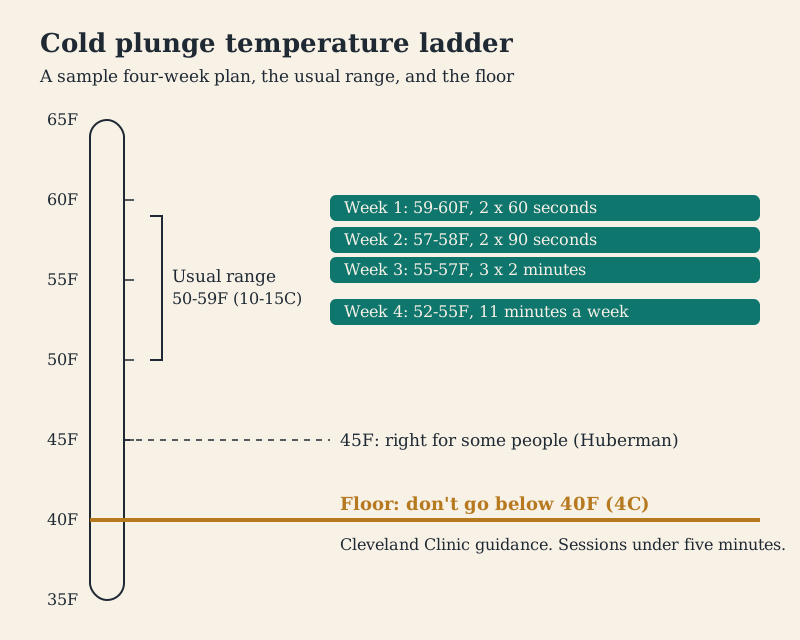
The usual cold plunge temperature is 50-59F (10-15C), the range Cleveland Clinic gives for beginners. Beginners start at the warm end, around 59-60F, and drop a few degrees a week. Cleveland Clinic's guidance is never to go below 40F (4C) and never to stay in longer than five minutes. The famous numbers, 250% more dopamine in the blood and a 350% jump in metabolism, come from a 2000 study in which young men sat in 14C water for an hour, so they tell you less about a two-minute dip than they seem to. Below are the range, a four-week plan, how long and how often to plunge, when to do it, and the signs you've gone too cold.
Quick reference
- Most people plunge at 50-59F (10-15C).
- Start around 59-60F for one to two minutes.
- Stay above 40F (4C) and under five minutes.
- Huberman's weekly target is 11 minutes in total, split into 2-4 sessions.
- End on cold and let your body rewarm itself.
- Plunge early in the day, and wait 6-8 hours after strength training.
What temperature should a cold plunge be?
Aim for 50-59F (10-15C). That's the beginner range Cleveland Clinic gives, and it matches the research: the trials in a 2025 meta-analysis of cold-water immersion used water between 7C and 15C (45-59F).
The thermometer reading matters less than how the water feels. Susanna Søberg, a metabolism researcher at the University of Copenhagen who studies winter swimmers, put it this way on the Huberman Lab podcast: "So as long as you get uncomfortable cold, it's cold enough." Andrew Huberman's test is similar. You want the thought "This is really cold (!), and I want to get out, BUT I can safely stay in." Some people tolerate cold far better than others, so that point might be 60F for one person and 45F for another.
Water feels colder than air at the same temperature for a physical reason. It conducts heat away from your body up to 26 times faster than air does, according to the National Weather Service.
Where the 250% dopamine number comes from
In a 2000 study (Šrámek and colleagues), young men sat in 14C water up to the neck for an hour, and the dopamine in their blood rose by 250%. Noradrenaline rose 530% and metabolic rate 350%. At 20C (68F) for an hour, metabolic rate rose 93%. At 32C (90F), it didn't change. Blood cortisol didn't rise at any of the three temperatures.
Those are real results with clear limits. Blood dopamine isn't brain dopamine, and a short plunge hasn't been tested for dopamine at all. Huberman's rule of thumb is that colder water needs less time, which fits the physics, but nobody has measured what one or two minutes at 55F does to dopamine. There's more on what that study does and doesn't say about dopamine in our dopamine guide.
Check it with a thermometer
Guessing doesn't work, because cold water always feels colder than it is in the first few seconds. A floating pool thermometer does the job. In a bathtub, run the cold tap and add ice until you reach your target, then check again before you get in. If you're weighing a tub against your shower, see cold shower vs cold plunge.
Cold plunge temperature by experience level
Jumping into 45F water on day one is a bad idea. Sudden cold triggers the cold shock response: a gasp, fast breathing and a racing heart. Huberman's advice is to start warmer than you think you need, because cold shock is possible.
Beginners: start near 60F (15C)
Begin at 59-60F for one to two minutes, once or twice a week, which is in line with Cleveland Clinic's beginner guidance. The first sessions are about learning to handle the first two minutes. The National Weather Service describes cold shock gasping and rapid breathing as lasting for "the first 2-3 minutes or more."
In the water:
- Lower yourself in slowly instead of jumping.
- Let the first gasp happen, then breathe out slowly through your mouth.
- Keep your breathing slow. Never hyperventilate on purpose before or during a plunge.
- Keep your head above water.
After a few weeks: the mid 50s
The gasp fades with practice. A 2024 meta-analysis of 17 groups found that the cold shock response shrinks after about four immersions, with the heart-rate jump falling by around 14 beats a minute. You're ready to go a couple of degrees colder when you can get in without gasping, your breathing settles quickly, and you feel alert instead of panicked.
Colder: 45-50F, and a floor at 40F
Huberman says the right temperature might be 45F (7C) for some people. Going colder isn't needed for the usual goals, and Cleveland Clinic advises never going below 40F (4C).
A sample four-week plan
This plan works down the temperature while building toward Huberman's suggested 11 minutes a week. Nobody has tested it as a protocol. Weeks 1 and 2 stay at two sessions, in line with Cleveland Clinic's once or twice a week for beginners, and week 3 adds a third. Repeat any week that feels too hard.
| Week | Water | Sessions | Time each | Weekly total |
|---|---|---|---|---|
| 1 | 59-60F (15C) | 2 | 60 seconds | 2 minutes |
| 2 | 57-58F (14C) | 2 | 90 seconds | 3 minutes |
| 3 | 55-57F (13-14C) | 3 | 2 minutes | 6 minutes |
| 4 | 52-55F (11-13C) | 3-4 | about 3-4 minutes | 11 minutes |
How cold is too cold? Safety thresholds
Below 40F (4C) is too cold for home plunging, by Cleveland Clinic's guidance. The bigger danger at any temperature is the cold shock in the first minutes.
Why the first minutes are the risky part
In a 2007 study, 13 men were lowered into 0C (32F) water for 30 seconds. Their breathing jumped from 16 to 38 breaths a minute, and the resulting hyperventilation cut blood flow speed in a main brain artery by 43% on average. Two of them showed signs of fainting. That's why slow breathing and a warmer start matter, and why you should never plunge alone or put your head under.
Signs to get out
Get out and warm up if you notice:
- breathing you can't slow down
- dizziness or blurred vision
- confusion or slurred speech
- clumsy hands or poor coordination
- shivering you can't stop
- chest pain
Numb hands and feet in the water are common. Numbness or confusion that lingers after you get out is not.
Who should check with a doctor first
Cleveland Clinic lists heart disease, high blood pressure, diabetes, pregnancy, peripheral neuropathy, poor circulation, venous stasis and cold agglutinin disease. Add Raynaud's and cold urticaria (hives from cold). Health note: if any of these apply to you, talk to your doctor before you start.
How long and how often: the 11-minute week
How long per session
Start with one to two minutes. Cleveland Clinic says "A session should never go longer than five minutes." Huberman's sessions sit inside that, at one to five minutes each.
Where 11 minutes comes from
Huberman's newsletter says: "Consider doing deliberate cold exposure for 11 minutes per week TOTAL", spread over 2-4 sessions of 1-5 minutes. The number comes from Søberg's research on experienced Danish winter swimmers, who dipped two to three times a week. When she added up their habits, it came to about 11 minutes of cold water a week, or one to two minutes per dip. Her 2021 study compared those swimmers with a control group. It didn't test 11 minutes against other doses, so treat it as a sensible target.
Several short dips over one long one
On the same podcast, Huberman and Søberg argued for short, separate sessions so that each one still delivers the cold shock. In Huberman's words, the idea is "to keep the stimulus a stimulus." No trial has compared one long session with several short ones. It's also easier to fit two minutes into a morning than eleven.
Count walls instead of seconds
Huberman calls the surges of "get me out of here" walls, and says they're adrenaline pulses. Each time one hits and you stay in, count it. He suggests setting a goal of 3-5 walls per session, or going for time if you prefer. Counting gives each session a clear end point.
Timing and temperature: when to plunge
Morning or early afternoon
Cold lowers your core temperature while you're in the water. Afterwards your body heats itself back up, and Huberman points out that a rising body temperature tends to wake you up. Søberg adds that the stress response makes it hard for some people to fall asleep. Both suggest plunging earlier in the day. If an evening plunge leaves you wired, move it earlier, and keep your bedroom temperature cool instead.
After lifting: wait 6-8 hours
In a 2015 study, 21 active men strength trained twice a week for 12 weeks, followed by either 10 minutes of cold water or 10 minutes of active recovery. Strength and muscle mass rose more in the active recovery group. Huberman's advice is to wait 6-8 hours or more after training, or plunge before you train. He says cold showers don't carry the same problem. More on when to plunge after a workout.
When you need calm instead
Cold works through the sympathetic nervous system, the fight-or-flight side. Šrámek's team concluded that the body's responses to cold in their study were mainly down to increased sympathetic activity. That's useful in the morning and less useful at 9 pm when you're already wound up. For those evenings, a downshift fits better: a few rounds of the physiological sigh or a short guided rest session.
The Søberg principle: why "end on cold" matters
What it says
Huberman named it after Søberg because the people in her study ended on cold. The rule is to finish with cold and let your body reheat on its own. Søberg explained on the Huberman Lab podcast that "when you end on the cold, you force your body to heat up by itself. And that will require that you keep your brown fat activated and also your muscles." No trial has compared ending on cold with ending on heat. If you also use a sauna, the principle means doing the sauna first and the plunge last.
The afterdrop
Your core temperature keeps falling for a while after you get out. In the water, blood vessels in your skin clamp down to keep warm blood around your organs. Once you're out, they open again, warm blood flows to the cold skin, cools, and returns to your core. That's why you can feel colder a few minutes after the plunge than you did in it, and why shivering often starts after you get out.
What to do after you get out
Huberman's version is specific. Don't huddle or cross your arms, don't towel off, and let your body reheat and dry naturally. Shivering is part of it: he notes that shivering releases succinate from muscle, which further activates brown fat. A hot shower straight away skips the rewarming the principle is about.
Cleveland Clinic is more cautious and says to dry off quickly and put on warm clothes. If you're new to plunging, you're outdoors, or you're shivering hard, follow that advice and warm up.
Use the thermal layer to change the dose
When you sit still in cold water, your body warms a thin layer of water against your skin, and it insulates you a little. Huberman's advice is to move your limbs, keeping your hands and feet in the water, to break that layer. The same water then feels much colder.
That lets you change the dose without changing the temperature:
- Stay still when the water is already at your limit.
- Move when you've adapted to a temperature you can't lower, like a lake in summer or a tub without a chiller.
FAQ
Is 50 degrees cold enough for a cold plunge?
Yes, 50F (10C) is cold enough. It's at the cold end of the usual 50-59F range. The best-known hormone measurements were taken at 57F (14C), after an hour, and nobody has shown that going colder than 50F adds anything for most goals.
What temperature is too cold for a cold plunge?
Below 40F (4C) is too cold, by Cleveland Clinic's guidance. In near-freezing water, the fast breathing of cold shock can slow blood flow to the brain enough to bring people close to fainting. In a 2007 study at 0C, two of 13 men showed signs of it within 30 seconds.
How long should I stay in a cold plunge?
Stay in a cold plunge for one to two minutes at first, and never more than five minutes per session. Huberman's weekly target is 11 minutes in total, split across 2-4 sessions of 1-5 minutes each.
Should I take a hot shower after a cold plunge?
Skip the hot shower straight afterwards if you're following the Søberg principle. Ending on cold makes your body rewarm itself through brown fat and muscle activity. Cleveland Clinic's advice is to dry off quickly and put on warm clothes, and if you're shaking hard, confused or can't warm up, get warm right away.
Can cold plunging before bed disrupt sleep?
Cold plunging close to bed can disrupt sleep for some people. Your body heats itself back up after a plunge, and the stress response raises alertness. Huberman suggests plunging early in the day, and if cold affects your sleep, doing it earlier or not at all.
What temperature does Huberman recommend for cold plunge?
Huberman doesn't give one cold plunge temperature. He says it might be 60F for some people and 45F for others, and that the water should feel "uncomfortably cold yet safe to stay in for a few minutes." His weekly target is 11 minutes in total, across 2-4 sessions.
Sources
- Šrámek P, Šimečková M, Janský L, Šavlíková J, Vybíral S (2000). Human physiological responses to immersion into water of different temperatures. European Journal of Applied Physiology, 81(5):436-442. https://pubmed.ncbi.nlm.nih.gov/10751106/
- Søberg S, Löfgren J, Philipsen FE, et al. (2021). Altered brown fat thermoregulation and enhanced cold-induced thermogenesis in young, healthy, winter-swimming men. Cell Reports Medicine, 2(10):100408. https://pubmed.ncbi.nlm.nih.gov/34755128/
- Mantoni T, Belhage B, Pedersen LM, Pott FC (2007). Reduced cerebral perfusion on sudden immersion in ice water: a possible cause of drowning. Aviation, Space, and Environmental Medicine, 78(4):374-376. https://pubmed.ncbi.nlm.nih.gov/17484338/
- Roberts LA, Raastad T, Markworth JF, et al. (2015). Post-exercise cold water immersion attenuates acute anabolic signalling and long-term adaptations in muscle to strength training. Journal of Physiology, 593(18):4285-4301. https://pubmed.ncbi.nlm.nih.gov/26174323/
- Cain T, Brinsley J, Bennett H, Nelson M, Maher C, Singh B (2025). Effects of cold-water immersion on health and wellbeing: A systematic review and meta-analysis. PLoS One, 20(1):e0317615. https://pubmed.ncbi.nlm.nih.gov/39879231/
- Barwood MJ, Eglin C, Hills SP, et al. (2024). Habituation of the cold shock response: A systematic review and meta-analysis. Journal of Thermal Biology, 119:103775. https://pubmed.ncbi.nlm.nih.gov/38211547/
- Huberman A (2022). The Science & Use of Cold Exposure for Health & Performance. Huberman Lab newsletter, 1 May 2022. https://www.hubermanlab.com/newsletter/the-science-and-use-of-cold-exposure-for-health-and-performance
- Huberman Lab (2023). Dr. Susanna Søberg: How to Use Cold & Heat Exposure to Improve Your Health. Podcast episode, 15 May 2023. https://www.hubermanlab.com/episode/dr-susanna-soberg-how-to-use-cold-and-heat-exposure-to-improve-your-health
- Cleveland Clinic (2026). Are 'Cold Plunge' Ice Baths Good for You? Health Essentials, 8 May 2026. https://health.clevelandclinic.org/what-to-know-about-cold-plunges
- National Weather Service. Cold Water Safety. https://www.weather.gov/safety/coldwater
- National Weather Service, Caribou ME. The Hazards of Cold Water Boating. https://www.weather.gov/car/TheHazardsofcoldwaterboating