Cyclic hyperventilation is a breathing drill. You take about 30 deep breaths in a row, breathe all the way out, and hold with empty lungs for about 15 seconds, then repeat for three rounds. It's designed to wake you up, and in lab studies this style of breathing raised adrenaline in the blood. A session takes about five minutes.
One rule first. Do it sitting or lying down on dry land. Never in or near water, never in the bath, never while driving.
What is cyclic hyperventilation?
The basic pattern
Each round has three parts:
- A run of deep breaths. About 25 to 30, in through the nose, with each exhale let go rather than pushed.
- An empty-lung hold. After the last breath you breathe all the way out and wait, usually for 15 to 30 seconds.
- A reset breath. You breathe in and either return to normal breathing or start the next round.
The inhale does the work and the exhale is a release. That lopsided ratio makes it an activation drill, used to feel more awake or to practise staying calm while the body is revved up. Calming techniques stretch the exhale instead.
Where the name comes from
Researchers use the name. A 2014 Dutch study described the breathing in Wim Hof's training as "cyclic hyperventilation followed by breath retention", and Stanford neuroscientist Andrew Huberman uses the term in his protocols. A 2023 Stanford trial (Balban et al.) tested it as "cyclic hyperventilation with retention", one of three daily breathing drills compared with mindfulness meditation. Wim Hof breathing is the best-known version.
How does cyclic hyperventilation work?
You blow off carbon dioxide
Breathing deeply and fast clears carbon dioxide from your blood faster than your body makes it. As Cleveland Clinic puts it, hyperventilation "creates a low level of carbon dioxide in your blood". Your blood turns slightly alkaline, and the low CO2 narrows blood vessels, including the ones that supply the brain.
That narrowing is where the familiar sensations come from: tingling in the arms or around the mouth, lightheadedness, a slightly floaty, detached feeling. They're expected, and the Wim Hof Method describes them as temporary. They also come from the same mechanism that makes people faint, which is why the setup rules matter.
Adrenaline goes up
In a 2014 study by Kox and colleagues, 12 volunteers trained for 10 days in meditation, cold exposure and cyclic hyperventilation with breath holds. When they practised the techniques, their blood became alkaline, oxygen dipped, and plasma epinephrine (adrenaline) rose sharply. The authors noted that the autonomic nervous system had been regarded as something people couldn't voluntarily influence.
That study mixed three practices. In a 2022 follow-up from the same team (Zwaag et al.), the breathing exercise on its own raised epinephrine in healthy young men, however long they'd trained and whoever taught them. That's the clearest evidence that the breathing itself tips the body's sympathetic and parasympathetic branches toward the "go" side. Adrenaline works alongside norepinephrine, the brain's main alertness chemical.
Huberman describes the result as a boost in alertness and focus. Focus wasn't measured in the studies above, so treat that part as plausible but untested.
Why the hold feels easy, and why that matters
The urge to breathe during a breath hold comes mostly from rising carbon dioxide. After 30 big breaths your CO2 starts low, so the urge takes longer to arrive and the hold feels oddly comfortable.
A 2024 lab study shows the catch. Nine non-divers, after an overnight fast, held their breath as long as they could three times in a row, once after normal breathing and once after 30 seconds of hyperventilation. After hyperventilating, the first involuntary breathing movements arrived later (a median of 134 seconds versus 97) and the holds lasted longer (220 seconds versus 185). Oxygen kept falling the whole time. Eight of the nine times a volunteer hit the safety cut-off of 65% blood oxygen were in the hyperventilation trials. The warning signal arrives late, and oxygen can run out first.
Cyclic hyperventilation vs cyclic sighing: when to use each
Two opposite jobs
Cyclic sighing is two inhales through the nose followed by a long, slow exhale through the mouth, repeated for a few minutes. Cyclic hyperventilation leans on the inhale. Cyclic sighing leans on the exhale.
That difference matters because your heart rate follows your breath. It speeds up a little on each inhale and slows on each exhale, a normal rhythm called respiratory sinus arrhythmia. Long exhales tip you toward calm. Big, fast inhales tip you toward arousal.
What the Stanford trial found
The 2023 Stanford trial randomised 108 adults to 5 minutes a day of cyclic sighing, box breathing, cyclic hyperventilation or mindfulness meditation for a month. Every group felt better straight after each session. The groups differed in three ways:
- Mood. The cyclic hyperventilation group's positive mood rose by about 2 points per session on a 10 to 50 scale (1.97), against 1.22 for meditation. The arm that beat meditation over the month was cyclic sighing.
- Anxiety. Of the breathing drills, cyclic hyperventilation lowered state anxiety least (−1.81 points) and cyclic sighing most (−3.85), roughly twice as much. Meditation came out at −3.95.
- Body measures. Over the month, cyclic sighing slowed people's resting breathing rate. No group changed its heart rate variability or resting heart rate.
It was a small, exploratory study that wasn't pre-registered, and it excluded people with heart disease, seizures, pregnancy and several psychiatric conditions.
Which one to pick
Pick cyclic hyperventilation when you want more energy and you already feel steady. Pick cyclic sighing, or the physiological sigh it's built on, when you feel stressed, wired or anxious. Huberman's own newsletter says "Even just 1-3 physiological sighs can allow us to stay in or return to a calmer state." For more calming options, see these breathing exercises for stress.
How to perform cyclic hyperventilation in 5 steps
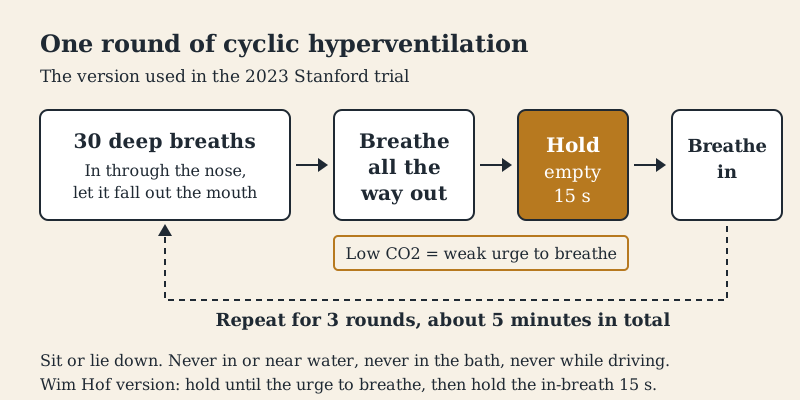
These steps follow the Stanford trial's version. The Huberman and Wim Hof variations come after.
Step 1: Sit or lie down somewhere safe
Use a chair, a sofa or the floor, somewhere you can't fall or hit anything if you get dizzy. Set a timer for 5 minutes. No water, no bath, no car.
Step 2: Take 30 deep breaths
Breathe in deeply through your nose (your mouth is fine if your nose is blocked). Then let the air "fall out from the mouth", as the trial instructions put it. Don't push it out. One deep inhale plus one passive exhale counts as one breath. Do 30 in a steady rhythm.
Step 3: Breathe all the way out
After the 30th breath, exhale fully through your mouth until your lungs feel empty.
Step 4: Hold on empty lungs for 15 seconds
Hold, relaxed, for 15 seconds, the hold used in the trial. Huberman's newsletter gives 15 to 30 seconds. Don't push past the point where you'd need to strain. Tingling is normal. Feeling faint, seeing spots or your vision narrowing means stop and breathe normally.
Step 5: Breathe in and repeat for 3 rounds
Take a normal breath in, then start the next set of 30. Three rounds is the trial protocol and fits in about five minutes. When you finish, breathe normally for a while before you stand up.
How the versions differ
- Stanford trial: 30 breaths, full exhale, 15-second empty hold, 3 rounds.
- Huberman newsletter: 25 breaths, full exhale, 15 to 30-second hold, repeated for up to 5 minutes.
- Wim Hof: 30 breaths, hold after the last exhale until you feel the urge to breathe, then a big recovery breath held for 15 seconds, 3 to 4 rounds.
The Wim Hof safety page says: "If you've fainted, that means you went too far, and have to take it easier next time." Shorter holds and fewer rounds are the fix. Holds that keep getting longer within a session are a warning sign. CO2 is staying low and the urge to breathe is arriving later, so they don't count as progress.
Safety: water, driving and blackouts
Never near water or while driving
Huberman's newsletter says: "And never, ever perform cyclic hyperventilation near or in any body of water or while driving." The Wim Hof Method's safety page adds diving, swimming and taking a bath to the list.
Hyperventilating before a breath hold underwater is a known cause of drowning, called hypoxic or shallow water blackout. Swimmers and divers can lose consciousness before they feel a strong urge to breathe. Live Science reports that in 2016 the Amsterdam newspaper Het Parool counted at least three deaths among people who had combined Wim Hof breathing with water. Pulmonary medicine doctor Frank Pernett, himself a free diver, put it plainly to Live Science: "If you are underwater and you faint, and nobody is there to help, you will die."
On land, Cleveland Clinic notes, fainting from hyperventilation is rare but can lead to injury. That's why the position rule in step 1 isn't optional, and why driving straight after a session is a bad idea too.
Who should skip it
The Stanford trial excluded people with heart disease, glaucoma, a history of seizures, pregnancy, psychosis, bipolar disorder, suicidality or substance use disorders. The Wim Hof Method says not to practise while pregnant or with epilepsy, and to see a doctor first with any heart condition.
Panic is the other big one. "We know that people who are breathing very rapidly feel more anxious, such as during a panic attack," said Stanford psychiatrist David Spiegel, a co-author of the trial. Huberman's newsletter asks for caution if you're prone to panic attacks or high anxiety.
Health note: don't try cyclic hyperventilation if you're pregnant or have epilepsy or a seizure history. If you have a heart condition, glaucoma or panic attacks, talk to your doctor first.
Pros and cons of cyclic hyperventilation
Pros
- Free and short. No equipment, about five minutes.
- A measurable mood lift. In the Stanford trial, positive mood rose after sessions (1.97 points on a 10 to 50 scale).
- Easy to learn. Across the trial, 74% of participants found their exercise easy and 90% reported positive experiences.
Cons
- Weakest anxiety relief of the breathing drills tested. Cyclic sighing cut state anxiety about twice as much.
- Uncomfortable for some. Huberman says to expect to feel "a little tingly or agitated" afterwards, and 10% of participants across all four groups of the trial reported negative experiences.
- Easy to overdo. The Wim Hof Method warns that intense practice over several rounds can, in rare cases, make you lose consciousness.
- Long-term benefits are unproven. Huberman argues repeated practice raises your stress threshold. The one month-long trial found no change in trait anxiety, heart rate variability or sleep.
Should you use cyclic hyperventilation?
It suits you if
- You want to feel more awake on demand, before a hard task or a workout. No study has shown it improves performance.
- You want to practise staying calm under arousal. That's Huberman's rationale. You get agitated on purpose and stay composed through the hold.
Skip it if
- You're already anxious, wired or panicky. Use cyclic sighing instead.
- You have one of the medical exclusions above, or you're unsure.
- You're anywhere near water or about to drive.
It's built to raise arousal, so earlier in the day makes more sense than right before bed. The trial measured sleep and found no effect either way.
Balancing activation with recovery: where NSDR fits
Non-sleep deep rest is guided, awake rest lying down, usually 10 to 30 minutes. It does the opposite job to cyclic hyperventilation, and unlike a nap, you get up without grogginess. A sensible pairing is cyclic hyperventilation before a workout or a demanding morning, and NSDR or slow, exhale-heavy breathing afterward. NSDR.co is free, and its guided breathwork techniques include calming patterns for that second half.
FAQ
Is cyclic hyperventilation safe?
On dry land, sitting or lying down, the main risk of cyclic hyperventilation for most healthy adults is fainting, which is why water, baths and driving are off-limits. Skip it if you're pregnant or have a seizure history, and ask your doctor first if you have heart disease, glaucoma or panic attacks.
What is the difference between cyclic hyperventilation and Wim Hof breathing?
Wim Hof breathing is the best-known version of cyclic hyperventilation. The main differences are in the hold. Wim Hof holds until you feel the urge to breathe, then adds a recovery breath held for 15 seconds, while the Stanford version uses a fixed 15-second hold. The full Wim Hof Method also adds cold exposure.
Can cyclic hyperventilation help with stress?
It can lift your mood in the moment, but it's a weak tool for calming down. In the Stanford trial it reduced state anxiety the least of the breathing drills, about half as much as cyclic sighing. The idea that it trains stress tolerance over time is Huberman's theory, and the trial found no change in trait anxiety after a month.
How long should I hold my breath during cyclic hyperventilation?
Hold for 15 seconds, the hold used in the Stanford trial, or up to 30 seconds as Huberman's newsletter suggests. Longer isn't better. Hyperventilating delays the urge to breathe while oxygen keeps falling, so chasing long holds raises the blackout risk.
What's the difference between cyclic hyperventilation and cyclic sighing?
The difference is which part of the breath gets the emphasis. Cyclic hyperventilation stresses big inhales and raises arousal and adrenaline. Cyclic sighing uses a double inhale and a long exhale and lowers arousal. In the Stanford trial, cyclic sighing cut anxiety about twice as much and was the drill that beat meditation on mood.
Sources
- Balban MY, Neri E, Kogon MM, Weed L, Nouriani B, Jo B, Holl G, Zeitzer JM, Spiegel D, Huberman AD (2023). Brief structured respiration practices enhance mood and reduce physiological arousal. Cell Reports Medicine 4(1):100895. https://pubmed.ncbi.nlm.nih.gov/36630953/
- Kox M, van Eijk LT, Zwaag J, van den Wildenberg J, Sweep FC, van der Hoeven JG, Pickkers P (2014). Voluntary activation of the sympathetic nervous system and attenuation of the innate immune response in humans. PNAS 111(20):7379-84. https://pubmed.ncbi.nlm.nih.gov/24799686/
- Zwaag J, Naaktgeboren R, van Herwaarden AE, Pickkers P, Kox M (2022). The effects of cold exposure training and a breathing exercise on the inflammatory response in humans: a pilot study. Psychosomatic Medicine 84(4):457-467. https://pubmed.ncbi.nlm.nih.gov/35213875/
- Elia A, Gennser M, Eiken O, Keramidas ME (2024). Effects of hyperventilation on repeated breath-holding while in a fasting state: do risks outweigh the benefits? American Journal of Physiology: Regulatory, Integrative and Comparative Physiology. https://pmc.ncbi.nlm.nih.gov/articles/PMC11550997/
- Yasuma F, Hayano J (2004). Respiratory sinus arrhythmia: why does the heartbeat synchronize with respiratory rhythm? Chest 125(2):683-90. https://pubmed.ncbi.nlm.nih.gov/14769752/
- Bart RM, Murray BP, Lau H (2026). Shallow water blackout. StatPearls. https://pubmed.ncbi.nlm.nih.gov/32119507/
- Huberman Lab newsletter. Breathwork protocols for health, focus and stress. https://www.hubermanlab.com/newsletter/breathwork-protocols-for-health-focus-stress
- Wim Hof Method. Breathing exercises; Safety warnings. https://www.wimhofmethod.com/breathing-exercises and https://wimhofmethod.com/safety-warnings
- Cleveland Clinic. Hyperventilation. https://my.clevelandclinic.org/health/diseases/hyperventilation
- Pester P (2024). 'Gambling with your life': Experts weigh in on dangers of the Wim Hof method. Live Science. https://www.livescience.com/health/gambling-with-your-life-experts-weigh-in-on-dangers-of-the-wim-hof-method
- Stanford Medicine (2023). Cyclic sighing can help breathe away anxiety. https://med.stanford.edu/news/insights/2023/02/cyclic-sighing-can-help-breathe-away-anxiety.html