HRV, or heart rate variability, is the small change in time from one heartbeat to the next, measured in milliseconds. A higher number usually means more input from the calming side of your nervous system. A lower one often follows stress, short sleep, alcohol or hard training. In large studies, lower HRV goes with higher mortality.
What is HRV? The 30-second answer
Your heart doesn't tick like a clock. At a resting 60 beats a minute, one gap between beats might be 940 milliseconds and the next 1,060. HRV summarises how much those gaps vary. As Fred Shaffer and J.P. Ginsberg put it in their 2017 review, "A healthy heart is not a metronome."
Exercise scientist Andy Galpin put it this way on his 2023 Huberman Lab recovery episode: under "extremely high stress, you will be very rhythmic", and a low HRV "means you're probably pretty stressed and wired".
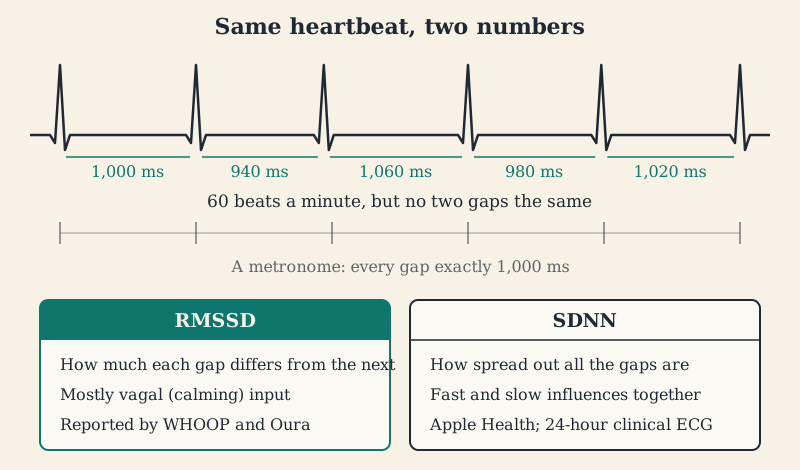
So more irregularity is the healthy pattern, mostly because it reflects more input from the vagus nerve. Higher isn't always better, though. Rhythm problems such as atrial fibrillation can push the number up, and an ECG is how doctors tell the two apart.
How HRV works: the nervous system connection
Two branches of your autonomic nervous system act on the heart's pacemaker. The sympathetic branch speeds it up; the parasympathetic branch slows it down. They work on different clocks. Parasympathetic signals act in under a second, and sympathetic ones take more than 5.
Breathing adds its own rhythm. Your heart speeds up a little on every in-breath and slows on every out-breath, driven by a blood-pressure reflex.
Under stress, sympathetic input rises and vagal input falls, so the gaps even out. That makes HRV a useful stress signal, and a noisy one, because it also shifts with time of day and last night's choices.
The vagus nerve's role
The vagus nerve carries the "slow down" signal to the heart. That breathing-linked speed-up and slow-down is called respiratory sinus arrhythmia. Stanford neuroscientist Andrew Huberman calls it "the basis of what we call heart rate variability" (How to Breathe Correctly, 2023).
More vagal activity shows up as a higher RMSSD, the beat-to-beat measure WHOOP and Oura report. Breathing is the part you can change on purpose. A 2022 meta-analysis of 223 studies found slow breathing raises vagally driven HRV during a session, just after it, and after programmes of repeated sessions.
What is a good HRV? Normal ranges by age
There's no official healthy range. A 2010 review of 44 studies found no agreed normal values for short recordings. What exists are reference numbers from specific groups.
Among WHOOP members, the middle half of 20-to-25-year-olds sit between 55 and 105 ms, and 60-to-65-year-olds between 25 and 45 ms. That's overnight RMSSD from a wrist strap, in a membership WHOOP says tends to be athletes and health-conscious people.
The best population numbers come from Germany's KORA study: 1,906 healthy adults, 5-minute ECGs taken lying down.
| Age | RMSSD, women (ms) | RMSSD, men (ms) |
|---|---|---|
| 25-34 | 43 | 40 |
| 35-44 | 35 | 32 |
| 45-54 | 26 | 23 |
| 55-64 | 21 | 20 |
| 65-74 | 19 | 19 |
A 5-minute reading lying down isn't the same measurement as an overnight average, so don't mix the two charts. Both show the same shape. The number roughly halves from youngest to oldest, and in KORA it barely moved after the late 50s.
You'll also see "below 50 ms is unhealthy, above 100 ms is healthy". Those bands come from 24-hour recordings in 808 people who had recently survived a heart attack (Kleiger 1987). SDNN under 50 ms carried 5.3 times the risk of death of SDNN over 100 ms. They don't describe a healthy person's overnight reading.
RMSSD vs SDNN: why your watch and your ring disagree
RMSSD measures how much each gap differs from the next, which mostly tracks vagal input. SDNN measures how spread out all the gaps are, mixing fast and slow influences; over 24 hours it's the clinical risk standard.
Apple Health has long recorded Apple Watch HRV as SDNN (the data type is named heartRateVariabilitySDNN), while WHOOP and Oura report RMSSD during sleep. A 2025 test of five devices against an ECG, in 13 adults over 536 nights, found Oura's rings most accurate and WHOOP moderate. The one Garmin and one Polar model tested agreed poorly. It's a small study, so treat it as a rough guide. Pick one device and stay with it.
Why your HRV changes day to day
Daily swings are normal. In 11 Olympic water polo players, WHOOP's overnight HRV varied by about 5% across a typical week. In 4,098 Finnish employees, alcohol lowered HRV in the first hours of sleep, more drinks lowered it more, and even low doses showed up. A 2025 meta-analysis of 11 trials found sleep deprivation lowered RMSSD.
One low reading isn't a reason to change your day. When coaching athletes, Galpin watches more closely after three to five low days in a row, and says he's "still really not going to take much action until that crosses more than seven days of consistent problems."
How to track HRV (without overcomplicating it)
Measure the same way every time; an overnight average from a ring or strap is easiest. Galpin suggests collecting at least a month, and up to six weeks, at roughly the same time before acting on the number, then using a running average.
He also pairs it with one subjective check, such as how you feel today. If the number drops while you feel fine, first ask whether you measured the usual way.
The week-over-week rule
Compare Monday with last Monday, not with Tuesday. Galpin's reasoning is that Monday's number reflects what you did on Sunday, and most weeks repeat.
Once you know your usual range, a reading outside it for several days is the one worth acting on. If you're following a step-by-step reset plan, that trend is your progress check.
Why HRV matters: what the research shows
The strongest evidence is a 2022 meta-analysis of 32 studies and 38,008 people. Lower HRV predicted higher mortality across ages, sexes and populations. People in the lowest quarter of 5-minute RMSSD had about 1.56 times the risk of everyone else, and the link held after correcting for heart rate. That's an association; whether raising your own number lowers your risk is still an open question.
For recovery, Galpin prefers HRV. Resting heart rate rises with alcohol, smoking and psychological stress, but he says it's "not sensitive enough" to catch a hard training session, while HRV is "a significantly better marker". WHOOP notes a downward trend can be one of the signs of overtraining.
Health note: a wearable's HRV is not a diagnostic test. Beta-blockers, other heart and blood-pressure drugs, and some antidepressants change it. If you have palpitations, dizziness or chest pain, see a doctor whatever the number says.
How to improve HRV: 3 protocols that work
The extended exhale protocol
Slow breathing raises HRV while you do it (see the 223-study review above). HRV biofeedback trains people to breathe at their own "resonance" rate, somewhere between 4.5 and 7.5 breaths a minute. Six a minute sits in the middle, and a 4-second in, 6-second out count gets you there. The evidence covers the slow pace, not the longer exhale itself.
- Sit or lie down and breathe through your nose.
- Breathe in for 4 seconds and out for 6.
- Keep going for 5 minutes, the daily dose in Stanford's breathing trial.
The guided coherent breathing session paces about 6 breaths a minute for you. Keep expectations honest about the physiological sigh. In Stanford's month-long trial, 5 minutes a day of cyclic sighing lifted mood more than mindfulness did, but HRV didn't differ between groups.
Sleep and recovery practices
Protecting sleep and limiting alcohol come first, because both show up in your overnight number (see above). Exercise helps too. A meta-analysis of 13 training studies (322 people) found vagal HRV rose with training. Among 8 million Fitbit users, more active people had higher HRV at every age, though that's a correlation.
Guided rest is less proven for HRV. In a 2026 trial of 102 young adults, one 10-minute NSDR session lowered heart rate more than a control session, but HRV didn't differ. A small study of 20 adults did see HRV shift toward the calming side during yoga nidra, but it had no comparison session without yoga nidra. The NSDR trial did find lower stress and sleepiness ratings, so use it to downshift, without expecting it to move your number.
The cold exposure paradox
Cold water drops HRV first. Galpin says HRV is "significantly compromised" within seconds of getting out, then keeps rising over the next 15 to 180 minutes, in testing he describes without citing a paper. Published work supports the later rise. In 18 trained cyclists, 10 minutes of cold water after hard riding raised RMSSD during recovery more than passive rest did. So wait a few hours after a cold plunge before you check HRV.
FAQ
What is HRV, in one sentence?
HRV, in one sentence, is the beat-to-beat change in the time between heartbeats, measured in milliseconds, and a higher one mostly means more calming vagal input to your heart.
What is a good HRV for my age?
A good HRV for your age is best judged against your own baseline. For reference, healthy adults on a 5-minute ECG average about 40 ms at 25 to 34 and about 20 ms at 55 to 64; overnight wearable numbers run higher.
Is 70 a good HRV?
An HRV of 70 is above the WHOOP member average for anyone over about 30, if it's an overnight RMSSD from a ring or strap. For a 25-year-old, whose WHOOP average is 78, it's below. There's no official healthy range, and Apple Watch reports SDNN, a different scale. What matters more is whether 70 is normal for you.
What is the fastest way to increase HRV?
The fastest way to increase HRV is slow breathing at about 6 breaths a minute, which raises it while you do it. Skipping alcohol and protecting sleep stop your overnight number dropping.
How long does it take to improve HRV?
How long HRV takes to improve depends on the method: minutes for a slow-breathing session, longer for lasting change from repeated practice or exercise training. Collect four to six weeks of baseline first so you can see a change.
Does HRV go down with age?
Yes, HRV goes down with age. Beat-to-beat measures such as RMSSD fall fastest until about your 50s, then level off. Women have lower SDNN than men but more vagal activity, according to a meta-analysis of 63,612 people.
Sources
- Shaffer F, Ginsberg JP (2017). An overview of heart rate variability metrics and norms. Frontiers in Public Health. https://pubmed.ncbi.nlm.nih.gov/29034226/
- Kleiger RE et al. (1987). Decreased heart rate variability and its association with increased mortality after acute myocardial infarction. American Journal of Cardiology. https://pubmed.ncbi.nlm.nih.gov/3812275/
- Jarczok MN et al. (2022). Heart rate variability in the prediction of mortality. Neuroscience & Biobehavioral Reviews. https://pubmed.ncbi.nlm.nih.gov/36243195/
- Voss A et al. (2015). Short-term heart rate variability: influence of gender and age. PLoS One. https://pubmed.ncbi.nlm.nih.gov/25822720/
- Nunan D et al. (2010). Normal values for short-term heart rate variability in healthy adults. Pacing and Clinical Electrophysiology. https://pubmed.ncbi.nlm.nih.gov/20663071/
- Natarajan A et al. (2020). Heart rate variability with photoplethysmography in 8 million individuals. Lancet Digital Health. https://pubmed.ncbi.nlm.nih.gov/33328029/
- Koenig J, Thayer JF (2016). Sex differences in healthy human heart rate variability. Neuroscience & Biobehavioral Reviews. https://pubmed.ncbi.nlm.nih.gov/26964804/
- Dial MB et al. (2025). Validation of nocturnal resting heart rate and HRV in consumer wearables. Physiological Reports. https://pubmed.ncbi.nlm.nih.gov/40834291/
- Bellenger CR et al. (2022). Day-to-day variability of WHOOP-derived HRV in Olympic water polo athletes. Sensors. https://pubmed.ncbi.nlm.nih.gov/36146073/
- Pietilä J et al. (2018). Acute effect of alcohol intake on cardiovascular autonomic regulation during sleep. JMIR Mental Health. https://pubmed.ncbi.nlm.nih.gov/29549064/
- Zhang S et al. (2025). Effects of sleep deprivation on heart rate variability. Frontiers in Neurology. https://pubmed.ncbi.nlm.nih.gov/40895095/
- Laborde S et al. (2022). Effects of voluntary slow breathing on heart rate and HRV. Neuroscience & Biobehavioral Reviews. https://pubmed.ncbi.nlm.nih.gov/35623448/
- Balban MY et al. (2023). Brief structured respiration practices enhance mood and reduce physiological arousal. Cell Reports Medicine. https://pubmed.ncbi.nlm.nih.gov/36630953/
- Sandercock GR et al. (2005). Effects of exercise on heart rate variability. Medicine & Science in Sports & Exercise. https://pubmed.ncbi.nlm.nih.gov/15741842/
- Boukhris O et al. (2026). Responses to a single non-sleep deep rest session. Applied Psychology: Health and Well-Being. https://pubmed.ncbi.nlm.nih.gov/42383502/
- Markil N et al. (2012). Yoga Nidra relaxation increases heart rate variability. Journal of Alternative and Complementary Medicine. https://pubmed.ncbi.nlm.nih.gov/22866996/
- Stanley J et al. (2012). Post-exercise hydrotherapy, exercise performance and heart rate variability. European Journal of Applied Physiology. https://pubmed.ncbi.nlm.nih.gov/21710292/
- Umetani K et al. (1998). Twenty-four hour time domain heart rate variability and heart rate: relations to age and gender over nine decades. Journal of the American College of Cardiology. https://pubmed.ncbi.nlm.nih.gov/9502641/
- Cao R et al. (2022). Accuracy assessment of Oura Ring nocturnal heart rate and heart rate variability in comparison with electrocardiography. Journal of Medical Internet Research. https://pubmed.ncbi.nlm.nih.gov/35040799/
- WHOOP (2026). What is a good HRV? https://www.whoop.com/us/en/thelocker/what-is-a-good-hrv/
- Healthline. Heart rate variability and what it means. https://www.healthline.com/health/fitness/what-is-heart-rate-variability
- Apple Developer Documentation. heartRateVariabilitySDNN. https://developer.apple.com/documentation/healthkit/hkquantitytypeidentifier/heartratevariabilitysdnn
- Huberman Lab (2023). Guest Series, Dr. Andy Galpin: Maximize Recovery to Achieve Fitness & Performance Goals. https://www.hubermanlab.com/episode/guest-series-dr-andy-galpin-maximize-recovery-to-achieve-fitness-and-performance-goals
- Huberman Lab (2023). How to Breathe Correctly for Optimal Health, Mood, Learning & Performance. https://www.hubermanlab.com/episode/how-to-breathe-correctly-for-optimal-health-mood-learning-and-performance