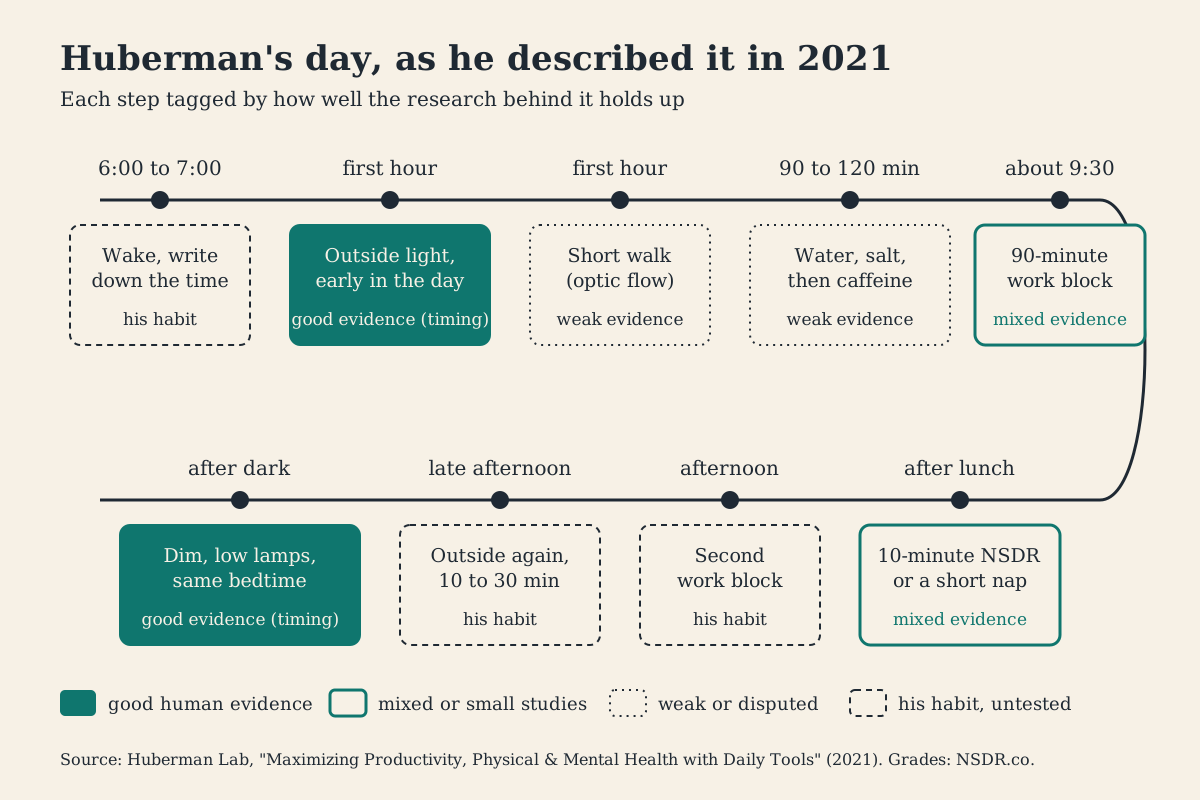
The Andrew Huberman daily routine, in his own telling, goes like this. He wakes between 6:00 and 7:00, goes outside for light and a short walk, drinks water and waits 90 to 120 minutes for caffeine. Then comes a 90-minute block of his hardest work, a short deep-rest session after lunch, a second work block, training most days, late-afternoon light, dim lights in the evening and a cool bedroom. He described it step by step in a 2021 Huberman Lab episode, "Maximizing Productivity, Physical & Mental Health with Daily Tools", and updated parts of it in later toolkit episodes.
Below is each habit, what he says it does, and how well the research holds up. Some of it is solid. Some rests on mouse studies or his own experience.
TL;DR: the 8 habits
- Light within 30 to 60 minutes of waking. About 5 minutes on a clear day, 20 to 30 under heavy cloud.
- A short morning walk. He does it to lower anxiety. The studies he cites didn't test walking.
- Water with a little sea salt, then caffeine 90 to 120 minutes after waking. A 2024 review found no evidence the delay prevents an afternoon crash.
- A 90-minute block of hard work each morning, phone off. The 90-minute waking rhythm behind it is contested.
- NSDR or a short nap after lunch. NSDR leaves no grogginess. The trials are few and small.
- Cold water, about 11 minutes a week. The dopamine figure comes from an hour at 14°C.
- Training six days a week. Each muscle worked about twice a week in his 2022 plan.
- Afternoon light, dim evenings, a cool room, a fixed bedtime. Regular sleep timing has some of the best data on this list.
Morning light: the habit he rates highest
If you copy one part of the Andrew Huberman daily routine, copy this. In the 2021 episode he names two habits worth doing every single day: morning sunlight and a regular sleep schedule.
What to do
Get outside within 30 to 60 minutes of waking. "The protocol is get outdoors, ideally with no sunglasses if you can do that safely," he says. Don't stare at the sun.
How long depends on the sky. His Sleep Toolkit episode (2022) suggests:
- Clear day: about 5 minutes
- Cloud cover: about 10 minutes
- Dense overcast or rain: 20 to 30 minutes
His figures shift between episodes. In 2021 he called 2 minutes the minimum and 30 "fantastic". Light through a window doesn't count, in his words: "just don't try and do it through a windshield, sunglasses, or a window."
Why the timing matters
Cells in the eye that contain melanopsin report light to the brain's master clock in the hypothalamus. Morning light puts your cortisol peak early in the day. In a small lab study of 8 men kept awake overnight, three hours of bright light from 5 a.m. raised cortisol by more than 50% (Leproult, 2001).
Huberman adds a warning about a cortisol pulse that arrives in the evening: "it's a signature of depression and anxiety disorder." He then says nobody knows whether it's cause or effect. He calls midday the "circadian dead zone", when he says light barely moves the clock. A Harvard lab study of 6.7-hour bright-light sessions in 21 people found "no prolonged 'dead zone'" during the day (Khalsa et al., 2003), so midday light isn't wasted. Morning light is the dependable part.
Sunlight on skin
A 2021 Israeli study (Parikh et al., Cell Reports) found that UVB on the skin raised sex hormones in mice. In people it found only questionnaire links and a correlation between testosterone and sunnier months. Rolled-up sleeves are fine. Don't burn.
Night owls and shift workers
Body temperature hits its low point in the early hours. Huberman's rule of thumb puts it about two hours before your usual wake time. Light before that point pushes your clock later, and light after it pulls the clock earlier (Khalsa et al., 2003). To shift earlier, get bright light after the low point and move your wake time in small steps.
Positioning, light boxes and evening light are covered in Huberman's full light protocol.
Water first, caffeine later
Huberman drinks 16 to 32 ounces (about half a litre to a litre) of room-temperature water first, with roughly half a teaspoon of sea salt, because "we do tend to get dehydrated at night." Then he waits: "I avoid drinking caffeine until about 90 minutes or two hours after waking. And when I do that, I find that I don't experience the afternoon crash."
His reasoning involves adenosine, the molecule behind sleep pressure. It builds while you're awake and clears while you sleep. Caffeine blocks its receptors, and in his account, once the caffeine wears off in the afternoon, "a lower level of adenosine is able to create a greater level of sleepiness."
A 2024 review in the Journal of the International Society of Sports Nutrition tested that idea against the literature. Its verdict: "There is no evidence that caffeine ingestion upon waking is somehow responsible for an afternoon 'crash' or that delaying consumption would somehow prevent this if it did occur."
The delay is his own habit and does no harm. If you hit a 2 p.m. slump, try it for two weeks and judge for yourself. Doses and cut-off times are in caffeine timing for focus.
A morning walk and optic flow
Huberman's second morning habit is a walk, and calories have nothing to do with it. Walking makes the scene stream past your eyes, which he calls optic flow. He says this quietens the amygdala, a brain area involved in fear and anxiety.
He cites two 2018 studies and is open about their limits. In the first (Macé et al., Neuron), mice watching moving stripes showed lower activity in the amygdala. In the second (de Voogd et al., Journal of Neuroscience), two groups of 24 people made goal-directed eye movements, and their amygdala activity dipped briefly. Neither study tested walking. The second team saw a similar dip with another demanding mental task, so the effect may not be specific to eye movements.
The walk pairs well with morning light. Huberman's point is the moving scenery, which a treadmill in a still room doesn't give you.
He also props his screen at eye level or slightly above. He says looking up supports alertness and looking down, with heavy eyelids, pushes you toward sleepiness. He names no study for it in the episode.
The 90-minute work block
Huberman puts his hardest work into a 90-minute block early in the day. His phone is "absolutely off", sometimes left in his car. A program blocks the internet, and a timer runs for 90 minutes. For someone who wakes at 6:30, he places the block around 9:30 a.m., give or take an hour. After lunch and NSDR he does a second 90-minute block, also with no phone and no internet.
He bases the length on ultradian cycles. Sleep does run in cycles of about 90 minutes. Whether alertness follows the same rhythm during the day is less clear. A 1995 study that tested 60 people every 10 minutes for nine hours found no 90-minute rhythm in their performance (Neubauer and Freudenthaler). Treat 90 minutes as a ceiling. More on that in how long a focus session should be.
NSDR after lunch
What NSDR is
Non-sleep deep rest is Huberman's umbrella term for yoga nidra, some forms of meditation and self-hypnosis. You lie down with your eyes closed and follow a guided recording through your breathing and body sensations. Unlike focus meditation, you don't try to hold your attention on anything.
How he uses it
In 2021 he did a 10-minute hypnosis script after lunch, then went back to work. By 2022 he described daily NSDR, yoga nidra or hypnosis "for anywhere from 10 to 20 to 30 minutes".
He also uses it after a short night. In his Fitness Toolkit episode he describes 10, ideally 30 or even 60 minutes of NSDR after three or four hours of sleep, so he can still train. If you fall asleep, fine. If you don't, he says, "it will restore your ability to perform mental and physical work."
What the research shows
Only four trials use the NSDR name. In the largest, 102 young adults did 10 minutes of NSDR or a control task. The NSDR group reported less sleepiness and stress, and their heart rate fell further, though the physical changes were modest (Boukhris et al., 2026). In another, 60 adults took a 10-minute NSDR session, a 25-minute nap or nothing. The nap beat both on readiness to perform, and NSDR showed no measurable effect. NSDR's advantage over a nap is no grogginess.
The "65% more dopamine" line comes from one small PET study (Kjaer 2002: 8 male yoga teachers, one 72-minute yoga nidra session), which estimated 65% more dopamine released during the session than at rest. It never measured baseline levels. No trial has tested whether NSDR makes up for lost sleep.
How to do it
Lie on your back after lunch with your arms by your sides. Take two slow breaths with long exhales, then follow the recording as it moves your attention around your body. When your mind wanders, return to the next body part the voice names. Start with 10 minutes. Huberman's own recordings are listed in Huberman's NSDR recordings and protocol.
Cold exposure: short and honest
The famous cold-water number comes from a 2000 study. Young men sat in 14°C water up to the neck for an hour, and the dopamine in their blood rose by 250% (Šrámek et al.). Blood dopamine isn't brain dopamine, and a short cold shower hasn't been tested for dopamine at all.
Huberman's guide is about 11 minutes a week in total, split into two to four sessions of two or three minutes, and he says it isn't a strict threshold. The water should feel cold enough that you want to get out but can stay in safely.
If you lift, timing matters. In a 12-week study, 21 men who sat in cold water for 10 minutes after each strength session gained less strength and muscle than men who did an active cool-down (Roberts et al., 2015). Huberman suggests leaving about four hours between strength training and cold immersion. See cold plunge temperatures and timing.
Health note: cold water raises heart rate and blood pressure. Check with a doctor first if you have a heart condition or are pregnant.
His training week
Versions of his weekly plan online differ. This is the one he gave in his Fitness Toolkit episode (October 2022):
- Day 1: long endurance, 60 to 75 minutes of easy jogging (Zone 2)
- Day 2: legs, 50 to 60 minutes
- Day 3: heat and cold, recovery
- Day 4: torso and neck
- Day 5: moderate cardio, about 35 minutes at 75% to 80% of all-out
- Day 6: high-intensity intervals
- Day 7: arms, neck and calves
Most muscle groups get one direct session a week. Huberman says each gets a second, indirect hit in another workout or a run, so he counts it as twice a week.
Copy the structure, with endurance and strength spread across the week. If muscle growth is your main goal, a 2016 meta-analysis of 10 studies found that training each muscle twice a week beat once a week (Schoenfeld et al.), so you may want more direct sessions than he does. After a night with no real sleep, he skips the session and moves the plan forward a day.
Evening: light down, room cool, same bedtime
Light
Huberman gets outside again in the late afternoon or evening for 10 to 30 minutes. After dark he keeps lamps low, on desks or near the floor, because overhead lights reach the same light-sensing cells that morning sun does. Between about 10 p.m. and 4 a.m. he avoids bright light. Blue-light glasses "can help a bit", he says, but dimming matters more.
Temperature
Keep the room cool and sleep under warm blankets, so you can push a foot out to shed heat. The Sleep Foundation puts the usual range at 65 to 68°F (15.6 to 20°C). A warm shower or bath helps too. A 2019 meta-analysis of 13 studies found that water at 40 to 42.5°C, 1 to 2 hours before bed, for as little as 10 minutes, shortened the time to fall asleep (Haghayegh et al.).
Timing
In a UK Biobank study of 60,977 adults wearing activity trackers, regular sleep timing predicted the risk of death better than sleep duration did (Windred et al., 2024). On weekends, Huberman's rule is to sleep in no more than about an hour past your usual wake time.
His evening also includes supplements, covered in his supplement stack. Check with a doctor before starting any, especially if you take medication.
Where to start
Don't copy the whole Andrew Huberman daily routine on day one. Start with the two habits he says to do every day, morning light and a regular sleep schedule. Both are free. Once they stick, add one habit at a time. For many people the next useful one is a 10-minute NSDR session after lunch, because it fits the post-lunch dip and leaves no grogginess.
FAQ
What time does Andrew Huberman wake up?
Huberman usually wakes up between 6:00 and 6:30 a.m., sometimes as late as 7:00, by his own 2021 account. He sets an alarm for 6:30 and writes down the time each morning, because he uses the average to estimate his temperature low point.
How much does Huberman's supplement stack cost?
No published figure covers Huberman's full supplement stack, and the price depends on which items and brands you buy. The behavioural habits in the Andrew Huberman daily routine are free.
The supplements themselves are covered in his supplement stack.
Can I do NSDR instead of napping?
You can use NSDR instead, but napping may do more if you're short on sleep. In the one trial that compared them, a 25-minute nap beat 10 minutes of NSDR on readiness to perform. NSDR's advantage is that you get up without grogginess, so it suits a slot where you need to go straight back to work.
What if I can't get morning sunlight?
Use a light box in the morning, then get outside once the sun is up. The Mayo Clinic gives the clinical standard for seasonal affective disorder: 10,000 lux, UV-filtered, about 16 to 24 inches from your face, for about 20 to 30 minutes within the first hour of waking. Huberman suggests bright indoor light on dark mornings, then going outside when you can.
How long did it take Huberman to build this routine?
Huberman hasn't said how long it took to build, and the routine keeps changing. His 2021 episode and 2022 toolkits differ on training and afternoon rest. Start with his own shortlist, morning light and regular sleep, then add one habit every week or two.
Sources
- Huberman A. (2021). Maximizing Productivity, Physical & Mental Health with Daily Tools. Huberman Lab podcast, 12 July 2021. https://www.hubermanlab.com/episode/maximizing-productivity-physical-and-mental-health-with-daily-tools
- Huberman A. (2021). Master Your Sleep & Be More Alert When Awake. Huberman Lab podcast, 11 January 2021. https://www.hubermanlab.com/episode/master-your-sleep-and-be-more-alert-when-awake
- Huberman A. (2021). Find Your Temperature Minimum to Defeat Jetlag, Shift Work & Sleeplessness. Huberman Lab podcast, 25 January 2021. https://www.hubermanlab.com/episode/find-your-temperature-minimum-to-defeat-jetlag-shift-work-and-sleeplessness
- Huberman A. (2022). Using Deliberate Cold Exposure for Health and Performance. Huberman Lab podcast, 4 April 2022. https://www.hubermanlab.com/episode/using-deliberate-cold-exposure-for-health-and-performance
- Huberman A. (2022). Sleep Toolkit: Tools for Optimizing Sleep & Sleep-Wake Timing. Huberman Lab podcast, 8 August 2022. https://www.hubermanlab.com/episode/sleep-toolkit-tools-for-optimizing-sleep-and-sleep-wake-timing
- Huberman A. (2022). Fitness Toolkit: Protocol & Tools to Optimize Physical Health. Huberman Lab podcast, 17 October 2022. https://www.hubermanlab.com/episode/fitness-toolkit-protocol-and-tools-to-optimize-physical-health
- Huberman Lab. Dr. Andrew Huberman's Guide to NSDR. https://www.hubermanlab.com/nsdr
- Huberman A. (2021). Toolkit for Sleep. Huberman Lab newsletter, 20 September 2021. https://www.hubermanlab.com/newsletter/toolkit-for-sleep
- Leproult R, Colecchia EF, L'Hermite-Balériaux M, Van Cauter E. (2001). Transition from dim to bright light in the morning induces an immediate elevation of cortisol levels. Journal of Clinical Endocrinology & Metabolism. https://pubmed.ncbi.nlm.nih.gov/11231993/
- Khalsa SB, Jewett ME, Cajochen C, Czeisler CA. (2003). A phase response curve to single bright light pulses in human subjects. Journal of Physiology. https://pubmed.ncbi.nlm.nih.gov/12717008/
- Parikh R, Sorek E, Parikh S, et al. (2021). Skin exposure to UVB light induces a skin-brain-gonad axis and sexual behavior. Cell Reports. https://pubmed.ncbi.nlm.nih.gov/34433056/
- Antonio J, Newmire DE, Stout JR, et al. (2024). Common questions and misconceptions about caffeine supplementation: what does the scientific evidence really show? Journal of the International Society of Sports Nutrition. https://pubmed.ncbi.nlm.nih.gov/38466174/
- Macé É, Montaldo G, Trenholm S, et al. (2018). Whole-brain functional ultrasound imaging reveals brain modules for visuomotor integration. Neuron. https://pubmed.ncbi.nlm.nih.gov/30521779/
- de Voogd LD, Kanen JW, Neville DA, Roelofs K, Fernández G, Hermans EJ. (2018). Eye-movement intervention enhances extinction via amygdala deactivation. Journal of Neuroscience. https://pubmed.ncbi.nlm.nih.gov/30181134/
- Neubauer AC, Freudenthaler HH. (1995). Ultradian rhythms in cognitive performance: no evidence for a 1.5-h rhythm. Biological Psychology. https://pubmed.ncbi.nlm.nih.gov/7669837/
- Boukhris O, Suppiah H, Kerkeni M, Holt A, Driller M. (2026). Time course of perceptual, cognitive, physical and physiological responses to a single non-sleep deep rest session in physically active young adults. Applied Psychology: Health and Well-Being. https://pubmed.ncbi.nlm.nih.gov/42383502/
- Boukhris O, Suppiah H, Driller M. (2026). Comparing the effects of a short nap and non-sleep deep rest on perceptual, cognitive, and physical performance in active adults. Clocks & Sleep. https://pubmed.ncbi.nlm.nih.gov/42783005/
- Kjaer TW, Bertelsen C, Piccini P, Brooks D, Alving J, Lou HC. (2002). Increased dopamine tone during meditation-induced change of consciousness. Cognitive Brain Research. https://pubmed.ncbi.nlm.nih.gov/11958969/
- Šrámek P, Šimečková M, Janský L, Šavlíková J, Vybíral S. (2000). Human physiological responses to immersion into water of different temperatures. European Journal of Applied Physiology. https://pubmed.ncbi.nlm.nih.gov/10751106/
- Roberts LA, Raastad T, Markworth JF, et al. (2015). Post-exercise cold water immersion attenuates acute anabolic signalling and long-term adaptations in muscle to strength training. Journal of Physiology. https://pubmed.ncbi.nlm.nih.gov/26174323/
- Schoenfeld BJ, Ogborn D, Krieger JW. (2016). Effects of resistance training frequency on measures of muscle hypertrophy: a systematic review and meta-analysis. Sports Medicine. https://pubmed.ncbi.nlm.nih.gov/27102172/
- Haghayegh S, Khoshnevis S, Smolensky MH, Diller KR, Castriotta RJ. (2019). Before-bedtime passive body heating by warm shower or bath to improve sleep: a systematic review and meta-analysis. Sleep Medicine Reviews. https://pubmed.ncbi.nlm.nih.gov/31102877/
- Windred DP, Burns AC, Lane JM, et al. (2024). Sleep regularity is a stronger predictor of mortality risk than sleep duration: a prospective cohort study. Sleep. https://pubmed.ncbi.nlm.nih.gov/37738616/
- Sleep Foundation. Best Temperature for Sleep. https://www.sleepfoundation.org/bedroom-environment/best-temperature-for-sleep
- Mayo Clinic. Seasonal affective disorder treatment: Choosing a light box. https://www.mayoclinic.org/diseases-conditions/seasonal-affective-disorder/in-depth/seasonal-affective-disorder-treatment/art-20048298