The main overtraining symptoms are a drop in performance that doesn't come back after a few easy days, workouts that feel harder than they should, and changes in mood, sleep and motivation. Heavy, sore muscles, more colds and a shift in resting heart rate often come with them. Most people who feel this way are overreached, not overtrained, says exercise physiologist Andy Galpin. Full overtraining syndrome means the slump lasts more than two months.
What is overtraining syndrome?
Overtraining syndrome (OTS) is a long-term drop in performance after a lasting imbalance between load and recovery, in a 2022 scoping review's definition. There's no gold-standard test, so doctors diagnose it by ruling other causes out (Carrard 2022). Load includes life outside training: a 2013 European and American consensus statement lists sleep loss, work pressure, moving house and relationship trouble (Meeusen 2013). A 2012 clinical guide in Sports Health describes it as a maladapted response that disturbs the nervous, hormonal and immune systems, with mood changes on top (Kreher 2012).
On the Huberman Lab recovery episode, Galpin calls true overtraining "quite rare." Surveys of elite runners found 60% of women and 64% of men reporting at least one past episode, against 33% of non-elite runners (Meeusen 2013). Those are self-reports, and the 2012 clinical guide counts the 60% as non-functional overreaching (Kreher 2012).
Overreaching vs overtraining
What matters is how long recovery takes.
- Functional overreaching. A planned hard block. Performance dips, then recovers within days to weeks, and may come back a little higher.
- Non-functional overreaching. Performance drops for longer, with mood or hormonal symptoms, and fully recovers after weeks to months of rest.
- Overtraining syndrome. The drop lasts more than two months, symptoms are more severe, and recovery can take months or possibly years (Kreher 2012; Meeusen 2013).
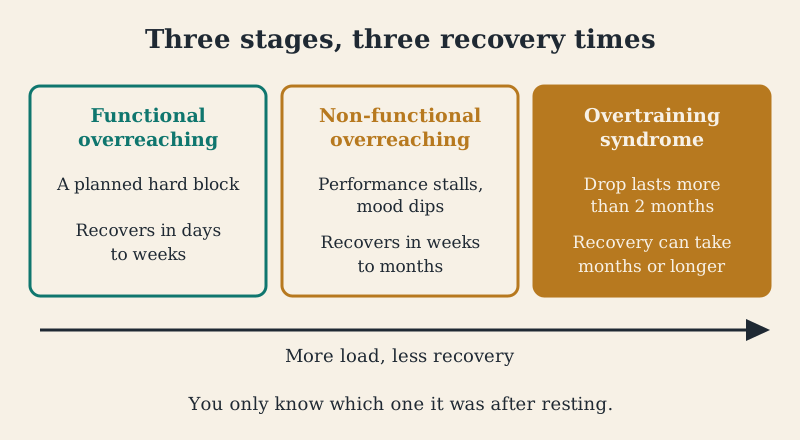
You can only tell the last two apart in hindsight, and cutoffs vary. In the clinical guide, if performance comes back within 14 to 21 days of rest, it was non-functional overreaching; if it takes longer, some doctors diagnose OTS (Kreher 2012). In a 2011 survey of 376 young English athletes (average age 15, club to international level), 29% reported non-functional overreaching or overtraining at least once (Matos 2011).
What causes it besides training
In that survey, training load didn't predict who got overtrained. The clinical guide's list of triggers is broader (Kreher 2012):
- more training without more recovery
- monotonous training, every day at the same effort
- too many competitions
- poor sleep
- stress from work, relationships or family
- a recent illness
- altitude, heat illness or a severe "bonk"
Your total stress, your allostatic load, counts. So does food: in a 2004 study of seven trained runners, a week of intensified training slowed them much less on 8.5 g of carbohydrate per kg of body weight a day than on 5.4 g (Achten 2004).
The volume problem
In a 2010 review of muscle growth, Brad Schoenfeld wrote that "studies seem to show that overtraining is more a result of excessive volume than intensity." Intensity can still do it alone. In a 1994 study, 11 weight-trained men trained on a squat machine every day for two weeks at 100% of their one-rep max, and that max fell by about 12 kg on average (Fry 1994).
Athletes also often train harder on days meant to be easy (Meeusen 2013), and a dip in performance is often met with more volume and intensity (Kreher 2012).
12 warning signs of overtraining
Overtraining symptoms show up in performance, body and mood. One sign alone means little; a cluster that sticks around is the warning.
Performance signs
1. Performance stalls or falls despite steady training. This is the hallmark. A typical pattern is starting a session or race at your normal pace and being unable to finish it, or losing your finishing kick (Kreher 2012; Meeusen 2013).
2. Workouts feel harder. Kreher and Schwartz, both physicians, write that "one of the initial signs of overreaching is increased rating of perceived exertion for a given workload."
3. Slower reactions. In a 2005 study, seven cyclists who doubled their training volume for two weeks got slower on a reaction-time test, especially the hardest version, while their cycling performance held steady (Rietjens 2005). In strength training, speed and power are the first kinds of performance to drop (Meeusen 2013).
4. Muscles stay heavy and sore. Stiff, sore muscles that don't clear between sessions are on the clinical guide's and Cleveland Clinic's lists.
Body signs
5. Fatigue that rest doesn't fix. The clinical guide relays a suggestion that fatigue is a "normal experience" in athletes. In one case study, a drop in vigor scores on a mood questionnaire looked more specific to overreaching (Kreher 2012).
6. A change in resting heart rate. Cleveland Clinic lists above 100 beats per minute in its middle stage and below 60 in its most severe. Neither shows up reliably (more below).
7. More colds. Cleveland Clinic lists this as an early sign. Hard training dampens immune cell function, but that doesn't separate overtrained athletes from ones adapting well (Meeusen 2013).
8. Appetite and weight changes. The clinical guide's symptom table lists loss of appetite and weight loss.
9. Poor sleep. Insomnia, restlessness and waking unrefreshed are all on the list. The guide says OTS "nearly always" includes disrupted mood, sleep and behaviour.
Mood signs
10. Loss of motivation. The clinical guide lists it, and Cleveland Clinic puts it in its most severe stage.
11. Irritability. Two studies using the Profile of Mood States questionnaire picked out 81% of "stale" swimmers, though scores also rise in athletes who are just training hard (Kreher 2012).
12. Low mood, anxiety, poor concentration. These overlap with depression. One clue to tell them apart, from sports psychiatrist Todd Stull speaking to Peloton: "You tend not to get overuse injuries with depression."
Mood is the cheapest early warning. Over ten years of tracking 400 competitive swimmers, mood disturbance rose with training load and fell back when the load came down (Morgan 1987). The consensus calls central fatigue, the slower reactions in sign 3, an early and maybe the earliest sign of overreaching.
Cleveland Clinic's three stages
Cleveland Clinic sorts these overtraining symptoms into three stages, though it says they don't always come in order: muscle pain, weight change, anxiety, poor sleep and colds in the first; insomnia, irritability, a fast resting heart rate and high blood pressure in the second; fatigue, depression, lost motivation and a slow resting heart rate in the third. The scheme echoes the old "sympathetic" and "parasympathetic" types (see how the two branches of the nervous system differ). The consensus warns the continuum may be an oversimplification.
How to diagnose overtraining: a self-assessment framework
No single marker confirms it. As Galpin puts it, "there's no test or a blood panel you can pull that would actually identify you in that state."
A two-minute daily log
The consensus describes swimmers' daily logs. Each morning, rate sleep quality, fatigue, stress and soreness, and note your early morning heart rate, any illness and, for women, your cycle. One criterion used to classify those swimmers as overtrained was fatigue above 5 on a 1 to 7 scale for more than seven days (Meeusen 2013). Galpin's performance rule runs on a similar clock: two bad days in a row don't worry him; after more than about five, he starts paying attention. Near competition, more than a couple is reason to act.
The three-marker check
Galpin suggests watching three kinds of marker:
- Performance: times, loads, power, a daily jump.
- Physiology: resting heart rate, heart rate variability (HRV) or another biomarker you can't consciously change.
- Symptoms: fatigue, sleep, mood, soreness.
His rule: "If you see all three of these popping up, you have reason to believe you've reached some overreaching."
What heart rate and HRV can and can't tell you
A 2008 meta-analysis cited in the consensus found that under two weeks of overload raised resting heart rate by about 4.5 beats per minute on average, while longer overload left it unchanged (Bosquet 2008; Meeusen 2013). A normal resting heart rate doesn't clear you.
The consensus calls HRV "a tool in theory" that "does not provide consistent results." In elite endurance athletes, both rises and falls have been linked to poor adaptation, so a 2013 review recommends averaging readings rather than trusting one morning's number (Plews 2013). See the separate guide to how HRV is measured and what moves it. Read either number alongside performance and symptoms.
When to see a doctor
See a sports medicine doctor if performance hasn't come back after a few weeks of easier training, if low mood or anxiety is affecting daily life, or if you're losing weight without trying. Many conditions mimic overtraining: asthma, thyroid or adrenal disease, diabetes, iron deficiency with or without anaemia, infections, and malnutrition, for example from an eating disorder or coeliac disease (Kreher 2012).
Expect blood tests such as a full blood count, inflammation markers, iron studies, creatine kinase and thyroid function. In one study of underperforming regional-level or better athletes, doctors found a cause for repeated infections or fatigue in 68% (Kreher 2012). Hormone tests help less: across 38 studies, resting hormone levels were mostly normal in overreached or overtrained athletes compared with healthy ones (Cadegiani 2017).
Health note: if your heart races or skips while you're training through an infection, stop and get checked. The consensus links infection during heavy training to a higher risk of heart complications, including myocarditis.
The recovery protocol: how to come back safely
The consensus statement is plain: "Rest and very light training seem to be the only therapeutic agents capable of effecting recovery."
Phase 1: back off hard
Cleveland Clinic's patient page describes a general sequence: stop high-intensity sessions, cut how hard and how often you train, usually by 50 to 70%, and stop completely if needed, with your doctor setting the details.
What's left should be very light: easy walking or cycling below zone 2 pace, mobility work. The clinical guide suggests "relative" rest if stopping completely worsens stress, mood or anxiety, and a sports psychologist when mood symptoms are strong (Kreher 2012).
Phase 2: rebuild volume before intensity
Add time before effort. Kreher and Schwartz suggest starting at 5 to 10 minutes of exercise a day and building until you tolerate an hour.
No marker says you've recovered, so let your signs and symptoms set the pace (Meeusen 2013). If sleep, mood or performance slip, drop back a step.
Rest-day tools: food, sleep, down-regulation
Eat enough. Athletes in hard training tend not to eat more, so add carbohydrate to avoid an energy deficit, without cutting protein (Meeusen 2013).
Sleep more. Adults need 7 or more hours a night, and more than 9 can be appropriate when recovering from sleep debt (Watson 2015).
Down-regulate after sessions. Galpin's favourite method is 3 to 10 minutes lying down after training, breathing through the nose at a set pace, for example box breathing with 3 to 8 second inhales. It's his coaching practice, and he gives no trial showing it helps overtrained athletes.
Try a short guided rest. In a 2024 trial of 65 physically active adults, one 10-minute session of non-sleep deep rest improved self-rated recovery and readiness and lowered stress and tension compared with sitting quietly for 10 minutes (Boukhris 2024). That was one session in healthy people, so treat it as an easy rest-day habit that adds no training load.
The psychology of forced rest
On the Huberman Lab recovery episode, Andrew Huberman suggests thinking of overtraining as a verb, something you're doing, rather than a label you carry, and Galpin agrees: "It is simply you are probably overtraining, and we need to reverse that quickly."
A short break may cost less than it feels like. In a 2011 study of 15 untrained young men doing 15 weeks of bench press training, half took a 3-week break after week 6 and ended with similar gains in strength and muscle size (Ogasawara 2011). They were beginners, not overtrained athletes, so read it as reassurance only.
How to prevent overtraining in the future
Log your load. The consensus describes a simple measure: session effort (how hard it felt) multiplied by minutes. In studies it cites, spikes in monotony (the same load day after day) and strain were followed by illness and injury.
Plan lighter weeks. In a 2023 Delphi consensus of strength and physique coaches, deloads generally came every 4 to 6 weeks for about a week, cutting sets and reps. The authors note limited evidence that pre-planned periodised training beats non-periodised training, so fixed deloads may not be necessary (Bell 2023). The consensus also recommends at least one full rest day a week.
Track mood. When collegiate swimmers had their training cut whenever mood scores worsened, burnout fell from 10% to zero (Kreher 2012).
Adjust early. Keep easy days easy, and count life stress, travel and poor sleep as load. When performance drops or fatigue feels excessive, the consensus advises cutting intensity or volume, or taking a full day off (Meeusen 2013).
FAQ
How long does it take to recover from overtraining?
Recovering from overtraining takes anywhere from days to years, depending on the stage: days to weeks for functional overreaching, weeks to months for non-functional overreaching, and months or possibly years for full overtraining syndrome (Kreher 2012; Meeusen 2013).
Can overtraining cause permanent damage?
Whether overtraining causes permanent damage depends on the stage. Most people who think they're overtrained aren't, says Galpin. Non-functional overreaching, which he calls much more common, fully recovers after rest (Kreher 2012). Full overtraining syndrome can take months or years to recover from and can end an athletic career.
How do I know if I'm overtrained or just tired?
Rest for three or four days and see whether you were just tired. If that brings you back, Galpin says you probably weren't overtrained, just non-functionally overreached. If overtraining symptoms show up in performance, a body measure like resting heart rate, and sleep or mood all at once, his rule says you're probably overreaching.
What's the difference between overtraining and undertraining?
Overtraining and undertraining can both look like a plateau, but the fixes are opposite. Overtraining comes with the fatigue, poor sleep and low mood listed above. Rule of thumb: if a few easy days leave you sharper, you needed rest. If you feel fresh and still aren't improving, you probably need more stimulus.
Can you still exercise while recovering from overtraining?
You can usually still exercise while recovering from overtraining, at a much lower level. Cleveland Clinic says light workouts may be fine if you don't push. Then rebuild volume before intensity.
Sources
- Achten J, Halson SL, Moseley L, Rayson MP, Casey A, Jeukendrup AE (2004). Higher dietary carbohydrate content during intensified running training results in better maintenance of performance and mood state. Journal of Applied Physiology. https://pubmed.ncbi.nlm.nih.gov/14660506/
- Bell L, Strafford BW, Coleman M, Androulakis Korakakis P, Nolan D (2023). Integrating deloading into strength and physique sports training programmes: an international Delphi consensus approach. Sports Medicine - Open. https://pubmed.ncbi.nlm.nih.gov/37730925/
- Bosquet L, Merkari S, Arvisais D, Aubert AE (2008). Is heart rate a convenient tool to monitor over-reaching? A systematic review of the literature. British Journal of Sports Medicine. https://pubmed.ncbi.nlm.nih.gov/18308872/
- Boukhris O et al. (2024). The acute effects of nonsleep deep rest on perceptual responses, physical, and cognitive performance in physically active participants. Applied Psychology: Health and Well-Being. https://pubmed.ncbi.nlm.nih.gov/38953770/
- Cadegiani FA, Kater CE (2017). Hormonal aspects of overtraining syndrome: a systematic review. BMC Sports Science, Medicine and Rehabilitation. https://pubmed.ncbi.nlm.nih.gov/28785411/
- Carrard J, Rigort AC, Appenzeller-Herzog C, et al. (2022). Diagnosing overtraining syndrome: a scoping review. Sports Health. https://pubmed.ncbi.nlm.nih.gov/34496702/
- Cleveland Clinic. Overtraining syndrome. https://my.clevelandclinic.org/health/diseases/overtraining-syndrome
- Fry AC, Kraemer WJ, van Borselen F, et al. (1994). Performance decrements with high-intensity resistance exercise overtraining. Medicine & Science in Sports & Exercise. https://pubmed.ncbi.nlm.nih.gov/7808252/
- Huberman Lab. Guest series: Dr. Andy Galpin, maximize recovery to achieve fitness and performance goals (transcript). https://www.hubermanlab.com/episode/guest-series-dr-andy-galpin-maximize-recovery-to-achieve-fitness-and-performance-goals
- Kreher JB, Schwartz JB (2012). Overtraining syndrome: a practical guide. Sports Health. https://pmc.ncbi.nlm.nih.gov/articles/PMC3435910/
- Matos NF, Winsley RJ, Williams CA (2011). Prevalence of nonfunctional overreaching/overtraining in young English athletes. Medicine & Science in Sports & Exercise. https://pubmed.ncbi.nlm.nih.gov/21131861/
- Meeusen R, Duclos M, Foster C, et al. (2013). Prevention, diagnosis, and treatment of the overtraining syndrome: joint consensus statement of the European College of Sport Science and the American College of Sports Medicine. Medicine & Science in Sports & Exercise. https://pubmed.ncbi.nlm.nih.gov/23247672/
- Morgan WP, Brown DR, Raglin JS, O'Connor PJ, Ellickson KA (1987). Psychological monitoring of overtraining and staleness. British Journal of Sports Medicine. https://pubmed.ncbi.nlm.nih.gov/3676635/
- Ogasawara R, Yasuda T, Sakamaki M, Ozaki H, Abe T (2011). Effects of periodic and continued resistance training on muscle CSA and strength in previously untrained men. Clinical Physiology and Functional Imaging. https://pubmed.ncbi.nlm.nih.gov/21771261/
- Peloton. 6 signs of overtraining to watch out for (with Sarah Eby MD PhD and Todd Stull MD). https://www.onepeloton.com/blog/signs-of-overtraining
- Plews DJ, Laursen PB, Stanley J, Kilding AE, Buchheit M (2013). Training adaptation and heart rate variability in elite endurance athletes: opening the door to effective monitoring. Sports Medicine. https://pubmed.ncbi.nlm.nih.gov/23852425/
- Rietjens GJ, Kuipers H, Adam JJ, et al. (2005). Physiological, biochemical and psychological markers of strenuous training-induced fatigue. International Journal of Sports Medicine. https://pubmed.ncbi.nlm.nih.gov/15643530/
- Schoenfeld BJ (2010). The mechanisms of muscle hypertrophy and their application to resistance training. Journal of Strength and Conditioning Research. https://pubmed.ncbi.nlm.nih.gov/20847704/
- Watson NF et al. (2015). Recommended amount of sleep for a healthy adult: a joint consensus statement of the American Academy of Sleep Medicine and Sleep Research Society. Journal of Clinical Sleep Medicine. https://pubmed.ncbi.nlm.nih.gov/25979105/