The default mode network (DMN) is a set of brain regions that gets most active when your attention turns inward: daydreaming, replaying a conversation, planning tomorrow. In a 2010 Harvard study that pinged 2,250 adults on their phones, minds wandered in 46.9% of the moments sampled, and people were less happy when they did. Pleasant daydreams were the exception. They left people about as happy as staying with the task, and no happier.
What is the default mode network?
Where it sits in the brain
The core of the default mode network is a handful of regions along the midline and sides of the brain: the medial prefrontal cortex behind your forehead, the posterior cingulate cortex and precuneus towards the back, and the angular gyrus on each side.
They don't all do the same job. In a 2010 Harvard study, a midline core, the posterior cingulate plus the front of the medial prefrontal cortex, was active when people made decisions about themselves. Regions in the medial temporal lobe, around the hippocampus, came online when people pictured a scene from memory (Andrews-Hanna and colleagues). A 2008 review says the network's medial temporal and medial prefrontal subsystems converge on the posterior cingulate (Buckner and colleagues).
What it does
The DMN is busy when you aren't focused on the world outside. That same review lists three jobs it keeps showing up for: recalling your own past, imagining the future, and working out what other people think. Wondering how a friend will take some news before you tell them is that kind of thinking.
It also tracks mind-wandering. In a 2007 brain-scan study in Science, the more often people said their minds wandered, the more active this network was.
Vinod Menon, a Stanford neuroscientist, goes further. In a 2023 review he argues the DMN builds a coherent "internal narrative" reflecting our individual experiences, which he sees as central to a sense of self.
How it was found
More than 50 years ago, Louis Sokoloff, Seymour Kety and colleagues noticed that the brain's energy use barely changes between rest and a task. The brain is about 2% of your body weight and uses about 20% of its energy, and a change in activity often adds less than 5% to that (Raichle 2015).
In 1997, Gordon Shulman and colleagues reanalysed nine brain-scan studies of visual tasks and found the same regions quietening in task after task. Marcus Raichle's group at Washington University called this a "default mode of brain function" in 2001. In 2003, a Stanford team led by Michael Greicius, with Menon as a co-author, showed these regions stay in sync at rest, the strongest evidence yet that they form one network.
The seesaw: how the DMN works with other brain networks
The DMN and the task-positive network
The opposite of the default mode network is the task-positive network, the regions that switch on when you write an email, follow directions or solve a puzzle. In a 2005 study, Michael Fox and colleagues found the two are "diametrically opposed" even while people lie still in the scanner. When one rises, the other tends to fall.
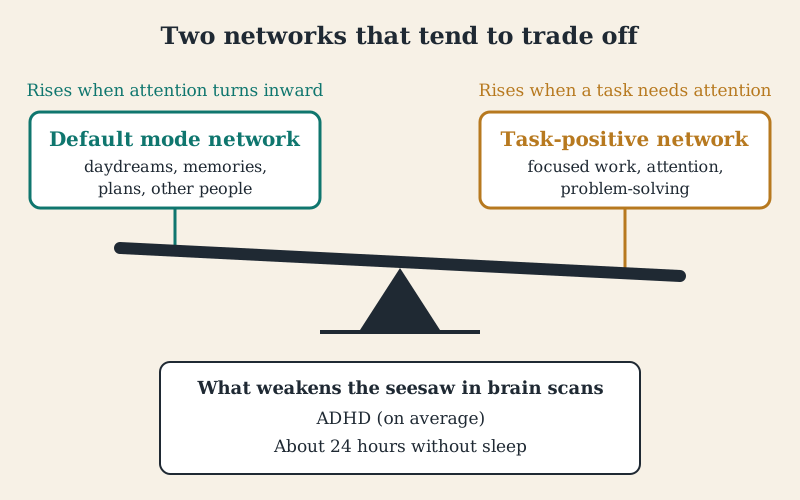
A common processing step, removing the global signal from the scans, can create part of that opposite pattern on its own (Murphy 2009). So the seesaw is a fair picture, but its exact strength is still argued over.
When the seesaw weakens: ADHD
In ADHD the two networks trade off less sharply, on average. In 2008, Castellanos and colleagues scanned 20 adults with ADHD and 20 without. The usual opposite swing between a frontal control region and the DMN was weaker in the ADHD group. A 2014 study of people aged about 7 to 22 found that connections within the DMN, and between it and attention networks, matured later in ADHD (Sripada and colleagues).
On his ADHD episode, Andrew Huberman compares this to a three-piece band whose bass and drums stop keeping the beat, with dopamine acting as the conductor. The scans show the weaker seesaw. The conductor is his explanation for it, built on the low-dopamine theory of ADHD.
When the seesaw weakens: sleep loss
Huberman makes a similar point about anyone who hasn't slept well, and one study tested a version of it. Twenty-six healthy adults were scanned after a normal night and again after about 24 hours awake. Without sleep, connections inside the DMN weakened, and so did the seesaw between it and its opposite network, both at rest and during an attention task (De Havas 2012). It didn't test how much of a foggy day this explains.
Signs your default mode network is overactive
Replaying and rehearsing
There's no home test for an overactive DMN, and every finding below is a group average from a scanner. The pattern most often linked to it is rumination: going over the same past conversation, or rehearsing a future one, without getting anywhere.
A 2011 Stanford study scanned 17 depressed and 17 healthy adults at rest. Among the depressed group, the more the DMN dominated the task network, the more depressive rumination people reported, and the less of the useful, reflective kind (Hamilton and colleagues). A 2020 meta-analysis of 14 brain-scan studies with 286 healthy people confirmed that rumination goes with DMN activity, centred on its core regions (Zhou and colleagues). For practical tools, try these methods for breaking an overthinking loop.
Worry
A 2025 review reports that anxiety disorders usually come with a more active DMN, especially during worry (Azarias and colleagues). In a smaller study of 24 healthy adults, tighter links in the front of the network went with higher anxiety and depression scores (Coutinho 2016). These are associations. Whether the network drives the worry or reflects it isn't settled.
The presence paradox
In the Harvard study (Killingsworth and Gilbert), what people were thinking predicted their mood better than what they were doing. Mind-wandering explained 10.8% of the swings in a person's happiness, and their activity explained 4.6%. The authors put it this way: "The ability to think about what is not happening is a cognitive achievement that comes at an emotional cost."
How to work with your default mode network
Aim for flexible switching
You need this network. In a 2018 study of 163 people, creative ability was predicted by a pattern of connections spanning the DMN and the brain's executive and salience networks, which usually work in opposition (Beaty and colleagues). Even rumination has a reflective form, which Hamilton and colleagues call adaptive. The useful goal is to shift out of the DMN when a loop starts, and back in when you want to think.
Give your attention a job
Raichle's 2001 paper describes the default mode as "suspended during specific goal-directed behaviors". So giving your attention a job, such as a puzzle, a recipe you have to follow or a tricky email, is one way to interrupt a loop.
Nature helps too. In a 2015 Stanford study, a 90-minute walk in a natural setting lowered self-reported rumination and activity in a brain area tied to it. The same walk in the city didn't (Bratman and colleagues).
Meditation: what the scans show
A 2011 Yale study compared experienced meditators with beginners (Brewer and colleagues). During three styles of meditation, the meditators' main DMN hubs were quieter. Both at rest and during meditation, their posterior cingulate was more tightly linked to regions involved in self-monitoring and cognitive control. A larger 2015 follow-up found meditators' DMN quieter than controls' during meditation, even measured against an active task rather than rest (Garrison and colleagues). Both were snapshots, so they can't show that the practice caused the difference.
For beginners, one well-known trial comes from NYU (Basso 2019). Non-meditators aged 18 to 45 did 13 minutes of guided meditation or listened to a podcast every day. After 8 weeks, but not 4, the meditation group had less negative mood and better attention and memory. It didn't scan the DMN. For a side-by-side, see how NSDR, meditation and yoga nidra differ.
Match the practice to your state
Huberman's meditation episode offers a practical rule. If you're stuck in your head with looping thoughts, do a short meditation focused on something outside you, such as a spot on the wall. If the world outside keeps pulling you around, focus inward on your breath or body. Pick the one that runs against where you are.
He adds a timing point. Some people find it harder to fall asleep after a focusing meditation done too close to bedtime, so near sleep he favours practices that have you defocus.
NSDR and the default mode network: what's known
No study has scanned the DMN during non-sleep deep rest (NSDR). The closest is a 2024 brain-scan study of yoga nidra, the older practice NSDR is closely related to (Fialoke and colleagues). Compared with their own resting scans, its 30 experienced meditators showed weaker connections within the DMN during yoga nidra, and its 31 beginners showed stronger ones. The more hours of practice people reported, the weaker those connections were. That result is for yoga nidra in trained people, and the practice itself is covered in how yoga nidra works.
The four small trials that use the NSDR name measured things like reaction time, heart rate and anxiety. The results were mixed, and none scanned the brain. For more, see what the brain studies on NSDR show.
Huberman calls NSDR and yoga nidra "anti-focus practices". You follow a voice around your body instead of holding your attention on one point, and when your mind wanders you pick up the next cue. That suits the moments when a focusing practice feels like hard work: after a long stretch of concentration, or at night when the replaying won't stop.
A 10-minute session
- Lie on your back, arms by your sides.
- Take two slow breaths in through the nose, each with a long exhale through the mouth.
- Follow the guide's cues around your body: right hand, forearm, shoulder, and on.
- When your mind drifts to a conversation or a to-do, return to the next body part the voice names.
- Stop at 10 minutes and get up slowly.
If stress keeps the loop running, pair it with a step-by-step plan for resetting your nervous system.
FAQ
What is the default mode network in simple terms?
In simple terms, the default mode network is the set of brain regions that runs your inner life when you aren't focused on a task: memories, plans, daydreams and thinking about other people. It quietens when something outside needs your attention.
What happens when the default mode network is overactive?
An overactive default mode network is linked to rumination and worry. Brain-scan studies tie DMN activity to depressive rumination, and reviews report a more active DMN in anxiety disorders. These are group findings, so they can't prove the network causes the problem.
How do I know if my DMN is causing problems?
You can't know from symptoms alone. DMN findings come from group brain scans, and a racing mind at night has many possible causes. If rumination, worry or poor sleep lasts for weeks, talk to a doctor or therapist.
Can you train your default mode network?
Possibly, but it isn't settled. In a small 2016 trial, 35 stressed adults were randomised to 3 days of mindfulness or relaxation training. Only mindfulness strengthened resting links between the default mode network's posterior cingulate and an executive control region (Creswell and colleagues). No study has tracked the DMN during NSDR.
What is the opposite of the default mode network?
The opposite of the default mode network is the task-positive network, the regions that switch on for focused work. The two tend to work like a seesaw, and in brain scans that seesaw is weaker on average in ADHD and after about 24 hours without sleep.
Is the default mode network active during sleep?
The default mode network doesn't switch off during sleep, but it changes. In deep sleep, its parts fall partly out of step, and the frontal region's involvement drops the most, according to a 2009 brain-scan study (Horovitz and colleagues).
Sources
- Killingsworth MA, Gilbert DT (2010). A wandering mind is an unhappy mind. Science. https://pubmed.ncbi.nlm.nih.gov/21071660/
- Andrews-Hanna JR, Reidler JS, Sepulcre J, Poulin R, Buckner RL (2010). Functional-anatomic fractionation of the brain's default network. Neuron. https://pubmed.ncbi.nlm.nih.gov/20188659/
- Buckner RL, Andrews-Hanna JR, Schacter DL (2008). The brain's default network: anatomy, function, and relevance to disease. Annals of the New York Academy of Sciences. https://pubmed.ncbi.nlm.nih.gov/18400922/
- Mason MF, Norton MI, Van Horn JD, Wegner DM, Grafton ST, Macrae CN (2007). Wandering minds: the default network and stimulus-independent thought. Science. https://pubmed.ncbi.nlm.nih.gov/17234951/
- Menon V (2023). 20 years of the default mode network: a review and synthesis. Neuron. https://pubmed.ncbi.nlm.nih.gov/37167968/
- Raichle ME (2015). The restless brain: how intrinsic activity organizes brain function. Philosophical Transactions of the Royal Society B. https://pubmed.ncbi.nlm.nih.gov/25823869/
- Shulman GL, Fiez JA, Corbetta M, et al. (1997). Common blood flow changes across visual tasks: II. Decreases in cerebral cortex. Journal of Cognitive Neuroscience. https://pubmed.ncbi.nlm.nih.gov/23965122/
- Raichle ME, MacLeod AM, Snyder AZ, Powers WJ, Gusnard DA, Shulman GL (2001). A default mode of brain function. Proceedings of the National Academy of Sciences. https://pubmed.ncbi.nlm.nih.gov/11209064/
- Greicius MD, Krasnow B, Reiss AL, Menon V (2003). Functional connectivity in the resting brain: a network analysis of the default mode hypothesis. Proceedings of the National Academy of Sciences. https://pubmed.ncbi.nlm.nih.gov/12506194/
- Fox MD, Snyder AZ, Vincent JL, Corbetta M, Van Essen DC, Raichle ME (2005). The human brain is intrinsically organized into dynamic, anticorrelated functional networks. Proceedings of the National Academy of Sciences. https://pubmed.ncbi.nlm.nih.gov/15976020/
- Murphy K, Birn RM, Handwerker DA, Jones TB, Bandettini PA (2009). The impact of global signal regression on resting state correlations: are anti-correlated networks introduced? NeuroImage. https://pubmed.ncbi.nlm.nih.gov/18976716/
- Castellanos FX, Margulies DS, Kelly C, et al. (2008). Cingulate-precuneus interactions: a new locus of dysfunction in adult attention-deficit/hyperactivity disorder. Biological Psychiatry. https://pubmed.ncbi.nlm.nih.gov/17888409/
- Sripada CS, Kessler D, Angstadt M (2014). Lag in maturation of the brain's intrinsic functional architecture in attention-deficit/hyperactivity disorder. Proceedings of the National Academy of Sciences. https://pubmed.ncbi.nlm.nih.gov/25225387/
- De Havas JA, Parimal S, Soon CS, Chee MW (2012). Sleep deprivation reduces default mode network connectivity and anti-correlation during rest and task performance. NeuroImage. https://pubmed.ncbi.nlm.nih.gov/21872664/
- Hamilton JP, Furman DJ, Chang C, Thomason ME, Dennis E, Gotlib IH (2011). Default-mode and task-positive network activity in major depressive disorder: implications for adaptive and maladaptive rumination. Biological Psychiatry. https://pubmed.ncbi.nlm.nih.gov/21459364/
- Zhou HX, Chen X, Shen YQ, et al. (2020). Rumination and the default mode network: meta-analysis of brain imaging studies and implications for depression. NeuroImage. https://pubmed.ncbi.nlm.nih.gov/31655111/
- Azarias FR, Almeida GHDR, de Melo LF, et al. (2025). The journey of the default mode network: development, function, and impact on mental health. Biology. https://pubmed.ncbi.nlm.nih.gov/40282260/
- Coutinho JF, Fernandes SV, Soares JM, Maia L, Gonçalves ÓF, Sampaio A (2016). Default mode network dissociation in depressive and anxiety states. Brain Imaging and Behavior. https://pubmed.ncbi.nlm.nih.gov/25804311/
- Beaty RE, Kenett YN, Christensen AP, et al. (2018). Robust prediction of individual creative ability from brain functional connectivity. Proceedings of the National Academy of Sciences. https://pubmed.ncbi.nlm.nih.gov/29339474/
- Bratman GN, Hamilton JP, Hahn KS, Daily GC, Gross JJ (2015). Nature experience reduces rumination and subgenual prefrontal cortex activation. Proceedings of the National Academy of Sciences. https://pubmed.ncbi.nlm.nih.gov/26124129/
- Brewer JA, Worhunsky PD, Gray JR, Tang YY, Weber J, Kober H (2011). Meditation experience is associated with differences in default mode network activity and connectivity. Proceedings of the National Academy of Sciences. https://pubmed.ncbi.nlm.nih.gov/22114193/
- Garrison KA, Zeffiro TA, Scheinost D, Constable RT, Brewer JA (2015). Meditation leads to reduced default mode network activity beyond an active task. Cognitive, Affective, & Behavioral Neuroscience. https://pubmed.ncbi.nlm.nih.gov/25904238/
- Basso JC, McHale A, Ende V, Oberlin DJ, Suzuki WA (2019). Brief, daily meditation enhances attention, memory, mood, and emotional regulation in non-experienced meditators. Behavioural Brain Research. https://pubmed.ncbi.nlm.nih.gov/30153464/
- Creswell JD, Taren AA, Lindsay EK, et al. (2016). Alterations in resting-state functional connectivity link mindfulness meditation with reduced interleukin-6: a randomized controlled trial. Biological Psychiatry. https://pubmed.ncbi.nlm.nih.gov/27021514/
- Horovitz SG, Braun AR, Carr WS, et al. (2009). Decoupling of the brain's default mode network during deep sleep. Proceedings of the National Academy of Sciences. https://pubmed.ncbi.nlm.nih.gov/19549821/
- Fialoke S, Tripathi V, Thakral S, Dhawan A, Majahan V, Garg R (2024). Functional connectivity changes in meditators and novices during yoga nidra practice. Scientific Reports. https://pubmed.ncbi.nlm.nih.gov/38839877/
- Huberman Lab. ADHD & How Anyone Can Improve Their Focus (episode). https://www.hubermanlab.com/episode/adhd-and-how-anyone-can-improve-their-focus
- Huberman Lab. How Meditation Works & Science-Based Effective Meditations (episode). https://www.hubermanlab.com/episode/how-meditation-works-and-science-based-effective-meditations