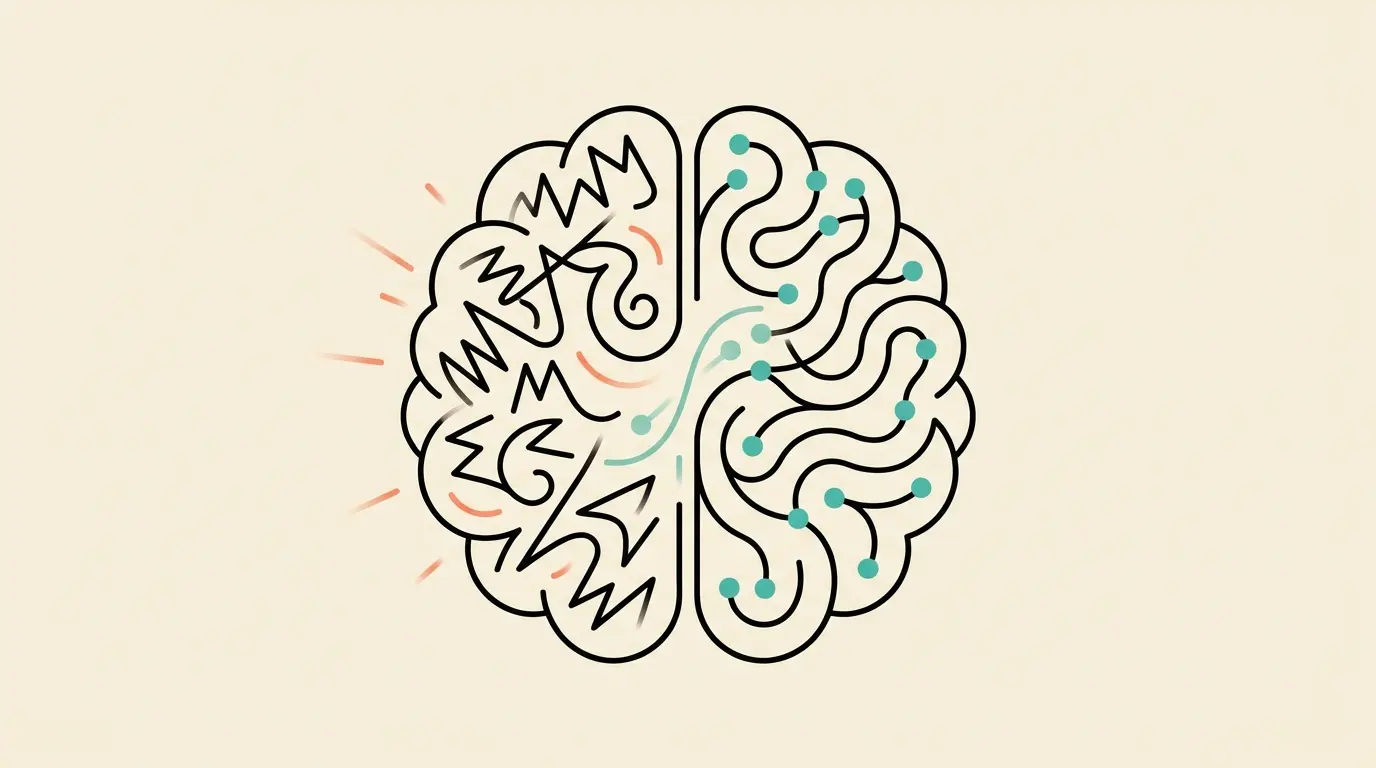
There's no button that resets your nervous system, and "reset" isn't a medical term. It usually means getting better at calming down after stress, and you can practise that. This 5-step plan for how to reset your nervous system adds one habit at a time. Start with your breathing, 5 minutes a day with a long exhale. Across 223 studies, slow breathing raised heart rate variability during a session and straight after it.
TL;DR
- A "reset" means coming down faster after stress. Calming takes minutes. Changing your baseline takes repeated practice.
- Start with 5 minutes a day of long-exhale breathing: cyclic sighing, or 4 seconds in, about 6 out.
- Fix the sleep basics: a fixed wake time, screens away before bed, a cool room.
- Add a daily 10-minute NSDR session once the breathing sticks.
- Then add regular movement, starting with walking.
- Track your HRV trend alongside sleep and mood. No study gives a timeline.
What does "resetting your nervous system" mean?
It means coming back down faster after stress.
Two branches, not an on/off switch
Your autonomic nervous system has a sympathetic ("stress") branch and a parasympathetic ("rest") branch. Both are active at once, and each can rise or fall independently. Read more about how the sympathetic and parasympathetic branches differ.
Stuck on, or shut down
The "window of tolerance" model, from trauma care, describes a stressed system as either stuck "on" (hyperarousal) or shut down (hypoarousal). It's a clinical model, and it isn't a diagnosis. Here are the signs of a dysregulated nervous system.
Calming now vs changing your baseline
A single slow-breathing session raises HRV, and so do multi-session programmes. Calming takes minutes. Changing your baseline takes repeated practice, and no study sets a number of weeks.
The reset plan, step by step
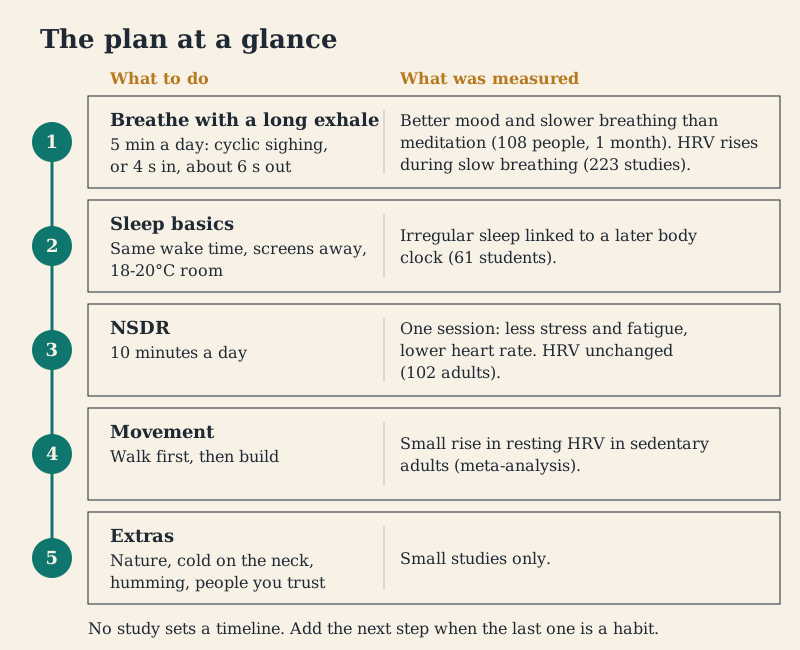
Most of how to reset your nervous system comes down to repetition, because your baseline shifts with repeated practice. Add one step at a time, since adding one habit at a time makes it more likely you'll keep them. Move on when the last step feels automatic.
Step 1: Breathe with a long exhale, 5 minutes a day
Breathing comes first. It's free, quick, and has the best evidence of anything here.
Option A: cyclic sighing
- Breathe in through your nose.
- Take a second, smaller breath in on top.
- Breathe out slowly and fully through your mouth.
- Repeat for 5 minutes.
Stanford neuroscientist Andrew Huberman describes it on Tools for Managing Stress & Anxiety: "With the physiological sigh, the best way to do it would be double inhale through the nose, exhale through the mouth."
Huberman co-led a one-month Stanford trial of 108 participants. In it, 5 minutes a day of cyclic sighing improved mood and slowed resting breathing more than mindfulness meditation. HRV didn't differ, and the study was exploratory. Read more about how the physiological sigh works.
Option B: slow breathing with a longer exhale
- Pick a time you'll keep, such as after waking or before bed.
- Breathe in through your nose for about 4 seconds and let your belly expand.
- Breathe out through your mouth for about 6 seconds.
- Keep going for 5-10 minutes, about 25-60 breaths, or use a guided 4-6 breathing animation.
The 223-study meta-analysis found vagally mediated HRV also rose after multi-session programmes. In a small lab study of 30 people, a longer exhale felt more relaxing. At 6 breaths a minute, it also gave more high-frequency HRV. Cleveland Clinic neurologist Dr Emad Estemalik calls breathwork "a powerful way to regulate your autonomic nervous system".
Cyclic sighing has the strongest single trial; 4-6 breathing has the bigger body of research. If you want the routine the Stanford trial tested, do cyclic sighing for 5 minutes a day. If a steady count is easier for you, or you'd rather follow the guided animation, use 4-6 breathing.
If breathing drills make you dizzy or set off panic, stop and breathe normally. If you have panic attacks, a heart condition or trauma symptoms, talk to your GP before starting.
Step 2: Fix the sleep basics
- The same wake time every day, weekends included. In a 30-day study of 61 students, the researchers linked irregular schedules to a later body clock.
- Screens away before bed. In a lab study, reading a tablet before bed delayed sleep, cut melatonin and shifted the body clock later than a printed book did.
- A cool room, 65-68°F (about 18-20°C), as the Sleep Foundation suggests. Sleep comes most easily as core temperature falls, and a hot bedroom means more time awake and less deep sleep.
Hold off on melatonin. The American Academy of Sleep Medicine advises against it for ordinary insomnia, with a "weak" rating. If you take it on prescription, talk to your GP before changing anything.
Step 3: Add a daily 10-minute NSDR session
NSDR (non-sleep deep rest) is a guided relaxation practice built on slow breathing and a step-by-step body scan.
- Choose a 10-minute session at a time you'll keep. After lunch and before bed both work.
- Lie down or recline.
- Follow the body-scan cues in the order the voice gives them.
- When your mind drifts, go back to the next cue the voice names.
- Stay with it for the full 10 minutes.
The 2026 trial ran its sessions in the late morning to early afternoon, but it didn't compare times of day. What it did and didn't show is in the NSDR section further down.
Step 4: Add movement, starting gently
A 2022 meta-analysis found exercise training gave sedentary adults a small rise in resting HRV (RMSSD, standardised mean difference 0.57).
Harder exercise pushes HRV lower during the session and slows its recovery. If you're already run down, walk.
Start with 20-30 minute walks, 3-4 times a week, then move to light cardio such as cycling or swimming. Consistency matters more than any single session.
Step 5: Extras with small studies behind them
- Time somewhere that feels like nature. In an 8-week study of 36 city dwellers, it lowered cortisol beyond its normal daily fall, and 20-30 minutes gave the most drop per minute.
- Cold on the side of the neck. In a lab study of 61 people, it raised HRV and lowered heart rate against a control.
- Humming on the out-breath. In a pilot of 16 adults, it raised HRV about as much as plain slow breathing.
- People you trust. In a brain-scan study of 16 married women facing a shock threat, holding a husband's hand dampened threat responses.
None of these is "vagus nerve stimulation", which is the name for a medical device.
How to calm your nervous system right now
The plan above shifts your baseline through repeated practice. For a hard moment, use a quick tool first, then go back to the plan.
- One to three physiological sighs. A double breath in through your nose, then a slow breath out through your mouth.
- Cold on your face. In a lab study of 10 healthy volunteers, an ice-cold compress on the face for 60 seconds slowed heart rate, most likely through the vagus nerve. Blood pressure rose too, so skip this if you have a heart condition.
- Tense, then release. Clench a muscle group for a few seconds, let go, and work up your body. A 2024 review of 46 studies covering more than 3,400 adults found progressive muscle relaxation programmes reduced stress, anxiety and depression.
- 5-4-3-2-1 grounding. Name 5 things you can see, 4 you can hear, 3 you can touch, 2 you can smell and 1 you can taste. Direct research on it is thin.
For more in-the-moment tools, ranked by speed, see how to calm down fast.
How to measure your progress
Heart rate variability (HRV)
HRV is the variation in time between one heartbeat and the next, and a practical way to check on your autonomic nervous system at home. Apple Watch reports SDNN. WHOOP reports RMSSD, and the Stanford trial took its HRV data from WHOOP. Oura shows an average of five-minute samples taken while you sleep. Numbers aren't comparable across brands, so compare yourself with yourself.
Rings and straps measure overnight. Take manual readings under the same conditions, such as just after waking. Watch an average of several days, not single readings. Higher isn't always better, since some medical conditions can push HRV up too.
Don't judge the plan on HRV alone. In the Stanford trial, mood improved while HRV didn't differ. Read more about what HRV is and how to read it.
Resting heart rate
Exercise training lowers resting heart rate, partly through vagal effects and partly through other factors, so a falling resting heart rate is a fair sign of better fitness. Track the weekly average.
How you sleep and feel
- Falling asleep faster, with fewer night wakings.
- Bouncing back faster after a stressful day.
- Digestion. The vagus nerve helps run digestion, so gut regularity is a fair personal check-in, though not a validated marker.
- Focus that lasts longer.
- Signs you're settling in the moment: slower breathing, a looser jaw or shoulders, or a sigh you didn't plan. In three lab experiments, people sighed more during relief than during stress.
Common mistakes that slow your reset
- Starting everything at once. One habit at a time sticks better.
- Skipping days, then doubling up. The tested dose was 5 minutes daily for a month.
- Leaving sleep for later. Poor sleep makes everything else harder.
- Expecting a calm-down tool to change your baseline. Baseline change came from multi-session programmes. Save calm-down techniques for hard moments.
- Going hard on exercise when you're run down. Walk instead.
NSDR for a nervous system reset
NSDR is Step 3 of the plan, a 10-minute daily habit alongside breathing, sleep and movement. The research on it is early.
What the research shows
In a 2026 trial, 102 physically active young adults (51 per group) did one 10-minute NSDR session or a control session. Sleepiness, fatigue, stress and heart rate fell more with NSDR. HRV didn't differ; the authors call the physiological findings modest.
For yoga nidra, which overlaps with NSDR, a 2025 review of 28 studies found improvements in blood pressure and heart rate, but most studies had methodological limitations.
Where it fits next to breathing
A guided session gives you more minutes of slow breathing and stillness. No study has tested whether that beats breathing alone. It can be easier to follow than counting breaths when your mind is racing. See how to do an NSDR session.
NSDR.co's sessions are free, and there will always be a free plan.
FAQ
How long does it take to reset your nervous system?
Calming your nervous system takes minutes, but a reset of your baseline takes longer, and no study gives a timeline for it. In the 108-person Stanford trial, 5 minutes of daily breathwork for a month improved mood more than mindfulness meditation did, but HRV didn't differ between groups. Judge your progress by how you sleep and feel as well as by the numbers.
Can you reset your nervous system in one day?
You can calm your nervous system in one day, but no study has shown a one-day reset of your baseline. Slow breathing raises HRV within a session, and one NSDR session lowered heart rate more than a control. The baseline changes in the research came after repeated practice.
How do you regulate your nervous system?
Regulating and resetting your nervous system mean much the same thing. Both cover calming down when you're wound up and coming back down faster after stress over time. Use the quick tools above for hard moments and the 5-step plan to shift your baseline, starting with 5 minutes a day of long-exhale breathing.
What's the fastest way to calm your nervous system?
By Huberman's account, the fastest way to calm down is the physiological sigh. He says one to three sighs "will bring down your level of stress very, very fast". The 2023 trial he co-led measured mood and breathing rate over a month, not speed. Try a guided physiological sigh.
What if breathing isn't enough?
See your GP or a therapist when breathing isn't enough, and don't wait if you're struggling. Self-help has limits, especially after trauma. For PTSD, NICE recommends trauma-focused CBT or EMDR. Somatic Experiencing has early, mixed-quality evidence.
Should you cut caffeine while you work on this?
You don't need to cut caffeine out. In a study of 15 volunteers, 250 mg by drip and a triple espresso both raised sympathetic nerve activity within an hour, and 400 mg taken 6 hours before bed still disrupted sleep. Stop at least 6 hours before bedtime; earlier is safer.
Is resetting different from healing a dysregulated nervous system?
No. Resetting and healing are two everyday words for the same goal, so how to reset your nervous system and how to heal it come down to the same tools: breathing, sleep, NSDR and movement. People tend to say "healing" after trauma, which is where professional support from a GP or therapist matters most.
Sources
- Laborde S et al. (2022). Effects of voluntary slow breathing on heart rate and heart rate variability: A systematic review and a meta-analysis. Neuroscience and Biobehavioral Reviews. https://pubmed.ncbi.nlm.nih.gov/35623448/
- Balban MY et al. (2023). Brief structured respiration practices enhance mood and reduce physiological arousal. Cell Reports Medicine. https://pubmed.ncbi.nlm.nih.gov/36630953/
- Van Diest I et al. (2014). Inhalation/Exhalation ratio modulates the effect of slow breathing on heart rate variability and relaxation. Applied Psychophysiology and Biofeedback. https://pubmed.ncbi.nlm.nih.gov/25156003/
- Huberman A (2021). Tools for Managing Stress & Anxiety. Huberman Lab podcast. https://www.hubermanlab.com/episode/tools-for-managing-stress-and-anxiety
- Cleveland Clinic (2025). How To Reset Your Vagus Nerve Naturally (with Dr Emad Estemalik). https://health.clevelandclinic.org/vagus-nerve-reset
- Berntson GG et al. (1991). Autonomic determinism: the modes of autonomic control, the doctrine of autonomic space, and the laws of autonomic constraint. Psychological Review. https://pubmed.ncbi.nlm.nih.gov/1660159/
- Corrigan FM et al. (2011). Autonomic dysregulation and the Window of Tolerance model of the effects of complex emotional trauma. Journal of Psychopharmacology. https://pubmed.ncbi.nlm.nih.gov/20093318/
- Phillips AJK et al. (2017). Irregular sleep/wake patterns are associated with poorer academic performance and delayed circadian and sleep/wake timing. Scientific Reports. https://pubmed.ncbi.nlm.nih.gov/28607474/
- Chang AM et al. (2015). Evening use of light-emitting eReaders negatively affects sleep, circadian timing, and next-morning alertness. PNAS. https://pubmed.ncbi.nlm.nih.gov/25535358/
- Sleep Foundation (2025). Best Temperature for Sleep. https://www.sleepfoundation.org/bedroom-environment/best-temperature-for-sleep
- Okamoto-Mizuno K, Mizuno K (2012). Effects of thermal environment on sleep and circadian rhythm. Journal of Physiological Anthropology. https://pubmed.ncbi.nlm.nih.gov/22738673/
- Sateia MJ et al. (2017). Clinical Practice Guideline for the Pharmacologic Treatment of Chronic Insomnia in Adults: An American Academy of Sleep Medicine Clinical Practice Guideline. Journal of Clinical Sleep Medicine. https://pubmed.ncbi.nlm.nih.gov/27998379/
- Boukhris O et al. (2026). Time course of perceptual, cognitive, physical and physiological responses to a single non-sleep deep rest session in physically active young adults. Applied Psychology: Health and Well-Being. https://pubmed.ncbi.nlm.nih.gov/42383502/
- Ghai S, Ghai I (2025). Yoga Nidra for cardiovascular health: a systematic review and meta-analysis of between- and within-group effects. Complementary Therapies in Medicine. https://pubmed.ncbi.nlm.nih.gov/40840566/
- Casanova-Lizón A et al. (2022). Does Exercise Training Improve Cardiac-Parasympathetic Nervous System Activity in Sedentary People? A Systematic Review with Meta-Analysis. International Journal of Environmental Research and Public Health. https://pubmed.ncbi.nlm.nih.gov/36360777/
- Michael S et al. (2017). Cardiac Autonomic Responses during Exercise and Post-exercise Recovery Using Heart Rate Variability and Systolic Time Intervals: A Review. Frontiers in Physiology. https://pubmed.ncbi.nlm.nih.gov/28611675/
- Sandercock GR et al. (2005). Effects of exercise on heart rate variability: inferences from meta-analysis. Medicine and Science in Sports and Exercise. https://pubmed.ncbi.nlm.nih.gov/15741842/
- Jungmann M et al. (2018). Effects of Cold Stimulation on Cardiac-Vagal Activation in Healthy Participants: Randomized Controlled Trial. JMIR Formative Research. https://pubmed.ncbi.nlm.nih.gov/30684416/
- Woo M et al. (2025). Effects of slow-paced breathing and humming breathing on heart rate variability and affect: a pilot investigation. Physiology & Behavior. https://pubmed.ncbi.nlm.nih.gov/40482984/
- Hunter MR et al. (2019). Urban Nature Experiences Reduce Stress in the Context of Daily Life Based on Salivary Biomarkers. Frontiers in Psychology. https://pubmed.ncbi.nlm.nih.gov/31019479/
- Coan JA et al. (2006). Lending a hand: social regulation of the neural response to threat. Psychological Science. https://pubmed.ncbi.nlm.nih.gov/17201784/
- Shaffer F, Ginsberg JP (2017). An Overview of Heart Rate Variability Metrics and Norms. Frontiers in Public Health. https://pubmed.ncbi.nlm.nih.gov/29034226/
- Plews DJ et al. (2013). Training adaptation and heart rate variability in elite endurance athletes: opening the door to effective monitoring. Sports Medicine. https://pubmed.ncbi.nlm.nih.gov/23852425/
- Apple Developer. HealthKit: heartRateVariabilitySDNN. https://developer.apple.com/documentation/healthkit/hkquantitytypeidentifier/heartratevariabilitysdnn
- Oura. Heart Rate Variability (support article). https://support.ouraring.com/hc/en-us/articles/360025441974
- Breit S et al. (2018). Vagus Nerve as Modulator of the Brain-Gut Axis in Psychiatric and Inflammatory Disorders. Frontiers in Psychiatry. https://pubmed.ncbi.nlm.nih.gov/29593576/
- NICE (2018). Post-traumatic stress disorder (NG116): Recommendations. https://www.nice.org.uk/guidance/ng116/chapter/Recommendations
- Kuhfuß M et al. (2021). Somatic experiencing: effectiveness and key factors of a body-oriented trauma therapy: a scoping literature review. European Journal of Psychotraumatology. https://pubmed.ncbi.nlm.nih.gov/34290845/
- Corti R et al. (2002). Coffee acutely increases sympathetic nerve activity and blood pressure independently of caffeine content: role of habitual versus nonhabitual drinking. Circulation. https://pubmed.ncbi.nlm.nih.gov/12460875/
- Drake C et al. (2013). Caffeine effects on sleep taken 0, 3, or 6 hours before going to bed. Journal of Clinical Sleep Medicine. https://pubmed.ncbi.nlm.nih.gov/24235903/
- Stemper B et al. (2002). Evaluation of cold face test bradycardia by means of spectral analysis. Clinical Autonomic Research. https://pubmed.ncbi.nlm.nih.gov/12102454/
- Muhammad Khir S et al. (2024). Efficacy of Progressive Muscle Relaxation in Adults for Stress, Anxiety, and Depression: A Systematic Review. Psychology Research and Behavior Management. https://pubmed.ncbi.nlm.nih.gov/38322293/
- Vlemincx E et al. (2009). Why do you sigh? Sigh rate during induced stress and relief. Psychophysiology. https://pubmed.ncbi.nlm.nih.gov/19497009/