A cold plunge cools your whole body at a temperature you can hold steady, and almost all the cold-water research used immersion. A cold shower is free, adds a minute to a shower you were taking anyway, and has very little research of its own. So in the cold shower vs cold plunge question, the plunge is the closer match to what the studies measured, especially for recovery after hard training. If you want a daily habit with no equipment, the shower wins.
Cold shower vs cold plunge: the short answer
No study has compared the two head to head, so any "plunges are X% better" figure you see online is a guess. Here is how they line up on what can be checked.
| Cold plunge | Cold shower | |
|---|---|---|
| Temperature | Whatever you set. Trials in a 2025 review used 7-15°C, about 45-59°F | Whatever your tap gives. Dutch trials worked with about 10-14°C |
| Body coverage | Everything below the neck at once | Wherever the spray lands |
| Research base | Dozens of trials and several meta-analyses | A handful of trials |
| Cost | A bathtub and ice, or $1,190 to $10,490 for a Plunge home tub (Oct 2026) | Nothing extra |
| Time | Setup, plus 1-5 minutes in the water | 30 seconds to 3 minutes at the end of a shower |
| Best for | Recovery after high-intensity training | A daily wake-up habit |
What is a cold plunge?
A cold plunge means sitting in cold water up to your neck or shoulders. It can be a chilled tub, a bath with ice, or a lake. What sets it apart is that all of you is in the same cold water for the whole session.
Temperature range
The trials in a 2025 meta-analysis used water between 7°C and 15°C. Andrew Huberman's rule is to pick water that feels really cold, so you want to get out, but that you can safely stay in. For one person that's 60°F; for another, 45°F. Our cold plunge temperature guide goes through the numbers in detail.
What happens in the body
Cold water tightens the blood vessels in your skin and switches on your sympathetic nervous system, the fight-or-flight branch. In a 2000 study, young men sat in 14°C water up to the neck for an hour. The noradrenaline in their blood rose 530%, and the authors put the cold response down to the sympathetic nervous system. Noradrenaline is another name for norepinephrine, the alertness chemical.
The research base
Immersion has real evidence for recovery. A 2022 meta-analysis of 52 studies in Sports Medicine found that after high-intensity exercise, people who sat in cold water had better muscular power, less soreness and felt more recovered 24 hours later than people who rested. Strength came back no faster. A 2018 review of 99 studies in Frontiers in Physiology found immersion reduced soreness too, though massage did better.
What is a cold shower?
A cold shower means turning the tap to its coldest setting, usually for the last part of a normal shower. How cold that is depends on your pipes.
How cold the water gets
Dutch and German cold-shower trials have worked with a range of about 10-14°C, or 50-57°F, for the cold setting. That's inside the range the plunge studies used. In a hot climate in summer, the cold tap may barely feel cool. UCLA Health's advice is to aim for below 60°F, and if your tap can't get there, the shower can't deliver much of a cold dose.
How much of you gets cold
"Showers are only reaching a specific region of the body, often the trunk," Corey Simon, a physical therapist and researcher at Duke University, told Peloton. Your back and shoulders get soaked. Your legs and front get whatever runs off. How much of you gets cold depends on how you stand, which is also why showers are hard to study.
The research gap
Huberman put it this way in his cold exposure episode: "there have been very few, if any studies of cold showers." Labs tend to use immersion because, as Huberman points out, a shower's dose is hard to measure.
Two shower trials are worth knowing, and both get misquoted.
The bigger one, in 2016, randomised 3,018 Dutch adults who didn't usually shower cold. They ended a hot shower with 30, 60 or 90 seconds of cold every day for 30 days, then carried on as they liked for 60 more. Their self-reported sickness absence fell 29% compared with the control group. Their illness days didn't change. They were ill as often; they took fewer days off.
The other, in 2022, followed 86 adults for 14 days. Cold showers of 15 to 60 seconds on their own did no better than doing nothing for perceived stress. Cold showers combined with a breathing technique did lower it.
Cold shower vs cold plunge: key differences
Temperature control
A tub with a chiller holds the temperature you set, so every session is the same. An ice bath drifts warmer as the ice melts. A shower gives you whatever the pipes deliver that day, which makes it hard to know your dose.
Body coverage
Huberman ranks immersion first and showers second. More cold skin should mean a bigger response, but no one has measured the gap.
Cost
Rachelle Reed, an exercise physiologist, sums up the shower's main advantage: "cold showers are more accessible, cheaper, and may have a lower barrier to entry for many consumers."
On 9 October 2026, Plunge, one of the bigger brands, listed home tubs with a built-in chiller at $4,490 to $10,490, and a tub without a chiller at $1,190. A bathtub with bags of ice costs what the ice costs.
Time
A cold shower adds a minute or two to a shower you were having anyway. A plunge needs a ready tub, ice or a chiller, and time to rewarm afterwards.
Benefits compared: what each was shown to do
Recovery and soreness
This is where the plunge has a clear lead. The 52-study meta-analysis above is about immersion, and nobody has tested cold showers for soreness in a comparable way. UCLA Health still recommends them after workouts. "Cold showers are a convenient way for a weekend warrior, amateur athlete or anyone who enjoys exercise to get some of the benefits of cold therapy after a workout," says Sharon Hame, an orthopaedic surgeon at UCLA Health.
There's a catch for anyone lifting to build muscle. A 2024 review of 8 studies in the European Journal of Sport Science found that cold-water immersion right after resistance training may blunt muscle growth. The studies were of fair to poor quality, so treat it as a caution.
Mood, alertness and dopamine
In a 2023 brain-imaging study, adults sat in 20°C water for 5 minutes. Afterwards they reported feeling more active, alert, attentive, proud and inspired, and less distressed. That was immersion. Whether a cold shower does the same hasn't been measured.
The famous dopamine number comes from the same 2000 study as the noradrenaline figure. Young men sat in 14°C water up to the neck for an hour, and the dopamine in their blood rose by 250%. Blood dopamine isn't brain dopamine, and a short cold shower hasn't been tested for dopamine at all. More on what baseline dopamine is and how to raise it.
Metabolism and weight loss
In the same hour at 14°C, metabolic rate rose 350%. That rise happened during an hour in cold water, and Huberman's own summary says the calories burned "are not that significant." Nobody has measured a two-minute shower. Cleveland Clinic says your metabolism goes up briefly in cold water, but it's not your best route to lose weight.
Sick leave and immunity
The Dutch trial is the best evidence for showers, and it's about time off work. A 2025 meta-analysis of 11 trials found no measurable change in immune markers in the hour after cold water.
Stress
The 2025 meta-analysis pooled 3,177 people, but 10 of its 11 trials used baths. Stress was lower 12 hours after cold water and no different at 1, 24 or 48 hours. For showers alone, the 14-day trial found no effect without the breathing exercise.
Protocols: how to do each one
Cold shower: a 4-week ramp
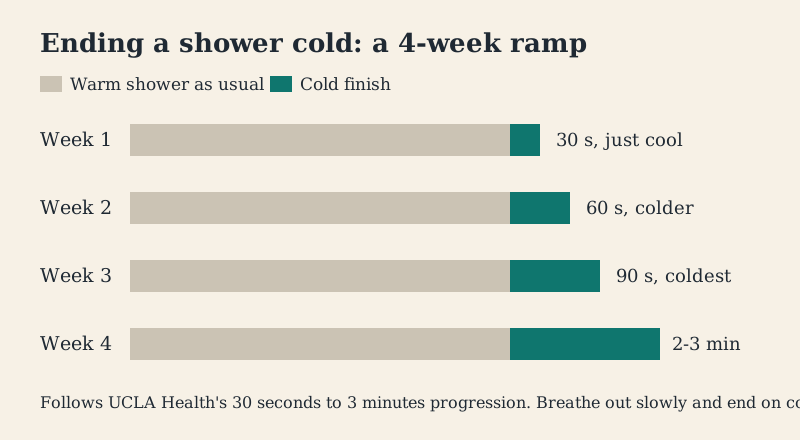
UCLA Health's advice is to start with 30 seconds of cold, work up to a minute, then build to 2-3 minutes. Spread over four weeks, that looks like this:
- Week 1. Shower as usual, then turn the water cool for the last 30 seconds. The goal is the habit.
- Week 2. Make it colder and stay for 60 seconds.
- Week 3. Turn it as cold as it goes for 90 seconds.
- Week 4. Hold the cold for 2-3 minutes.
Breathe out slowly when the cold hits, and don't gasp or hyperventilate. Finish on cold. Once you're comfortable, UCLA Health's athletic trainers suggest a contrast shower after workouts: 3 minutes hot, 1 minute cold, three times, ending cold.
Cold plunge protocol
- Start warmer than you think. Huberman warns that cold shock is possible, so begin at a temperature you can stay in and work colder over weeks.
- Get in steadily. Don't hyperventilate before or during.
- Stay 1-5 minutes. Colder water needs less time.
- Aim for about 11 minutes a week. That's Huberman's suggestion, split into 2-4 sessions. It hasn't been tested as a dose.
- Let yourself rewarm. End on cold and let your body heat itself back up, with no hot shower. Huberman calls this the Søberg Principle, after cold researcher Susanna Søberg.
For a week-by-week version, see Huberman's 4-week cold plunge plan.
Timing around training
If you're lifting for strength or size, Huberman's advice is to leave 6 to 8 hours between training and immersion, or do the cold before you train. He finds it hard to imagine that a brief cold shower after lifting would cancel out the training, though no study has checked. Full detail in when to cold plunge after a workout.
Who should skip cold water
Health note: if you have heart disease, an abnormal heart rhythm, Raynaud's, cold urticaria, or are pregnant, check with your doctor before trying either. Cleveland Clinic says anyone with heart rhythm problems should avoid cold showers. Never get into a dangerous body of water, which is the first rule in Huberman's cold newsletter. Andrew Jagim, a sports medicine specialist at Mayo Clinic, has said plunges in controlled tubs aren't a "big level of concern" and that icy lakes carry far bigger risks.
When to use cold showers vs cold plunges
Use cold showers when
- You want no extra cost or equipment
- You're new to cold and building tolerance
- Your goal is waking up rather than recovery from hard training
Use cold plunges when
- You do high-intensity training and care about how you feel 24 hours later
- You want a temperature you can control and repeat
- You have the space and budget, or a cold bath with ice
The honest take
A cold shower you take every day is more use than a tub you rarely get into. Start with the shower ramp. If you train hard and want the recovery benefits the studies found, move to a plunge, and time it away from strength sessions.
After the cold: settling back down
Cold water is deliberate activation. If you're left wired afterwards, a physiological sigh or a short NSDR session can help you come down. No study has tested NSDR after cold water, so treat it as a sensible pairing.
FAQ
Is a cold shower as effective as an ice bath?
For recovery after hard exercise, a cold shower probably isn't as effective as an ice bath. That's the biggest gap in the cold shower vs cold plunge comparison. The recovery evidence comes from immersion, and showers haven't been tested the same way. For a daily wake-up, a cold shower is fine and far easier to keep up.
How cold does a cold shower need to be for benefits?
Aim for below 60°F, which is UCLA Health's advice. Dutch shower trials worked with about 10-14°C, or 50-57°F. If your tap stays lukewarm in summer, the shower won't give much of a cold dose.
Can cold showers provide the same benefits as cold water immersion?
Cold showers may provide some of the same benefits, but it hasn't been shown. Cold water immersion has the evidence for recovery, mood and blood noradrenaline. Cold showers have one trial showing less sick leave and one showing no stress benefit on their own.
How long should you stay in a cold plunge vs cold shower?
In a cold plunge, stay 1-5 minutes per session. For a cold shower, start at 30 seconds and build to 2-3 minutes over about four weeks. Huberman suggests about 11 minutes of cold a week in total, split across 2-4 sessions. It's a suggestion, not a tested dose.
Should I take a cold shower or cold plunge after a workout?
After high-intensity work, a cold plunge helps soreness and power at 24 hours. After strength training, Huberman's advice is to wait 6 to 8 hours before plunging if you want to keep muscle gains; a brief cold shower is probably fine, though untested.
Do cold showers boost immunity?
Cold showers haven't been shown to boost immunity. In the 3,018-person Dutch trial, people who ended their showers cold took 29% less sick leave, but they were ill just as often.
Do cold showers help you lose weight?
Cold showers won't help much with weight loss. Your metabolism rises while you're cold, but the calories are small, and Cleveland Clinic says it's not your best route to lose weight.
Sources
- Šrámek P et al. (2000). Human physiological responses to immersion into water of different temperatures. European Journal of Applied Physiology. https://pubmed.ncbi.nlm.nih.gov/10751106/
- Moore E et al. (2022). Impact of cold-water immersion compared with passive recovery following a single bout of strenuous exercise on athletic performance in physically active participants: a systematic review with meta-analysis and meta-regression. Sports Medicine. https://pubmed.ncbi.nlm.nih.gov/35157264/
- Dupuy O et al. (2018). An evidence-based approach for choosing post-exercise recovery techniques to reduce markers of muscle damage, soreness, fatigue, and inflammation: a systematic review with meta-analysis. Frontiers in Physiology. https://pubmed.ncbi.nlm.nih.gov/29755363/
- Piñero A et al. (2024). Throwing cold water on muscle growth: a systematic review with meta-analysis of the effects of post-exercise cold water immersion on resistance training-induced hypertrophy. European Journal of Sport Science. https://pmc.ncbi.nlm.nih.gov/articles/PMC11235606/
- Buijze GA et al. (2016). The effect of cold showering on health and work: a randomized controlled trial. PLoS ONE. https://pubmed.ncbi.nlm.nih.gov/27631616/
- Buijze GA et al. (2019). An add-on training program involving breathing exercises, cold exposure, and meditation attenuates inflammation and disease activity in axial spondyloarthritis: a proof of concept trial. PLoS ONE. https://pmc.ncbi.nlm.nih.gov/articles/PMC6886760/
- Kopplin CS, Rosenthal L (2022). The positive effects of combined breathing techniques and cold exposure on perceived stress: a randomised trial. Current Psychology. https://pmc.ncbi.nlm.nih.gov/articles/PMC9540300/
- Cain T et al. (2025). Effects of cold-water immersion on health and wellbeing: a systematic review and meta-analysis. PLoS ONE. https://pubmed.ncbi.nlm.nih.gov/39879231/
- Yankouskaya A et al. (2023). Short-term head-out whole-body cold-water immersion facilitates positive affect and increases interaction between large-scale brain networks. Biology. https://pubmed.ncbi.nlm.nih.gov/36829490/
- Yankouskaya A et al. (2023). The effects of whole-body cold-water immersion on brain connectivity related to the affective state in adults using fMRI: a protocol of a pre-post experimental design. Bio-protocol. https://pubmed.ncbi.nlm.nih.gov/37719079/
- Huberman Lab. Using deliberate cold exposure for health and performance (episode 66). https://www.hubermanlab.com/episode/using-deliberate-cold-exposure-for-health-and-performance
- Huberman Lab. The science and use of cold exposure for health and performance (newsletter). https://www.hubermanlab.com/newsletter/the-science-and-use-of-cold-exposure-for-health-and-performance
- Peloton. Cold showers vs. ice baths: which is better for exercise recovery? https://www.onepeloton.com/blog/cold-shower-vs-ice-bath
- UCLA Health. 6 cold shower benefits to consider. https://www.uclahealth.org/news/article/6-cold-shower-benefits-consider
- Cleveland Clinic Newsroom (2024). Does taking cold showers benefit your health? https://newsroom.clevelandclinic.org/2024/02/26/does-taking-cold-showers-benefit-your-health
- Consky M (2024). Shivering for health: the myths and truths of ice baths explained. CTV News. https://www.ctvnews.ca/health/article/shivering-for-health-the-myths-and-truths-of-ice-baths-explained/
- Plunge. Product catalogue (prices checked 9 October 2026). https://plunge.com/