You can't switch flow on, but you can set up the conditions that make it likely. Mihaly Csikszentmihalyi's research points to three: a clear goal, immediate feedback, and a task that stretches your skill without swamping it. Add a block of time nobody can interrupt and a stress level in the middle range, and you have five steps. Here's how to enter flow state, and what the studies behind each step found.
- Pick a task a little harder than is comfortable.
- Decide what "done" means for this session, and how you'll see progress.
- Remove interruptions before you start, phone first.
- Get your stress into the middle range. Calm down if you're wired, and move if you're flat.
- Work on something you're curious about.
What is flow state?
What it feels like
Flow is being so absorbed in a hard task that you lose track of yourself and the time. Csikszentmihalyi first described it in his 1975 book Beyond Boredom and Anxiety and made it famous with Flow in 1990.
He and Jeanne Nakamura list six parts of the experience: intense concentration, action and awareness merging, losing self-consciousness, a sense of control, time running fast or slow, and the activity feeling worth doing for its own sake. In his 2004 TED talk he described the clarity this way: "you know exactly what you want to do from one moment to the other; you get immediate feedback."
What makes it likely
Three conditions keep coming up: clear goals, clear and immediate feedback, and a challenge that matches your skill. Csikszentmihalyi's team interviewed more than 8,000 people who enjoy their work, from Dominican monks to Navajo shepherds, and found they described the same experience regardless of culture or education.
What happens in your brain
Less is known than popular books suggest. In one fMRI study, 27 people did mental arithmetic that adjusted to their skill as they went (Ulrich et al., 2014). During flow, the medial prefrontal cortex, which handles thinking about yourself, and the amygdala, linked to negative arousal, were quieter.
A 2017 review called the neuroscience of flow "preliminary" (Harris et al.). A 2021 review proposes that dopamine and noradrenaline systems drive flow's motivation and mood, while noting "relatively little insight" into the mechanisms (van der Linden et al.). The five-chemical "flow cocktail" you'll read about is Steven Kotler's popular model, and it goes well beyond these studies.
How to enter flow state: 5 methods
1. Pick a task that stretches you a little
This condition has the best evidence. In two lab experiments, Keller and Bless (2008) showed that matching task demands to a person's skill raised flow.
You may see "aim for 4% beyond your ability". That's Kotler's rule of thumb. No study measured it.
If the work feels easy, add one constraint: a word limit, an earlier deadline, a harder version of the problem. If it feels impossible, cut the scope until the next step is clearly doable.
2. Decide what "done" looks like for this session
Clear goals and fast feedback are two of the three conditions, and they're the easiest to set up. Before you start, write one line saying what will exist at the end of this block. "Get the failing test to pass" works. "Work on the project" doesn't.
Then find a feedback signal you can see every few minutes, such as tests going green or a rising word count.
3. Remove interruptions before you start
In a 2008 experiment, people who were interrupted finished their task faster and just as well, but reported more stress, frustration, time pressure and effort (Mark et al.). In a field study of office workers, people switched tasks about every three minutes (González & Mark, 2004).
Your phone is the obvious culprit. A 2017 study found people scored better on working-memory and reasoning tests with their phone in another room (Ward et al.), but a 2022 direct replication found no difference (Ruiz Pardo & Minda). Move it anyway, because a phone you can't hear can't interrupt you.
Turn notifications off, pick one task, and tell people when you'll be back. There are more ways to sharpen focus if distraction is your main problem.
4. Get your stress into the middle range
Flow needs you alert, and too much stress gets in the way. In a 2015 double-blind crossover trial, 64 young adults took 20 mg of cortisol, a dose matching a severe stressor, on one day and a placebo on another, then played Pac-Man (Peifer et al.). Cortisol lowered flow. Together with earlier work, it points to an inverted U, where some arousal helps and a lot hurts.
If you're wired, downshift first. A few slow breaths with long exhales, like the physiological sigh, take under a minute. A 10-minute NSDR session may help you settle before a work block, though nobody has tested it for flow. More on NSDR before focused work.
If you're flat and foggy, move for a few minutes. A meta-analysis of 79 studies found one bout of exercise gives a small boost to thinking afterwards (Chang et al., 2012). It hasn't been tested for flow. See how exercise affects dopamine.
5. Work on something you care about
The sixth part of flow is that the activity feels worth doing for its own sake.
Summaries of Kotler's book The Art of Impossible describe a "motivation stack" that starts with curiosity and builds to passion, purpose, autonomy and mastery. It hasn't been tested as a sequence, but the first step is practical. Before a session, write down the one question you want this work to answer. Even dull tasks have one: can I do this in half the steps?
How long it takes to enter flow (and stay there)
No study has timed how long flow takes to arrive. Andrew Huberman calls the first 5 to 10 minutes of a focus session a warm-up, and one designer quoted by Asana puts her own entry at 10 to 15 minutes. Expect the first stretch to feel effortful. That's normal.
Plan a block of 60 to 90 minutes so the warm-up isn't most of it. Ninety minutes is Huberman's 90-minute cap, which he bases on ultradian rhythms, the roughly 90-minute cycles seen in sleep. Break style seems to matter less than people think. In a 2025 study of students, Pomodoro, Flowtime and self-chosen breaks made no difference to reported flow (Smits et al.).
What to do when flow won't come
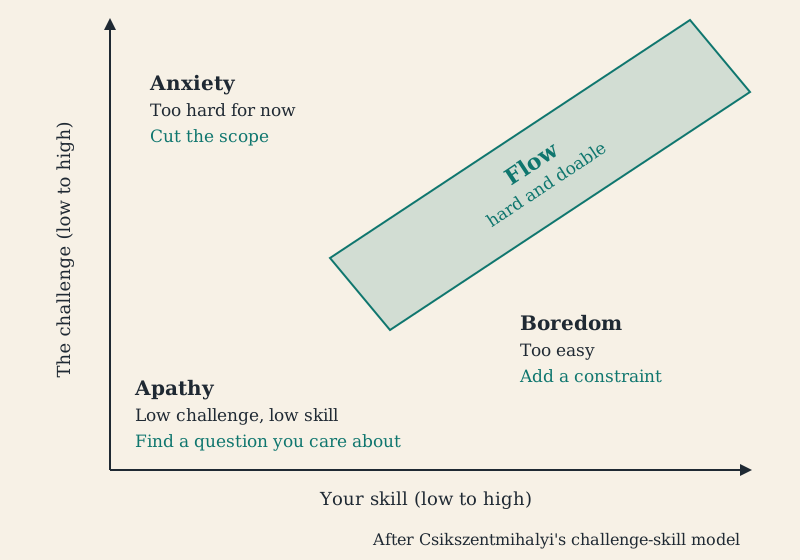
Csikszentmihalyi gave people pagers that went off 10 times a day and asked how challenged and how skilled they felt. Flow showed up most when both were above the person's own average. Use that map to work out what's wrong.
- It feels like anxiety. The task is too hard for now. Cut the scope or start with the easiest piece.
- It feels like boredom. The task is too easy. Add a constraint or a deadline.
- You're wired. Downshift first (method 4).
- You're flat. Move for a few minutes.
- You don't care. Find a question you want answered. If there isn't one, the task may be the problem.
The bottom corner, low challenge and low skill, is apathy. "Unfortunately, a lot of people's experience is in apathy," Csikszentmihalyi said, and its largest single source was watching television.
When an interruption breaks a good session, go back to the exact line you were on before starting anything new. Some days the state won't return, and that's fine.
Flow numbers to treat with care
The best-known figure, "500% more productive", comes from Kotler, who says a ten-year McKinsey study found top executives five times more productive in flow, based on their own reports. No McKinsey report with the figure has been found, so treat it as a talking point. The DARPA story that snipers trained in flow found their targets 2.3 times faster, the "4%" rule and "15 minutes to recover from a text" don't trace to published flow studies either.
What Csikszentmihalyi did show is why flow matters. In his talk, US incomes had more than doubled, almost tripled, since 1956, while the share of people calling themselves very happy stayed at about 30%. Flow was his answer to where satisfaction comes from once money stops adding to it.
FAQ
How long does it take to enter flow state?
Nobody has measured how long it takes to enter flow state. Huberman calls the first 5 to 10 minutes of a focus session a warm-up, and one designer quoted by Asana puts her own entry at 10 to 15. Plan a 60 to 90 minute block.
What is the difference between flow state and hyperfocus?
Flow has six defined features, including a sense of control and the task feeling rewarding in itself. Hyperfocus is a looser term, used mostly about ADHD and autism, for absorption so complete that you tune out everything else. A 2021 review says researchers haven't agreed on its definition (Ashinoff & Abu-Akel).
Can anyone achieve flow state?
Flow isn't limited to experts or one culture, and the way to achieve it is to set up the conditions above. Csikszentmihalyi's team interviewed more than 8,000 people who enjoy their work, across very different cultures and jobs, and found they described the same experience regardless of culture or education.
What activities are best for achieving flow?
The best activities for flow have a clear goal, quick feedback and room to get harder as you improve. Music, sport, games, writing and coding all fit. Csikszentmihalyi's interviews ran from Himalayan climbers to Navajo shepherds, so the structure matters more than the activity.
Why can't I enter flow state even when I try?
Knowing how to enter flow state doesn't guarantee it on a given day, so when you can't, check three things: the task's difficulty, your stress level, and your interest. Fix difficulty with scope or constraints, stress with a downshift or some movement, and interest by finding a question to answer.
Sources
- Csikszentmihalyi M (2004). Flow, the secret to happiness. TED2004. https://www.ted.com/talks/mihaly_csikszentmihalyi_flow_the_secret_to_happiness
- Csikszentmihalyi M (1975). Beyond Boredom and Anxiety. Jossey-Bass.
- Nakamura J, Csikszentmihalyi M (2009). Flow theory and research. In: Oxford Handbook of Positive Psychology, 2nd ed. Oxford University Press.
- Keller J, Bless H (2008). Flow and regulatory compatibility: an experimental approach to the flow model of intrinsic motivation. Personality and Social Psychology Bulletin. https://pubmed.ncbi.nlm.nih.gov/18212330/
- Ulrich M, Keller J, Hoenig K, Waller C, Grön G (2014). Neural correlates of experimentally induced flow experiences. NeuroImage. https://pubmed.ncbi.nlm.nih.gov/23959200/
- Harris DJ, Vine SJ, Wilson MR (2017). Neurocognitive mechanisms of the flow state. Progress in Brain Research. https://pubmed.ncbi.nlm.nih.gov/29031465/
- van der Linden D, Tops M, Bakker AB (2021). Go with the flow: a neuroscientific view on being fully engaged. European Journal of Neuroscience. https://pubmed.ncbi.nlm.nih.gov/33084102/
- Peifer C, Schächinger H, Engeser S, Antoni CH (2015). Cortisol effects on flow-experience. Psychopharmacology. https://pubmed.ncbi.nlm.nih.gov/25304863/
- Chang YK, Labban JD, Gapin JI, Etnier JL (2012). The effects of acute exercise on cognitive performance: a meta-analysis. Brain Research. https://pubmed.ncbi.nlm.nih.gov/22480735/
- Mark G, Gudith D, Klocke U (2008). The cost of interrupted work: more speed and stress. Proceedings of CHI 2008. https://www.ics.uci.edu/~gmark/chi08-mark.pdf
- González VM, Mark G (2004). "Constant, constant, multi-tasking craziness": managing multiple working spheres. Proceedings of CHI 2004. https://www.ics.uci.edu/~gmark/CHI2004.pdf
- Ward AF, Duke K, Gneezy A, Bos MW (2017). Brain drain: the mere presence of one's own smartphone reduces available cognitive capacity. Journal of the Association for Consumer Research. https://doi.org/10.1086/691462
- Ruiz Pardo AC, Minda JP (2022). Reexamining the "brain drain" effect: a replication of Ward et al. (2017). Acta Psychologica. https://doi.org/10.1016/j.actpsy.2022.103717
- Ashinoff BK, Abu-Akel A (2021). Hyperfocus: the forgotten frontier of attention. Psychological Research. https://pubmed.ncbi.nlm.nih.gov/31541305/
- Smits EJC, Wenzel N, de Bruin A (2025). Investigating the effectiveness of self-regulated, Pomodoro, and Flowtime break-taking techniques among students. Behavioral Sciences. https://pubmed.ncbi.nlm.nih.gov/40723645/
- Huberman Lab (2022). Focus toolkit: tools to improve your focus & concentration (episode 88). https://www.hubermanlab.com/episode/focus-toolkit-tools-to-improve-your-focus-and-concentration
- Asana (n.d.). Flow state work: 6 tips to find focus and do best work. https://asana.com/resources/flow-state-work
- Kotler S, quoted in Thought Economics. Firms like McKinsey are self-reporting that their people are 5x more productive in flow. https://thoughteconomics.com/te-quotes/steven-kotler-firms-like-mckinsey-are-self-reporting-that-their-people-are/