The short answer to how to stop overthinking is to stop pushing the thoughts away and give your mind a specific job instead. Calm your body if it's wound up, park the worry until a set time later, or put it on paper and question it. Where to start depends on the shape of your overthinking. Some minds scatter across many worries. Others circle one for hours.
The five methods:
- Nervous system reset. A 10 to 20-minute guided NSDR session when your body is wound up.
- Attention training. Practise moving your attention on purpose.
- Scheduled worry time. Postpone worries to a fixed 30-minute slot.
- Write it down and question it. Sort what you can act on.
- Physical state reset. Sleep, a walk somewhere green, or 5-4-3-2-1 grounding.
Why overthinking feels impossible to stop
The suppression trap
Ordering yourself to stop rarely works. "Telling yourself not to have a certain thought is not the way to not have the thought," clinical psychologist Catherine Pittman told Headspace. "You need to replace the thought."
In the 1987 "white bear" experiment, Daniel Wegner asked people to talk through their thoughts for five minutes without thinking of a white bear, ringing a bell each time it came up. They couldn't keep it out. Afterwards they thought about the bear more than people who'd been allowed to think about it from the start. In a second experiment, people given one specific thing to think about instead were less preoccupied later.
A 2020 meta-analysis of 31 studies found that rebound reliably. During the suppression itself, the thought only got stronger when people were also mentally busy.
Your body keeps the loop running
Overthinking is a mental habit, and your body is part of it. A 2020 review found that rumination tends to prolong low moods, get in the way of problem-solving and keep the body's stress response going.
It works the other way too. The prefrontal cortex, which helps you regulate attention, is the brain region most sensitive to stress. Even quite mild stress that feels out of your control can rapidly impair it, according to a 2009 review by Yale neuroscientist Amy Arnsten that draws on human and animal studies. So redirecting your thinking is hardest exactly when you need it.
That's the case for calming the body first. Slow breathing is the simplest start. Across 223 studies, it raised the part of heart rate variability linked to the calming, vagal side of the nervous system.
It's a learned habit, not a character flaw
Metacognitive therapy (MCT), developed by Adrian Wells at the University of Manchester, treats worry and rumination as unhelpful coping strategies. People use them to manage upsetting thoughts, and two kinds of belief drive them. One says worry is useful ("Worry helps me stay prepared"). The other says it's out of your hands ("I have no control over my worry/rumination").
Rumination researcher Ed Watkins describes it as a learnt habit that grows out of "dwelling on problematic goals". The five methods below are practice at a different habit.
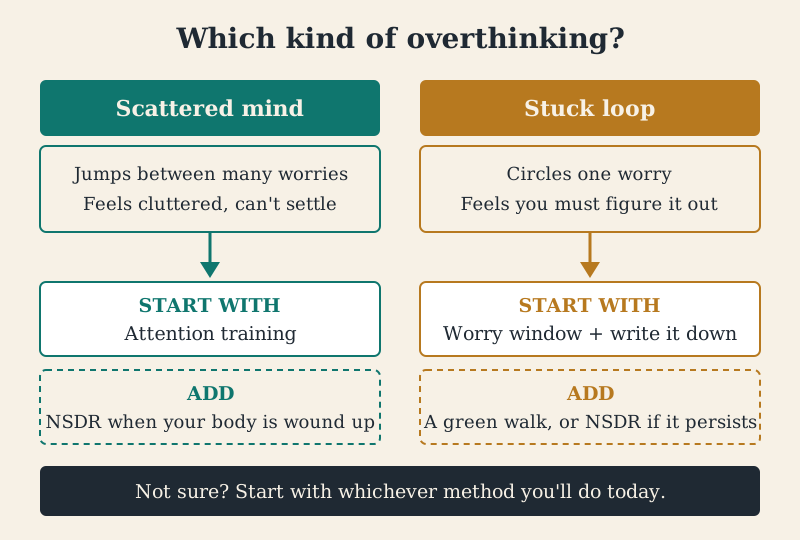
Two types of overthinking (and why it matters)
Type 1: The scattered mind
Your attention jumps from work to yesterday's conversation to the weekend and back. Nothing gets resolved because nothing gets enough attention. You need to steady your attention on one thing.
Type 2: The stuck loop
You replay one scenario, analysing it from every angle, and never reach a conclusion. It feels productive, which is the trap.
"So often people confuse overthinking with problem-solving," clinical psychologist Helen Odessky told Headspace. "But what ends up happening is we just sort of go in a loop. We're not really solving a problem." You need interruption and a little distance.
Quick self-assessment
When you catch yourself overthinking, ask:
- Is my mind jumping between many different topics? (Type 1)
- Am I circling the same issue again and again? (Type 2)
- Do I feel mentally cluttered from too many threads? (Type 1)
- Do I feel I have to figure this out before I can relax? (Type 2)
These aren't clinical categories, and metacognitive therapy uses the same core tools for worry and rumination. Use them only to pick your first method.
Method 1: Nervous system reset (NSDR)
Why start with the body
If your heart is up and your jaw is tight, a thinking technique asks a stressed brain to do its hardest job. Settle your body first.
How to do an NSDR session
Lie on your back and put on a guided NSDR track of 10 to 20 minutes. The voice moves your attention through your body and slows your breathing. Follow it and stay awake. If your mind drifts back to the worry, return to the next body part the voice names.
No NSDR study has measured overthinking. In one trial of 65 active adults, a single 10-minute NSDR session lowered self-rated stress and tension more than sitting quietly for 10 minutes. Four small trials use the NSDR name, and in one of them a 25-minute nap beat a 10-minute session on readiness, with NSDR showing no effect. More on what NSDR is and how it was studied.
When to use it
Use it when your body feels wound up: after a stressful meeting, in the early afternoon, or as a spiral starts. At night, a track built for sleep fits better because it doesn't ask you to stay awake. For racing thoughts at bedtime, see the sleep anxiety guide.
Method 2: Attention training
A simple focus drill
Pick one focus point, such as a sound in the room or your breath. Hold your attention there for 5 to 10 minutes. When it wanders, notice where it went and bring it back. Each return is practice at choosing where your attention goes.
The clinical version: attention training technique
Wells's attention training technique (ATT) takes about 12 minutes and uses several sounds at once, some louder and some quieter, coming from different places. For about 5 minutes you focus on one sound at a time. For the next 5 you switch rapidly between them. For the last 2 you try to hear them all at once.
For a rough home version, sit somewhere with a few distinct sounds, such as traffic, a fan and a clock, and run the same three stages.
What the evidence shows
ATT was designed to reduce self-focused, repetitive thinking, so it suits stuck loops as well as scattered minds. A 2016 review of 10 studies (295 people) found it promising for anxiety and depression, with the authors warning that the samples were small.
MCT also uses a second skill called detached mindfulness. You become aware of a trigger thought ("what if I lose my job?") and take a step back from it without engaging any further.
Method 3: Scheduled worry time
How postponement works
When a worry arrives, note it and postpone it to a set slot later in the day. MCT uses this on purpose, so you learn that worry can be put off and that leaving it is harmless.
Pittman also asks clients to set aside time for it later. "Can we schedule a time for you to worry from 4 to 5 p.m. and that's all you do during that time?" she told Headspace.
Setting up your worry window
Natacha Duke, a psychotherapist at Cleveland Clinic, describes a worry period of about 30 minutes. Write down all your worries, highlight the ones you can problem-solve and brainstorm solutions for those. Let the rest go until your next worry period.
"You're really trying to only worry during your worry period. It takes a little bit of time," Duke says. "But eventually what happens is you develop better control over your worrying."
Holding the worry window well before bed is a rule of thumb the trials didn't test.
What the trials found
In a 2013 trial, 53 people who worried a lot spent two weeks restricting worry to a daily 30-minute slot at a set time and place. Compared with a control group, they had bigger drops in worry, anxiety, negative mood and insomnia, though not in depression.
A 2016 online version didn't work. People postponed worry to a 30-minute early-evening slot for six days and worried no less than people who just logged their worries. Participants reported difficulty postponing, and only 361 of 996 finished. Copy the 2013 version: a fixed time, a fixed place and a notebook.
Method 4: Write it down and question it
Get it out of your head
A loop is hard to inspect while it's running. On paper it's a list. Write each worry down in one plain sentence.
At bedtime, try a forward-looking list instead. In a 2018 sleep-lab study of 57 young adults, five minutes writing a specific to-do list helped people fall asleep faster than writing about tasks they'd already finished.
Ask three questions
For each line, Duke suggests asking whether the thought is helpful, then: "What is the evidence that my negative thought is true? Is there an alternative possibility?"
Then, as Duke suggests, turn any "what if" into an "if then" with a concrete plan. "What if the presentation goes badly?" becomes "If it goes badly, then I'll ask for feedback and fix the slides."
Turn one worry into one action
Pick one fixable item and take the smallest real step, such as sending the email. "Do something in real time and real life rather than sitting and thinking," advises clinical psychologist David Carbonell, author of The Worry Trick.
Method 5: Physical state reset
When the problem is exhaustion
In a study of 52 adults prone to repetitive negative thinking, those who habitually slept less had more trouble pulling their attention away from negative images. It was a snapshot, so it can't show which came first. If sleep has slipped, work on it alongside the other methods, starting with a same-day plan after a bad night.
A walk somewhere green
"It removes us from active participation," Carbonell says of overthinking. Getting outside is one way back into it. In a Stanford study, healthy adults who took a 90-minute walk somewhere green reported less rumination afterwards and showed less activity in a brain area linked to it. Those who walked for the same time in an urban setting didn't. Shorter walks weren't tested.
The 5-4-3-2-1 grounding technique
Name 5 things you can see, 4 you can touch, 3 you can hear, 2 you can smell and 1 you can taste. It gives your attention a specific job, which is Pittman's "replace the thought" in practice. No trial has tested it on its own, so treat it as a quick tool to try. There are other fast ways to calm down too.
Which method should you try first?
If you're scattered (Type 1)
Start with attention training. Do the simple drill daily, or the 12-minute version if you can find a recording. Add an NSDR session on days your body feels wound up.
If you're stuck (Type 2)
Start with a worry window and write the loop down. Add a walk somewhere green when you notice tension building, and an NSDR session if the loop keeps going anyway.
If you don't know your type
Start with whichever one you'll do today, such as a 10-minute NSDR session. If your attention keeps jumping, add the focus drill. If you keep circling one worry, add a worry window.
When to get more help
This section is general information. Persistent rumination is worth taking seriously. In a study that followed people over time, it predicted later depression, including new depressive episodes, and anxiety symptoms. If worry is hard to control on most days, or you ever feel unsafe, see a GP or a mental health professional.
Two therapies target the habit directly: MCT and rumination-focused CBT. MCT came out ahead of CBT-type treatments in a 2018 meta-analysis, whose authors asked for larger trials. In a 2020 depression trial of 174 adults, 74% recovered on a self-report scale after MCT versus 52% after CBT, though a clinician-rated scale showed no difference and MCT's originator led the trial.
The information trap (stop reading, start doing)
Reading about overthinking is still overthinking
Reading guides like this one can become another loop. It feels like problem-solving, which is Odessky's point, and it spares you the discomfort of trying something.
The one-thing rule
Pick one method and give it two weeks, the length of the worry-period trial, before switching or adding another. The best method is the one you're still doing on day ten.
Your next step
- Wound up most evenings: try a 10-minute NSDR session tonight.
- Scattered during the day: 5 minutes of the focus drill tomorrow morning.
- Stuck in loops: set a worry window this week, with a time, a place and a notebook.
FAQ
How do I stop overthinking at night?
To stop overthinking at night, move the worrying earlier and give the bedtime version somewhere to go. Hold a worry window in the late afternoon or early evening. At bedtime, spend five minutes writing a specific to-do list, which helped young adults in a sleep-lab study fall asleep faster. A sleep-focused audio track is an option if you'd rather listen than lie there thinking.
What is the root cause of overthinking?
Overthinking doesn't have one root cause. Rumination research points to a learnt habit that grows out of dwelling on problematic goals and processing them in an abstract way. Metacognitive therapy adds beliefs about worry itself, such as believing worry keeps you prepared or that you can't control it. Stress and short sleep are both linked with more trouble pulling your attention away from negative things.
Is overthinking a mental illness?
Overthinking isn't a mental illness on its own, though it can be part of one. Generalised anxiety disorder is diagnosed when worry is hard to control on most days for at least six months, along with at least three symptoms such as restlessness, fatigue, poor concentration, irritability, muscle tension or sleep problems. If that sounds like you, talk to a GP or mental health professional.
How long does it take to stop overthinking?
There's no standard timeline for how long it takes to stop overthinking. In the worry-period trial, people saw changes after two weeks of daily practice. Full metacognitive therapy for depression ran up to 24 sessions in one trial.
Can you train your brain to stop overthinking?
Yes, to a degree, you can train your brain to overthink less. Metacognitive therapy, which targets worry and rumination directly, has its strongest trial evidence in anxiety and depression, and attention training looks promising in small studies.
Sources
- Wegner DM, Schneider DJ, Carter SR, White TL (1987). Paradoxical effects of thought suppression. Journal of Personality and Social Psychology. https://pubmed.ncbi.nlm.nih.gov/3612492/
- Wang DA, Hagger MS, Chatzisarantis NLD (2020). Ironic effects of thought suppression: a meta-analysis. Perspectives on Psychological Science. https://pubmed.ncbi.nlm.nih.gov/32286932/
- Watkins ER, Roberts H (2020). Reflecting on rumination: consequences, causes, mechanisms and treatment of rumination. Behaviour Research and Therapy. https://pubmed.ncbi.nlm.nih.gov/32087393/
- Nolen-Hoeksema S (2000). The role of rumination in depressive disorders and mixed anxiety/depressive symptoms. Journal of Abnormal Psychology. https://pubmed.ncbi.nlm.nih.gov/11016119/
- Arnsten AF (2009). Stress signalling pathways that impair prefrontal cortex structure and function. Nature Reviews Neuroscience. https://pubmed.ncbi.nlm.nih.gov/19455173/
- Laborde S, Allen MS, Borges U, et al. (2022). Effects of voluntary slow breathing on heart rate and heart rate variability: a systematic review and a meta-analysis. Neuroscience & Biobehavioral Reviews. https://pubmed.ncbi.nlm.nih.gov/35623448/
- Normann N, Morina N (2018). The efficacy of metacognitive therapy: a systematic review and meta-analysis. Frontiers in Psychology. https://pubmed.ncbi.nlm.nih.gov/30487770/
- Callesen P, Reeves D, Heal C, Wells A (2020). Metacognitive therapy versus cognitive behaviour therapy in adults with major depression: a parallel single-blind randomised trial. Scientific Reports. https://pubmed.ncbi.nlm.nih.gov/32398710/
- Davison C, Capobianco L, Carter K, Wells A (2026). Cognitive and neuropsychological correlates of the attention training technique: a systematic review and evidence synthesis. Frontiers in Psychiatry. https://pubmed.ncbi.nlm.nih.gov/42344681/
- Knowles MM, Foden P, El-Deredy W, Wells A (2016). A systematic review of efficacy of the attention training technique in clinical and nonclinical samples. Journal of Clinical Psychology. https://pubmed.ncbi.nlm.nih.gov/27129094/
- McGowan SK, Behar E (2013). A preliminary investigation of stimulus control training for worry: effects on anxiety and insomnia. Behavior Modification. https://pubmed.ncbi.nlm.nih.gov/22977265/
- Versluis A, Verkuil B, Brosschot JF (2016). Reducing worry and subjective health complaints: a randomized trial of an internet-delivered worry postponement intervention. British Journal of Health Psychology. https://pubmed.ncbi.nlm.nih.gov/26511764/
- Scullin MK, Krueger ML, Ballard HK, Pruett N, Bliwise DL (2018). The effects of bedtime writing on difficulty falling asleep: a polysomnographic study comparing to-do lists and completed activity lists. Journal of Experimental Psychology: General. https://pubmed.ncbi.nlm.nih.gov/29058942/
- Nota JA, Coles ME (2018). Shorter sleep duration and longer sleep onset latency are related to difficulty disengaging attention from negative emotional images in individuals with elevated transdiagnostic repetitive negative thinking. Journal of Behavior Therapy and Experimental Psychiatry. https://pubmed.ncbi.nlm.nih.gov/29111422/
- Bratman GN, Hamilton JP, Hahn KS, Daily GC, Gross JJ (2015). Nature experience reduces rumination and subgenual prefrontal cortex activation. Proceedings of the National Academy of Sciences. https://pubmed.ncbi.nlm.nih.gov/26124129/
- Boukhris O, et al. (2024). The acute effects of nonsleep deep rest on perceptual responses, physical, and cognitive performance in physically active participants. Applied Psychology: Health and Well-Being. https://pubmed.ncbi.nlm.nih.gov/38953770/
- Headspace. How to stop overthinking and start living (Pittman, Odessky and Carbonell quotes). https://www.headspace.com/articles/stop-overthinking-start-living
- Cleveland Clinic. How To Stop Overthinking (Natacha Duke, RP). https://health.clevelandclinic.org/how-to-stop-overthinking
- National Institute of Mental Health. Generalized Anxiety Disorder: When Worry Gets Out of Control. https://www.nimh.nih.gov/health/publications/generalized-anxiety-disorder-gad