The fastest tools for a racing heart are a slow exhale and cold water on your face. Your heart beats a little faster on every inhale and a little slower on every exhale, so a long exhale tips it toward slowing. Knowing how to lower heart rate quickly starts with one to three physiological sighs, then a few minutes of slow breathing. These tools suit a heart that's racing from stress, a workout or coffee. A sudden, very fast or irregular rhythm needs a doctor.
TL;DR
- Sigh first. Two inhales through the nose, one long exhale through the mouth, one to three times.
- Then breathe slowly with a longer exhale, about 4 seconds in and 6 out, for a few minutes.
- Cold on the forehead and around the eyes triggers a reflex that slows the heart.
- The Valsalva maneuver is a treatment doctors teach for a diagnosed fast rhythm called SVT. It isn't a home trick.
- After exercise, cool down with easy walking instead of stopping dead.
- Chest pain, fainting, trouble breathing, or a resting rate that stays above 100 means getting help.
Check this first: a racing heart or a rhythm problem?
A fast heart rate from fear, anxiety, exercise or caffeine is called sinus tachycardia. Cleveland Clinic says it goes away when you calm down or rest. That's the kind the methods below help with.
Chest pain, trouble breathing or feeling faint means getting help now. The warning signs are listed further down. Cardiologist Marc Eisenberg told TODAY that if a watch shows a fast, irregular rhythm, it may be atrial fibrillation, and you should get medical help right away because atrial fibrillation can cause a stroke. If you have a heart condition, ask your doctor which of these techniques are safe for you.
Why your heart rate speeds up
What counts as high
A normal resting heart rate is 60 to 100 beats a minute. Cleveland Clinic arrhythmia specialist Shady Nakhla says it's reasonable to seek care for a resting rate over 100.
One accelerator, one brake
Two branches of your nervous system act on your heart at once. The sympathetic branch speeds it up. The vagus nerve, the main nerve of the parasympathetic branch, works as a brake. Most of the fast tools below work by pressing the brake harder. More on how the sympathetic and parasympathetic branches differ.
Your breathing already moves your heart rate
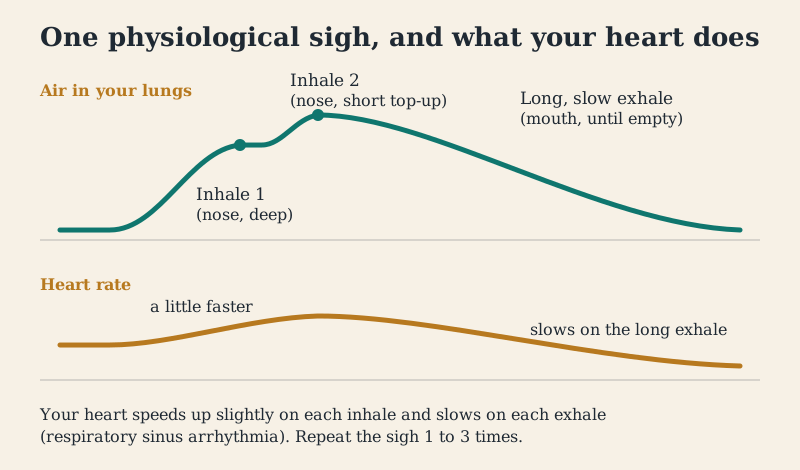
Each inhale shortens the gap between heartbeats and each exhale lengthens it. This rhythm is called respiratory sinus arrhythmia. A long exhale spends more time in the slow-down phase, so every breathing method below stretches the out-breath.
Method 1: The physiological sigh
What it is
You already sigh without trying. Spontaneous sighs happen every few minutes to reopen tiny air sacs in the lungs, and they come more often under stress. The deliberate version is a deep breath in, topped up with a second, shorter one, then a long, slow breath out.
The trial behind it
In a one-month Stanford trial of about 110 adults, 5 minutes a day of this "cyclic sighing" improved mood and slowed resting breathing more than mindfulness meditation did. Heart rate variability didn't differ between groups, and it was an exploratory study. Andrew Huberman, a Stanford neuroscientist and one of the authors, said in his podcast episode "Tools for Managing Stress & Anxiety" that one to three sighs "will bring down your level of stress very, very fast." Nobody has timed that against a heart rate monitor.
How to do it
- Breathe in through your nose until your lungs feel full.
- Without breathing out, take a second, shorter breath in through your nose to top up.
- Breathe out slowly through your mouth until your lungs are empty.
- Repeat one to three times. As a daily practice, the trial used 5 minutes.
One to three sighs take under a minute. The full guide to the physiological sigh covers the research in more depth.
Method 2: Slow breathing with a long exhale
Why the exhale matters
In a 30-person lab study, people felt more relaxed breathing slowly with a long exhale than with a short one, and the long exhale raised the vagal part of heart rate variability. A 2022 meta-analysis of 223 studies found that slow breathing raises this vagal measure during a session and straight after it. Read what heart rate variability measures if you track it.
4 in, 6 out
This is the simplest default. Breathe in through your nose for 4 seconds and out for 6, which is 6 breaths a minute. Keep it up for three or four minutes.
The 4-7-8 technique
- Breathe out fully through your mouth.
- Breathe in through your nose for a count of 4.
- Hold for 7.
- Breathe out through your mouth for 8.
- Repeat four times.
Four cycles take about a minute and a quarter. In a 2022 study of 43 adults aged 19 to 25, three sets of six cycles lowered heart rate and systolic blood pressure straight afterwards, in sleep-deprived and rested people alike. If the 7-count hold leaves you short of air, shorten it.
Box breathing
Breathe in for 4, hold for 4, out for 4, hold for 4, four to six times. The counts are easy to remember, but in the Stanford trial the sigh did better on mood.
Method 3: Cold water on your face
How the dive reflex works
Cold on your face excites the trigeminal nerve, which signals the brainstem, which slows the heart through the vagus. The forehead and the skin around the eyes are the most sensitive spots. Because it's a reflex, it works even when you can't relax. The slowing is strongest at the start, then fades.
How to do it safely
Start with a cold, wet cloth or a cold pack on your forehead and eyes, or splash your face. In the study that set up the "cold face test", the slowing from a cold compress matched up well with the slowing from a full face dunk.
For the stronger version, sit at a sink with a bowl of cold water, hold your breath and put your face in for a few seconds, up to about 30. In one lab protocol, everyone's heart slowed with their face in water of 2 to 3°C for at least 30 seconds. Stop if you feel dizzy, and skip it if you have a heart condition or a history of fainting unless your doctor has said it's fine. Cleveland Clinic warns of a drowning risk when the whole face goes into ice water.
A cold pack on the side of the neck also works. In a 61-person study, 16-second bursts of cold there lowered heart rate.
Where the evidence is
The clearest test is after exercise. In 13 men, cold water on the face sped up heart rate recovery compared with sitting quietly. Nobody has tested it during panic attacks.
Method 4: Vagal maneuvers, taught by a doctor
What they are and who they're for
Vagal maneuvers are "physical actions that make your vagus nerve act on your heart's natural pacemaker." Doctors use them first for supraventricular tachycardia, or SVT, a fast rhythm that starts and stops suddenly. For certain fast rhythms they work 20% to 40% of the time. Cleveland Clinic's advice is "Don't try these yourself without talking to your healthcare provider first."
The Valsalva maneuver
You strain for 15 to 20 seconds against a closed mouth and nose, as if pushing on the toilet. Cleveland Clinic says it stops SVT 5% to 20% of the time, and when it works the heart slows in about a minute. In an emergency-department trial of 433 people with SVT, the standard strain restored a normal rhythm in 17%. Lying flat with the legs raised straight after the strain lifted that to 43%, and the authors say this version "can be taught to patients."
So there are no steps for it here. The strain can cause chest pain, fainting or an abnormal rhythm, and people with some eye conditions shouldn't do it, while some heart conditions call for extra care. If you have SVT, learn it from your doctor.
Gentler options you'll see suggested
Cleveland Clinic lists gargling and coughing as ways to stimulate the vagus nerve, but no study has measured gargling and heart rate. Humming stretches the exhale. In one 16-person study it matched slow breathing, and in another heart rate rose while humming. For the anatomy, read what the vagus nerve does.
Method 5: Guided rest with NSDR
Non-sleep deep rest is a guided session where you lie still and stay awake while a voice slows your breathing and moves your attention through your body. In a 2026 trial of 102 young adults, 10 minutes of NSDR lowered sleepiness, fatigue and stress ratings, and heart rate fell a little more than during quiet sitting. The authors call the physiological findings modest.
It fits after the spike has passed, when you can lie down for ten minutes. New to it? Start with what NSDR is.
Which method should you choose?
If your heart is racing from anxiety or stress
Start with one to three sighs, because you can do them anywhere. Then move to 4-in, 6-out breathing for a few minutes. If you can't focus on counting, hold a cold compress on your forehead and eyes. For the longer game, follow a step-by-step plan for calming down after stress.
If you just finished exercising
Cleveland Clinic cardiologist Tamanna Singh says "you should see your heart rate drop at least 12 beats per minute within the first minute after completing exercise in your training zone." Don't stop dead. She recommends a cool-down, and the American Heart Association suggests 5 to 10 minutes of slower walking. Cold water on your face is the one add-on with a study behind it.
If it's caffeine or another stimulant
Too much caffeine or alcohol can cause a fast heart rate. Slow breathing makes the wait easier but won't clear the caffeine faster, so give it time and skip the next coffee.
When to seek medical help
Warning signs that need immediate attention
Call 999 in the UK or 911 in the US if a fast heartbeat comes with:
- chest pain, pressure or squeezing, especially if it spreads to your arm, neck or jaw
- trouble breathing
- fainting, or feeling faint or dizzy
- a pounding heart that won't settle
Don't drive yourself to hospital.
When to see a doctor (non-emergency)
Book an appointment if:
- your resting heart rate is regularly over 100
- you keep getting episodes of a fast heartbeat
- your heart rate doesn't come down after exercise
- your heartbeat feels irregular, or a watch flags a fast, irregular rhythm
Conditions that can raise your heart rate
Cleveland Clinic lists stress, dehydration, high blood pressure, low blood sugar, pregnancy, anaemia, an untreated thyroid problem, heart disease and some medicines. Some types of tachycardia, left untreated, can lead to blood clots, stroke or a weakened heart muscle. A fast rate that keeps coming back needs a diagnosis.
In a Norwegian study of about 29,000 adults, a rise from under 70 to over 85 across ten years came with about 1.9 times the risk of dying from coronary heart disease, though the margin of error was wide. It's an association, and a falling rate showed no general benefit.
FAQ
How can I lower my heart rate in 5 minutes?
In 5 minutes you have time for one to three sighs, then three or four minutes of breathing 4 seconds in and 6 out, which slows your heart rate on each long exhale. If you can't concentrate, hold a cold, wet cloth on your forehead and eyes instead.
What is the quickest way to lower heart rate?
Cold water on the face and a slow exhale are how to lower heart rate quickly without medicine, and the sigh needs no equipment. No study has ranked them. With diagnosed SVT, use the maneuver your doctor taught you.
Is 120 heart rate bad?
A heart rate of 120 during exercise can be normal. For a 50-year-old, the American Heart Association's exercise target zone is 85 to 145 beats a minute. At rest, anything over 100 counts as tachycardia, so a resting 120 that doesn't settle is worth checking with a doctor, and urgently if it comes with chest pain, breathlessness or dizziness.
What are vagal maneuvers?
Vagal maneuvers are physical actions, such as the Valsalva strain or the diving reflex, that make the vagus nerve slow the heart's natural pacemaker. Doctors use them to stop SVT and teach them to patients with that diagnosis, so talk to your doctor before trying one.
Can anxiety cause a high heart rate?
Yes, anxiety can cause a high heart rate. Fear and stress speed up the heart's pacemaker, and this sinus tachycardia settles once the feeling passes. If it happens often or comes with chest pain, see a doctor.
Sources
- Cleveland Clinic (2025). Tachycardia. https://my.clevelandclinic.org/health/diseases/22108-tachycardia
- Cleveland Clinic. Here's When You Should Go to the Hospital for a Dangerous Heart Rate (Shady Nakhla, MD). https://health.clevelandclinic.org/when-to-go-to-the-hospital-for-a-dangerous-heart-rate
- Cleveland Clinic. Quick Tips To Bring Down a High Heart Rate (Tamanna Singh, MD). https://health.clevelandclinic.org/immediately-lower-heart-rate
- Cleveland Clinic. Vagal Maneuvers. https://my.clevelandclinic.org/health/treatments/22227-vagal-maneuvers
- Cleveland Clinic. Valsalva Maneuver. https://my.clevelandclinic.org/health/articles/23209-valsalva-maneuver
- TODAY. How to Lower Heart Rate Quickly With 6 Simple Steps (Marc Eisenberg, MD; Pamela Mason, MD). https://www.today.com/health/how-to-lower-heart-rate-rcna222032
- NHS. Supraventricular tachycardia (SVT). https://www.nhs.uk/conditions/supraventricular-tachycardia-svt/
- NHS. Heart attack. https://www.nhs.uk/conditions/heart-attack/
- American Heart Association (2024). Target Heart Rates Chart. https://www.heart.org/en/healthy-living/fitness/fitness-basics/target-heart-rates
- American Heart Association. Warm Up, Cool Down. https://www.heart.org/en/healthy-living/fitness/fitness-basics/warm-up-cool-down
- Yasuma F, Hayano J (2004). Respiratory sinus arrhythmia: why does the heartbeat synchronize with respiratory rhythm? Chest. https://pubmed.ncbi.nlm.nih.gov/14769752/
- Li P et al. (2016). The peptidergic control circuit for sighing. Nature. https://pubmed.ncbi.nlm.nih.gov/26855425/
- Balban MY et al. (2023). Brief structured respiration practices enhance mood and reduce physiological arousal. Cell Reports Medicine. https://pubmed.ncbi.nlm.nih.gov/36630953/
- Huberman A (2021). Tools for Managing Stress & Anxiety. Huberman Lab podcast. https://www.hubermanlab.com/episode/tools-for-managing-stress-and-anxiety
- Van Diest I et al. (2014). Inhalation/exhalation ratio modulates the effect of slow breathing on heart rate variability and relaxation. Applied Psychophysiology and Biofeedback. https://pubmed.ncbi.nlm.nih.gov/25156003/
- Laborde S et al. (2022). Effects of voluntary slow breathing on heart rate and heart rate variability: A systematic review and a meta-analysis. Neuroscience & Biobehavioral Reviews. https://pubmed.ncbi.nlm.nih.gov/35623448/
- Vierra J et al. (2022). Effects of sleep deprivation and 4-7-8 breathing control on heart rate variability, blood pressure, blood glucose, and endothelial function in healthy young adults. Physiological Reports. https://pubmed.ncbi.nlm.nih.gov/35822447/
- Khurana RK et al. (1980). Cold face test in the assessment of trigeminal-brainstem-vagal function in humans. Annals of Neurology. https://pubmed.ncbi.nlm.nih.gov/7369721/
- Lundell RV et al. (2021). Diving responses in experienced rebreather divers: short-term heart rate variability in cold water diving. Frontiers in Physiology. https://pubmed.ncbi.nlm.nih.gov/33897457/
- Konishi M et al. (2016). Diurnal variation in the diving bradycardia response in young men. Clinical Autonomic Research. https://pubmed.ncbi.nlm.nih.gov/26795189/
- Jungmann M et al. (2018). Effects of cold stimulation on cardiac-vagal activation in healthy participants: randomized controlled trial. JMIR Formative Research. https://pubmed.ncbi.nlm.nih.gov/30684416/
- Al Haddad H et al. (2010). Influence of cold water face immersion on post-exercise parasympathetic reactivation. European Journal of Applied Physiology. https://pubmed.ncbi.nlm.nih.gov/19882167/
- Appelboam A et al. (2015). Postural modification to the standard Valsalva manoeuvre for emergency treatment of supraventricular tachycardias (REVERT): a randomised controlled trial. The Lancet. https://pubmed.ncbi.nlm.nih.gov/26314489/
- Nivethitha L et al. (2017). Heart rate variability changes during and after the practice of Bhramari Pranayama. International Journal of Yoga. https://pubmed.ncbi.nlm.nih.gov/28546681/
- Woo M, Kim T (2025). Effects of slow-paced breathing and humming breathing on heart rate variability and affect: a pilot investigation. Physiology & Behavior. https://pubmed.ncbi.nlm.nih.gov/40482984/
- Boukhris O et al. (2026). Time course of perceptual, cognitive, physical and physiological responses to a single non-sleep deep rest session in physically active young adults. Applied Psychology: Health and Well-Being. https://pubmed.ncbi.nlm.nih.gov/42383502/
- Nauman J et al. (2011). Temporal changes in resting heart rate and deaths from ischemic heart disease. JAMA. https://pubmed.ncbi.nlm.nih.gov/22187277/