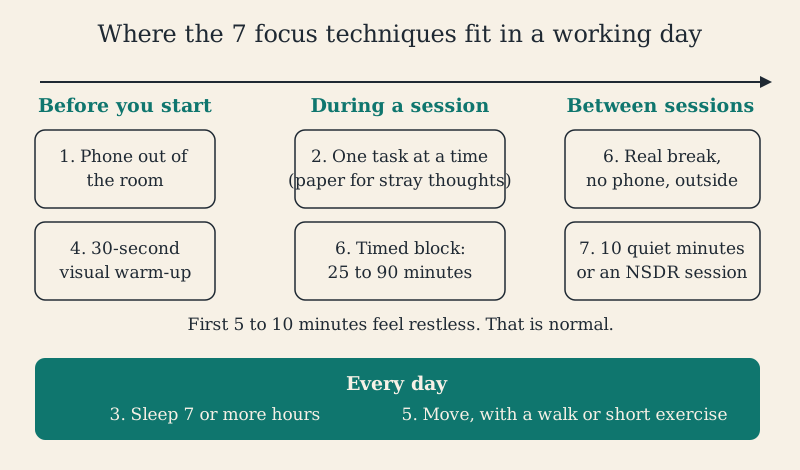
The best-supported focus techniques are plain ones. Work on one task at a time, sleep at least seven hours, and keep notifications away while you work. Movement helps a little, and a quiet rest after hard work helps you keep what you've just learned. Attention drills and timed work blocks rest on thinner evidence, but they cost almost nothing to try. Below are all seven, with timings and the size of the research behind each.
The 7 focus techniques at a glance
- Phone out of the room, notifications off. Mixed evidence, zero cost.
- One task at a time. Strong evidence that switching costs time.
- Seven or more hours of sleep. Strong evidence. Attention is the first thing sleep loss hits.
- Train attention directly. A 30-second visual drill (thin evidence) or a mindfulness course (one good trial).
- Move during the day. Small but consistent effects.
- Timed blocks with real breaks. Pomodoro to get started, up to 90 minutes for deep work.
- Rest after hard work. Ten quiet minutes, or a guided NSDR session. Two memory studies and one small NSDR trial.
1. Get your phone out of the room
Silence notifications, close the email tab and put the phone in another room before you start. Check messages at set times, say once an hour, instead of when they arrive.
Interruptions cost more than the few seconds they take. In a 2003 study that recorded the screens of 16 employees at one UK company, people let email interrupt them about every five minutes, and it took them 64 seconds on average to get back to the pace they'd been working at (Jackson et al.). They reacted to 70% of new emails within six seconds of arrival.
The evidence on the phone itself is mixed. In a 2017 study, people whose phones sat in another room did better on working-memory and reasoning tests than people whose phones lay face down on the desk (Ward et al.). A preregistered replication in 2022 found no difference between the locations (Ruiz Pardo & Minda). So the phone's mere presence may or may not drain you. Its notifications are a better-documented cost, and moving it costs nothing.
2. Work on one task at a time
Pick the task, close everything that isn't for it, and keep a scrap of paper next to you. When another job pops into your head, write it down and go back.
Every switch has a price. In lab experiments, swapping between two tasks slowed people down, and the cost grew as the tasks got more complex (Rubinstein, Meyer & Evans, 2001). Real offices switch constantly. In one field study, information workers spent about three minutes on a task before moving to another (González & Mark, 2004).
You may have read that heavy multitaskers are worse at filtering distractions. A 2009 Stanford study found that, but a later meta-analysis of 39 results found the link was weak and disappeared once small studies were corrected for (Wiradhany & Nieuwenstein, 2017). The safer conclusion is narrower. Switching in the moment costs time, whatever your habits.
3. Protect your sleep
Sleep belongs near the top of any list of focus techniques. Adults should sleep 7 or more hours a night on a regular basis, according to the joint consensus of the American Academy of Sleep Medicine and the Sleep Research Society (Watson et al., 2015).
Attention is what goes first. A meta-analysis of 70 articles on short-term sleep deprivation found the biggest effect on lapses in simple attention, the moments where you stare at the screen and nothing goes in (Lim & Dinges, 2010). Reasoning accuracy barely changed. Those studies kept people up for a night or more, but the direction is clear. A short night hits the exact skill you need for focused work. If your nights are the problem, start with fixing your sleep before adding any drill.
4. Train attention directly
Three drills, from quickest to most proven.
Huberman's visual focus warm-up
In his Focus Toolkit episode, neuroscientist Andrew Huberman suggests a warm-up before focused work. Pick a spot on the wall, or on a blank screen, and hold your gaze on it for 30 seconds. Add about five seconds a day, working up towards three minutes. Blink as normal. "This is not a test of how long you can go without blinking," he says. If you drift mid-session, look back at the spot for a moment instead of picking up your phone.
His reasoning is that visual attention and mental focus share circuitry, so practising one trains the other. He doesn't name a trial of this exact drill. Treat it as a free experiment for a week.
A mindfulness course
The better-tested option is mindfulness training, which means sitting and bringing your attention back to your breath each time it wanders. In a randomized trial, a 2-week course cut mind-wandering and raised scores on GRE reading comprehension and a working-memory test (Mrazek et al., 2013). Minds wander a lot. Using phone check-ins, Harvard researchers found people think about something other than what they're doing almost as often as they think about the task in hand (Killingsworth & Gilbert, 2010).
The 30-minute reading check
Kim Willment, a neuropsychologist at Brigham and Women's Hospital, suggests reading for 30 minutes with a timer that goes off every five minutes. Each time it rings, notice whether your mind was on the page. She says it helps "strengthen the monitoring process", the skill of catching yourself drifting.
5. Move during the day
A bout of exercise before a hard task helps a little. A 2012 meta-analysis of 79 studies found single bouts of exercise improved cognitive performance by a small amount, whether people were tested during, right after or a while after the exercise (Chang et al.).
Short, regular movement can add up. In a 2018 study of 116 fifth-graders, the 31 children who did a 6-minute coordinated-movement break in class every day for four weeks scored better on an attention test than a control group (Buchele Harris et al.). They got faster and more focused, though not more accurate.
For adults, the practical version is a 10-minute walk before your hardest block, or a few minutes of movement when you feel yourself glazing over.
6. Work in timed blocks with real breaks
A timer turns "work on the report" into something with an end. Two common lengths:
- Pomodoro. 25 minutes of work, then a 5-minute break. Good for admin, email and tasks you're avoiding, because 25 minutes is easy to start.
- Up to 90 minutes. Huberman's cap for deep work, with the first 5 to 10 minutes counted as a transition and 5 to 30 minutes of phone-free downtime afterwards.
Neither length is proven. Three small student trials found Pomodoro breaks about as productive as breaks people chose themselves, with mixed effects on mood. And a 1995 study of 60 people found no 90-minute rhythm in waking performance, so treat 90 as a ceiling to stay under. The full breakdown is in our guide to how long a focus session should be.
What you do in the break matters. Huberman's advice is to defocus. Walk down the hall without looking at your phone, or daydream. Go outside if you can. In two experiments, a walk in nature, or even looking at pictures of nature, improved attention scores, while a walk through city streets didn't help as much (Berman et al., 2008).
7. Rest after hard work
When a hard session ends, take 10 quiet minutes before the next thing. Eyes closed, no phone, no podcast.
That rest seems to help you keep what you just did. In a 2012 study, people heard two stories. After one they rested quietly for 10 minutes; after the other they played a spot-the-difference game. A week later they remembered more of the story they'd rested after (Dewar et al.). On a smaller scale, a 2021 study in Cell Reports had people practise a typing sequence in 10-second bursts with 10-second rests. Their skill improved during the rests, not the practice, and brain recordings picked up the sequence replaying at high speed (Buch et al.). Those were 10-second rests, so the study says nothing direct about longer guided sessions.
NSDR (non-sleep deep rest) is a structured way to take that rest. You spend 10 to 30 minutes lying still, following a voice through your body while you stay awake. Four trials have used the name. In the first, 65 active adults did 10 minutes of NSDR or sat quietly for 10 minutes, and the NSDR group improved more on a reaction-time test and on accuracy in a second task, the Simon test of cognitive control (Boukhris et al., 2024). Compared with a nap, the advantage is that you skip the grogginess. For timing and session length, see using NSDR after a study session and what NSDR is and how to do it. NSDR.co is free, and a 10-minute track is an easy start.
Why the first minutes of focus feel hard
Sessions often start badly. You read a paragraph twice, reach for your phone, remember an email. Huberman calls the first 5 to 10 minutes "a transition time", a warm-up you should expect rather than a sign you can't concentrate.
"If you're feeling agitation and it's challenging to focus and you're feeling like you're not doing it right, chances are you're doing it right," he says in How to Focus to Change Your Brain.
His model of the chemistry goes like this. Epinephrine is released when you're alert, acetylcholine works as a spotlight for attention, and dopamine, which he calls "really the molecule of motivation", keeps you going. It's his framework, not a recipe anyone has measured, but the practical point holds. The restlessness is normal, and in Huberman's view each time you pull your attention back is the training. Give a session ten minutes before you judge it.
Which focus technique should you choose?
Start with the problem you have.
| If your problem is... | Start with |
|---|---|
| You can't get started | A 25-minute Pomodoro, plus the 30-second visual warm-up |
| You start well, then drift | Phone in another room, one task, a scrap of paper for stray thoughts |
| Your focus is gone by mid-afternoon | Sleep first, then a walk or 10 minutes of NSDR after lunch |
| You finish sessions but forget what you did | 10 quiet minutes after each hard block |
| Your mind wanders constantly | The 30-minute reading check or a 2-week mindfulness course |
A minimal stack covers most days: phone in another room, one task per block of up to 90 minutes, a real break with no phone, and seven or more hours of sleep. If you use coffee, read up on when to time caffeine.
FAQ
What is the 3 3 3 focus technique?
The 3-3-3 technique, credited to the writer Oliver Burkeman, is a plan for the day: three hours on your most important project, then three shorter tasks, and in most versions three maintenance jobs. It works as a priority rule, so pair it with the techniques above to protect the three hours.
What is the Pomodoro technique?
The Pomodoro technique means 25 minutes of focused work followed by a 5-minute break, repeated. Small student trials found it about as productive as breaks people chose for themselves. It's best for starting tasks you're avoiding; longer blocks suit deep work.
How do I train my brain to focus?
Train your brain to focus by practising returning to the task. A 2-week mindfulness course improved working memory and cut mind-wandering in one randomized trial. Of the other focus techniques here, Huberman's 30-second visual drill and the 30-minute reading check train the same habit of catching yourself drifting.
How many hours of deep work can you do per day?
About four hours of deep work a day is a common ceiling. Research on deliberate practice found essentially no extra benefit beyond about 4 hours a day of practice (Ericsson et al., 1993), and Cal Newport has said he's good for about four to four and a half hours of real output a day. Huberman suggests two or three focus sessions a day.
Why does focusing feel so hard?
Focusing feels hard because the first 5 to 10 minutes are a restless transition, in Huberman's account, and because minds wander almost as often as they stay on task. The agitation is expected. Stick with the session for ten minutes before deciding it isn't working.
Does background music or noise help you focus?
Background music or noise helps some people, but the research is small and mixed. See what the research says about focus music and noise.
When is trouble focusing worth seeing a doctor?
Trouble focusing is worth raising with a doctor if it lasts for weeks despite decent sleep, or gets in the way of work or study. Ongoing poor concentration can have medical causes, including ADHD, depression, sleep disorders and some medications. Health note: these techniques support focus; they don't diagnose or treat any condition.
Sources
- Jackson TW, Dawson R, Wilson D (2003). Understanding email interaction increases organizational productivity. Communications of the ACM. https://www.interruptions.net/literature/Jackson-CACM-p80-jackson.pdf
- Ward AF, Duke K, Gneezy A, Bos MW (2017). Brain drain: the mere presence of one's own smartphone reduces available cognitive capacity. Journal of the Association for Consumer Research. https://doi.org/10.1086/691462
- Ruiz Pardo AC, Minda JP (2022). Reexamining the "brain drain" effect: a replication of Ward et al. (2017). Acta Psychologica. https://pubmed.ncbi.nlm.nih.gov/36007374/
- Rubinstein JS, Meyer DE, Evans JE (2001). Executive control of cognitive processes in task switching. Journal of Experimental Psychology: Human Perception and Performance. https://pubmed.ncbi.nlm.nih.gov/11518143/
- González VM, Mark G (2004). "Constant, constant, multi-tasking craziness": managing multiple working spheres. Proceedings of CHI 2004. https://www.ics.uci.edu/~gmark/CHI2004.pdf
- Ophir E, Nass C, Wagner AD (2009). Cognitive control in media multitaskers. Proceedings of the National Academy of Sciences. https://pubmed.ncbi.nlm.nih.gov/19706386/
- Wiradhany W, Nieuwenstein MR (2017). Cognitive control in media multitaskers: two replication studies and a meta-analysis. Attention, Perception, & Psychophysics. https://pubmed.ncbi.nlm.nih.gov/28840547/
- Watson NF, Badr MS, Belenky G, et al. (2015). Recommended amount of sleep for a healthy adult: a joint consensus statement of the American Academy of Sleep Medicine and Sleep Research Society. Sleep. https://pubmed.ncbi.nlm.nih.gov/26039963/
- Lim J, Dinges DF (2010). A meta-analysis of the impact of short-term sleep deprivation on cognitive variables. Psychological Bulletin. https://pubmed.ncbi.nlm.nih.gov/20438143/
- Huberman A (2022). Focus Toolkit: Tools to Improve Your Focus & Concentration. Huberman Lab podcast #88. https://www.hubermanlab.com/episode/focus-toolkit-tools-to-improve-your-focus-and-concentration
- Huberman Lab Essentials (2024). How to Focus to Change Your Brain. YouTube. https://youtube.com/watch?v=4AwyVTHEU3s
- Mrazek MD, Franklin MS, Phillips DT, Baird B, Schooler JW (2013). Mindfulness training improves working memory capacity and GRE performance while reducing mind wandering. Psychological Science. https://pubmed.ncbi.nlm.nih.gov/23538911/
- Killingsworth MA, Gilbert DT (2010). A wandering mind is an unhappy mind. Science. https://pubmed.ncbi.nlm.nih.gov/21071660/
- Harvard Health Publishing (2023). Tips to improve concentration. https://www.health.harvard.edu/mind-and-mood/tips-to-improve-concentration
- Chang YK, Labban JD, Gapin JI, Etnier JL (2012). The effects of acute exercise on cognitive performance: a meta-analysis. Brain Research. https://pubmed.ncbi.nlm.nih.gov/22480735/
- Buchele Harris H, Cortina KS, Templin T, Colabianchi N, Chen W (2018). Impact of coordinated-bilateral physical activities on attention and concentration in school-aged children. BioMed Research International. https://pubmed.ncbi.nlm.nih.gov/29998131/
- Biwer F, Wiradhany W, Oude Egbrink MGA, de Bruin ABH (2023). Understanding effort regulation: comparing 'Pomodoro' breaks and self-regulated breaks. British Journal of Educational Psychology. https://pubmed.ncbi.nlm.nih.gov/36859717/
- Smits EJC, Wenzel N, de Bruin A (2025). Investigating the effectiveness of self-regulated, Pomodoro, and Flowtime break-taking techniques among students. Behavioral Sciences. https://pubmed.ncbi.nlm.nih.gov/40723645/
- Göksu A, Wiradhany W, de Bruin ABH (2026). When to take a break: comparing effects of systematic short (Pomodoro) and self-regulated breaks on subjective experience and actual learning. Behavioral Sciences. https://pubmed.ncbi.nlm.nih.gov/42510279/
- Neubauer AC, Freudenthaler HH (1995). Ultradian rhythms in cognitive performance: no evidence for a 1.5-h rhythm. Biological Psychology. https://pubmed.ncbi.nlm.nih.gov/7669837/
- Berman MG, Jonides J, Kaplan S (2008). The cognitive benefits of interacting with nature. Psychological Science. https://pubmed.ncbi.nlm.nih.gov/19121124/
- Dewar M, Alber J, Butler C, Cowan N, Della Sala S (2012). Brief wakeful resting boosts new memories over the long term. Psychological Science. https://pubmed.ncbi.nlm.nih.gov/22829465/
- Buch ER, Claudino L, Quentin R, Bönstrup M, Cohen LG (2021). Consolidation of human skill linked to waking hippocampo-neocortical replay. Cell Reports. https://pubmed.ncbi.nlm.nih.gov/34107255/
- Boukhris O, Suppiah H, Halson S, et al. (2024). The acute effects of nonsleep deep rest on perceptual responses, physical, and cognitive performance in physically active participants. Applied Psychology: Health and Well-Being. https://pubmed.ncbi.nlm.nih.gov/38953770/
- Ericsson KA, Krampe RT, Tesch-Römer C (1993). The role of deliberate practice in the acquisition of expert performance. Psychological Review. https://doi.org/10.1037/0033-295X.100.3.363
- NHS. Attention deficit hyperactivity disorder (ADHD). https://www.nhs.uk/conditions/attention-deficit-hyperactivity-disorder-adhd/
- Huberman A, Newport C (2024). Dr. Cal Newport: How to Enhance Focus and Improve Productivity. Huberman Lab podcast. https://www.hubermanlab.com/episode/dr-cal-newport-how-to-enhance-focus-and-improve-productivity