When people compare NSDR vs yoga nidra, they're comparing close relatives. In both you lie down and follow a voice through a body scan and slow breathing, and Andrew Huberman coined NSDR as an umbrella term that includes yoga nidra. Meditation is usually done sitting, and you hold or bring back your own attention. The evidence is lopsided: one meditation meta-analysis pooled 45 randomized trials, a 2026 yoga nidra meta-analysis pooled 73 mostly low-quality studies, and NSDR itself has four small published trials. Below, we compare the three on 4 counts (posture, guidance, intention, evidence) and say which to pick for what.
The short version:
- NSDR is Huberman's umbrella term for guided, awake rest. Yoga nidra is one practice inside it.
- NSDR and yoga nidra share a core, but yoga nidra adds a sankalpa, yogic language and Satyananda's 8-stage order.
- Meditation is usually done sitting, and you do the attending yourself.
- Meditation has lots of evidence, yoga nidra has many weak studies, and NSDR has four small, mixed published trials.
- Nobody has compared all three. One 2018 trial compared yoga nidra with seated meditation; both helped stress and anxiety.
| NSDR | Yoga nidra | Meditation | |
|---|---|---|---|
| Posture | Usually lying down; Huberman's protocol allows sitting | Lying on your back | Usually sitting, spine straight |
| Who steers your attention | A recorded voice | A teacher's or recorded voice | You hold or bring it back yourself |
| Intention (sankalpa) | Usually left out | Set at the start, repeated near the end | Not part of the two commonly studied styles |
| Session length in studies | 10 minutes; Huberman suggests 20 to 30 | 11 to 72 minutes | 13 minutes a day (Basso); 45-minute classes (Mrazek) |
| Evidence base | Four small published trials, mostly single sessions | 73 studies in a 2026 meta-analysis, mostly low quality | One 2017 meta-analysis alone pooled 45 randomized trials |
| Best for | A quick reset when you can lie down | Longer guided rest; sleep (pilot data) | Training attention over weeks |
What is NSDR?
NSDR is a guided recording you follow, usually lying down, through a body scan and slow, intentional breathing. Huberman Lab gives the aim as "to diffuse attention and de-focus the mind". Sessions can be as short as 10 minutes or last an hour or more.
Where the name came from
Huberman coined it. His site says he uses the umbrella term NSDR "so that the name of a more specific practice doesn't serve as a barrier", and he told Tim Ferriss he wanted something more palatable to people uncomfortable with meditation or yoga. It began as a Western-friendly name for yoga nidra and now covers yoga nidra and some forms of meditation too. More on what NSDR is.
What a session involves
Huberman's 10-minute script is typical. You take deep inhales through the nose and long exhales through pursed lips, then follow a "spotlight" of attention that starts at your feet and widens. There is no skill to learn.
Brain activity during NSDR hasn't been recorded; the theta data comes from one 2002 yoga nidra study. Here is how to do NSDR step by step.
What the NSDR trials found
In a 2024 trial of 65 physically active adults, 10 minutes of NSDR beat 10 minutes of quiet sitting on reaction time, accuracy on one task and self-rated emotional balance when tested 10 minutes later. A 2026 trial of 102 young adults found lower sleepiness, fatigue and stress ratings. But in that trial, the reaction-time gain faded within 20 minutes, physical performance didn't change, and heart rate fell only a little more than with quiet sitting. A third trial found no effect.
The only multi-session trial, a pilot in 45 cardiac rehabilitation patients, found 8 NSDR sessions cut anxiety and stress scores, with no significant difference from 8 virtual reality sessions.
Overall, the effects are small and mostly about how people feel, and the one cognitive gain tracked over time didn't last. None of the NSDR trials measured cortisol. See what NSDR does and doesn't do.
What is meditation?
Meditation covers many practices. Two styles that researchers commonly study ask you to steer your attention yourself, usually sitting upright.
Two commonly studied styles
Focused attention means picking an object, often the breath, noticing when your mind drifts and bringing it back. Open monitoring means watching your experience moment to moment without latching on (Lutz et al., 2008). Either way, you do the attending. NSDR hands that job to the voice.
What the research shows
Results depend on the dose. In a 2013 study of 48 students, two weeks of mindfulness classes (45 minutes, four times a week) improved GRE reading accuracy and working memory compared with a nutrition class. The researchers estimated the GRE gain at about 16 percentile points.
A lighter dose takes longer. In a 2019 study from Wendy Suzuki's lab at NYU (Basso et al.), beginners doing a 13-minute guided meditation daily improved on attention, working memory and recognition memory, and were less anxious in a lab stress test, compared with podcast listeners. The gains showed at 8 weeks, with nothing yet at 4.
A 2017 meta-analysis of 45 randomized trials (Pascoe et al.) found that, against active controls, meditation lowered cortisol, blood pressure, heart rate and some inflammation markers. Across 65 trials of brief mindfulness training, the effect on negative mood was small, and almost nil after correcting for unpublished studies.
Is NSDR a kind of meditation?
In his episode "Leverage Dopamine to Overcome Procrastination & Optimize Effort", Huberman says "meditation itself is a focusing exercise. It is not known to increase dopamine." Sara Mednick, a cognitive neuroscientist at the University of California, Irvine, told Fatherly: "To me, this is just a repackaging and appropriation of every meditation tradition that's existed for hundreds of years."
The clearest split between NSDR and meditation is focus versus letting go. Meditation asks you to hold your attention; NSDR and yoga nidra ask you to follow a voice and relax. Still, the two overlap. Huberman's site counts some forms of meditation as NSDR, and researchers call yoga nidra a meditative practice.
What is yoga nidra?
Yoga nidra, "yogic sleep", is a guided practice done lying on your back. Its goal is complete relaxation, and you stay awake. In a 2022 study, researchers scored 26 people with 2 weeks of practice as awake throughout, yet found local slow waves they called "local sleep".
An old idea, a modern method
The idea of a yogic sleep state goes back to the Upanishads, around 600 BCE. The guided method is modern. Swami Satyananda Saraswati systematized it from the 1960s and made it widely known in 1976. More on what yoga nidra is and where it comes from.
The sankalpa and the 8 stages
Satyananda's version has 8 stages: internalization, sankalpa, rotation of consciousness, breath awareness, manifestation of opposites, creative visualization, sankalpa repeated, externalization. The sankalpa is a personal resolve. The rotation of consciousness starts at the right-hand thumb. Jennifer Reis, a teacher quoted in Yoga Journal, also guides people through the koshas, five "levels of being". Huberman Lab calls yoga nidra "a more specific form of NSDR".
What the yoga nidra research shows
There are plenty of studies, but most are weak. A 2026 meta-analysis by Ghai and colleagues pooled 73 studies (5,201 participants) and found benefits for stress, anxiety and depression, but most trials were at high risk of bias and the effects "likely reflect inflated estimates".
A 2023 pilot taught a 20-minute practice to 41 novices, all healthy young men. After four weeks, overnight recordings in 30 of them showed sleep efficiency up 3.6%, with about 20 fewer minutes awake after falling asleep. The study had no control group.
In a 2021 trial of 41 people with chronic insomnia, salivary cortisol fell and deep sleep improved in the yoga nidra group (21 people; the other 20 did CBT for insomnia). It's small, and it doesn't show yoga nidra beating CBT-I.
A 2024 brain-scan study (30 experienced meditators, 31 novices) looked at the default mode network, a network active during mind-wandering. During yoga nidra, its connectivity was weaker in the experienced group and the opposite in novices. Mind-wandering itself wasn't measured.
NSDR vs yoga nidra vs meditation: key differences
NSDR and yoga nidra differ in framing and structure. Both differ from meditation in who steers your attention.
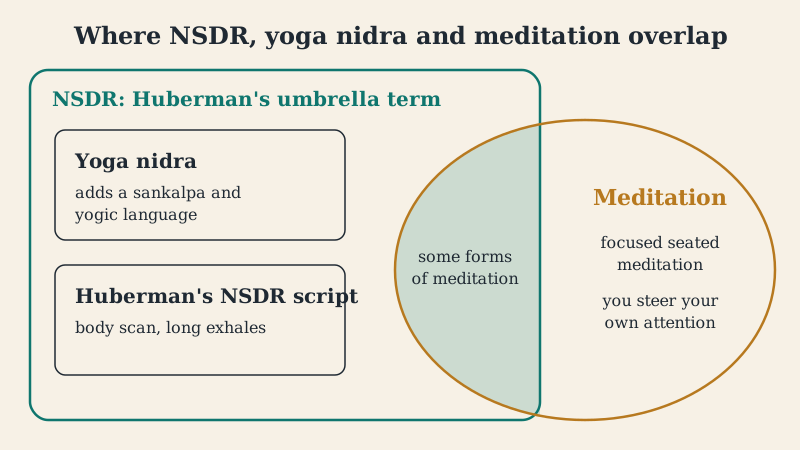
What NSDR and yoga nidra share
Huberman calls NSDR "very similar although different" to yoga nidra. Both have you lie down for a body scan and slow breathing. Neither needs prior skill, though some yoga nidra studies began with supervised sessions (five, in the 2022 study).
NSDR vs yoga nidra: where they differ
Yoga nidra opens and closes with a sankalpa and uses yogic language; NSDR scripts usually drop both. Satyananda's yoga nidra follows a fixed 8-stage order starting at the right-hand thumb. NSDR scripts vary, and Huberman's widens a spotlight from the feet.
Nobody has compared the two head to head, and most of the research has used yoga nidra. That a short NSDR track does the same is an assumption.
Brainwaves and dopamine: what's been measured
EEG studies of mindfulness most often find more alpha and theta (Lomas et al., 2015). One yoga nidra study also found more theta, and another found slow delta-like patches while people stayed awake. No one has compared all three, or recorded EEG during a session labelled NSDR.
On dopamine, Huberman says in the same episode that NSDR and yoga nidra "have been shown to increase the amount of dopamine in your dopamine reserves by up to 65%". The source is a 2002 PET study of eight healthy male yoga teachers during a 72-minute yoga nidra session. Tracer binding in the ventral striatum fell 7.9%, which the authors estimated as a 65% increase in dopamine release.
That is release during a session, not stored reserves. It hasn't been repeated, no NSDR track was tested, and no study has compared dopamine in meditation with either.
How fast each one shows effects
- NSDR. One 10-minute session gave small effects in two published trials and none in a third.
- Meditation. Cognitive gains showed after an intensive 2-week course, or after 8 weeks of 13 minutes a day.
- Yoga nidra. Self-reported sleep improved after 2 weeks in one study and lab-measured sleep after 4 weeks in another. Neither study was controlled.
What each one can't do
NSDR can't replace sleep. Huberman's own site says "nothing can completely replace sleep". In a 2024 Harvard master's thesis, 27 sleep-deprived students did no better on attention or working memory after NSDR than after a podcast (the author called it inconclusive). Dr. Chester Wu, double board certified in psychiatry and sleep medicine, told Rise Science: "Non-sleep deep rest, or NSDR, can't replace sleep, but it can help you relax and unwind". NSDR also isn't designed to train attention.
Brief mindfulness training, from one session to two weeks, does little for negative mood in beginners. Yoga nidra's stress research is mostly low quality.
When to use NSDR vs yoga nidra vs meditation
Each does a different job, with different amounts of evidence behind it.
By goal
- Quick midday reset. 10 minutes of NSDR is an easy first try. In two of three published trials, a single session left people a little less tired and stressed, or slightly quicker. If you're short on sleep, nap instead, as Rise Science advises. A nap did more in the one head-to-head trial. More on NSDR vs napping.
- Better sleep. Do yoga nidra near-daily for two to four weeks, as in the studies.
- Attention and memory. Meditate daily, as in the NYU study.
- Stress and anxiety. Try yoga nidra or seated meditation. In the one trial comparing them (60 college professors, 3 months), both beat the control group on stress and anxiety.
NSDR.co is free and has guided NSDR and yoga nidra sessions.
By preference
If you want to lie down and be led, with no spiritual language, choose NSDR. If you like intention-setting and tradition, choose yoga nidra. If you prefer to sit up and train focus, choose meditation.
A sample week
Try 13 minutes of seated meditation most mornings, 10 minutes of NSDR in the afternoon dip, and yoga nidra on evenings when you want longer rest. No study has tested this combination.
If you have a mental health condition, especially one involving trauma or dissociation, check with your clinician before starting. If a session leaves you more anxious, stop or try a shorter one.
This is general information, not medical advice. If you have a heart condition, a sleep disorder or a mental health condition, talk to your doctor before using NSDR, yoga nidra or meditation alongside treatment.
FAQ
Is NSDR the same as yoga nidra?
NSDR isn't quite the same as yoga nidra, though the two share a core: lying down, a body scan, slow breathing and a voice to follow. Yoga nidra adds a sankalpa, yogic language and, in Satyananda's version, a fixed 8-stage order. Whether the benefits match hasn't been tested, because no trial has run NSDR vs yoga nidra head to head.
Is NSDR better than meditation?
Neither NSDR nor meditation is better across the board. NSDR suits a quick reset, with small gains in some trials. Regular meditation over weeks has the evidence for attention and memory. No study has compared them directly.
Can you do NSDR and meditation together?
Yes, you can do NSDR and meditation on the same day, since they ask different things of you (focus versus letting go). No study has tested combining them.
How long should an NSDR session be?
An NSDR session of 10 minutes is enough to start; the Boukhris trials all used 10 minutes. Huberman suggests 20 to 30 minutes when you have time. No study has compared lengths.
Does NSDR increase dopamine?
No study has shown that NSDR increases dopamine. The 65% figure comes from the single 2002 yoga nidra study above. The NSDR trials found small changes in how people feel and, in one trial, a modest drop in heart rate.
Is NSDR better than a nap?
NSDR came out behind a nap in the one trial that compared them. In that 2026 study of 60 active adults, nappers felt more ready to perform than the NSDR group 40 minutes later, and NSDR had no measurable effect. Nap if you're short on sleep; use NSDR when it's too late to nap or you need to avoid grogginess.
Sources
- Boukhris O, Suppiah H, Halson S, et al. (2024). The acute effects of nonsleep deep rest on perceptual responses, physical, and cognitive performance in physically active participants. Applied Psychology: Health and Well-Being 16(4):1967-1987. https://pubmed.ncbi.nlm.nih.gov/38953770/
- Boukhris O, Suppiah H, Kerkeni M, Holt A, Driller M (2026). Time course of perceptual, cognitive, physical and physiological responses to a single non-sleep deep rest session in physically active young adults. Applied Psychology: Health and Well-Being 18(4):e70180. https://pubmed.ncbi.nlm.nih.gov/42383502/
- Boukhris O, Suppiah H, Driller M (2026). Comparing the effects of a short nap and non-sleep deep rest on perceptual, cognitive, and physical performance in active adults. Clocks & Sleep 8(3):52. https://pubmed.ncbi.nlm.nih.gov/42783005/
- Wrzeciono A, Cieślik B, Kiper P, Szczepańska-Gieracha J, Gajda R (2024). Non-sleep deep rest relaxation and virtual reality therapy for psychological outcomes in patients with coronary artery disease: a pilot randomized controlled trial. Journal of Clinical Medicine 13(23):7178. https://pubmed.ncbi.nlm.nih.gov/39685636/
- Akram G (2024). Testing Non-Sleep Deep Rest (NSDR) protocol to counter the cognitive consequences of short sleep in young adult students. ALM thesis, Harvard University Division of Continuing Education. https://dash.harvard.edu/entities/publication/68e0b583-681d-4143-b56b-4e214ca855a7
- Basso JC, McHale A, Ende V, Oberlin DJ, Suzuki WA (2019). Brief, daily meditation enhances attention, memory, mood, and emotional regulation in non-experienced meditators. Behavioural Brain Research 356:208-220. https://pubmed.ncbi.nlm.nih.gov/30153464/
- Mrazek MD, Franklin MS, Phillips DT, Baird B, Schooler JW (2013). Mindfulness training improves working memory capacity and GRE performance while reducing mind wandering. Psychological Science 24(5):776-781. https://pubmed.ncbi.nlm.nih.gov/23538911/ (press release with sample size and percentile estimate: Association for Psychological Science, https://www.psychologicalscience.org/news/releases/brief-mindfulness-training-may-boost-test-scores-working-memory.html)
- Pascoe MC, Thompson DR, Jenkins ZM, Ski CF (2017). Mindfulness mediates the physiological markers of stress: systematic review and meta-analysis. Journal of Psychiatric Research 95:156-178. https://pubmed.ncbi.nlm.nih.gov/28863392/
- Schumer MC, Lindsay EK, Creswell JD (2018). Brief mindfulness training for negative affectivity: a systematic review and meta-analysis. Journal of Consulting and Clinical Psychology 86(7):569-583. https://pubmed.ncbi.nlm.nih.gov/29939051/
- Lutz A, Slagter HA, Dunne JD, Davidson RJ (2008). Attention regulation and monitoring in meditation. Trends in Cognitive Sciences 12(4):163-169. https://pubmed.ncbi.nlm.nih.gov/18329323/
- Lomas T, Ivtzan I, Fu CH (2015). A systematic review of the neurophysiology of mindfulness on EEG oscillations. Neuroscience and Biobehavioral Reviews 57:401-410. https://pubmed.ncbi.nlm.nih.gov/26441373/
- Kjaer TW, Bertelsen C, Piccini P, et al. (2002). Increased dopamine tone during meditation-induced change of consciousness. Cognitive Brain Research 13(2):255-259. https://pubmed.ncbi.nlm.nih.gov/11958969/ (news coverage with participant and session details: AuntMinnie, "Strike a pose: PET sheds light on benefits of yoga", Dec 2002, https://www.auntminnie.com/clinical-news/molecular-imaging/article/15563882/strike-a-pose-pet-sheds-light-on-benefits-of-yoga)
- Datta K, Tripathi M, Verma M, Masiwal D, Mallick HN (2021). Yoga nidra practice shows improvement in sleep in patients with chronic insomnia: a randomized controlled trial. National Medical Journal of India 34(3):143-150. https://pubmed.ncbi.nlm.nih.gov/34825538/
- Datta K, Mallick HN, Tripathi M, Ahuja N, Deepak KK (2022). Electrophysiological evidence of local sleep during yoga nidra practice. Frontiers in Neurology 13:910794. https://pubmed.ncbi.nlm.nih.gov/35903117/
- Datta K, Bhutambare A, V L M, et al. (2023). Improved sleep, cognitive processing and enhanced learning and memory task accuracy with Yoga nidra practice in novices. PLoS ONE 18(12):e0294678. https://pubmed.ncbi.nlm.nih.gov/38091317/
- Fialoke S, Tripathi V, Thakral S, Dhawan A, Majahan V, Garg R (2024). Functional connectivity changes in meditators and novices during yoga nidra practice. Scientific Reports 14:12957. https://pubmed.ncbi.nlm.nih.gov/38839877/
- Ghai S, Odyniec P, Ghai I (2026). Effects of Yoga Nidra on stress, anxiety, and depression: a systematic review and meta-analysis. Annals of the New York Academy of Sciences 1556(1):e70149 (published online Dec 2025). https://pubmed.ncbi.nlm.nih.gov/41327816/
- Ferreira-Vorkapic C, Borba-Pinheiro CJ, Marchioro M, Santana D (2018). The impact of Yoga Nidra and seated meditation on the mental health of college professors. International Journal of Yoga 11(3):215-223. https://pubmed.ncbi.nlm.nih.gov/30233115/
- Moszeik EN, von Oertzen T, Renner KH (2020). Effectiveness of a short Yoga Nidra meditation on stress, sleep, and well-being in a large and diverse sample. Current Psychology 41:5272-5286. https://link.springer.com/article/10.1007/s12144-020-01042-2
- Pandi-Perumal SR, Spence DW, Srivastava N, et al. (2022). The origin and clinical relevance of yoga nidra. Sleep and Vigilance 6(1):61-84. https://pubmed.ncbi.nlm.nih.gov/35496325/
- Huberman Lab. Non-Sleep Deep Rest (NSDR). https://www.hubermanlab.com/nsdr
- Huberman Lab. Leverage Dopamine to Overcome Procrastination & Optimize Effort (podcast episode). https://www.hubermanlab.com/episode/leverage-dopamine-to-overcome-procrastination-and-optimize-effort
- Huberman Lab Clips. 10 Minute Non-Sleep Deep Rest (NSDR) (YouTube). https://www.youtube.com/watch?v=KHIbgSN2qAU
- Sleep Foundation. What Is Non-Sleep Deep Rest (NSDR)? (posture). https://www.sleepfoundation.org/meditation-for-sleep/what-is-non-sleep-deep-rest
- Rise Science. NSDR Can't Replace Sleep, But It May Help You Sleep Better (Chester Wu quote; nap advice). https://www.risescience.com/blog/nsdr
- Yoga Journal. NSDR Is the Trendy Practice Right Now. But Is It Better Than Yoga Nidra? (Huberman's Tim Ferriss comment). https://www.yogajournal.com/yoga-101/types-of-yoga/yoga-nidra/nsdr-or-yoga-nidra/
- Fatherly. Article on the hype around non-sleep deep rest, quoting Sara Mednick. https://www.fatherly.com/health/the-hype-behind-non-sleep-deep-rest-nsdr-explained
- Wikipedia. Yoga nidra (history, eight stages). https://en.wikipedia.org/wiki/Yoga_nidra