The parasympathetic nervous system is the "rest and digest" branch of your autonomic nervous system. It slows your heart, lowers blood pressure and gets digestion moving. Most of its fibres run in one nerve, the vagus. Every long exhale slows your heart a little. This guide covers how it's wired, how to read it with heart rate variability (HRV), and five ways to activate it.
TL;DR
- The parasympathetic side "conserves and restores". It lowers heart rate, stimulates digestion and relaxes the body after stress.
- About 75% of its fibres travel in the vagus nerve, and most vagal fibres carry information up to the brain.
- Acetylcholine is its main chemical messenger.
- HRV is the most practical way to watch vagal activity at home.
- Huberman calls the physiological sigh the fastest way to activate the parasympathetic system. The trial behind it tested 5 minutes a day for a month. Speed wasn't measured.
- Lasting constipation, a fast resting heart rate or dizziness on standing are worth a doctor's visit.
What is the parasympathetic nervous system?
Your autonomic nervous system runs the things you don't steer, like heart rate, digestion and your pupils. The parasympathetic nervous system is the part that leads when you're safe. In the MSD Manual's words, it "conserves and restores".
The autonomic nervous system in brief
Some references split the autonomic system into two branches, sympathetic and parasympathetic. Others add a third, the enteric nervous system in the gut wall.
The two main branches aren't a light switch. "Both systems are tonically active," as a 2007 physiology review puts it (McCorry 2007). They don't sit on one sliding scale either: each can change on its own, or both can rise together (Berntson 1991), so "more parasympathetic" doesn't always mean "less sympathetic".
Rest and digest vs fight or flight
When the sympathetic branch leads, your heart beats faster and harder, your pupils widen and digestion slows. When the parasympathetic branch leads, heart rate and blood pressure come down and the gut gets back to work. For a side-by-side table, see sympathetic vs parasympathetic.
Where it runs: four cranial nerves and the sacral cord
Parasympathetic signals leave the central nervous system from two places, the brainstem and the base of the spinal cord. Hence its other name, the craniosacral division.
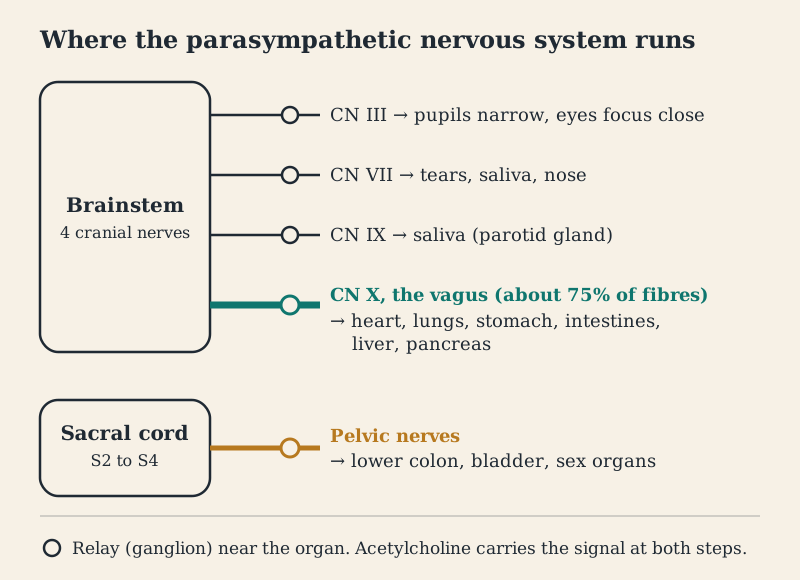
Four cranial nerves carry the brainstem signals. Cranial nerve III narrows the pupils and sets the eye for close focus. VII drives tears, saliva and nasal mucus. IX drives the parotid salivary gland. X, the vagus, handles most of the chest and abdomen: heart, lungs, stomach, liver, pancreas, small intestine and the first part of the large intestine.
From sacral segments S2 to S4, the pelvic nerves serve the lower colon, rectum, bladder and sex organs.
About 75% of parasympathetic fibres travel in the vagus, according to a 2007 physiology review (McCorry 2007). It runs from the brainstem down through the neck, chest and abdomen.
How the parasympathetic nervous system works
The vagus nerve is mostly a sensory line
About 80 to 90% of the vagus nerve's fibres carry signals up from the organs to the brain. Only 10 to 20% carry commands down (Breit 2018).
So the vagus mostly reports. Stretch and chemical sensors in the oesophagus, stomach and upper small intestine send updates, as do endings in the liver and pancreas. Serotonin released by gut cells acts on receptors (5-HT3) at the ends of vagal sensory fibres, one of the ways the gut tells the brain what's going on in there (Breit 2018).
That also means vagal activity doesn't always calm you down. In his June 2025 vagus episode, Andrew Huberman points out that some vagal pathways, when activated, make you "more alert, not less alert". His example: moving your big leg and trunk muscles releases adrenaline, which acts on vagal receptors and ends with the brainstem's locus coeruleus releasing norepinephrine across the brain. More on what holds up in vagus nerve stimulation.
Acetylcholine and the two-step relay
Each parasympathetic command passes through two neurons. The first runs from the brainstem or sacral cord to a relay station (a ganglion) in or near the target organ. The second covers the short last stretch.
Acetylcholine carries the signal at both steps. At the relay it binds nicotinic receptors; at the organ, mostly muscarinic ones.
Acetylcholine also talks to the immune system. In 2000, Kevin Tracey's group showed it cut the release of inflammatory signals such as TNF from human immune cells in a dish, and that stimulating the vagus lowered TNF and prevented shock in rats given a lethal dose of bacterial toxin (Borovikova 2000). A 2003 mouse study found the effect needs the alpha-7 nicotinic receptor on those cells (Wang 2003). This cholinergic anti-inflammatory pathway is solid lab science. Whether breathing or relaxation recruits it enough to matter in people hasn't been shown.
What the parasympathetic nervous system controls
| Organ | What the parasympathetic side does |
|---|---|
| Eyes | Narrows the pupils, sets the lens for close vision, makes tears |
| Mouth and nose | More saliva and nasal mucus |
| Lungs | Tightens the airways |
| Heart | Lowers heart rate and pumping force |
| Stomach and gut | Speeds digestion and stomach secretions |
| Pancreas | Releases insulin |
| Bladder and bowel | Contracts the bladder and relaxes the sphincters so you can pee and poo |
| Sex organs | Drives arousal (erection, lubrication) |
Why parasympathetic tone matters for recovery
Heart rate variability: the vagus you can measure
You can watch your vagus at work in your own pulse. Heart rate variability is the variation in time between one heartbeat and the next. In a healthy heart, those gaps keep changing.
Part of that variation follows your breathing. Beats come a little closer together on the in-breath and spread out on the out-breath. This is respiratory sinus arrhythmia, and it's thought to be largely the vagus at work (Russo 2017). That's the likely reason a long exhale slows your heart within a single breath.
Those shifting gaps let the heart adjust quickly to physical and mental demands (Shaffer 2017). A 2025 narrative review links low HRV with cardiovascular disease, high blood pressure, inflammation and mental health disorders (Gitler 2025). A 2022 meta-analysis of 32 studies and 38,008 people found lower HRV predicted higher mortality (Jarczok 2022). Those are associations. Low HRV is a marker, and nobody has shown that pushing the number up adds years.
For more on the numbers, read what HRV is and how to read it.
How to check yours at home
You have two easy windows.
HRV from a chest strap or a good wearable. Measure at the same time each day, ideally on waking, in the same position. Compare yourself with your own baseline over weeks. Published norms shift with age, sex and recording length, and 24-hour norms don't apply to a 5-minute morning reading (Shaffer 2017).
Heart-rate recovery after exercise. The drop in the first minute after you stop "is a function of vagal reactivation" (Cole 1999). In that study of 2,428 adults sent for exercise tests, the researchers counted a fall of 12 beats a minute or less as abnormal, and it went with twice the risk of death over six years. One slow reading after a casual workout isn't a diagnosis.
The stress-recovery connection
Stress, fatigue and overtraining can all keep your heart rate up when it should be coming down, says Chelsea Long, an exercise physiologist at the Hospital for Special Surgery.
People often call this "dysregulation". It isn't a diagnosis, just a loose name for a stress response that switches on too easily or takes too long to settle. For a day-by-day plan, see how to reset your nervous system.
The gut-brain axis runs through your vagus nerve
The gut holds much of the body's serotonin. Cells in the gut lining make it, and it helps move food along and supplies blood platelets (Yano 2015). That serotonin stays separate from the serotonin your brain uses for mood. It does fire vagal sensory endings, so the gut's state reaches the brain.
The best-known evidence for that route is a 2011 mouse study. Mice fed Lactobacillus rhamnosus had less stress hormone (corticosterone) and less anxiety-like behaviour, and in mice with a cut vagus nerve the brain and behaviour changes didn't appear (Bravo 2011). In people, a 2018 review calls the evidence that gut bacteria help mood and anxiety "preliminary" (Breit 2018).
Huberman suggests one to four servings a day of low-sugar fermented foods, based on a Stanford trial (Wastyk 2021). Over 17 weeks, the 18 people on the high-fermented-food diet gained microbiome diversity and their inflammatory markers fell. Nobody measured the vagus.
5 ways to activate your parasympathetic nervous system
These run roughly from quickest to slowest-building. The five haven't been compared in one trial.
1. The physiological sigh
Breathe in fully through your nose. Then take a second, short, sharp sip of air through the nose on top of it. Then let it all out slowly through your mouth until your lungs feel empty.
People sigh on their own every few minutes, which reopens the lungs' tiny air sacs (Li 2016). Huberman's verdict on the deliberate version: "if you want to calm down fast, the physiological sigh is still going to be your best tool." In his account, the second inhale tops up the lungs and the long exhale brings in the out-breath slowing of the heart.
The trial behind it measured something slower. In Balban 2023, 108 people did 5 minutes a day of one of four practices for a month. Cyclic sighing lifted daily positive mood more than mindfulness meditation and slowed resting breathing. HRV didn't differ, and anxiety fell in every group. More detail in the physiological sigh guide.
2. Slow breathing with a longer exhale
Breathe in for 4 seconds and out for 6. That works out at six breaths a minute, close to the rate where the breath-linked swing in heart rate is largest (Russo 2017). Five minutes, the session length in the Stanford breathing trial, is a reasonable start.
This has the deepest evidence here. A 2022 meta-analysis pooled 223 studies: 172 measured during a session, 16 right after one and 49 after programmes of several sessions. Slow breathing raised vagal HRV in all three groups (Laborde 2022).
Huberman also suggests stretching an exhale 10 to 20 times through the day. Nobody has tested that schedule, but it costs nothing.
3. Cold water on your face
Cold on your forehead and around your eyes triggers a reflex. The trigeminal nerve signals the brainstem, and the brainstem slows the heart through the vagus. The slowing from a cold compress on the face tracks the slowing from dunking your face with the breath held, and the forehead and eyes are the most sensitive spot (Khurana 1980). In one lab test, all 18 young men slowed down with the face in near-freezing water and the breath held for 30 seconds (Konishi 2016).
In 26 experienced divers in 2 to 4°C water, the parasympathetic jump was strongest when the face went in at the start of the dive, then seemed to fade quickly (Lundell 2021). After hard exercise, cold water on the face sped up parasympathetic recovery in 13 men (Al Haddad 2010). A splash, cold flannel or ice pack on the forehead is the safer default. Skip breath-hold immersion if you have a heart condition or have fainted before.
4. Regular exercise, with time to come down
During exercise your heart speeds up partly because vagal tone drops. In the minute after you stop, the vagus comes back in and your heart rate falls (Cole 1999). Over weeks, the effect shows at rest. In previously sedentary people, exercise programmes gave a small rise in RMSSD (Casanova-Lizón 2022). Long's advice is a proper cooldown before the shower, so your heart rate has time to drop.
5. NSDR
Non-sleep deep rest means lying down, awake, following a voice through slow breathing and a scan of your body. In a 2026 trial of 102 active young adults, one 10-minute NSDR session lowered sleepiness, fatigue and stress more than a control session, and heart rate fell more (Boukhris 2026). The authors call the physiological changes modest. Over weeks, the evidence is thinner. In a pilot trial of 45 heart patients, the 15 or so who added eight 20-minute NSDR sessions to cardiac rehab saw anxiety and stress fall more than those on standard care (Wrzeciono 2024). That trial didn't measure HRV, and no trial yet shows NSDR raising resting vagal HRV. More in our guide to non-sleep deep rest.
When your parasympathetic nervous system isn't working
Everyday stress isn't the same thing as damage to the autonomic nerves. Doctors group real problems under autonomic disorders, sometimes called dysautonomia.
Signs that point to an autonomic problem
- Constipation, or feeling full early because the stomach empties slowly (gastroparesis)
- A fast heart rate even at rest, or heart rhythm problems
- Light-headedness or blurred vision when you stand up
- Dry eyes and mouth, or less sweating than normal
- Bladder or bowel problems, including incontinence
- Erectile problems
Each of these has plenty of other causes. Several together, especially with dizziness on standing, are worth a proper look.
When to talk to a doctor
See a doctor if any of these signs persist. Diabetes is one of the most common causes of autonomic damage. Others include Parkinson's disease, ageing, nerve disorders, multiple system atrophy, inherited amyloidosis, spinal cord injury and some medicines. People with multiple sclerosis can have a weaker cold-face response too (Khurana 1980).
Common tests include an ECG to see whether your heart rate changes as it should when you breathe deeply and during the Valsalva manoeuvre, a tilt table test for blood pressure and heart rate on standing, and sweat tests.
Health note: this article is general information, not a diagnosis. Breathing, cold water and NSDR can support recovery from everyday stress. They don't treat autonomic disease.
FAQ
What does the parasympathetic nervous system do?
The parasympathetic nervous system handles "rest and digest". It slows your heart rate, lowers blood pressure, stimulates digestion and insulin release, and drives saliva and tears. It runs mainly through the vagus nerve, alongside a sympathetic branch that is never fully off.
How do you activate the parasympathetic nervous system quickly?
To activate the parasympathetic nervous system quickly, lengthen your exhale. Breathing in for 4 seconds and out for 6 is a simple start. A physiological sigh (full inhale, short second sip, long exhale) is Huberman's go-to. Cold water on the forehead slows the heart by reflex.
What is the difference between sympathetic and parasympathetic nervous systems?
The sympathetic and parasympathetic nervous systems pull many organs in opposite directions. Sympathetic activity speeds the heart and slows digestion; parasympathetic activity does the reverse. Both are active all the time. See sympathetic vs parasympathetic for the full comparison.
What are signs your parasympathetic nervous system isn't working properly?
Signs your parasympathetic nervous system isn't working properly include constipation, slow stomach emptying, a fast resting heart rate, dry eyes and mouth, bladder problems and erectile problems. Dizziness on standing points to wider autonomic trouble. Diabetes is one of the most common causes, so see a doctor rather than guessing.
Can you train your parasympathetic nervous system to be stronger?
You can train your parasympathetic nervous system to a degree, judging by HRV. A 2022 meta-analysis pooled 49 studies of slow-breathing programmes and found vagal HRV rose afterwards (Laborde 2022), and exercise programmes gave sedentary people a small rise in resting HRV (Casanova-Lizón 2022). No trial yet shows NSDR raising resting vagal HRV.
Sources
- McCorry LK (2007). Physiology of the autonomic nervous system. American Journal of Pharmaceutical Education. https://pmc.ncbi.nlm.nih.gov/articles/PMC1959222/
- Breit S, Kupferberg A, Rogler G, Hasler G (2018). Vagus nerve as modulator of the brain-gut axis in psychiatric and inflammatory disorders. Frontiers in Psychiatry. https://pmc.ncbi.nlm.nih.gov/articles/PMC5859128/
- Berntson GG, Cacioppo JT, Quigley KS (1991). Autonomic determinism: the modes of autonomic control, the doctrine of autonomic space, and the laws of autonomic constraint. Psychological Review. https://pubmed.ncbi.nlm.nih.gov/1660159/
- Cleveland Clinic. Parasympathetic Nervous System (PSNS): What It Is & Function. https://my.clevelandclinic.org/health/body/23266-parasympathetic-nervous-system-psns
- MSD Manual Consumer Version. Overview of the Autonomic Nervous System. https://www.msdmanuals.com/home/brain-spinal-cord-and-nerve-disorders/autonomic-nervous-system-disorders/overview-of-the-autonomic-nervous-system
- Kenhub. Parasympathetic nervous system (Sendić G, reviewed Andrușca A, 2023). https://www.kenhub.com/en/library/anatomy/the-parasympathetic-nervous-system
- Huberman Lab (2025). Control Your Vagus Nerve to Improve Mood, Alertness & Neuroplasticity. https://www.hubermanlab.com/episode/control-your-vagus-nerve-to-improve-mood-alertness-neuroplasticity
- Borovikova LV, Ivanova S, Zhang M, et al. (2000). Vagus nerve stimulation attenuates the systemic inflammatory response to endotoxin. Nature. https://pubmed.ncbi.nlm.nih.gov/10839541/
- Wang H, Yu M, Ochani M, et al. (2003). Nicotinic acetylcholine receptor alpha7 subunit is an essential regulator of inflammation. Nature. https://pubmed.ncbi.nlm.nih.gov/12508119/
- Shaffer F, Ginsberg JP (2017). An overview of heart rate variability metrics and norms. Frontiers in Public Health. https://pubmed.ncbi.nlm.nih.gov/29034226/
- Russo MA, Santarelli DM, O'Rourke D (2017). The physiological effects of slow breathing in the healthy human. Breathe. https://pubmed.ncbi.nlm.nih.gov/29209423/
- Gitler A, Bar Yosef Y, Kotzer U, Levine AD (2025). Harnessing non-invasive vagal neuromodulation: HRV biofeedback and SSP for cardiovascular and autonomic regulation (Review). Medicine International. https://www.spandidos-publications.com/10.3892/mi.2025.236
- Jarczok MN, Weimer K, Braun C, et al. (2022). Heart rate variability in the prediction of mortality: a systematic review and meta-analysis of healthy and patient populations. Neuroscience & Biobehavioral Reviews. https://pubmed.ncbi.nlm.nih.gov/36243195/
- Cole CR, Blackstone EH, Pashkow FJ, Snader CE, Lauer MS (1999). Heart-rate recovery immediately after exercise as a predictor of mortality. New England Journal of Medicine. https://pubmed.ncbi.nlm.nih.gov/10536127/
- Hospital for Special Surgery. How the Parasympathetic Nervous System Can Lower Stress (Chelsea Long, MS, CSCS). https://www.hss.edu/health-library/move-better/parasympathetic-nervous-system
- Yano JM, Yu K, Donaldson GP, et al. (2015). Indigenous bacteria from the gut microbiota regulate host serotonin biosynthesis. Cell. https://pubmed.ncbi.nlm.nih.gov/25860609/
- Bravo JA, Forsythe P, Chew MV, et al. (2011). Ingestion of Lactobacillus strain regulates emotional behavior and central GABA receptor expression in a mouse via the vagus nerve. PNAS. https://pubmed.ncbi.nlm.nih.gov/21876150/
- Wastyk HC, Fragiadakis GK, Perelman D, et al. (2021). Gut-microbiota-targeted diets modulate human immune status. Cell. https://pubmed.ncbi.nlm.nih.gov/34256014/
- Li P, Janczewski WA, Yackle K, et al. (2016). The peptidergic control circuit for sighing. Nature. https://pubmed.ncbi.nlm.nih.gov/26855425/
- Balban MY, Neri E, Kogon MM, et al. (2023). Brief structured respiration practices enhance mood and reduce physiological arousal. Cell Reports Medicine. https://pubmed.ncbi.nlm.nih.gov/36630953/
- Laborde S, Allen MS, Borges U, et al. (2022). Effects of voluntary slow breathing on heart rate and heart rate variability: a systematic review and a meta-analysis. Neuroscience & Biobehavioral Reviews. https://pubmed.ncbi.nlm.nih.gov/35623448/
- Khurana RK, Watabiki S, Hebel JR, Toro R, Nelson E (1980). Cold face test in the assessment of trigeminal-brainstem-vagal function in humans. Annals of Neurology. https://pubmed.ncbi.nlm.nih.gov/7369721/
- Konishi M, Kawano H, Xiang M, et al. (2016). Diurnal variation in the diving bradycardia response in young men. Clinical Autonomic Research. https://pubmed.ncbi.nlm.nih.gov/26795189/
- Lundell RV, Tuominen L, Ojanen T, Parkkola K, Räisänen-Sokolowski A (2021). Diving responses in experienced rebreather divers: short-term heart rate variability in cold water diving. Frontiers in Physiology. https://pubmed.ncbi.nlm.nih.gov/33897457/
- Al Haddad H, Laursen PB, Ahmaidi S, Buchheit M (2010). Influence of cold water face immersion on post-exercise parasympathetic reactivation. European Journal of Applied Physiology. https://pubmed.ncbi.nlm.nih.gov/19882167/
- Casanova-Lizón A, Manresa-Rocamora A, Flatt AA, Sarabia JM, Moya-Ramón M (2022). Does exercise training improve cardiac-parasympathetic nervous system activity in sedentary people? A systematic review with meta-analysis. International Journal of Environmental Research and Public Health. https://pubmed.ncbi.nlm.nih.gov/36360777/
- Boukhris O, Suppiah H, Kerkeni M, Holt A, Driller M (2026). Time course of perceptual, cognitive, physical and physiological responses to a single non-sleep deep rest session in physically active young adults. Applied Psychology: Health and Well-Being. https://pubmed.ncbi.nlm.nih.gov/42383502/
- Wrzeciono A, Cieślik B, Kiper P, Szczepańska-Gieracha J, Gajda R (2024). Non-sleep deep rest relaxation and virtual reality therapy for psychological outcomes in patients with coronary artery disease: a pilot randomized controlled trial. Journal of Clinical Medicine. https://pubmed.ncbi.nlm.nih.gov/39685636/