Learning how to calm down fast starts with your exhale. Take two inhales through the nose, then one long exhale through the mouth, and repeat it once or twice. If that isn't enough, cold water on your face slows the heart. The seven methods below are ranked from a few seconds to ten minutes or more, with what the research on each found and where it stops.
Why your body won't calm down on command
The stress-calm toggle in your nervous system
Your autonomic nervous system has two branches. The sympathetic branch is the accelerator, the fight-or-flight response. The parasympathetic branch is the brake, sometimes called rest-and-digest.
When worry starts, the accelerator goes down. Your heart speeds up, you breathe faster, your muscles tighten and you start to sweat.
None of this is a choice. "The sympathetic system, also known as our fight-or-flight response, is largely unconscious," says Grace Tworek, PsyD, a health psychologist at Cleveland Clinic. "We don't tell our body to feel nervous or on edge."
Why "just relax" doesn't work
The alarm also feeds itself. Stanford psychiatrist David Spiegel, who co-led a 2023 trial of breathing techniques, describes the loop: "As soon as you notice what's going on in your body, your brain thinks, 'Oh no, this must be really bad,' and you get more anxious. It's like a snowball rolling downhill." (Stanford Medicine)
You can't order an unconscious response to stop, but you can give your body a physical input that slows it down.
What the fastest techniques have in common
The two quickest methods press the brake directly. The brake's main nerve is the vagus nerve, the longest cranial nerve (Cleveland Clinic). A long exhale is one way in. Andrew Huberman's explanation is that each breath out sends a signal from the brainstem that slows the heart a little, so to calm down quickly, make your exhales longer than your inhales. Cold on the face is the other. It sets off a reflex that runs through the brainstem and the vagus to the heart.
The slower methods give your attention or your muscles a job instead.
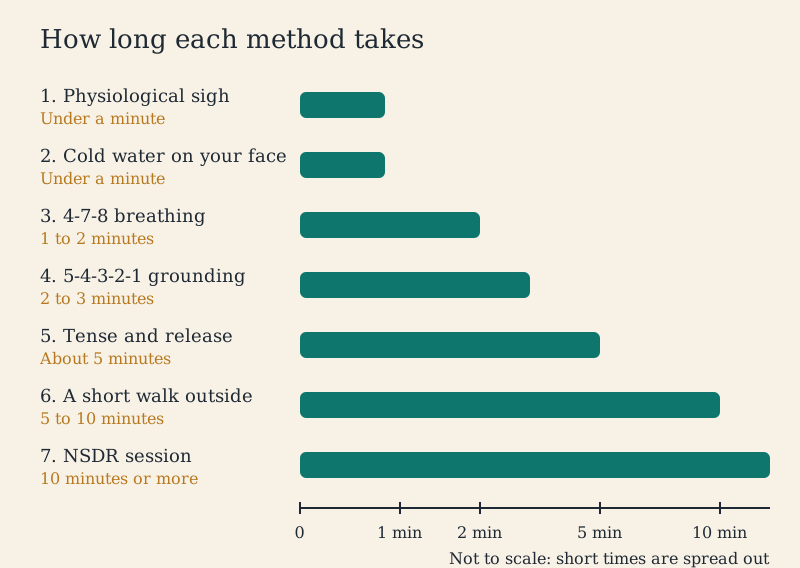
TL;DR: 7 ways to calm down fast, ranked
- Physiological sigh (under a minute). Two inhales through the nose, one long exhale through the mouth, one to three times.
- Cold water on your face (under a minute). A cold cloth or a splash on the forehead and around the eyes.
- 4-7-8 breathing (1 to 2 minutes). In for 4, hold for 7, out for 8, four rounds.
- 5-4-3-2-1 grounding (2 to 3 minutes). Name what you see, touch, hear, smell and taste.
- Tense and release (about 5 minutes). Squeeze each muscle group for 5 seconds, then let go.
- A short walk, outside if you can (5 to 10 minutes). One bout of movement lowers anxiety a little.
- An NSDR session (10 minutes or more). Guided rest lying down, for a longer reset.
30-second fixes: the fastest ways to calm down
The physiological sigh (under a minute)
Try this first. It takes seconds and works anywhere.
- Breathe in slowly through your nose.
- When your lungs feel full, take a second, shorter inhale on top.
- Breathe out slowly through your mouth until your lungs feel empty.
- Do it once, twice, or three times.
One sigh looks much like a normal breath, so you can do it at a desk or in a meeting.
The best test at this speed is small. In a 2026 pilot study, 47 university students did one minute of either cyclic sighing (repeated sighs) or box breathing during real stressful moments. Five minutes later, both groups had lower anxiety than students who did nothing. Their reaction times were slower afterwards, which is worth knowing before a task that needs quick reactions.
The bigger trial is the Stanford one. Melis Yilmaz Balban, Spiegel and Huberman had 108 adults do 5 minutes a day of cyclic sighing, one of two other breathing patterns, or mindfulness meditation for a month. Positive mood rose 1.89 points per session with cyclic sighing, against 1.22 with meditation, and resting breathing slowed more. Anxiety fell about equally in every group. One to three sighs in the moment is Huberman's advice and hasn't been tested at that dose. More on how the physiological sigh works.
Cold water on your face (under a minute)
Cold on the face triggers the diving reflex, which slows the heart. In a 1980 study, the slowing from a cold compress on the face closely tracked the slowing from dunking the face in water while holding the breath. The forehead and around the eyes, served by the trigeminal nerve's ophthalmic branch, were the most sensitive area.
- Run a cloth under the coldest tap you have, or wrap a cold pack in a thin towel.
- Hold it over your forehead and eyes for 15 to 30 seconds, breathing normally.
- No cloth? Splash cold water on your forehead and cheeks a few times.
In 13 men after hard exercise, cold water on the face sped up the heart's recovery straight away. In 26 divers in near-freezing water, the effect peaked at the start of the dive and faded quickly. Nobody has tested it in panic attacks, but it's a reflex, so it doesn't need your concentration.
Keep it to tap-cold water, not ice. Cleveland Clinic lists an ice-water face plunge or an ice-cold wet towel as a vagal maneuver for a fast heart rate, and says to talk to your doctor before trying one. If you have a heart condition or have fainted before, ask first. More on slowing a racing heart.
5-minute resets: calming techniques for bigger stress
4-7-8 breathing (1 to 2 minutes)
- Breathe in through your nose for a count of 4.
- Hold for 7.
- Breathe out through your mouth for 8.
- Repeat for four rounds.
Each round is 19 seconds, so four rounds take about a minute and a quarter. If the hold makes you air-hungry, count faster.
Two studies back it, both narrow. In a 2023 trial of 90 patients recovering from weight-loss surgery, the 4-7-8 group ended with lower anxiety scores than a deep-breathing group or routine care. In a 2022 study of 43 healthy adults aged 19 to 25, three sets of six rounds lowered heart rate and systolic blood pressure straight afterwards.
5-4-3-2-1 sensory grounding (2 to 3 minutes)
If your thoughts keep dragging you away from counting breaths, give your attention a concrete job.
- Name 5 things you can see
- Name 4 things you can touch
- Name 3 things you can hear
- Name 2 things you can smell
- Name 1 thing you can taste
It can help to name the feeling first ("this is anxiety"). In a brain-imaging study, putting a feeling into words dampened the amygdala's response to upsetting photos. That was a lab test, so treat it as a hint. No trial has tested 5-4-3-2-1 on its own.
Tense and release (about 5 minutes)
This is a short version of progressive muscle relaxation.
- Start with your feet. Squeeze for about 5 seconds, then let go.
- Work up through calves, thighs, stomach, hands, shoulders and face.
- Breathe out slowly as you release each group.
Short on time? Do the shoulders, jaw and hands. A 2024 review of 46 studies covering more than 3,400 adults found progressive muscle relaxation reduced stress, anxiety and depression. It looked at the method in general, not this five-minute version.
If breathing makes you more anxious
That happens, and it isn't a failure. In a small 1983 study of 14 tense adults, nearly a third felt more tense after a session of progressive relaxation, and more than half after focused mantra meditation. The authors called it relaxation-induced anxiety. That study didn't test breathing, but slow breathing is a relaxation method too.
The breathing evidence is also modest. A 2023 meta-analysis of 20 randomised trials found breathwork lowered anxiety by a small-to-moderate amount compared with control groups, and its authors warned against hype. If slow breathing winds you up, switch to cold water, grounding or a walk.
10-minute deep calm: a walk outside and NSDR
A short walk, outside if you can (5 to 10 minutes)
Walk around the block, take the stairs, or march on the spot. Across 36 randomised trials, a single bout of exercise lowered anxiety by a small amount compared with control conditions.
A 2020 review of 14 studies, mostly with Japanese college students, found that as little as 10 minutes sitting or walking in a natural setting improved measures of mental wellbeing compared with the same time in a built-up area. Do your sighs while you walk.
NSDR (10 minutes or more)
NSDR, short for non-sleep deep rest, is guided rest. You lie down, stay awake, and follow a voice that slows your breathing and moves your attention around your body. Read what NSDR is and how to do it.
The evidence is early. Four trials use the NSDR name. In one, 65 active adults did 10 minutes of NSDR or 10 minutes of sitting quietly, and the NSDR group reported less stress and tension afterwards. In another, with 102 active adults, one session lowered stress a little. In a third, 10 minutes of NSDR showed no effect next to a 25-minute nap. The fourth, in heart patients, is covered in the research on NSDR for anxiety.
When quick fixes aren't enough
These are tools for everyday stress, not treatment. If you need them several times a day, or panic attacks keep coming back, see a GP. Anxiety disorders and panic disorder are treatable, and a GP will usually suggest talking therapy first.
Get medical help right away for chest pain, or a racing heart with dizziness. If you feel unsafe or are thinking about harming yourself, call or text 988 in the US, or call Samaritans free on 116 123 in the UK, any time of day or night. For a daily routine, try a step-by-step plan to reset your nervous system.
Which calming technique should you use?
Match the technique to the moment
| Situation | Try this | Time |
|---|---|---|
| At your desk before a meeting | Physiological sigh | Under a minute |
| In a bathroom before a presentation | Cold water on your face | Under a minute |
| Heart racing, can't focus on breathing | Cold water on your face | Under a minute |
| In bed at 3am | 4-7-8 breathing | 1 to 2 minutes |
| Thoughts spiralling | 5-4-3-2-1 grounding | 2 to 3 minutes |
| Whole body tense | Tense and release | About 5 minutes |
| After an argument or bad news | A short walk, outside if you can | 5 to 10 minutes |
| Still wound up, with time to lie down | NSDR session | 10 minutes or more |
Switch or stack when one isn't enough
If a method has changed nothing after two minutes, try a different kind rather than repeating it, such as cold water or 5-4-3-2-1 after a sigh. You can also chain them: a sigh, then a five-minute walk, or at night, 4-7-8 breathing, then tense and release.
Practise when you're calm
Try each method once on an ordinary day, so you already know it when your heart is racing. In the Stanford trial, the mood benefit of cyclic sighing grew the more days people did it, which the other groups didn't show. Five minutes a day was the tested dose. For longer relaxation methods to build into a routine, start there.
FAQ
What is the 5-4-3-2-1 calming technique?
The 5-4-3-2-1 calming technique is a grounding exercise. You name 5 things you can see, 4 you can touch, 3 you can hear, 2 you can smell and 1 you can taste, which gives racing thoughts something concrete to do. No trial has tested it on its own, so treat it as a simple tool to try.
How do you calm down anxiety in 5 minutes?
To calm down anxiety in 5 minutes, start with one to three physiological sighs, then spend the rest on 4-7-8 breathing or a short walk. In a pilot study of 47 students, one minute of cyclic sighing lowered anxiety more than doing nothing. If breathing makes you feel worse, use cold water on your face or 5-4-3-2-1 grounding instead.
What is the 333 rule for anxiety?
The 333 rule for anxiety is a shorter grounding exercise. Name 3 things you can see and 3 sounds you can hear, then move or touch 3 things, such as your arms and legs or objects near you. There's no formal research on it.
Does NSDR help with anxiety?
NSDR may help with anxiety, but the evidence is thin. The only NSDR trial that measured anxiety was in 45 heart patients in cardiac rehab, about 15 of whom did eight 20-minute NSDR sessions. Their anxiety and stress fell more than with standard care. In healthy active adults, one 10-minute session lowered stress and tension. Nobody has tested NSDR in people diagnosed with an anxiety disorder.
How long does it take to calm down from a panic response?
It can take 5 to 20 minutes to calm down from a panic attack on its own. The NHS says most last that long, and some up to an hour. In the meantime, cold water on your face or a long exhale slows the heart. Knowing how to calm down fast helps in the moment, but if attacks keep coming back, see a GP.
Sources
- Balban MY, Neri E, Kogon MM, et al. (2023). Brief structured respiration practices enhance mood and reduce physiological arousal. Cell Reports Medicine. https://pubmed.ncbi.nlm.nih.gov/36630953/
- Riedl EM, Bracklo T, Wimmer K, et al. (2026). Simply breathing anxiety away? A pilot, just-in-time ecological momentary intervention study of one-minute cyclic sighing versus box breathing as tools for acute anxiety reduction and attention promotion in real life. Anxiety, Stress, & Coping. https://pubmed.ncbi.nlm.nih.gov/42002307/
- Stanford Medicine (2023). "Cyclic sighing" can help breathe away anxiety. https://med.stanford.edu/news/insights/2023/02/cyclic-sighing-can-help-breathe-away-anxiety.html
- Cleveland Clinic. Feeling Nervous? Here Are 6 Ways To Calm Yourself Down (Grace Tworek, PsyD). https://health.clevelandclinic.org/how-to-calm-down
- Cleveland Clinic. Vagus Nerve. https://my.clevelandclinic.org/health/body/22279-vagus-nerve
- Cleveland Clinic. Vagal Maneuvers. https://my.clevelandclinic.org/health/treatments/22227-vagal-maneuvers
- Cleveland Clinic. Here's When You Should Go to the Hospital for a Dangerous Heart Rate. https://health.clevelandclinic.org/when-to-go-to-the-hospital-for-a-dangerous-heart-rate
- Huberman Lab (2021). Tools for Managing Stress & Anxiety (podcast episode). https://www.hubermanlab.com/episode/tools-for-managing-stress-and-anxiety
- Khurana RK, Watabiki S, Hebel JR, et al. (1980). Cold face test in the assessment of trigeminal-brainstem-vagal function in humans. Annals of Neurology. https://pubmed.ncbi.nlm.nih.gov/7369721/
- Lundell RV, Tuominen L, Ojanen T, et al. (2021). Diving responses in experienced rebreather divers: short-term heart rate variability in cold water diving. Frontiers in Physiology. https://pubmed.ncbi.nlm.nih.gov/33897457/
- Al Haddad H, Laursen PB, Ahmaidi S, Buchheit M (2010). Influence of cold water face immersion on post-exercise parasympathetic reactivation. European Journal of Applied Physiology. https://pubmed.ncbi.nlm.nih.gov/19882167/
- Aktaş GK, İlgin VE (2023). The effect of deep breathing exercise and 4-7-8 breathing techniques applied to patients after bariatric surgery on anxiety and quality of life. Obesity Surgery. https://pubmed.ncbi.nlm.nih.gov/36480101/
- Vierra J, Boonla O, Prasertsri P (2022). Effects of sleep deprivation and 4-7-8 breathing control on heart rate variability, blood pressure, blood glucose, and endothelial function in healthy young adults. Physiological Reports. https://pubmed.ncbi.nlm.nih.gov/35822447/
- Lieberman MD, Eisenberger NI, Crockett MJ, et al. (2007). Putting feelings into words: affect labeling disrupts amygdala activity in response to affective stimuli. Psychological Science. https://pubmed.ncbi.nlm.nih.gov/17576282/
- Muhammad Khir S, Wan Mohd Yunus WMA, Mahmud N, et al. (2024). Efficacy of progressive muscle relaxation in adults for stress, anxiety, and depression: a systematic review. Psychology Research and Behavior Management. https://pubmed.ncbi.nlm.nih.gov/38322293/
- Heide FJ, Borkovec TD (1983). Relaxation-induced anxiety: paradoxical anxiety enhancement due to relaxation training. Journal of Consulting and Clinical Psychology. https://pubmed.ncbi.nlm.nih.gov/6341426/
- Fincham GW, Strauss C, Montero-Marin J, Cavanagh K (2023). Effect of breathwork on stress and mental health: a meta-analysis of randomised-controlled trials. Scientific Reports. https://pubmed.ncbi.nlm.nih.gov/36624160/
- Ensari I, Greenlee TA, Motl RW, Petruzzello SJ (2015). Meta-analysis of acute exercise effects on state anxiety: an update of randomized controlled trials over the past 25 years. Depression and Anxiety. https://pubmed.ncbi.nlm.nih.gov/25899389/
- Meredith GR, Rakow DA, Eldermire ERB, et al. (2020). Minimum time dose in nature to positively impact the mental health of college-aged students, and how to measure it: a scoping review. Frontiers in Psychology. https://pubmed.ncbi.nlm.nih.gov/31993007/
- Boukhris O, Suppiah H, Halson S, et al. (2024). The acute effects of nonsleep deep rest on perceptual responses, physical, and cognitive performance in physically active participants. Applied Psychology: Health and Well-Being. https://pubmed.ncbi.nlm.nih.gov/38953770/
- Boukhris O, et al. (2026). Time course of perceptual, cognitive, physical and physiological responses to a single non-sleep deep rest session in physically active young adults. Applied Psychology: Health and Well-Being. https://pubmed.ncbi.nlm.nih.gov/42383502/
- Boukhris O, Suppiah H, Driller M (2026). Comparing the effects of a short nap and non-sleep deep rest on perceptual, cognitive, and physical performance in active adults. Clocks & Sleep. https://pubmed.ncbi.nlm.nih.gov/42783005/
- Wrzeciono A, Cieślik B, Kiper P, et al. (2024). Non-sleep deep rest relaxation and virtual reality therapy for psychological outcomes in patients with coronary artery disease: a pilot randomized controlled trial. Journal of Clinical Medicine. https://pubmed.ncbi.nlm.nih.gov/39685636/
- Healthline. 333 Rule for Anxiety. https://www.healthline.com/health/333-rule-anxiety
- NHS. Panic disorder. https://www.nhs.uk/mental-health/conditions/panic-disorder/
- NHS. Generalised anxiety disorder in adults: treatment. https://www.nhs.uk/mental-health/conditions/generalised-anxiety-disorder/treatment/
- 988 Suicide & Crisis Lifeline. https://988lifeline.org/
- Samaritans. Contact a Samaritan. https://www.samaritans.org/how-we-can-help/contact-samaritan/