NSDR for anxiety can help some people take the edge off, but the evidence on NSDR itself is thin. One published NSDR trial has measured anxiety. In it, about 15 of 45 heart patients did eight 20-minute NSDR sessions, and their anxiety scores fell 28%. The large numbers you see quoted come from yoga nidra, the older practice NSDR grew out of, and a 362-person yoga nidra trial found a small effect. Use NSDR as a daily tool alongside treatment, never instead of it.
Health note: this is general information, not medical advice. NSDR is not a treatment for anxiety disorders. If anxiety is getting in the way of daily life, see a GP. In a mental health crisis, get urgent help: call 111 and choose the mental health option, or call 999 if a life is at risk.
How NSDR reduces anxiety
Anxiety has two parts. One is physical arousal, a body that's revved up. The other is a mind that keeps worrying about what comes next. NSDR works on the body side first.
A session is simple. You lie down, close your eyes and follow a recorded voice that slows your breathing and moves your attention through your body. Andrew Huberman coined the term, and his definition covers yoga nidra and some forms of meditation. Here's how to do NSDR, step by step.
Huberman's site makes a second point that fits anxiety well. Knowing you have "a zero-cost, zero-equipment, day-or-night tool to access a relaxed state of mind and body can prevent secondary or meta-anxiety", which the site defines as feeling anxious about feeling anxious.
The measured changes in the body are small. In a 2026 trial of 102 young adults, heart rate fell a little more during 10 minutes of NSDR than during 10 minutes of quiet sitting, and the authors called the physical findings modest. A 2022 review of yoga nidra studies describes lower sympathetic (fight-or-flight) activity during the practice, with the balance tending to shift toward the calming parasympathetic side.
Brain recordings exist only for yoga nidra. One 2002 study found more theta activity, and a 2022 study of 30 novices found patches of slow, sleep-like waves while people stayed awake. Nobody has recorded EEG during a session labelled NSDR.
You may also have seen the dopamine figure. One small PET study (Kjaer 2002: 8 male yoga teachers, one 72-minute yoga nidra session) estimated 65% more dopamine released during the session than at rest. It never measured baseline levels, and it tells you nothing about anxiety.
What the research says about NSDR and anxiety
The NSDR trials
Four trials use the NSDR name: Boukhris 2024 (n=65, 10 min), Wrzeciono 2024 (45 heart patients, eight 20-min sessions), Boukhris 2026a (n=102, 10 min) and Boukhris 2026b (n=60, 10 min vs a 25-min nap; the nap won on readiness, NSDR showed no effect).
Only Wrzeciono measured anxiety. Patients in cardiac rehab added eight NSDR sessions or eight virtual reality (VR) sessions, or stayed on usual care, which included autogenic training, another relaxation method. Anxiety scores fell 28% with NSDR, 1.1% with VR, and rose 7% with usual care. NSDR beat usual care, but it didn't differ significantly from VR. It was a small pilot that measured only short-term effects, and the authors say longer follow-up is needed.
The two Boukhris single-session trials looked at stress, not anxiety. Ten minutes of NSDR lowered self-rated stress compared with sitting quietly. Both recruited healthy, physically active adults, so they say little about people with an anxiety problem.
The yoga nidra research
The large figures often quoted for NSDR and anxiety come from a yoga nidra review. Ghai and colleagues (2026) pooled 73 yoga nidra studies covering 5,201 people. For anxiety the pooled effect looked large (Hedges' g of -1.35 against other activities, -1.43 against no treatment). But 17 of the 22 randomised trials were at high risk of bias, and the authors wrote that the effects "likely reflect inflated estimates".
A large single trial found a much smaller effect. Moszeik and colleagues (2025) randomised 362 adults to an 11-minute yoga nidra recording, a 30-minute one, 10 minutes of music, or a waitlist. People listened online, ideally daily, for two months. Against the waitlist, the 11-minute version cut anxiety by a small amount (d = -0.16), and the gains largely held three months later. Against the music group, it made no difference to anxiety. About a third of the 11-minute group had dropped out by the two-month mark.
More on yoga nidra and its research.
What this adds up to
Expect a small benefit, built up over weeks, for everyday anxiety. A 2022 review notes that yoga nidra's benefits have been shown for mild anxiety but not shown to extend to severe anxiety. The trials that found changes measured them after two months of yoga nidra, or after eight weeks of a 13-minute guided meditation, which showed nothing at four weeks.
An NSDR protocol for anxiety
Every day
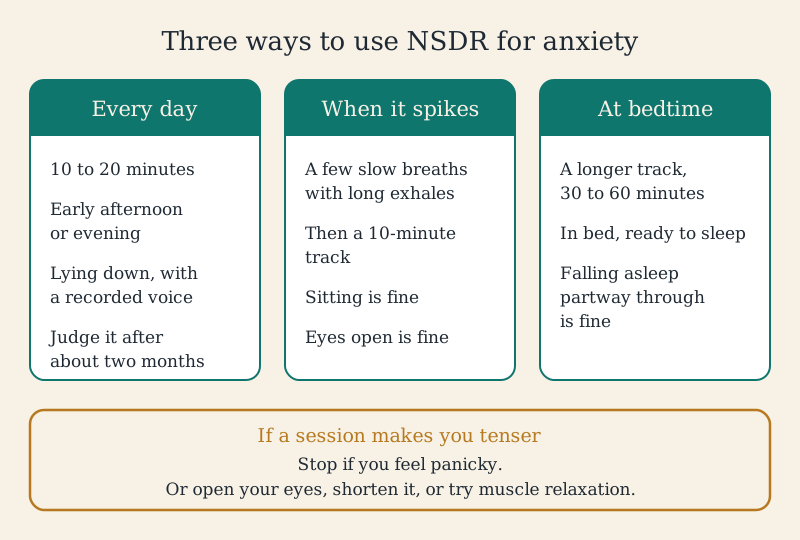
- Do 10 to 20 minutes once a day. Huberman says 10 minutes has benefits and suggests 20 to 30 when you can.
- Pick a fixed slot. Early afternoon suits many people, because it covers the post-lunch slump, which Huberman puts between 2 and 5pm. The evening works too.
- Lie on your back and use a recording. A voice gives a busy mind something to follow.
- Give it about two months before you judge it.
When anxiety spikes
Start with a few slow breaths that end in a long exhale, such as the physiological sigh. Then put on a 10-minute track. Sitting is fine if you can't lie down, and so is keeping your eyes open. When worries come up, let them, and go back to the body part the voice names next.
At bedtime
If anxiety shows up when you try to sleep, a longer track can help, because you stop worrying about whether you'll drift off before it ends. Huberman suggests 30 to 60 minutes for this. Falling asleep partway through is fine. For more, see the guide to sleep anxiety.
If a session makes you more anxious
This happens, and it has a name: relaxation-induced anxiety. In a small 1983 study, 14 tense adults each tried a session of progressive muscle relaxation and a session of mantra meditation. About a third felt more tense after the muscle relaxation, and more than half after the meditation.
If it happens to you, open your eyes, try a shorter track, or switch to something more physical like muscle relaxation. Stop if you start to feel panicky. It isn't a failure, and it doesn't mean nothing will help.
NSDR vs other anxiety techniques
Breathwork
Breathing is the quickest option. In a month-long Stanford trial, 5 minutes a day of cyclic sighing (two inhales, then one long exhale) improved mood and slowed breathing more than the same time spent in mindfulness meditation. It suits the moment a spike hits. NSDR takes longer and asks less of you once it starts. Breathing first and then NSDR is a sensible pairing, though no study has tested the combination.
Meditation
NSDR is a guided, lying-down relative of meditation. A 2019 trial found that 13 minutes a day of guided meditation lowered anxiety under a lab stress test after eight weeks. In the 1983 study, though, the focused mantra method made more people tense than muscle relaxation did. If following a voice feels easier than steering your own attention, start with NSDR. See NSDR, yoga nidra and meditation compared.
Progressive muscle relaxation
Nobody has compared NSDR with progressive muscle relaxation (PMR), where you tense and release each muscle group. PMR came out ahead in the 1983 study, with bigger drops on the anxiety measures and fewer people feeling worse. If PMR already helps you, keep it. NSDR's body scan covers the same ground without the tensing.
When NSDR is not enough for anxiety
For generalised anxiety disorder, the NHS usually starts with cognitive behavioural therapy (CBT) with a therapist. Some people are also offered an SSRI, a type of antidepressant. You can use NSDR at home alongside that.
See a GP if:
- you think you might have an anxiety disorder
- you're having panic attacks
- you're struggling to cope with anxiety, fear or panic, or the things you're trying yourself aren't helping
- you're already being treated and it isn't helping
If you're in a mental health crisis in the UK, the NHS says to call 111 and choose the mental health option, or call 999 or go to A&E if someone's life is at risk.
If you want more tools to try alongside NSDR, here are other natural ways to ease anxiety.
FAQ
Does NSDR actually help with anxiety?
NSDR may help a little with everyday anxiety. In the one NSDR trial that measured anxiety, the NSDR group of about 15 heart patients saw scores fall 28% over eight sessions. Yoga nidra studies point the same way, but the largest one found a small effect, and the pooled figures are probably inflated.
How long does it take for NSDR to reduce anxiety?
NSDR can lower stress within a single 10-minute session, at least in two trials of healthy, active adults. Reducing anxiety takes longer. The yoga nidra and meditation trials that found effects ran for eight weeks to two months, so give it that long.
Is NSDR better than meditation for anxiety?
Nobody has tested NSDR against meditation for anxiety. NSDR may suit you better if steering your own attention makes you tenser, because the voice does the steering. If meditation already works for you, there's no reason to switch.
Can I do NSDR during a panic attack?
You can, but slow breathing is the simpler first step. The NHS advises breathing slowly and deeply, and notes that most panic attacks last 5 to 20 minutes and aren't dangerous. Nobody has tested NSDR during a panic attack. A short track once the peak passes is reasonable.
How often should I do NSDR for anxiety?
Once a day is a sensible target for NSDR for anxiety. The yoga nidra and meditation trials that found effects used daily practice, and the NSDR heart-patient trial used eight sessions during rehab. In the 2025 yoga nidra trial, both the 11-minute and 30-minute versions helped a little, and the longer one did slightly better on some measures. Ten to 20 minutes a day is a good place to start.
Sources
- Wrzeciono A, Cieślik B, Kiper P, Szczepańska-Gieracha J, Gajda R (2024). Non-sleep deep rest relaxation and virtual reality therapy for psychological outcomes in patients with coronary artery disease: a pilot randomized controlled trial. Journal of Clinical Medicine 13(23):7178. https://pubmed.ncbi.nlm.nih.gov/39685636/
- Boukhris O, Suppiah H, Halson S, et al. (2024). The acute effects of nonsleep deep rest on perceptual responses, physical, and cognitive performance in physically active participants. Applied Psychology: Health and Well-Being 16(4):1967-1987. https://pubmed.ncbi.nlm.nih.gov/38953770/
- Boukhris O, Suppiah H, Kerkeni M, Holt A, Driller M (2026). Time course of perceptual, cognitive, physical and physiological responses to a single non-sleep deep rest session in physically active young adults. Applied Psychology: Health and Well-Being 18(4):e70180. https://pubmed.ncbi.nlm.nih.gov/42383502/
- Boukhris O, Suppiah H, Driller M (2026). Comparing the effects of a short nap and non-sleep deep rest on perceptual, cognitive, and physical performance in active adults. Clocks & Sleep 8(3):52. https://pubmed.ncbi.nlm.nih.gov/42783005/
- Ghai S, Odyniec P, Ghai I (2026). Effects of Yoga Nidra on stress, anxiety, and depression: a systematic review and meta-analysis. Annals of the New York Academy of Sciences 1556(1):e70149 (published online Dec 2025). https://pubmed.ncbi.nlm.nih.gov/41327816/
- Moszeik EN, Rohleder N, Renner KH (2025). The effects of an online Yoga Nidra meditation on subjective well-being and diurnal salivary cortisol: a randomised controlled trial. Stress and Health 41(3):e70049. https://pubmed.ncbi.nlm.nih.gov/40373021/
- Pandi-Perumal SR, Spence DW, Srivastava N, et al. (2022). The origin and clinical relevance of yoga nidra. Sleep and Vigilance 6(1):61-84. https://pubmed.ncbi.nlm.nih.gov/35496325/
- Kjaer TW, Bertelsen C, Piccini P, et al. (2002). Increased dopamine tone during meditation-induced change of consciousness. Cognitive Brain Research 13(2):255-259. https://pubmed.ncbi.nlm.nih.gov/11958969/
- Datta K, Mallick HN, Tripathi M, Ahuja N, Deepak KK (2022). Electrophysiological evidence of local sleep during yoga nidra practice. Frontiers in Neurology 13:910794. https://pubmed.ncbi.nlm.nih.gov/35903117/
- Basso JC, McHale A, Ende V, Oberlin DJ, Suzuki WA (2019). Brief, daily meditation enhances attention, memory, mood, and emotional regulation in non-experienced meditators. Behavioural Brain Research 356:208-220. https://pubmed.ncbi.nlm.nih.gov/30153464/
- Heide FJ, Borkovec TD (1983). Relaxation-induced anxiety: paradoxical anxiety enhancement due to relaxation training. Journal of Consulting and Clinical Psychology 51(2):171-182. https://pubmed.ncbi.nlm.nih.gov/6341426/
- Balban MY, Neri E, Kogon MM, et al. (2023). Brief structured respiration practices enhance mood and reduce physiological arousal. Cell Reports Medicine 4(1):100895. https://pubmed.ncbi.nlm.nih.gov/36630953/
- Huberman Lab. Non-Sleep Deep Rest (NSDR) topic page. https://www.hubermanlab.com/nsdr
- NHS. Generalised anxiety disorder in adults: treatment. https://www.nhs.uk/mental-health/conditions/generalised-anxiety-disorder/treatment/
- NHS. Panic disorder. https://www.nhs.uk/mental-health/conditions/panic-disorder/
- NHS. Anxiety, fear and panic. https://www.nhs.uk/mental-health/feelings-symptoms-behaviours/feelings-and-symptoms/anxiety-fear-panic/
- NHS. Where to get urgent help for mental health. https://www.nhs.uk/nhs-services/mental-health-services/where-to-get-urgent-help-for-mental-health/