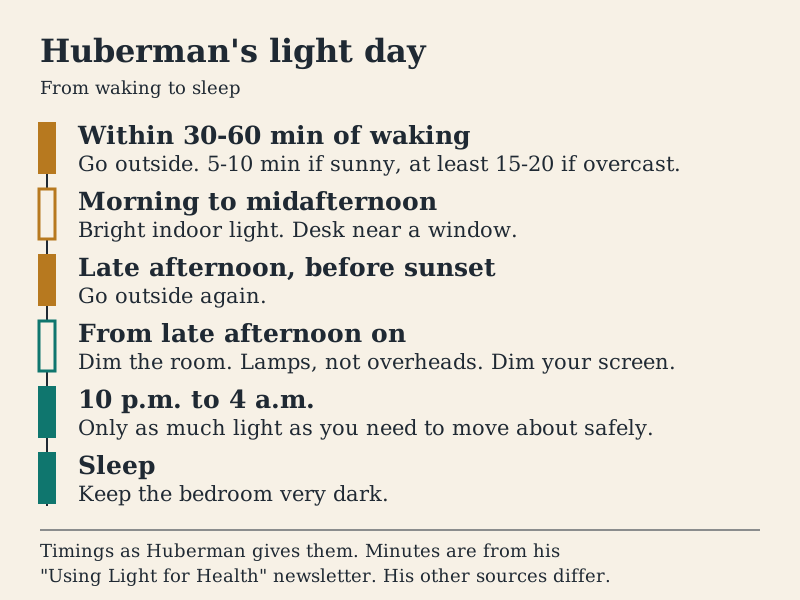
The Huberman light exposure protocol comes down to four moves: get outside within 30 to 60 minutes of waking, get outside again in the late afternoon, dim the lights after that, and avoid bright light between about 10 p.m. and 4 a.m. On a sunny morning he suggests 5 to 10 minutes outside, and at least 15 to 20 when it's overcast. Below is each step with the episode it comes from, plus a plain verdict on which parts rest on human research and which on mouse studies or rules of thumb.
TL;DR
- Within 30 to 60 minutes of waking, go outside and face the sun's direction without staring at it (Huberman).
- Stay out 5 to 10 minutes if it's sunny, at least 15 to 20 if it's overcast. His other sources give different times.
- Glass blocks much of the effect. Glasses and contacts are fine; sunglasses aren't (Huberman).
- Get outside again in the late afternoon, before sunset.
- Dim the lights in the evening, and from about 10 p.m. to 4 a.m. use as little light as you can safely move around with.
- Treat the skin-hormone and dopamine claims as early research. The strongest evidence behind the protocol is about clock timing.
Why morning light matters for your circadian clock
Your clock runs slightly long
Without daylight to reset it, your body clock drifts about 12 minutes a day. In lab studies the average human circadian period comes out at about 24.2 hours (Czeisler et al., 1999). Dr. Samer Hattar of the National Institute of Mental Health cites that figure on Huberman Lab Ep #43.
The cells that read daylight
The suprachiasmatic nucleus is the brain's master clock. Its light information comes from ipRGCs, retinal cells that carry the effects of light beyond image vision (Fernandez et al., 2018).
What morning light does to cortisol and melatonin
Bright light in the first 30 to 60 minutes after waking, ideally sunlight, helps the cortisol peak land early in the day. That's Huberman's claim in his Sleep Toolkit episode, and the lab evidence for it is small. In 8 healthy men kept awake overnight in a lab, switching from dim to bright light at 5 a.m. raised cortisol by more than 50% (Leproult et al., 2001). It shows that morning light moves cortisol in a lab. It doesn't show what ten minutes outside does to your own daily curve. Our cortisol guide explains how cortisol rises and falls across the day.
On Ep #2 he describes a rhythm in which the morning cortisol rise is followed by melatonin 12 to 16 hours later. In the Sleep Toolkit he says morning light sets a timer for falling asleep about 16 hours later. Both are rules of thumb.
On Ep #28 he says "getting sunlight in your eyes first thing in the morning is absolutely vital to mental and physical health..."
What morning light does to your sleep
Morning sun mostly changes when you sleep, not how long. In a survey of 1,762 adults in Brazil, run in late 2020 and published in 2025, each extra 30 minutes of sun before 10 a.m. was linked to a sleep midpoint 23 minutes earlier (de Menezes-Júnior et al., 2025). The midpoint is the halfway point between falling asleep and waking. More morning sun also went with better scores on the Pittsburgh Sleep Quality Index questionnaire.
It wasn't linked to total sleep time, time to fall asleep or sleep efficiency. Each extra 30 minutes after 3 p.m. was linked to a smaller shift, 19 minutes, and midday sun showed no link.
This was a one-off survey with self-reported sun, so it can't show cause. It matches lab work showing light after the body's temperature low moves the clock earlier (Khalsa et al., 2003). If your trouble is getting to sleep too late, start with morning light.
The morning light protocol, step by step
When to go out
In the Sleep Toolkit and his "Toolkit for Sleep" newsletter, Huberman says to view sunlight within 30 to 60 minutes of waking. Earlier is better. The window counts from your wake time, so if you wake between 6 and 8 a.m., outside by 7 to 9 a.m. fits.
Body temperature hits its low point late in the night. On Ep #28, Huberman puts his own low at about two hours before his average wake-up time. Lab studies show light before that low point delays the clock and light after it advances it (Khalsa et al., 2003). That's the logic behind using your temperature minimum to shift your body clock.
Why noon doesn't replace the morning
On Ep #2, Huberman says the cells that set the clock respond best to sunlight at a low solar angle, which you can still catch within an hour or two of sunrise. "Once the sun is overhead, the quality of light shifts so that you miss this opportunity to time the cortisol pulse." He links a late cortisol rise, around 8 or 9 p.m., to anxiety and depression, and says it isn't known whether that's a cause or a consequence.
That's his reasoning, not a tested cut-off. The Brazilian survey points the same way: sun between 10 a.m. and 3 p.m. showed no link.
How long, by weather
His minutes vary by source.
| Source | Sunny | Overcast | Dense overcast or rain |
|---|---|---|---|
| "Using Light for Health" newsletter | 5-10 min | At least 15-20 min | Not given |
| Sleep Toolkit episode | About 5 min | About 10 min | 20-30 min |
| "Toolkit for Sleep" newsletter | 10 min | 20 min | 30-60 min |
These are Huberman's estimates, and no study tested them. Hattar, on Ep #43, called 10 to 15 minutes in the shade on a sunny day ample. "There's going to be so many photons out there in the shade, it's going to be perfect."
If you want one rule, use the one from "Using Light for Health", the most recent source.
Where to look
Face toward the sun without staring, Huberman's "Using Light for Health" newsletter says. Never look directly at the sun, or at any light so bright it hurts. Blink as needed. Glasses and contacts are fine, even with UV protection, but sunglasses and blue blockers aren't. The "Toolkit for Sleep" newsletter adds that a brimmed hat, sunglasses and shade together won't "wake up" your clock.
On Ep #2, Huberman explains that "these cells ... reside mostly, not exclusively, but mostly in the bottom half of our retina ... that means that these cells are actually viewing our upper visual field." A 2003 study of 9 people found that, at night, light on the lower retina suppressed melatonin more than light on the upper retina (Glickman et al., 2003).
Windows, windshields and cloudy days
Step outside rather than standing at a window or sitting in the car. On Ep #2, Huberman, citing Stanford sleep researcher Jamie Zeitzer, says sunlight through a window is about 50 times less effective than going outside. That figure is an estimate, and Hattar says it depends on the glass. "Using Light for Health" says a window or windshield "won't work".
Cloud matters less. On Ep #68 Huberman says "even on a cloud-covered day, you are going to get far more light energy, photons, through cloud cover than you are going to get from an indoor light source". In the Sleep Toolkit he notes a light-meter app typically reads around 1,000 lux indoors and 5,000 to 10,000, sometimes 90,000, lux outside under cloud. That's a demonstration, and no study backs it.
Fitting it into your morning
Attach it to something you already do: coffee on the doorstep, the walk to the station, the dog's first walk. Your phone won't stand in for it. In the Sleep Toolkit, Huberman says that even at full brightness a phone screen isn't bright enough to trigger the morning cortisol rise, and that ordinary home lights aren't either. On grey mornings, he says, "you especially need to get outside", and for longer.
If you miss a day
Hattar says, "Daily is the best. This system is really about ... multiple days". Huberman calls missing it here and there "not a big deal" in "Toolkit for Sleep".
Why Huberman adds afternoon light
Late afternoon, before sunset
Go outside again in the late afternoon, before sunset. Both newsletters include this step, and neither gives a clock time. "Toolkit for Sleep" uses the same minutes as the morning: 10 on a cloudless day, 20 when cloudy and 30 to 60 when very overcast. "Using Light for Health" gives no time. Huberman's reasoning is that low-sun light tells the clock it is evening and time to start winding down. It's an untested suggestion. The morning step is the one with lab studies behind it, so if you only manage one, make it the morning.
A backup anchor and the "Netflix inoculation"
If you miss the morning, "Using Light for Health" treats afternoon sunlight as a second "anchor point". On Ep #28 he adds, "What I call your Netflix inoculation." His idea is that late-afternoon light may partly offset screens later at night. The newsletter says it reduces "some (not all!)" of the effect. Like the rest of the afternoon step, it rests on his reasoning rather than a study.
Light indoors during the workday
From morning until midafternoon, "Using Light for Health" says, use bright overhead lights, raise the room's light rather than your screen brightness, and put your desk near a window. From late afternoon, dim the space by switching off overheads, using lamps and dimming your screen. Our routine guide shows how light fits into the rest of Huberman's daily routine.
The evening light protocol and the dopamine question
The 10 p.m. to 4 a.m. window
Between 10 p.m. and 4 a.m., use only as much artificial light as you need to move about safely. That's the rule in the "Toolkit for Sleep" newsletter, which adds that bright light of all colours is a problem for the clock, and blue is only part of it. "Once in a while is fine," Huberman adds in "Using Light for Health".
On Ep #28, Huberman goes further, saying that "if we view bright lights, or even not-so-bright lights, between the hours of 10:00 p.m. and 4:00 a.m., that is strongly disruptive, very disruptive for our dopamine production." The dopamine part rests on mouse research.
What the dopamine claim rests on
In "Using Light for Health", Huberman summarises Hattar's warning that light from artificial sources and screens between 10 p.m. and 4 a.m. lowers dopamine and makes depression and anxiety worse. The circuit work was done in mice. In An et al. (2020), light at night produced depression-like behaviour in mice through a retina-to-perihabenular pathway. Fernandez et al. (2018) mapped separate mood and learning pathways, also in mice.
No human study has measured dopamine under this rule. Hattar, on the mood pathway, said, "We don't know what light does to it. We don't know how it interacts."
Dim the lights for your clock, but treat the dopamine claim as untested in people.
Light while you sleep
Light during sleep affects heart rate and metabolism too. In Mason et al. (2022), with 20 healthy adults, one night under 100 lux room light, compared with a dim room (under 3 lux), raised nighttime heart rate, lowered heart rate variability and raised next-morning insulin resistance. The study was small, and the fix is cheap. "Using Light for Health" says to keep the bedroom very dark.
If you need light at night
Hattar says on Ep #43 that "below 10 lux of red light literally doesn't affect sleep at all." Huberman suggests candlelight or inexpensive red bulbs (Office Hours and both newsletters). If you get up in the night, "Using Light for Health" says to use no light, very dim light, or amber or red light. Blue blockers "can help a bit" at night, says "Toolkit for Sleep", but still dim the lights.
Skin exposure and hormones
Huberman's suggested routine
On Ep #68 Huberman says "your skin is actually an endocrine organ, meaning it is a hormone-producing and hormone-influencing organ". His routine in "Using Light for Health" is about 20 to 30 minutes outdoors in shorts and a T-shirt, in the afternoon, 2 to 3 times a week. "Don't sunburn!"
What the 2021 Cell Reports study found
The routine is based on Parikh et al. (2021) in Cell Reports. UVB on the skin raised sex hormones in mice, an effect that depended on p53 signalling in skin keratinocytes.
The human evidence was thinner. After a single 25-minute midday sun session, blood-protein patterns in a small group (5 people per condition) pointed towards higher sex-steroid activity. In health records from 13,086 men aged 21 to 25, testosterone peaked in summer (July). The study never measured hormones on Huberman's 2 to 3 times a week schedule.
Mouse findings on pain and mood
UVB on the skin raised beta-endorphin (Skobowiat et al., 2017), and bright light through the eyes reduced pain responses via a retina-to-midbrain (periaqueductal gray) circuit (Hu et al., 2022). Neither has been tested in people. They might help explain why people often report feeling better in bright, sunny conditions, though only mice have shown the mechanism.
Don't let your skin burn. If you burn easily or have skin-cancer risk factors, keep exposure short and protect your skin.
What to do when sunlight isn't available
Before sunrise and in winter
If you're up before sunrise, Huberman's newsletters say to turn on bright indoor lights, then go outside once the sun is up.
Light boxes
The Mayo Clinic gives the clinical standard for seasonal affective disorder: 10,000 lux, UV-filtered, about 16 to 24 inches from your face, for about 20 to 30 minutes within the first hour of waking. Follow the maker's instructions.
Huberman says on Ep #28 that he uses an inexpensive drawing light pad of about 930 lux, "really bright enough, at least for me". That's far below the 10,000 lux the Mayo Clinic recommends.
If you have an eye condition or take a medicine that makes you sensitive to light, ask your doctor before using a light box.
Red light for your eyes is a different tool
The UCL researchers behind two small trials say longer red wavelengths, 650 to 1,000 nm, improve mitochondrial activity. They used 670 nm light to try to improve how the eye's photoreceptors work. In a small 2020 UCL pilot of 24 people (Shinhmar et al., 2020), three minutes a day for two weeks improved blue-axis colour contrast sensitivity in people around 40 and older. Some improved by up to about 20%. Younger people saw no change. A 2021 follow-up in 20 people aged 38 to 70 found a single 3-minute exposure at 8 to 9 a.m. improved those thresholds by an average of 17% three hours later. In the 10 people retested a week later, a smaller improvement of about 10% remained (Shinhmar et al., 2021).
In "Using Light for Health", Huberman says to do it early in the day with a special red light. The UCL studies measured colour vision, not the body clock, so this doesn't replace morning sun.
Shift work
For shift work, "Using Light for Health" says to avoid bright light in the middle of your own sleep period, use dark shades and dim light, and keep the same schedule for at least two weeks at a time. Otherwise, try a step-by-step plan to reset your sleep schedule.
How strong is the evidence behind each step?
| Step | Where Huberman says it | What the evidence is | Strength |
|---|---|---|---|
| Morning light within an hour of waking | Sleep Toolkit; Toolkit newsletter | Human lab studies (Khalsa 2003; Leproult 2001) | Good for the principle; the exact window is his |
| Minutes by weather | Three sources, three sets | No study tested them | Rule of thumb |
| Face the sun, don't stare | Ep #2; newsletter | 9 people (Glickman 2003) | Small human study |
| Windows 50x less effective | Ep #2, citing Zeitzer | A remark; Hattar says it depends on the glass | Expert estimate |
| Afternoon light | Newsletters; Ep #28 | No study in our sources | Huberman's reasoning |
| Avoid bright light 10 p.m.-4 a.m. (dopamine) | Ep #28; newsletter | Mouse circuit studies (An 2020; Fernandez 2018) | Mouse evidence only |
| Very dark bedroom | Newsletter | 20 adults, one night (Mason 2022) | Small human lab study |
| Dim red light at night | Ep #43 (Hattar) | Hattar's statement | Expert statement |
| Sun on skin for hormones | Ep #68; newsletter | Mice, plus thin human data (Parikh 2021) | Mostly mouse |
| 10,000-lux light box | Mayo Clinic, not Huberman | Standard treatment guidance for seasonal affective disorder | Clinical guidance |
| 670 nm red light for eyes | Ep #68; newsletter | Two small UCL pilots (24 and 20 people) | Small human pilots |
The clock-timing core of the Huberman light exposure protocol is the best-supported part. The dopamine and hormone claims are the weakest.
How light fits with rest and your nervous system
Lamps and screens at bedtime
Switch off the lamp and the TV before you sleep, or put them on a timer if you tend to drift off with them on. The Mason study above is the reason.
Where NSDR sits in Huberman's toolkit
In the Sleep Toolkit, Huberman suggests NSDR, yoga nidra or self-hypnosis for 10 to 30 minutes. He doesn't tie it to cortisol timing. The Toolkit newsletter also suggests NSDR if you wake in the night and can't fall back asleep. An audio session fits the 10 p.m. to 4 a.m. rule, because you can follow it lying in the dark with no lamp on. NSDR.co is free, with 50+ guided sessions, and there will always be a free plan. For how Huberman frames the practice, see Huberman's NSDR protocol.
FAQ
How long should you get morning sunlight according to Huberman?
Huberman's "Using Light for Health" newsletter suggests 5 to 10 minutes of morning sunlight if it's sunny and at least 15 to 20 if it's overcast. The Sleep Toolkit episode and the "Toolkit for Sleep" newsletter say to get it within 30 to 60 minutes of waking. Other sources for the Huberman light exposure protocol give different figures, from about 5 minutes on a clear day in the Sleep Toolkit episode to 30 to 60 minutes on very overcast days in "Toolkit for Sleep".
Does morning sunlight help you sleep?
Morning sunlight seems to help mainly with sleep timing. In a survey of 1,762 adults, each extra 30 minutes of sun before 10 a.m. was linked to a sleep midpoint 23 minutes earlier and better sleep-quality scores. It wasn't linked to how long people slept or how fast they fell asleep.
Can a phone screen or indoor lights replace morning sunlight?
No, a phone screen or indoor lights can't replace morning sunlight, Huberman says in the Sleep Toolkit. Neither is bright enough to trigger the morning cortisol rise, yet both can disrupt sleep late at night.
Does morning sunlight work through a window?
Morning sunlight works much less well through a window. Huberman, citing Jamie Zeitzer, says it's about 50 times less effective than going outside, and Hattar says it depends on the glass. Go outside.
Is it only blue light you should avoid at night?
No, blue light isn't the only light to avoid at night. The Toolkit newsletter says bright light of all colours matters, so dim the lights. Hattar says red light below 10 lux doesn't affect sleep.
Does bright light at night lower dopamine?
Huberman says bright light at night disrupts dopamine production, but the evidence comes from mouse circuit studies. No human study has measured it, and Hattar has said the mechanism isn't known.
Does sunlight on your skin increase testosterone?
Sunlight on your skin may increase testosterone, but the human evidence is limited. A 2021 Cell Reports study found UVB raised sex hormones in mice. In people, it found only hints: blood-protein patterns in a small group after one 25-minute session, and a summer testosterone peak in records from 13,086 young men.
Sources
- Czeisler CA, Duffy JF, Shanahan TL, et al. (1999). Stability, precision, and near-24-hour period of the human circadian pacemaker. Science. https://pubmed.ncbi.nlm.nih.gov/10381883/
- Glickman G, Hanifin JP, Rollag MD, et al. (2003). Inferior retinal light exposure is more effective than superior retinal exposure in suppressing melatonin in humans. Journal of Biological Rhythms. https://pubmed.ncbi.nlm.nih.gov/12568246/
- Leproult R, Colecchia EF, L'Hermite-Balériaux M, et al. (2001). Transition from dim to bright light in the morning induces an immediate elevation of cortisol levels. Journal of Clinical Endocrinology & Metabolism. https://pubmed.ncbi.nlm.nih.gov/11231993/
- Khalsa SB, Jewett ME, Cajochen C, et al. (2003). A phase response curve to single bright light pulses in human subjects. Journal of Physiology. https://pubmed.ncbi.nlm.nih.gov/12717008/
- Fernandez DC, Fogerson PM, Lazzerini Ospri L, et al. (2018). Light affects mood and learning through distinct retina-brain pathways. Cell. https://pubmed.ncbi.nlm.nih.gov/30173913/
- An K, Zhao H, Miao Y, et al. (2020). A circadian rhythm-gated subcortical pathway for nighttime-light-induced depressive-like behaviors in mice. Nature Neuroscience. https://pubmed.ncbi.nlm.nih.gov/32483349/
- de Menezes-Júnior LAA, Sabião TDS, Carraro JCC, et al. (2025). The role of sunlight in sleep regulation: analysis of morning, evening and late exposure. BMC Public Health. https://pubmed.ncbi.nlm.nih.gov/41053799/
- Mason IC, Grimaldi D, Reid KJ, et al. (2022). Light exposure during sleep impairs cardiometabolic function. PNAS. https://pubmed.ncbi.nlm.nih.gov/35286195/
- Parikh R, Sorek E, Parikh S, et al. (2021). Skin exposure to UVB light induces a skin-brain-gonad axis and sexual behavior. Cell Reports. https://pubmed.ncbi.nlm.nih.gov/34433056/
- Skobowiat C, Postlethwaite AE, Slominski AT (2017). Skin exposure to ultraviolet B rapidly activates systemic neuroendocrine and immunosuppressive responses. Photochemistry and Photobiology. https://pubmed.ncbi.nlm.nih.gov/27716949/
- Hu Z, Mu Y, Huang L, et al. (2022). A visual circuit related to the periaqueductal gray area for the antinociceptive effects of bright light treatment. Neuron. https://pubmed.ncbi.nlm.nih.gov/35263618/
- Shinhmar H, Grewal M, Sivaprasad S, et al. (2020). Optically improved mitochondrial function redeems aged human visual decline. Journals of Gerontology, Series A. https://pubmed.ncbi.nlm.nih.gov/32596723/
- Shinhmar H, Hogg C, Neveu M, Jeffery G (2021). Weeklong improved colour contrasts sensitivity after single 670 nm exposures associated with enhanced mitochondrial function. Scientific Reports. https://pubmed.ncbi.nlm.nih.gov/34819619/
- Mayo Clinic. Seasonal affective disorder treatment: Choosing a light box. https://www.mayoclinic.org/diseases-conditions/seasonal-affective-disorder/in-depth/seasonal-affective-disorder-treatment/art-20048298
- Huberman Lab Ep #2, "Master Your Sleep & Be More Alert When Awake" (2021). https://www.hubermanlab.com/episode/master-your-sleep-and-be-more-alert-when-awake
- Huberman Lab Ep #28, "Maximizing Productivity, Physical & Mental Health with Daily Tools" (2021). https://www.hubermanlab.com/episode/maximizing-productivity-physical-and-mental-health-with-daily-tools
- Huberman Lab Ep #43, "Dr. Samer Hattar: Timing Light, Food, & Exercise for Better Sleep, Energy & Mood" (2021). https://www.hubermanlab.com/episode/dr-samer-hattar-timing-light-food-exercise-for-better-sleep-energy-mood
- Huberman Lab Ep #68, "Using Light (Sunlight, Blue Light & Red Light) to Optimize Health" (2022). https://www.hubermanlab.com/episode/using-light-sunlight-blue-light-and-red-light-to-optimize-health
- Huberman Lab, "Sleep Toolkit: Tools for Optimizing Sleep & Sleep-Wake Timing" (2022). https://www.hubermanlab.com/episode/sleep-toolkit-tools-for-optimizing-sleep-and-sleep-wake-timing
- Huberman Lab Office Hours, "Using Science to Optimize Sleep, Learning & Metabolism" (2021). https://www.hubermanlab.com/episode/using-science-to-optimize-sleep-learning-and-metabolism
- Huberman Lab newsletter, "Toolkit for Sleep" (2021). https://www.hubermanlab.com/newsletter/toolkit-for-sleep
- Huberman Lab newsletter, "Using Light for Health" (2023). https://www.hubermanlab.com/newsletter/using-light-for-health