If your sleep schedule has drifted late, the fix starts in the morning. Pick a wake time and keep it every day, get outside within an hour of waking, keep your evenings dim, and move your wake time 15 to 30 minutes at a time. Your body clock runs a little longer than 24 hours, so it slides later unless morning light pulls it back. The seven steps below cover how to fix sleep schedule problems in order, with the evidence for each.
This is general information, not medical advice. Talk to a doctor before taking melatonin, or if poor sleep goes on for weeks.
TL;DR: How to fix your sleep schedule
- Get up at the same time every day, weekends included.
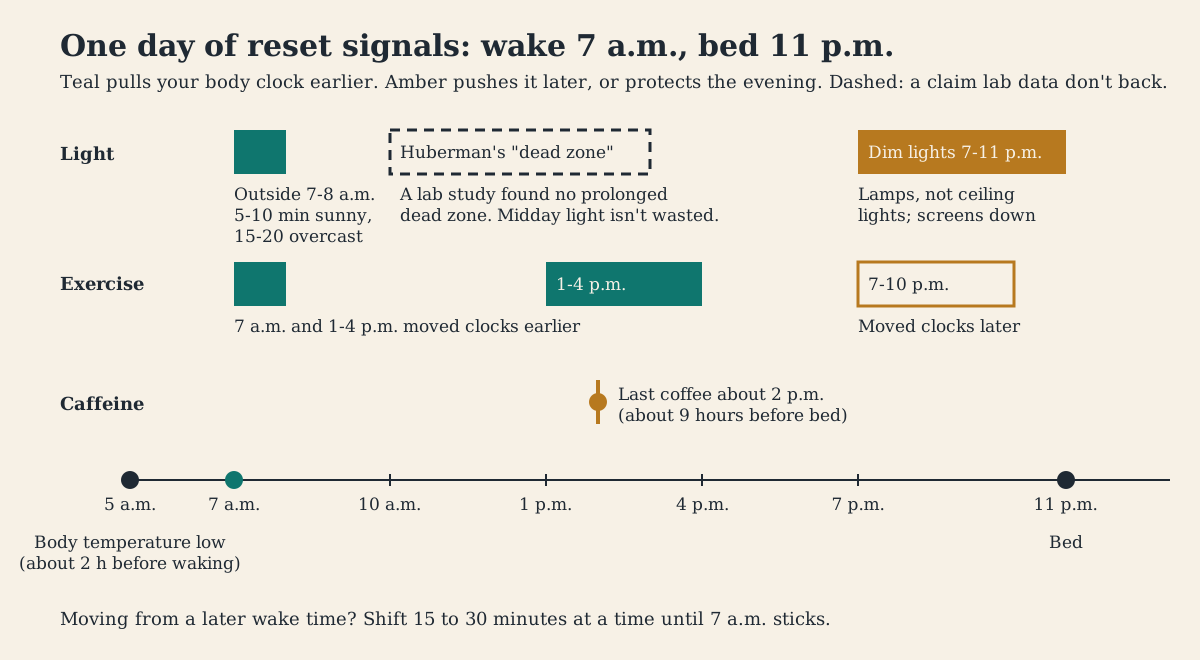
- Go outside within 30 to 60 minutes of waking: 5 to 10 minutes if it's sunny, 15 to 20 if it's overcast.
- Dim the lights in the 2 to 4 hours before bed and turn screens right down.
- Move your wake time 15 to 30 minutes at a time, not two hours overnight.
- Keep the bedroom cool, around 65°F (18°C).
- Have your last coffee about 9 hours before bed, and exercise in the morning or early afternoon.
- Swap a late-afternoon nap for 10 minutes of NSDR.
Why your sleep schedule drifts
Your clock runs slightly long
Your master clock, in a part of the brain called the suprachiasmatic nucleus, runs on a cycle of about 24.2 hours without daylight (Czeisler et al., 1999). It drifts later by about 11 minutes a day, and late nights, lie-ins and bright evenings push it the same way. Light is the main signal that resets it, earlier or later depending on when you see it.
Two drives decide when you sleep (Borbély et al., 2016). Sleep pressure builds the longer you're awake; adenosine, which caffeine blocks, is part of it. The circadian clock sets when you feel sleepy or alert. When the two fall out of step, you can feel tired in the afternoon and alert at midnight.
Why an earlier bedtime rarely works
On his jet lag episode, Andrew Huberman says "it's easier to stay up later than we would naturally want to, than it is to go to sleep earlier." Cathy Goldstein of the University of Michigan Sleep Disorders Center told Peloton, "Falling asleep is like falling in love; you can't try too hard." So the plan starts from the morning. Fix the wake time and the light, and bedtime follows.
Step 1: Lock in a consistent wake time
Pick a wake time you can keep seven days a week
Sleep scientist Matt Walker puts regularity first of his six sleep tips. "Regularity is king," he says, and that holds on weekends and "even if you've had a bad night of sleep." Nancy Foldvary-Schaefer, a sleep specialist at Cleveland Clinic, says the same thing. "Set a wake-up time that's the same every day, including work days and non-work days."
Why wake time matters more than bedtime
In a study of 120 young adults, the evening rise in melatonin came about 13.5 hours after waking (Burgess & Eastman, 2005). Move the wake time and that rise moves with it. Huberman's newsletter rule is to wake at the same time each day and go to bed when you first feel sleepy.
The weekend lie-in
A Saturday lie-in also moves your first daylight later. Researchers call the gap between workday and free-day sleep "social jetlag" (Wittmann et al., 2006), and it has been linked to higher body weight (Roenneberg et al., 2012) and, in a review of 41 studies, to worse health (Chaput et al., 2020). The same review linked weekend catch-up sleep to better outcomes, so if you're short on sleep, go to bed earlier on Friday and keep the alarm.
Step 2: Use morning light as your main reset signal
Get outside within 30 to 60 minutes of waking
"The most important thing to focus on is light exposure," sleep physician Chester Wu told Rise Science. Huberman suggests going outside within 30 to 60 minutes of waking, for 5 to 10 minutes on a sunny morning and at least 15 to 20 when it's overcast. No trial has tested those times. Face the sun's direction without looking at it; glasses and contacts are fine, sunglasses aren't. The full routine is in Huberman's light exposure protocol.
Why indoor light isn't enough
In Huberman's light-meter demonstration, the brightest light in a home reads about 1,000 lux, and a cloudy sky reads 5,000 to 10,000, sometimes 90,000. Ordinary room light in one Harvard study was under 200 lux. Glass cuts it further. Huberman, citing Stanford's Jamie Zeitzer, estimates sunlight through a window is about 50 times less effective.
Does midday light count?
Huberman calls roughly 10 a.m. to 3 p.m. a "circadian dead zone", when light barely moves the clock. A Harvard lab study of single bright-light pulses in 21 people found "no prolonged 'dead zone'" during the day (Khalsa et al., 2003). Midday light isn't wasted, though that study used 6.7-hour light sessions in a lab, not a lunchtime walk. Morning light is the dependable part. Huberman puts your body's temperature low at 90 minutes to 2 hours before your usual wake time, and lab work shows light before that low delays the clock while light after it advances it (Khalsa et al., 2003). Light after you wake comes after that low, so it moves the clock earlier.
Step 3: Keep evenings dim to protect melatonin
Dim the lights 2 to 4 hours before bed
Evening light delays melatonin, the hormone that tells your body it's night. In a Harvard study of 116 adults aged 18 to 30, ordinary room light (under 200 lux) in the 8 hours before bed delayed the start of melatonin in 99% of them and shortened its nightly release by about 90 minutes, compared with dim light (Gooley et al., 2011).
Goldstein's routine dims the lights 4 hours before bed. Start with 2, with the ceiling lights off and lamps set low. Huberman's newsletter says bright light of any colour is a problem, and from 10 p.m. to 4 a.m. it says to use only as much light as you need to move around safely.
Screens
People who read on a light-emitting e-reader before bed took longer to fall asleep, released less melatonin and had later body clocks than when they read a printed book (Chang et al., 2015). Turn screens right down and keep them below eye level. In a 2003 study of 9 people, light reaching the lower half of the retina, which looks upward, suppressed melatonin more than light on the upper half (Glickman et al., 2003).
Step 4: Shift your schedule gradually, 15 to 30 minutes at a time
How to shift
The Sleep Foundation's advice is small steps: 15 or 30 minutes at a time, over a series of days. Move the alarm first and let bedtime follow when you feel sleepy. Going from a 9 a.m. to a 7 a.m. wake time takes 4 to 8 steps.
How long it takes
Experts quoted by Peloton put a reset at one to two weeks, and jet lag at about one day per time zone. Foldvary-Schaefer warns that "those first few days might feel like a struggle because you're acclimating", and says most people then notice better sleep fairly quickly.
Faster resets for travel or a shift change
Huberman says that combining light, exercise and meals at the right times can shift the clock "anywhere from one to three hours per day". That's his estimate; no study has tested that figure. To time it, see how to find your temperature minimum and shift your clock for travel.
Step 5: Use temperature to reinforce your new rhythm
Keep the bedroom cool
Your core temperature has to drop by about one degree Celsius to fall and stay asleep, says Walker. He suggests a bedroom of about 65°F, a little over 18°C, and the Sleep Foundation gives 65 to 68°F. A 2012 review found that a warm room increases waking and cuts both deep and REM sleep (Okamoto-Mizuno & Mizuno, 2012).
A warm bath or shower in the evening
A bath or shower at 40 to 42.5°C (104 to 108.5°F), 1 to 2 hours before bed, was linked with falling asleep faster in a 2019 meta-analysis, even when it lasted only 10 minutes (Haghayegh et al., 2019).
Step 6: Time your caffeine, exercise and meals
Caffeine: last cup about 9 hours before bed
Caffeine's half-life averages about 4 hours in healthy adults but ranges from 2 to 8 (EFSA, 2015). A 2023 meta-analysis of 24 studies found caffeine cut total sleep by 45 minutes and deep sleep by about 11 minutes. It set the cutoff for a regular coffee at 8.8 hours before bed, and 13.2 hours for a pre-workout drink (Gardiner et al., 2023). For a 10 p.m. bedtime, that's about 1 p.m. More on how long caffeine stays in your system.
Exercise: mornings or early afternoon
In a 2019 lab study, 99 adults did an hour of moderate treadmill exercise on three straight days, at one of eight times. Exercise at 7 a.m. or between 1 and 4 p.m. moved their clocks earlier, and exercise between 7 and 10 p.m. moved them later (Youngstedt et al., 2019). Evening exercise is otherwise fine for sleep, though vigorous exercise that ends within about an hour of bed might hurt it (Stutz et al., 2019).
Meals: regular times
Meal timing helps set the clocks in your body outside the brain. When 10 young men had their meals moved 5 hours later in a 2017 lab study, their blood-sugar rhythm shifted by about 5.7 hours, while their melatonin and cortisol rhythms didn't move (Wehrens et al., 2017). Eat at regular times. Rise Science advises finishing big meals 2 to 3 hours before bed, a guideline that hasn't been tested as a number.
Step 7: Use NSDR for the afternoon slump instead of a nap
Why late naps work against you
A nap uses up sleep pressure you need at bedtime, so the Sleep Foundation's rule is under 30 minutes and early in the afternoon. In a study of 24 young adults after a short night, a 10-minute nap gave the best lift, and a 30-minute nap left them groggy first (Brooks & Lack, 2006).
Where NSDR fits
Non-sleep deep rest (NSDR) is a guided session where you lie still and stay awake while your body relaxes. In his Sleep Toolkit episode, Huberman suggests NSDR, yoga nidra or self-hypnosis for 10 to 30 minutes, and says he does NSDR or a sleep hypnosis app almost every day. Because you stay awake, you get up without the grogginess a nap can leave.
A nap is still the stronger reset. In the one trial that compared them, with 60 people, a 25-minute nap beat 10 minutes of NSDR on readiness, and NSDR showed no effect (Boukhris et al., 2026). Nobody has measured whether NSDR spares sleep pressure. Use it on days a nap would wreck your bedtime. See NSDR vs napping, and how to recover from a bad night the same day.
To try it, lie on your back in the early afternoon and follow a guided track. Ten minutes is enough to start; three of the four trials that use the NSDR name tested 10-minute sessions. NSDR.co is free, and there will always be a free plan.
When to see a doctor
Delayed sleep-wake phase disorder keeps the clock running late, and the American Academy of Sleep Medicine gives timed melatonin for it a weak recommendation (Auger et al., 2015). If two to three weeks of steady wake times and morning light haven't fixed your sleep schedule problems, or poor sleep is affecting your days, see a doctor. For insomnia that has lasted months, cognitive behavioural therapy for insomnia (CBT-I) is the recommended first treatment (Qaseem et al., 2016; Edinger et al., 2021).
FAQ
How long does it take to fix a sleep schedule?
Fixing a sleep schedule usually takes one to two weeks, according to experts quoted by Peloton. If you're planning how to fix sleep schedule problems around a deadline, treat that as an estimate, not a tested figure. A bigger shift takes longer. Moving your wake time by 2 hours at 15 to 30 minutes a step is 4 to 8 steps.
Can you fix a sleep schedule in one night?
No, you can't fix a sleep schedule in one night, and an all-nighter won't do it. "Pulling an all-nighter isn't a quick fix for resetting your sleep schedule," Chester Wu told Rise Science. Start with tomorrow's wake time and morning light.
Is it better to stay up all night or sleep 2 hours?
Sleeping the 2 hours is usually better, though no study has compared the two for resetting a schedule. A short sleep still pays down some sleep pressure. Expect some grogginess if the alarm catches you in deep sleep; after a short night it can last longer than the usual half hour. Then keep your usual wake time and get outside.
Why is my sleep schedule so messed up?
A messed-up sleep schedule usually comes from a clock that runs slightly longer than 24 hours, plus habits that push it later, such as lie-ins, bright evenings, late coffee and late naps. Short sleep is common too. More than a third of US adults report usually sleeping under 7 hours (Liu et al., 2016). To fix it, start with Steps 1 and 2.
Does melatonin help fix a sleep schedule?
Melatonin can help fix a sleep schedule, but timing matters more than dose. In a lab study, 3 mg at bedtime barely shifted the clock; afternoon doses, hours before the body's own melatonin rise, shifted it most (Burgess et al., 2008). Taken 2 to 4 hours before that rise, 0.5 mg shifted the clock about as much as 3 mg did at its best time (Burgess et al., 2010). In a Canadian test of 31 supplements, melatonin content ranged from 83% below to 478% above the label (Erland & Saxena, 2017). Ask a doctor or pharmacist first, especially if you're pregnant or take other medicines, and see timed low-dose melatonin for a late body clock.
Sources
- Czeisler CA, Duffy JF, Shanahan TL, et al. (1999). Stability, precision, and near-24-hour period of the human circadian pacemaker. Science. https://pubmed.ncbi.nlm.nih.gov/10381883/
- Borbély AA, Daan S, Wirz-Justice A, Deboer T (2016). The two-process model of sleep regulation: a reappraisal. Journal of Sleep Research. https://pubmed.ncbi.nlm.nih.gov/26762182/
- Khalsa SB, Jewett ME, Cajochen C, Czeisler CA (2003). A phase response curve to single bright light pulses in human subjects. Journal of Physiology. https://pubmed.ncbi.nlm.nih.gov/12717008/
- Burgess HJ, Eastman CI (2005). The dim light melatonin onset following fixed and free sleep schedules. Journal of Sleep Research. https://pubmed.ncbi.nlm.nih.gov/16120097/
- Wittmann M, Dinich J, Merrow M, Roenneberg T (2006). Social jetlag: misalignment of biological and social time. Chronobiology International. https://pubmed.ncbi.nlm.nih.gov/16687322/
- Roenneberg T, Allebrandt KV, Merrow M, Vetter C (2012). Social jetlag and obesity. Current Biology. https://pubmed.ncbi.nlm.nih.gov/22578422/
- Chaput JP, Dutil C, Featherstone R, et al. (2020). Sleep timing, sleep consistency, and health in adults: a systematic review. Applied Physiology, Nutrition, and Metabolism. https://pubmed.ncbi.nlm.nih.gov/33054339/
- Gooley JJ, Chamberlain K, Smith KA, et al. (2011). Exposure to room light before bedtime suppresses melatonin onset and shortens melatonin duration in humans. Journal of Clinical Endocrinology and Metabolism. https://pubmed.ncbi.nlm.nih.gov/21193540/
- Chang AM, Aeschbach D, Duffy JF, Czeisler CA (2015). Evening use of light-emitting eReaders negatively affects sleep, circadian timing, and next-morning alertness. PNAS. https://pubmed.ncbi.nlm.nih.gov/25535358/
- Glickman G, Hanifin JP, Rollag MD, et al. (2003). Inferior retinal light exposure is more effective than superior retinal exposure in suppressing melatonin in humans. Journal of Biological Rhythms. https://pubmed.ncbi.nlm.nih.gov/12568246/
- Okamoto-Mizuno K, Mizuno K (2012). Effects of thermal environment on sleep and circadian rhythm. Journal of Physiological Anthropology. https://pubmed.ncbi.nlm.nih.gov/22738673/
- Haghayegh S, Khoshnevis S, Smolensky MH, Diller KR, Castriotta RJ (2019). Before-bedtime passive body heating by warm shower or bath to improve sleep: a systematic review and meta-analysis. Sleep Medicine Reviews. https://pubmed.ncbi.nlm.nih.gov/31102877/
- European Food Safety Authority (2015). Caffeine: EFSA explains risk assessment. https://www.efsa.europa.eu/sites/default/files/corporate_publications/files/efsaexplainscaffeine150527.pdf
- Gardiner C, Weakley J, Burke LM, et al. (2023). The effect of caffeine on subsequent sleep: a systematic review and meta-analysis. Sleep Medicine Reviews. https://pubmed.ncbi.nlm.nih.gov/36870101/
- Youngstedt SD, Elliott JA, Kripke DF (2019). Human circadian phase-response curves for exercise. Journal of Physiology. https://pubmed.ncbi.nlm.nih.gov/30784068/
- Stutz J, Eiholzer R, Spengler CM (2019). Effects of evening exercise on sleep in healthy participants: a systematic review and meta-analysis. Sports Medicine. https://pubmed.ncbi.nlm.nih.gov/30374942/
- Wehrens SMT, Christou S, Isherwood C, et al. (2017). Meal timing regulates the human circadian system. Current Biology. https://pubmed.ncbi.nlm.nih.gov/28578930/
- Brooks A, Lack L (2006). A brief afternoon nap following nocturnal sleep restriction: which nap duration is most recuperative? Sleep. https://pubmed.ncbi.nlm.nih.gov/16796222/
- Boukhris O, Suppiah H, Driller M (2026). Comparing the effects of a short nap and non-sleep deep rest on perceptual, cognitive, and physical performance in active adults. Clocks & Sleep. https://pubmed.ncbi.nlm.nih.gov/42783005/
- Boukhris O et al. (2024). The acute effects of nonsleep deep rest on perceptual responses, physical, and cognitive performance in physically active participants. Applied Psychology: Health and Well-Being. https://pubmed.ncbi.nlm.nih.gov/38953770/
- Boukhris O et al. (2026). Time course of perceptual, cognitive, physical and physiological responses to a single non-sleep deep rest session in physically active young adults. Applied Psychology: Health and Well-Being. https://pubmed.ncbi.nlm.nih.gov/42383502/
- Burgess HJ, Revell VL, Eastman CI (2008). A three pulse phase response curve to three milligrams of melatonin in humans. Journal of Physiology. https://pubmed.ncbi.nlm.nih.gov/18006583/
- Burgess HJ, Revell VL, Molina TA, Eastman CI (2010). Human phase response curves to three days of daily melatonin: 0.5 mg versus 3.0 mg. Journal of Clinical Endocrinology and Metabolism. https://pubmed.ncbi.nlm.nih.gov/20410229/
- Erland LA, Saxena PK (2017). Melatonin natural health products and supplements: presence of serotonin and significant variability of melatonin content. Journal of Clinical Sleep Medicine. https://pubmed.ncbi.nlm.nih.gov/27855744/
- Auger RR, Burgess HJ, Emens JS, et al. (2015). Clinical practice guideline for the treatment of intrinsic circadian rhythm sleep-wake disorders. Journal of Clinical Sleep Medicine. https://pubmed.ncbi.nlm.nih.gov/26414986/
- Tassi P, Muzet A (2000). Sleep inertia. Sleep Medicine Reviews. https://pubmed.ncbi.nlm.nih.gov/12531174/
- Wrzeciono A et al. (2024). Non-sleep deep rest relaxation and virtual reality therapy for psychological outcomes in patients with coronary artery disease: a pilot randomized controlled trial. Journal of Clinical Medicine. https://pubmed.ncbi.nlm.nih.gov/39685636/
- Liu Y, Wheaton AG, Chapman DP, et al. (2016). Prevalence of healthy sleep duration among adults, United States, 2014. Morbidity and Mortality Weekly Report. https://pubmed.ncbi.nlm.nih.gov/26890214/
- Qaseem A, Kansagara D, Forciea MA, Cooke M, Denberg TD (2016). Management of chronic insomnia disorder in adults: a clinical practice guideline from the American College of Physicians. Annals of Internal Medicine. https://pubmed.ncbi.nlm.nih.gov/27136449/
- Edinger JD, Arnedt JT, Bertisch SM, et al. (2021). Behavioral and psychological treatments for chronic insomnia disorder in adults: an American Academy of Sleep Medicine clinical practice guideline. Journal of Clinical Sleep Medicine. https://pubmed.ncbi.nlm.nih.gov/33164742/
- Walker M. 6 tips for better sleep. TED (Sleeping with Science). https://www.ted.com/talks/matt_walker_6_tips_for_better_sleep/transcript
- Huberman A (2021). How to Defeat Jet Lag, Shift Work & Sleeplessness. Huberman Lab podcast. https://www.hubermanlab.com/episode/find-your-temperature-minimum-to-defeat-jetlag-shift-work-and-sleeplessness
- Huberman A (2022). Sleep Toolkit: Tools for Optimizing Sleep & Sleep-Wake Timing. Huberman Lab podcast. https://www.hubermanlab.com/episode/sleep-toolkit-tools-for-optimizing-sleep-and-sleep-wake-timing
- Huberman A (2021). Toolkit for Sleep. Huberman Lab newsletter. https://www.hubermanlab.com/newsletter/toolkit-for-sleep
- Huberman A (2023). Using Light for Health. Huberman Lab newsletter. https://www.hubermanlab.com/newsletter/using-light-for-health
- Sleep Foundation. How to Fix Your Sleep Schedule. https://www.sleepfoundation.org/sleep-hygiene/how-to-reset-your-sleep-routine
- Sleep Foundation. Best Temperature for Sleep. https://www.sleepfoundation.org/bedroom-environment/best-temperature-for-sleep
- Cleveland Clinic (2025). How to Fix Your Sleep Schedule. https://health.clevelandclinic.org/how-to-fix-your-sleep-schedule
- Rise Science. How to Fix Your Sleep Schedule: 18 Expert-Approved Tips. https://www.risescience.com/blog/how-to-reset-sleep-schedule
- Peloton (2023). How to Fix Your Sleep Schedule for Good. https://www.onepeloton.com/blog/how-to-fix-sleep-schedule