To recover from poor sleep, get up at your usual time and get outside in daylight. Have your coffee but stop around midday, nap for 10 to 20 minutes early in the afternoon if you can, eat a proper breakfast, put off big decisions and go to bed at your normal time. Full recovery can take a couple of nights.
TL;DR: How to recover from poor sleep
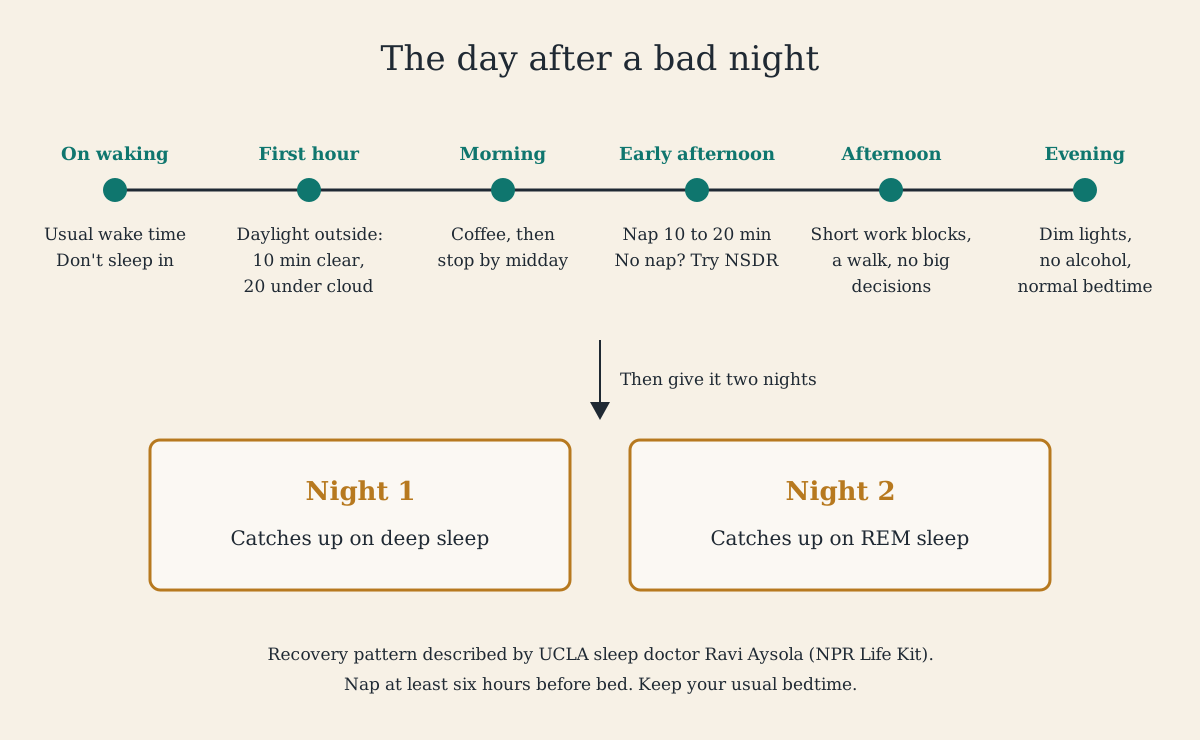
- Get up at your usual time. Don't sleep in.
- Get outside within 30 to 60 minutes of waking: about 10 minutes in clear weather, 20 under cloud.
- Have your normal coffee, then stop around midday.
- Eat protein, drink water, skip the doughnut.
- Nap for 10 to 20 minutes in the early afternoon, at least six hours before bed. Can't nap? Try a short NSDR session.
- Work in 20 to 30 minute blocks, put off big decisions, and don't drive drowsy.
- Tonight, dim the lights, skip alcohol and keep your normal bedtime. Give it two nights.
What happens to your body after a bad night of sleep
Most studies use one short night or a full night awake, so treat their numbers as the upper end of a restless night.
Your stress hormones wind down late
In a 1997 lab study of young men, one night of only four hours' sleep left their evening cortisol 37% higher the next day, and a night with no sleep left it 45% higher (Leproult 1997).
Mood does dip. After 24 hours awake, 23 young adults (average age 21) rated themselves more anxious, tired, confused and low (Thompson 2022).
Attention takes the biggest hit
A 2010 meta-analysis of 70 studies of people kept awake for under 48 hours found the largest effect on lapses in simple attention, and only a small, non-significant one on reasoning accuracy (Lim and Dinges 2010). In the 2022 study, vigilance reaction time slowed from about 286 to 316 milliseconds, a borderline result, while lapses and accuracy held steady.
Driving is the real risk. In a study of 39 people, after 17 to 19 hours awake, performance on some tests matched or fell below that at a 0.05% blood alcohol level (Williamson and Feyer 2000). If you're fighting to keep your eyes open, don't drive.
What about dopamine?
You'll often read that a bad night drains your dopamine. The evidence is thin and mixed. In a 2008 PET study, 15 people kept awake all night showed less binding of a tracer that competes with dopamine, which the authors read as more dopamine (Volkow 2008). A 2012 follow-up in 20 people pointed to fewer D2/D3 receptors instead (Volkow 2012). Either way, they felt sleepier and less alert, and neither study looked at food or audio as a fix.
How to recover from poor sleep: the morning protocol
Get up at your usual time
Get up at your usual time and take a short nap later instead. Sleeping in throws off your circadian rhythm; NPR's Andee Tagle, passing on UCLA sleep doctor Ravi Aysola's advice, compared it to giving yourself jet lag. Henry Ford psychiatrist Gregory Mahr agrees: "Sleeping in way past your normal wake time can leave you feeling groggy and sluggish."
Get outside within 30 to 60 minutes of waking
Bright light suppresses melatonin and, in lab studies, eases sleepiness during sleep loss (Leproult 2001). Dr. Seema Khosla of the North Dakota Center for Sleep keeps it simple: "Go outside. Go get some sun. Put your feet on the ground."
Huberman's Toolkit for Sleep suggests about 10 minutes on a clear day, 20 under cloud and 30 to 60 when it's very overcast. Skip the sunglasses if you safely can (glasses and contacts are fine), and don't look at the sun. More in Huberman's morning light protocol.
Have your coffee, then stop around midday
You'll want caffeine, and that's fine. Khosla and Aysola's advice on NPR was to have it and stop around midday, so you don't stack up a second bad night. Waiting 90 minutes after waking is Huberman's advice, but a 2024 review found no evidence that coffee on waking causes an afternoon crash, or that waiting prevents one (Antonio 2024).
The cutoff is what counts. In a 2013 study, 400 mg of caffeine (roughly four cups of coffee) taken six hours before bed still disrupted sleep (Drake 2013). A 2023 meta-analysis put the cutoff for a cup of coffee at least 8.8 hours before bed (Gardiner 2023). Caffeine's half-life averages about four hours but runs from two to eight depending on the person (EFSA 2015); see how long caffeine stays in your system.
Eat for recovery, not comfort
The cravings are real. After two nights of restricted sleep, 12 young men felt hungrier, and their appetite for calorie-dense, high-carb foods rose by 33 to 45% (Spiegel 2004). NPR's Life Kit says skip the doughnut and the cheeseburger, because they'll leave you more sluggish.
Eat protein at breakfast instead. NPR suggests foods high in tyrosine (eggs, meat, tofu, whole grains) plus omega-3 foods like fish, nuts and seeds. Tyrosine is a building block of dopamine, but the research is on supplements, and the results vary a lot (Jongkees 2015). Treat eggs as a sensible breakfast, not a dopamine fix.
Drink water through the day too. NPR notes that short sleep may cause dehydration, which affects mood and performance.
The afternoon rescue plan
Nap for 10 to 20 minutes, early
One lab study tested naps after a short night directly. In 2006, 24 young adults slept about five hours, then napped at 3 pm (Brooks and Lack 2006):
- A 10-minute nap helped straight away, with some benefits lasting up to 155 minutes.
- A 20-minute nap helped too, but only after about 35 minutes.
- A 30-minute nap left people groggy first, then better.
- Five minutes did very little.
Grogginess is worst when you wake out of deep sleep, and sleep loss increases deep sleep, so after a short night the fog is usually worse than normal (Tassi and Muzet 2000). Set an alarm.
NPR's summary of the doctors' advice: finish at least six hours before bed so sleep pressure can build back up, and no later than 2 or 3 pm for a 10 pm bedtime. Henry Ford's Mahr says eight. More on timing in how to nap without the grogginess.
Move, at whatever level you can manage
"Light exercise, like a short morning walk, can temporarily improve your mood, productivity and energy levels," says Mahr. Aysola adds that harder exercise brings more deep sleep, while Khosla says any movement counts. Your reactions are slower, so avoid anything where a slip could hurt you.
Work in short blocks and put off big decisions
Fortune Well suggests alternating 20 to 30 minutes of focused work with a 5 to 10 minute walk. Khosla's rule: "If you haven't slept well, maybe don't make those important decisions."
NSDR for sleep recovery: what it can and can't do
NSDR (non-sleep deep rest) is a short guided session where you lie still, follow a voice through slow breathing and your body, and stay awake. It's the backup for days when you can't nap.
What the NSDR studies found
Huberman's site says NSDR "can provide many of the benefits of sleep when trying to recover from a poor night's sleep", and that "nothing can completely replace sleep". The trials are small and mixed:
- In 65 active adults, 10 minutes of NSDR beat sitting quietly on reaction time, accuracy and self-rated stress (Boukhris 2024).
- In 102 active young adults, one session lowered sleepiness, fatigue and stress compared with a control. A reaction-time gain right after the session was gone 20 minutes later (Boukhris 2026a).
- In a head-to-head with 60 active adults, a 25-minute nap beat both NSDR and a control on readiness, and beat the control on fatigue. NSDR showed no effect (Boukhris 2026b).
None used sleep-deprived people. A 2024 Harvard master's thesis did: 27 sleep-deprived students tried NSDR or a podcast, and NSDR had no significant effect on attention or working memory (Akram 2024). So if you can nap, nap. More in NSDR vs napping.
How to do an NSDR session after a bad night
- Lie on your back somewhere quiet.
- Set an alarm for a few minutes after the track ends. After a bad night you may fall asleep, and then it's a nap.
- Play a guided NSDR track: two slow breaths in through the nose, long breaths out, then follow the voice around your body.
- If your mind wanders, return to the next body part the voice names.
The three Boukhris trials used 10 minutes. Huberman suggests 30 to 60 after a poor night, longer than any of those trials ran.
Protect tonight's sleep (and the night after)
Why recovery can take two nights
Plan on about two nights. Aysola's estimate on NPR was "probably two nights of recovery after one night of bad sleep." In sleep-deprivation experiments, he said, "the first recovery night, they kind of try to recover slow-wave sleep. And the second recovery night, the pattern is they try to recover REM sleep."
Keep your normal bedtime. "Go to bed on time the following night so you can break the cycle," says Mahr.
Evening protocol: wind down
- Dim the lights. Huberman's toolkit says avoid bright overhead lights between 10 pm and 4 am.
- Put the screen down. In a 2015 lab study, reading a light-emitting e-reader before bed, rather than a printed book, meant taking longer to fall asleep, less melatonin and less alertness the next morning (Chang 2015). Huberman says blue blockers help a bit, but dim the lights anyway.
- Skip the alcohol. It helps you fall asleep, then breaks up the second half of the night, delays REM and, at moderate and higher doses, usually cuts total REM (Ebrahim 2013). Khosla says one drink might be OK; heavy drinking isn't.
- Keep the room cool and dark. Huberman notes your body temperature has to drop for you to fall and stay asleep.
If you wake up at night
"More time in bed does not equal more sleep," Aysola says. Lying there frustrated teaches your brain to link bed with stress. Get up and, as Aysola suggested, read a dull book in low light. Huberman suggests an NSDR track in bed instead; pick a 30 to 60 minute one.
Don't stress about one bad night
Worry turns one bad night into a run of them. "All those things are activating the sympathetic nervous system, and that's incompatible with sleep," Aysola says of worrying in bed. Behavioral sleep medicine physician Shelby Harris, PhD, told Fortune: "Every night of sleep does not have to be perfect." More on sleep anxiety.
One bad night isn't insomnia. On NPR's definition, chronic insomnia means trouble three or more nights a week for three months or more, not explained by another health problem, and Khosla adds it needs some daytime impairment. If your bedtime has drifted later over weeks, reset your sleep schedule instead. Health note: if bad nights keep happening, or you're nodding off during the day or at the wheel, see a doctor. Sleep disorders are common and treatable.
FAQ
How long does it take to recover from poor sleep?
Recovering from one night of poor sleep probably takes about two nights, by UCLA sleep doctor Ravi Aysola's estimate: deep sleep first, then REM. Several bad nights in a row take longer, with no fixed number. Either way, the steps stay the same: usual wake time, daylight, an early short nap.
Can NSDR replace lost sleep?
No, NSDR can't replace lost sleep, and Huberman's own site says so. In a small 2024 thesis it had no significant effect on sleep-deprived students' attention or working memory, and in rested adults a nap beat it. Use it when you can't nap.
What should I eat after a bad night of sleep?
After a bad night, eat a protein breakfast (eggs, meat or tofu, with whole grains) and omega-3 foods like fish, nuts and seeds, as NPR's Life Kit suggests. Drink water too.
Is it better to nap or push through after poor sleep?
It's usually better to nap after poor sleep, if you can. After a five-hour night in one lab study, a 10-minute nap lifted alertness and performance straight away. Keep it to 10 to 20 minutes, at least six hours before bed.
How do I recover from poor sleep without caffeine?
If you're working out how to recover from poor sleep without caffeine, lean on daylight, a short nap and movement. Get outside soon after waking, nap early in the afternoon, take a walk and eat protein rather than sugar.
Sources
- Leproult R et al. (1997). Sleep loss results in an elevation of cortisol levels the next evening. Sleep. https://pubmed.ncbi.nlm.nih.gov/9415946/
- Thompson KI et al. (2022). Acute sleep deprivation disrupts emotion, cognition, inflammation, and cortisol in young healthy adults. Frontiers in Behavioral Neuroscience. https://pubmed.ncbi.nlm.nih.gov/36212194/
- Lim J, Dinges DF (2010). A meta-analysis of the impact of short-term sleep deprivation on cognitive variables. Psychological Bulletin. https://pubmed.ncbi.nlm.nih.gov/20438143/
- Williamson AM, Feyer AM (2000). Moderate sleep deprivation produces impairments in cognitive and motor performance equivalent to legally prescribed levels of alcohol intoxication. Occupational and Environmental Medicine. https://pubmed.ncbi.nlm.nih.gov/10984335/
- Volkow ND et al. (2008). Sleep deprivation decreases binding of [11C]raclopride to dopamine D2/D3 receptors in the human brain. Journal of Neuroscience. https://pubmed.ncbi.nlm.nih.gov/18716203/
- Volkow ND et al. (2012). Evidence that sleep deprivation downregulates dopamine D2R in ventral striatum in the human brain. Journal of Neuroscience. https://pubmed.ncbi.nlm.nih.gov/22573693/
- Leproult R et al. (2001). Transition from dim to bright light in the morning induces an immediate elevation of cortisol levels. Journal of Clinical Endocrinology & Metabolism. https://pubmed.ncbi.nlm.nih.gov/11231993/
- Antonio J et al. (2024). Common questions and misconceptions about caffeine supplementation. Journal of the International Society of Sports Nutrition. https://pubmed.ncbi.nlm.nih.gov/38466174/
- Drake C et al. (2013). Caffeine effects on sleep taken 0, 3, or 6 hours before going to bed. Journal of Clinical Sleep Medicine. https://pubmed.ncbi.nlm.nih.gov/24235903/
- EFSA (2015). Caffeine: EFSA explains risk assessment. European Food Safety Authority. https://www.efsa.europa.eu/sites/default/files/corporate_publications/files/efsaexplainscaffeine150527.pdf
- Gardiner C et al. (2023). The effect of caffeine on subsequent sleep: a systematic review and meta-analysis. Sleep Medicine Reviews. https://pubmed.ncbi.nlm.nih.gov/36870101/
- Spiegel K et al. (2004). Sleep curtailment in healthy young men is associated with decreased leptin levels, elevated ghrelin levels, and increased hunger and appetite. Annals of Internal Medicine. https://pubmed.ncbi.nlm.nih.gov/15583226/
- Jongkees BJ et al. (2015). Effect of tyrosine supplementation on clinical and healthy populations under stress or cognitive demands: a review. Journal of Psychiatric Research. https://pubmed.ncbi.nlm.nih.gov/26424423/
- Brooks A, Lack L (2006). A brief afternoon nap following nocturnal sleep restriction: which nap duration is most recuperative? Sleep. https://pubmed.ncbi.nlm.nih.gov/16796222/
- Tassi P, Muzet A (2000). Sleep inertia. Sleep Medicine Reviews. https://pubmed.ncbi.nlm.nih.gov/12531174/
- Boukhris O et al. (2024). The acute effects of nonsleep deep rest on perceptual responses, physical, and cognitive performance in physically active participants. Applied Psychology: Health and Well-Being. https://pubmed.ncbi.nlm.nih.gov/38953770/
- Boukhris O et al. (2026a). Time course of perceptual, cognitive, physical and physiological responses to a single non-sleep deep rest session in physically active young adults. Applied Psychology: Health and Well-Being. https://pubmed.ncbi.nlm.nih.gov/42383502/
- Boukhris O et al. (2026b). Comparing the effects of a short nap and non-sleep deep rest on perceptual, cognitive, and physical performance in active adults. Clocks & Sleep. https://pubmed.ncbi.nlm.nih.gov/42783005/
- Akram G (2024). Testing Non-Sleep Deep Rest (NSDR) protocol to counter the cognitive consequences of short sleep in young adult students. Master's thesis, Harvard University. https://dash.harvard.edu/entities/publication/68e0b583-681d-4143-b56b-4e214ca855a7
- Ebrahim IO et al. (2013). Alcohol and sleep I: effects on normal sleep. Alcoholism: Clinical and Experimental Research. https://pubmed.ncbi.nlm.nih.gov/23347102/
- Chang AM et al. (2015). Evening use of light-emitting eReaders negatively affects sleep, circadian timing, and next-morning alertness. PNAS. https://pubmed.ncbi.nlm.nih.gov/25535358/
- Huberman A (2021). Toolkit for Sleep. Huberman Lab. https://www.hubermanlab.com/newsletter/toolkit-for-sleep
- Huberman Lab. What is non-sleep deep rest? (NSDR). https://www.hubermanlab.com/nsdr
- NPR Life Kit (2024). How to recover from a bad night of sleep (transcript). https://www.npr.org/transcripts/1211597187
- Mikhail A (2023). 7 ways to bounce back after a bad night's sleep. Fortune Well. https://fortune.com/well/2023/05/03/how-to-recover-from-a-bad-night-sleep/
- Henry Ford Health (2025). How to recover from a bad night's sleep. https://www.henryford.com/blog/2025/03/how-to-recover-from-a-bad-nights-sleep