To sleep better, keep the same wake time every day, get outside in the morning, keep evenings dim and the bedroom cool, dark and quiet, and stop coffee about nine hours before bed. Those habits have the most evidence behind them for how well you sleep through the whole night. Below they're ranked, with effect sizes where studies measured them, plus a checklist and the signs it's time to see a doctor.
How to sleep better: 7 habits ranked by evidence
- Get up at the same time every day. In one large study, regular sleep timing predicted risk of death better than hours slept.
- Get bright light in the morning and keep evenings dim. Ordinary room light before bed delays melatonin.
- Keep the bedroom cool, dark and quiet. Around 65 to 68°F (18 to 20°C), with no light on while you sleep.
- Stop coffee about nine hours before bed. Caffeine cuts total and deep sleep, not only how fast you drop off.
- Drink alcohol early or not at all. It helps you drop off, then breaks up the second half of the night.
- Move during the day, keep naps short and skip big late meals. Evening exercise is fine for most people.
- Wind down for an hour, and know when habits aren't enough. Chronic insomnia has its own first-line treatment, CBT-I.
Fix your sleep schedule first
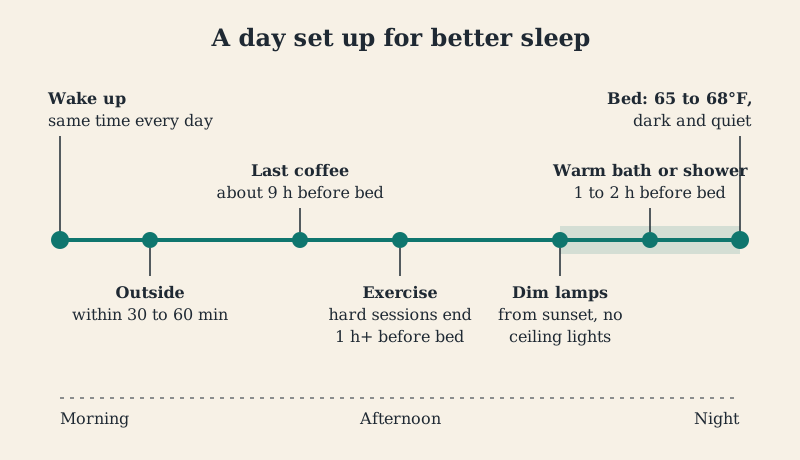
If you change one thing, make it your wake time, and keep it the same every day, weekends included.
Why regularity matters as much as hours
A 2020 review of 41 studies, covering 92,340 adults, found that later and more irregular sleep went with worse health, though the evidence was rated very low to moderate quality. A 2024 study of 60,977 UK Biobank adults who wore activity trackers went further. The regularity of their sleep predicted their risk of death over about six years better than its length did, and the more regular groups had a 20 to 48% lower risk than the least regular.
Your internal clock times melatonin, the evening fall in body temperature and the morning rise in alertness. Moving your sleep by a few hours every weekend gives it a small dose of jet lag, which researchers call social jetlag. The 2020 review linked it to worse health.
What about weekends?
Keep the wake time. NHS advice says the same, and so does Andrew Huberman's 2021 sleep newsletter: "Wake up at the same time each day and go to sleep when you first start to feel sleepy."
The same review did find weekend catch-up sleep linked to better outcomes. If you're short on sleep, an earlier bedtime gives you the extra hours and keeps your clock steadier than a lie-in until noon. For a step-by-step reset, see how to fix your sleep schedule.
Control light exposure: bright mornings, dim evenings
Light is the main signal that sets your internal clock, and indoor life tends to give you too little of it in the morning and too much at night.
Get outside in the morning
In Huberman's light-meter test, the brightest lamp in a home reads about 1,000 lux. Point the meter at a cloudy sky and it reads 5,000 to 10,000 lux, sometimes up to 90,000.
His newsletter says to get outside within 30 to 60 minutes of waking, for about 10 minutes on a clear day, 20 when it's cloudy and 30 to 60 when it's very overcast. In his Sleep Toolkit episode he says morning light sets a timer for you to fall asleep about 16 hours later. Those exact minutes haven't been tested in a trial.
Dim the lights after sunset
After sunset, switch to lamps set low and turn screens down. Huberman's rule is to "only use as much artificial lighting as is necessary for you to remain and move about safely at night", and to avoid bright overhead lights between 10 pm and 4 am.
In a Harvard lab study of 116 adults aged 18 to 30, ordinary room light (under 200 lux) in the 8 hours before bed delayed the start of melatonin in 99% of them and shortened its nightly release by about 90 minutes, compared with dim light.
Keep the bedroom dark all night
In a Northwestern study of 20 healthy adults, the 10 who slept one night with a 100-lux light on had a higher heart rate overnight and higher insulin resistance the next morning than after a night in near-darkness (under 3 lux). In the Harvard study, room light during the usual sleep hours cut melatonin by more than half in most trials. Blackout curtains or an eye mask, as the NHS suggests, deal with most of it. Cover standby lights too.
Keep your bedroom cool, dark and quiet
Temperature
The Sleep Foundation puts the best bedroom temperature at about 65°F (18.3°C) and says most doctors recommend 65 to 68°F. A 2012 review found that in normal bedding, heat increases waking and cuts both deep (slow-wave) sleep and REM sleep, so a warm room costs you deep and REM sleep.
Huberman's newsletter says your body temperature needs to drop by 1 to 3 degrees (he gives no unit) to fall and stay asleep, and that a rise in temperature is one reason you wake. He suggests a cool room and blankets you can push off, because throwing off a blanket is easier than cooling a hot room. To find a number that suits you, see how to find your ideal bedroom temperature.
A warm bath or shower
A 2019 meta-analysis linked a bath or shower at 40 to 42.5°C (104 to 108.5°F), taken 1 to 2 hours before bed, with better-rated sleep and sleep efficiency. The authors think warm water sends blood to your hands and feet, which then shed heat, and they call the research thin. The full routine is in how to fall asleep faster tonight.
Quiet
The NHS lists noise among the most common causes of insomnia and suggests ear plugs. Keep any sound machine low. In a 2026 lab study, pink noise played on its own at 50 dB cut REM sleep by about 19 minutes. Treat 50 dB as a ceiling, not a target.
Get caffeine and alcohol timing right
The caffeine cutoff
Have your last coffee about 9 hours before bed, around 1 pm for a 10 pm bedtime. Caffeine's half-life averages about 4 hours in healthy adults but ranges from 2 to 8, according to the European Food Safety Authority. For a slow metaboliser, half of a 2 pm coffee is still there at 10 pm.
A 2023 meta-analysis of 24 studies found caffeine cut total sleep by 45 minutes and sleep efficiency by 7%, added 12 minutes awake in the night and took about 11 minutes off deep sleep. The authors set the cutoff at 8.8 hours before bed for coffee, and 13.2 hours for a standard pre-workout drink. See what caffeine, alcohol and screens do to deep sleep for more.
What about alcohol?
Alcohol helps you fall asleep faster. A review of all known studies in healthy people found the first half of the night more solid and the second half more broken. Your first REM period comes later at any dose, and total REM falls at moderate and high doses.
There's no tested safe gap before bed; the usual rule of thumb is at least 3 hours. Less is better, and none is best on nights that matter.
Daytime habits: exercise, naps and meals
Exercise, including in the evening
Regular exercise has a moderate benefit for how people rate their sleep, according to a meta-analysis of 66 studies. The NHS insomnia page says not to exercise within 4 hours of bed, while a 2019 meta-analysis of 23 studies in healthy people found evening exercise didn't hurt sleep overall and slightly increased deep sleep. Its one exception was vigorous exercise ending within about an hour of bed, which might delay and shorten sleep. If you sleep well, train when it suits you and keep the last hour easy; if you have insomnia, the NHS's 4-hour gap is the safer choice.
Naps and late meals
In a study of 24 young adults who'd slept about 5 hours, a 10-minute afternoon nap gave the best lift in alertness, while a 30-minute nap left them groggy first. Huberman's limit is under 90 minutes, or no nap at all. With insomnia, the NHS advice is not to nap during the day, and not to eat a big meal late at night.
Build a wind-down routine
Give yourself the last hour before bed to slow down.
A sample wind-down
- 90 minutes before bed: Warm bath or shower, if you like one (inside the 1 to 2 hour window).
- 60 minutes before bed: A bedtime alarm goes off. Dim the lights and close the laptop.
- 30 minutes before bed: Write tomorrow's to-do list, then read a paper book, stretch, or play a guided NSDR or yoga nidra track.
- 15 minutes before bed: Get into bed. If you're not sleepy, keep reading until you are.
When your mind won't stop racing
Spend 5 minutes writing a specific to-do list for the next few days. In a sleep-lab study of 57 adults aged 18 to 30, people who did this fell asleep faster than people who wrote about tasks they'd finished.
If you're still awake after about 20 minutes, the Sleep Foundation's advice is to get out of bed, and the NHS says to go to bed only when you feel sleepy. More on that first half hour is in how to fall asleep faster tonight.
If you wake in the night
Waking once or so a night is normal, according to Huberman's newsletter. If you can't get back to sleep, he suggests an NSDR or yoga nidra recording. None of the four trials that use the NSDR name measured night-time sleep, so the nearest sleep evidence is from yoga nidra. In a 2023 study, 30 healthy young men did 20-minute sessions for four weeks and afterwards spent about 20 fewer minutes awake at night. There was no control group. See why you wake up at 3am for the causes, and NSDR protocols for sleep for using a session in bed.
Your sleep hygiene checklist, morning to night
These habits are known as sleep hygiene. Here they are in the order your day runs.
Morning
- Get up at your usual time, weekends included.
- Get outside within 30 to 60 minutes, for about 10 minutes if clear, 20 if cloudy, longer if very overcast.
Daytime
- Last coffee about 9 hours before bed; a pre-workout drink about 13.
- Exercise when it suits you; finish hard sessions an hour or more before bed (4 hours if you have insomnia, per the NHS).
- Keep naps short, or skip them if you have insomnia.
Evening
- No big meal late.
- Lamps instead of ceiling lights; screens turned down.
- Bedtime alarm an hour before bed.
- Warm bath or shower 1 to 2 hours before bed, if you like one.
- Alcohol early, or none.
- Five-minute to-do list for tomorrow.
Bedroom
- 65 to 68°F (18 to 20°C), with blankets you can push off.
- Blackout curtains or an eye mask; standby lights covered.
- Ear plugs if needed; any sound machine kept low.
If you can't sleep
- Up after about 20 minutes awake, back when sleepy, lights low.
When to see a doctor
Habits fix a lot of poor sleep. They don't fix sleep disorders.
Red flags
The NHS advises seeing a GP if:
- your breathing stops and starts while you sleep, or someone hears you gasp, snort or choke;
- you always feel very tired during the day;
- you've had trouble sleeping for months, or it makes your days hard to cope with;
- changing your sleep habits hasn't helped.
Restless legs at night or suddenly falling asleep during the day are worth raising too. The NHS lists restless legs syndrome and narcolepsy among the conditions behind poor sleep. Insomnia that lasts 3 months or longer counts as long-term. The CDC links regularly sleeping under 7 hours to obesity, diabetes, high blood pressure and heart disease, and in a 2014 CDC survey more than a third of US adults reported sleeping that little.
CBT-I: the first treatment for chronic insomnia
Cognitive behavioural therapy for insomnia (CBT-I) is a structured programme that changes the thoughts and habits that keep you awake. The American College of Physicians recommends it as the first treatment for chronic insomnia in adults, and the American Academy of Sleep Medicine (AASM) gives it a strong recommendation. The AASM also advises against relying on sleep hygiene alone for chronic insomnia.
A review of five trials comparing CBT-I with sleeping pills found CBT-I worked better over the long term (low to moderate quality evidence), while weaker evidence suggests pills work faster at first. The NHS warns that sleeping pills can have serious side effects and can cause dependence.
If you suspect a sleep disorder, start with a doctor rather than more habits, and ask a doctor or pharmacist before taking melatonin or any other sleep aid.
FAQ
How long does it take to fix your sleep?
How long it takes to fix your sleep depends on the cause, and no study gives a set timeline for habits like these. Give each change two weeks before you judge it, starting with wake time and light. If nothing improves, or you've had trouble for months, the NHS advice is to see a GP.
What is sleep hygiene and why does it matter?
Sleep hygiene is the set of daily habits and bedroom conditions that support good sleep, such as a regular schedule, morning daylight, a cool, dark, quiet room and sensible caffeine and alcohol timing. It matters because most of how to sleep better comes down to removing what gets in the way.
Does sleep hygiene work for insomnia?
Sleep hygiene often helps: the NHS says insomnia usually gets better by changing your sleeping habits. For chronic insomnia, the AASM advises against using sleep hygiene as the only treatment, and CBT-I is the recommended first step.
What should I do when I can't sleep at 3am?
At 3am, if you've been awake for about 20 minutes, get up, keep the lights low and do something calm until you feel sleepy, then go back to bed. If it happens most nights, read why you wake up at 3am and talk to a doctor.
Is melatonin safe to take every night?
Melatonin looks safe enough in trials, but its effect on sleep is small. Two meta-analyses found people fell asleep about 4 minutes sooner (Brzezinski 2005) and about 7 minutes sooner (Ferracioli-Oda 2013), and slept 8 to 13 minutes longer. The 2013 review called its side effects relatively benign. Ask a doctor or pharmacist before taking it nightly, especially if you take other medicines.
Does exercise help you sleep better?
Yes, regular exercise helps you sleep better, with a moderate benefit for sleep quality across 66 studies. On timing, the NHS says to leave 4 hours before bed, though a 2019 review of 23 studies found only vigorous exercise ending within an hour of bed might hurt sleep.
Sources
- Liu Y, Wheaton AG, Chapman DP, Cunningham TJ, Lu H, Croft JB (2016). Prevalence of Healthy Sleep Duration among Adults, United States, 2014. Morbidity and Mortality Weekly Report. https://pubmed.ncbi.nlm.nih.gov/26890214/
- Chaput JP, Dutil C, Featherstone R, et al. (2020). Sleep timing, sleep consistency, and health in adults: a systematic review. Applied Physiology, Nutrition, and Metabolism. https://pubmed.ncbi.nlm.nih.gov/33054339/
- Windred DP, Burns AC, Lane JM, et al. (2024). Sleep regularity is a stronger predictor of mortality risk than sleep duration: a prospective cohort study. Sleep. https://pubmed.ncbi.nlm.nih.gov/37738616/
- Gooley JJ, Chamberlain K, Smith KA, et al. (2011). Exposure to room light before bedtime suppresses melatonin onset and shortens melatonin duration in humans. Journal of Clinical Endocrinology and Metabolism. https://pubmed.ncbi.nlm.nih.gov/21193540/
- Mason IC, Grimaldi D, Reid KJ, et al. (2022). Light exposure during sleep impairs cardiometabolic function. PNAS. https://pubmed.ncbi.nlm.nih.gov/35286195/
- Okamoto-Mizuno K, Mizuno K (2012). Effects of thermal environment on sleep and circadian rhythm. Journal of Physiological Anthropology. https://pubmed.ncbi.nlm.nih.gov/22738673/
- Haghayegh S, Khoshnevis S, Smolensky MH, Diller KR, Castriotta RJ (2019). Before-bedtime passive body heating by warm shower or bath to improve sleep: a systematic review and meta-analysis. Sleep Medicine Reviews. https://pubmed.ncbi.nlm.nih.gov/31102877/
- Basner M, Smith MG, Cordoza M, et al. (2026). Efficacy of pink noise and earplugs for mitigating the effects of intermittent environmental noise exposure on sleep. Sleep. https://pubmed.ncbi.nlm.nih.gov/41627391/
- Gardiner C, Weakley J, Burke LM, et al. (2023). The effect of caffeine on subsequent sleep: a systematic review and meta-analysis. Sleep Medicine Reviews. https://pubmed.ncbi.nlm.nih.gov/36870101/
- European Food Safety Authority (2015). Caffeine: EFSA explains risk assessment. https://www.efsa.europa.eu/sites/default/files/corporate_publications/files/efsaexplainscaffeine150527.pdf
- Ebrahim IO, Shapiro CM, Williams AJ, Fenwick PB (2013). Alcohol and sleep I: effects on normal sleep. Alcoholism: Clinical and Experimental Research. https://pubmed.ncbi.nlm.nih.gov/23347102/
- Kredlow MA, Capozzoli MC, Hearon BA, Calkins AW, Otto MW (2015). The effects of physical activity on sleep: a meta-analytic review. Journal of Behavioral Medicine. https://pubmed.ncbi.nlm.nih.gov/25596964/
- Stutz J, Eiholzer R, Spengler CM (2019). Effects of evening exercise on sleep in healthy participants: a systematic review and meta-analysis. Sports Medicine. https://pubmed.ncbi.nlm.nih.gov/30374942/
- Brooks A, Lack L (2006). A brief afternoon nap following nocturnal sleep restriction: which nap duration is most recuperative? Sleep. https://pubmed.ncbi.nlm.nih.gov/16796222/
- Scullin MK, Krueger ML, Ballard HK, Pruett N, Bliwise DL (2018). The effects of bedtime writing on difficulty falling asleep: a polysomnographic study comparing to-do lists and completed activity lists. Journal of Experimental Psychology: General. https://pubmed.ncbi.nlm.nih.gov/29058942/
- Datta K, et al. (2023). Improved sleep, cognitive processing and enhanced learning and memory task accuracy with yoga nidra practice in novices. PLoS ONE. https://pubmed.ncbi.nlm.nih.gov/38091317/
- Qaseem A, Kansagara D, Forciea MA, Cooke M, Denberg TD (2016). Management of chronic insomnia disorder in adults: a clinical practice guideline from the American College of Physicians. Annals of Internal Medicine. https://pubmed.ncbi.nlm.nih.gov/27136449/
- Edinger JD, Arnedt JT, Bertisch SM, et al. (2021). Behavioral and psychological treatments for chronic insomnia disorder in adults: an American Academy of Sleep Medicine clinical practice guideline. Journal of Clinical Sleep Medicine. https://pubmed.ncbi.nlm.nih.gov/33164742/
- Mitchell MD, Gehrman P, Perlis M, Umscheid CA (2012). Comparative effectiveness of cognitive behavioral therapy for insomnia: a systematic review. BMC Family Practice. https://pubmed.ncbi.nlm.nih.gov/22631616/
- Brzezinski A, Vangel MG, Wurtman RJ, et al. (2005). Effects of exogenous melatonin on sleep: a meta-analysis. Sleep Medicine Reviews. https://pubmed.ncbi.nlm.nih.gov/15649737/
- Ferracioli-Oda E, Qawasmi A, Bloch MH (2013). Meta-analysis: melatonin for the treatment of primary sleep disorders. PLoS ONE. https://pubmed.ncbi.nlm.nih.gov/23691095/
- Huberman A (2021). Toolkit for Sleep. Huberman Lab Neural Network newsletter. https://www.hubermanlab.com/newsletter/toolkit-for-sleep
- Huberman A (2022). Sleep Toolkit: Tools for Optimizing Sleep & Sleep-Wake Timing. Huberman Lab podcast. https://www.youtube.com/watch?v=h2aWYjSA1Jc
- Sleep Foundation. Best Temperature for Sleep. https://www.sleepfoundation.org/bedroom-environment/best-temperature-for-sleep
- Sleep Foundation (2026). How to Fall Asleep Fast. https://www.sleepfoundation.org/sleep-hygiene/how-to-fall-asleep-fast
- NHS. Insomnia. https://www.nhs.uk/conditions/insomnia/
- NHS. Sleep apnoea. https://www.nhs.uk/conditions/sleep-apnoea/