The groggy, heavy feeling after a nap is called sleep inertia, and it's worst when you wake from deep sleep. Learning how to nap without feeling groggy is mostly about timing. Sleep 10 to 20 minutes with an alarm set, nap in the early afternoon, and leave at least 15 to 30 minutes before anything that needs quick reactions. Caffeine just before the nap, or bright light after it, helps you come round faster. If a nap doesn't fit your day, rest awake instead.
TL;DR
- Sleep 10 to 20 minutes. In one lab study, 10 minutes gave the fastest lift.
- Nap between about noon and 3 pm, at the same time each day.
- A caffeine nap (coffee, then straight to sleep) beat a plain nap in one small study and caffeine alone in another.
- The 30-90 rule helps, but even a 90-minute nap can leave you foggy for an hour.
- If you wake up groggy, get bright light and give it time before demanding tasks.
Why naps make you groggy (sleep inertia explained)
What happens when you fall asleep
A nap runs through the same stages of sleep as a night, and the deeper ones are harder to wake from.
Stages 1 and 2 are light sleep. Stage 1, the changeover from waking, usually lasts a few minutes. In stage 2 your heartbeat and breathing slow and your body temperature drops. Light sleep is enough to help: a 2010 review by Lovato and Lack notes that brief naps lift alertness with almost no deep sleep in them.
Stage 3 is deep, slow-wave sleep. You're hard to wake, and being pulled out of it is what leaves you foggy.
REM sleep, when most dreaming happens, first arrives about 90 minutes in.
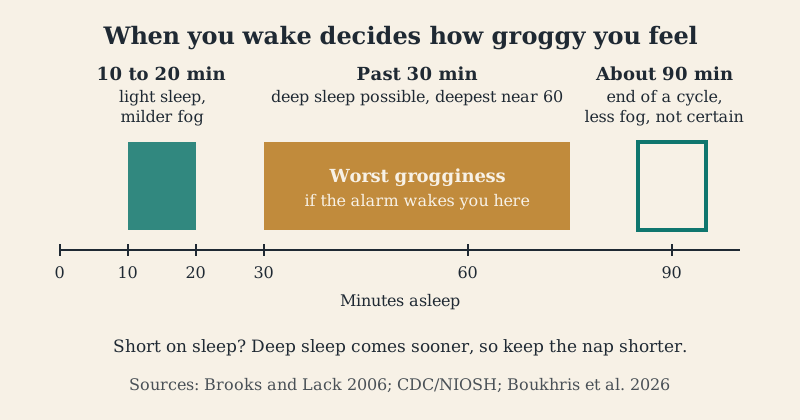
The Sleep Foundation says naps longer than about 30 minutes can reach deep sleep, and CDC/NIOSH guidance puts the deepest level at about an hour in. Short on sleep, you get there sooner.
Sleep inertia: the science behind the fog
NIOSH, the CDC's workplace safety institute, defines sleep inertia as "a temporary disorientation and decline in performance and/or mood after awakening from sleep." Reaction time, short-term memory, thinking and learning all slow while it lasts.
The stage you wake from matters most. A 2000 review by Tassi and Muzet found that waking from slow-wave sleep brings more inertia than waking from stage 1 or 2, with REM in between.
It usually clears within about 30 minutes, according to NIOSH and the same review, and Mayo Clinic says within about 35. After deep sleep or a short night it can last an hour or more, and NIOSH notes it has been seen lasting 2 hours.
Why you can't fully control which stage you wake from
A 20-minute alarm lowers the odds of waking from deep sleep without removing them. A 2017 review of short-nap studies found mixed results on when deep sleep starts, depending on how much people had slept beforehand and the time of day.
Sleep loss is the big one. It gets you into deep sleep faster and makes waking from it worse. Sleep specialist Jade Wu, author of Hello Sleep, told NPR that if a 30-minute nap takes you into deep sleep, "that's a sign you're not getting enough sleep at night. Your brain is so desperate to get into deep sleep that even a 30-minute nap will get you there."
So the people who need a nap most are the likeliest to wake from it groggy. If that's you, see how to recover from a bad night.
How to nap without feeling groggy: 6 tips
1. Keep it to 10 to 20 minutes
NIOSH says waking at about 20 minutes, before deeper sleep, tends to mean milder grogginess that clears within 15 to 30 minutes. Mayo Clinic suggests 20 to 30 minutes, and warns that the longer you nap, the groggier you're likely to feel.
Shorter may be better. In Brooks and Lack's 2006 study, 24 young adults slept about 5 hours, then napped at 3 pm. Ten minutes of sleep gave an immediate drop in sleepiness and fatigue and a lift in performance, with some benefits lasting up to 155 minutes. After 20 minutes of sleep, the benefits took 35 minutes to appear. Five minutes did little.
Set an alarm for 10 to 20 minutes plus however long you usually take to drop off.
2. Nap in the early afternoon, at the same time each day
If you sleep normal hours, Wu's advice is to nap between noon and 3 pm, at a consistent time. That window matches the post-lunch dip, a mid-afternoon rise in sleepiness that some people get even without lunch and a common cause of the afternoon energy crash.
Later naps cost you at night. Sleep pressure builds from the moment you wake and a nap releases some of it, so a late nap leaves less for bedtime. Mayo Clinic says napping after 3 pm can make it harder to sleep soundly. In a small study of 14 student athletes, naps of 25 or 90 minutes ending at 3 pm didn't disrupt that night's sleep.
3. Try the caffeine nap
Drink coffee, then lie down straight away. Caffeine takes about 30 minutes to reach full effect, so it kicks in around the time you wake. Two small studies back it:
- Hayashi and colleagues, 2003. Ten young adults took a 20-minute nap at lunchtime. With 200 mg of caffeine beforehand, they felt less sleepy and performed better than after the nap alone, and the effect held for the full hour of testing.
- Reyner and Horne, 1997. Twelve sleepy people had a 30-minute break before a two-hour afternoon drive in a simulator. Caffeine plus a nap of under 15 minutes cut driving incidents to 9% of placebo levels. Caffeine alone got them to 34%.
Both used 200 mg. The FDA puts 400 mg at two to three 12-ounce cups of coffee, so 200 mg is roughly one large mug. If caffeine keeps you up, check how long caffeine stays in your system before trying this late.
4. Follow the 30-90 rule, with one caveat
The rule says nap for under 30 minutes or for about 90. NIOSH's reasoning is that 90 minutes is roughly the end of one sleep cycle, so you're more likely to wake from lighter sleep. The riskiest point is around an hour in, when you're most likely in deep sleep.
The caveat is that 90 minutes isn't a clean exit. In a 2026 EEG study, 17 active adults had a 25-minute and a 90-minute nap opportunity. Performance was worse in the first 30 minutes after both, grogginess was stronger after the 90-minute nap, and it took at least an hour to clear either way. After that the longer nap paid off, with the biggest gains 90 to 120 minutes after waking.
So a long nap can still be worth it if nothing urgent is due for an hour afterwards. Lovato and Lack's review says the same of naps over 30 minutes, which bring a short spell of inertia, then benefits that can last for hours.
5. Make falling asleep easy, and don't worry if you don't
Mayo Clinic suggests somewhere quiet and dark at a comfortable temperature. In a car or an office, an eye mask and earplugs help.
If sleep doesn't come, the time still counts. In Reyner and Horne's driving study, naps that were only "nonsleep dozing" still helped. Seema Khosla, a sleep physician who hosts the American Academy of Sleep Medicine's Talking Sleep podcast, told NPR: "Closing your eyes, checking out from what you're doing and having a little bit of 'me' time ... that is OK."
6. What to do when you wake up groggy
Even a well-timed nap can leave some fog. These help:
- Get bright light. In Hayashi's study, one minute of bright light (2,000 lux) straight after the nap worked about as well as the caffeine nap for sleepiness, though not for performance. Step outside or sit by a bright window.
- Have caffeine on waking. NIOSH notes that 100 mg on waking shortened sleep inertia.
- Wash your face. It made people feel less sleepy right away in Hayashi's study, but the effect was mild and didn't last.
- Leave a buffer. Grogginess is worst right after waking. Give it at least 15 to 30 minutes after a short nap, and an hour or more after a long nap or a short night, before driving or anything that needs sharp responses.
When to skip the nap and rest awake
Sometimes a nap is the wrong tool: when it's after 3 pm, when you sleep badly at night (Mayo Clinic says napping can make that worse), when there's nowhere to lie down, or when you need a clear head straight away.
That's where awake rest fits. Non-sleep deep rest, or NSDR, is Stanford neuroscientist Andrew Huberman's term for mindfulness practices that bring deep relaxation without falling fully asleep, yoga nidra included. You stay awake, so there's no sleep to wake from and no grogginess. Most people do stay awake: in a sleep-lab study of yoga nidra, 26 of 30 beginners were scored awake throughout after two weeks of practice. Huberman says it can be done sitting up, at any time of day, without hurting night sleep, though that hasn't been tested.
The trade is real, though. In the only trial to compare the two, 60 active adults had a 25-minute nap opportunity, 10 minutes of NSDR, or neither, at about 3 pm. Forty minutes later the nappers felt more ready to perform than both other groups, and NSDR showed no measurable effect. So nap when you can, and use NSDR when you can't or when grogginess is the one thing you can't afford. The full comparison is in NSDR vs napping.
One health note. If you need naps more than usual, or wake tired after a full night, talk to a doctor. Mayo Clinic lists medicines, sleep disorders and other conditions as possible causes.
FAQ
Why do I feel groggy after a 20-minute nap?
Grogginess after a 20-minute nap usually means you reached deeper sleep early, which happens when you're short on sleep. Also, in Brooks and Lack's study the benefits of 20 minutes of sleep took about 35 minutes to show, while 10 minutes helped straight away. Try 10 to 15 minutes, and look at your night sleep.
Is it better to nap or just rest?
A nap has the stronger evidence for alertness, and in the one head-to-head trial a short nap beat 10 minutes of NSDR. Resting still has value: "nonsleep dozing" helped sleepy drivers in a 1997 study. If you're still working out how to nap without feeling groggy, rest awake on days when grogginess would cost you.
What is the 30-90 rule for napping?
The 30-90 rule says to nap for under 30 minutes or for about 90, a full sleep cycle, and avoid waking around the hour mark, when you're most likely in deep sleep. It's a guide only. In a 2026 EEG study, a 90-minute nap left people groggier than a 25-minute one, and both needed at least an hour to clear.
Can NSDR replace napping?
NSDR can't fully replace napping on the current evidence. In the only trial comparing them, a short nap left people more ready to perform 40 minutes later, and 10 minutes of NSDR showed no measurable effect. NSDR's sourced advantage is no grogginess, so it suits late afternoons and days you can't nap.
How long does sleep inertia last?
Sleep inertia usually lasts up to about 30 minutes (Mayo Clinic says about 35). After deep sleep or a short night it can last an hour or more, occasionally 2 hours. Bright light and caffeine on waking help it pass.
Sources
- Brooks A, Lack L (2006). A brief afternoon nap following nocturnal sleep restriction: which nap duration is most recuperative? Sleep. https://pubmed.ncbi.nlm.nih.gov/16796222/
- Lovato N, Lack L (2010). The effects of napping on cognitive functioning. Progress in Brain Research. https://pubmed.ncbi.nlm.nih.gov/21075238/
- Tassi P, Muzet A (2000). Sleep inertia. Sleep Medicine Reviews. https://pubmed.ncbi.nlm.nih.gov/12531174/
- Hilditch CJ, Dorrian J, Banks S (2017). A review of short naps and sleep inertia: do naps of 30 min or less really avoid sleep inertia and slow-wave sleep? Sleep Medicine. https://pubmed.ncbi.nlm.nih.gov/28366332/
- Hayashi M, Masuda A, Hori T (2003). The alerting effects of caffeine, bright light and face washing after a short daytime nap. Clinical Neurophysiology. https://pubmed.ncbi.nlm.nih.gov/14652086/
- Reyner LA, Horne JA (1997). Suppression of sleepiness in drivers: combination of caffeine with a short nap. Psychophysiology. https://pubmed.ncbi.nlm.nih.gov/9401427/
- Boukhris O et al. (2026). The effects of sleep inertia following EEG-monitored short and long naps on perceptual, cognitive, and physical performance in recreational athletes. Chronobiology International. https://pubmed.ncbi.nlm.nih.gov/41379073/
- Boukhris O, Suppiah H, Driller M (2026). The influence of 25- and 90-min afternoon nap opportunities on subsequent nighttime sleep in student athletes. Journal of Sleep Research. https://pubmed.ncbi.nlm.nih.gov/40537913/
- Boukhris O, Suppiah H, Driller M (2026). Comparing the effects of a short nap and non-sleep deep rest on perceptual, cognitive, and physical performance in active adults. Clocks & Sleep. https://pubmed.ncbi.nlm.nih.gov/42783005/
- Datta K et al. (2022). Electrophysiological evidence of local sleep during yoga nidra practice. Frontiers in Neurology. https://pubmed.ncbi.nlm.nih.gov/35903117/
- Monk TH (2005). The post-lunch dip in performance. Clinics in Sports Medicine. https://pubmed.ncbi.nlm.nih.gov/15892914/
- CDC/NIOSH. Training for Nurses on Shift Work and Long Work Hours, Module 7: Sleep inertia. https://www.cdc.gov/niosh/work-hour-training-for-nurses/longhours/mod7/03.html
- CDC/NIOSH. Training for Nurses on Shift Work and Long Work Hours, Module 7: Napping. https://www.cdc.gov/niosh/work-hour-training-for-nurses/longhours/mod7/05.html
- NINDS. Brain Basics: Understanding Sleep. https://www.ninds.nih.gov/health-information/public-education/brain-basics/brain-basics-understanding-sleep
- Mayo Clinic. Napping: Do's and don'ts for healthy adults. https://www.mayoclinic.org/healthy-lifestyle/adult-health/in-depth/napping/art-20048319
- Sleep Foundation. Napping. https://www.sleepfoundation.org/sleep-hygiene/napping
- NPR Life Kit (2024, updated 2025). The secret to waking up from a nap feeling refreshed (and not groggy). https://www.npr.org/2024/02/26/1199886001/how-to-take-the-perfect-nap
- FDA. Spilling the Beans: How Much Caffeine Is Too Much? https://www.fda.gov/consumers/consumer-updates/spilling-beans-how-much-caffeine-too-much
- Huberman Lab. Non-Sleep Deep Rest (NSDR). https://www.hubermanlab.com/nsdr