Sympathetic vs parasympathetic comes down to direction. They are the two main branches of your autonomic nervous system, the part that runs your body without being asked. The sympathetic branch gears you up: heart rate and blood pressure rise, your pupils widen and digestion slows. The parasympathetic branch slows the heart and gets digestion going again. Both run all day, and what shifts is the balance between them.
Sympathetic vs parasympathetic nervous system: quick answer
The sympathetic nervous system drives the fight-or-flight response. The parasympathetic nervous system drives rest-and-digest. If one is the accelerator, the other is the brake.
At rest, both branches send a steady signal to the heart, and the vagal (parasympathetic) side is the stronger of the two. They also don't have to move in opposite directions. A 1991 paper in Psychological Review set out the evidence that the two branches can rise or fall independently, so "sympathetic dominance" and "parasympathetic dominance" aren't two ends of a single line.
Sympathetic vs parasympathetic: at a glance
| Sympathetic | Parasympathetic | |
|---|---|---|
| Also called | Fight-or-flight | Rest-and-digest |
| Main job | Mobilise energy for action | Restore and conserve |
| Heart rate | Raises it | Lowers it |
| Blood pressure | Raises it | Lowers it, mostly indirectly by slowing the heart |
| Pupils | Widen | Narrow |
| Digestion | Slows it | Restarts it |
| Messenger at the organ | Mostly norepinephrine | Acetylcholine |
| Leaves the spinal cord or brain | Thoracic and lumbar spinal cord (T1 to L2) | Brainstem (cranial nerves III, VII, IX, X) and sacrum (S2 to S4) |
| Key nerves | Sympathetic chain | Vagus nerve (cranial nerve X) |
| Reach | Most organs and most blood vessels | Mainly the head, chest and abdominal organs, and genitals |
| Leads during | Stress, exercise, danger | Rest, digestion, non-REM sleep |
What is the sympathetic nervous system?
The sympathetic nervous system is the branch that prepares you to act. When it fires, your heart beats faster and harder, blood pressure rises, your pupils widen, your liver breaks down stored glycogen into sugar, and the gut slows its movements.
It doesn't do this one organ at a time. Its nerves leave the spinal cord from segments T1 to L2, in the chest and upper lumbar region, and pass through a chain of relay stations beside the spine. From there, long fibres fan out to organs all over the body. Physiologists call the result a "mass sympathetic discharge", with many tissues switched on together.
Physical danger switches it on, and so does psychological stress, though a 2009 review found stress responses are "extremely variable and specific" to the type of stressor. Cleveland Clinic notes that anxiety and chronic stress can strain the sympathetic nervous system.
What is the parasympathetic nervous system?
The parasympathetic nervous system is the recovery branch. It slows your heart and gets digestion moving again. It lowers blood pressure mostly indirectly, by slowing the heart, since blood vessel tone is set mainly by the sympathetic side. It barely reaches your skeletal muscles or skin.
The vagus nerve does most of the work here. About 75% of all parasympathetic fibres travel in it, according to a physiology review by Laurie McCorry. It runs from the brainstem to the organs of the chest and abdomen, and many of its fibres carry reports from those organs back up to the brain. There's more on that in how the parasympathetic nervous system works.
Stephen Porges, PhD, who proposed polyvagal theory, told The Psychologist in 2022 that "our nervous system is always trying to figure out a way for us to survive, meaning to be safe." The basic physiology in this article is textbook material. Polyvagal theory's more specific claims about two vagal circuits are another matter. A 2023 review argued its five basic premises are "untenable or highly implausible".
Sympathetic vs parasympathetic: key differences
Neurotransmitters
Both branches use the same messenger, acetylcholine, at the first relay outside the brain and spinal cord. The difference comes at the organ. Sympathetic nerves mostly release norepinephrine there, while parasympathetic nerves release acetylcholine. Sweat glands are the odd one out. The sympathetic fibres that make your palms damp use acetylcholine.
Beta-blockers work on the sympathetic side. They block the action of norepinephrine and adrenaline (epinephrine), which slows the heart.
Anatomy and origin
Sympathetic nerves leave the middle of the spinal cord, T1 to L2. Parasympathetic nerves leave from either end. Four cranial nerves come straight out of the brainstem: III to the eyes, VII to the tear glands, salivary glands and nose, IX to the parotid salivary gland, and X, the vagus, to the chest and abdomen. The rest exit the lowest part of the spinal cord, at S2 to S4.
The wiring differs too. Sympathetic relay stations sit near the spine. Parasympathetic ones sit next to or inside the organ they serve.
Speed and duration
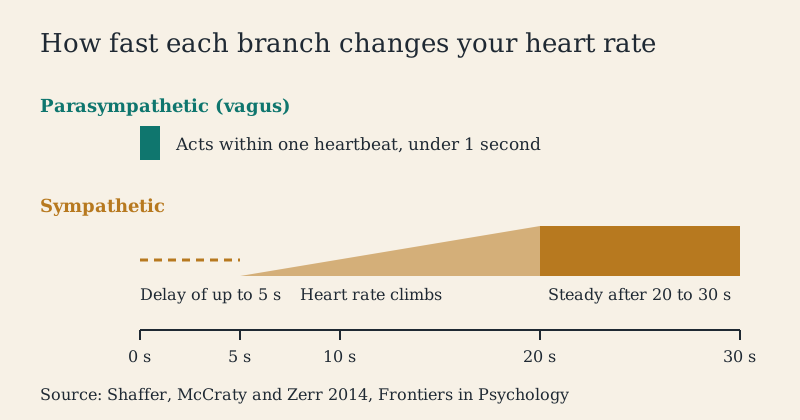
The sympathetic system is often described as the fast one. For heart rate, it's the other way round. Vagal input slows the heart in under a second, often within the same heartbeat. Sympathetic input has a delay of up to 5 seconds before heart rate starts climbing, and under steady stimulation it takes 20 to 30 seconds to level off.
If calming down still feels slow, the stress response isn't only nerves. Your adrenal glands also release adrenaline and noradrenaline into the bloodstream.
Scope of effect
Sympathetic activation is broad. The mass discharge reaches the heart, pupils, liver, gut and blood vessels together, and most blood vessels with a nerve supply receive only sympathetic fibres. Parasympathetic effects are more discrete and local, so the branch can act on one organ and leave the others alone.
Dominance patterns
Both branches are always active. In a healthy day the lead passes back and forth: sympathetic during a workout, then vagal activity returning in recovery; parasympathetic after a meal. During non-REM sleep, the balance shifts toward the parasympathetic side, mostly because parasympathetic activity rises. REM sleep looks more like waking.
The problem is a sympathetic side that stays up. A 2015 review in Circulation Research describes sympathetic overactivity as a promoter and amplifier of high blood pressure.
Norepinephrine: the sympathetic side's main messenger
Norepinephrine, also called noradrenaline, works in two places. In the body, most sympathetic nerves release it onto organs, and the adrenal glands add it to the blood as a hormone, about 20% of their output against 80% adrenaline (epinephrine). In the brain it's a neurotransmitter. Much of the brain's supply comes from the locus coeruleus, a small cluster of brainstem cells with far-reaching fibres. All of its neurons receive input related to arousal.
Cold water raises it sharply. In a 2000 study, young men sat in 14°C water up to the neck for an hour, and the noradrenaline in their blood rose by 530%. Adrenaline didn't change and cortisol didn't rise. A short cold shower hasn't been tested the same way. Whole-body cold like this is a sympathetic stimulus, the opposite of the face-only trick further down.
Signs your sympathetic system is dominant
In the moment, the sympathetic side is easy to notice: a fast or pounding heart, sweaty palms, widened pupils and digestion on hold.
Over weeks, it's harder to tell. No symptom checklist shows which branch "dominates", and signs like tight shoulders or racing thoughts overlap with anxiety, poor sleep and much else. Resting heart rate gives a rough trend. The normal adult range is 60 to 100 beats a minute, and very fit people can sit lower. Heart rate variability (HRV) is better, because it indexes cardiac vagal tone, the parasympathetic side's contribution to heart control. Readings depend on age, sex and how they were taken, so compare yours with your own baseline over time, not with someone else's.
If a racing heart, faintness or anxiety keeps coming back, see your GP.
How to activate your parasympathetic nervous system
Slow breathing with a longer exhale
Your heart speeds up slightly on every in-breath and slows on every out-breath. A long exhale gives the slowing more time.
The evidence is broad. A 2022 meta-analysis of 223 studies found slow breathing raised vagally mediated HRV during a session, straight after one, and after multi-session programmes. In a lab study of 30 people, a longer out-breath felt more relaxing than a longer in-breath, and at 6 breaths a minute it also gave more high-frequency HRV.
Breathe in through your nose for about 4 seconds and out for about 6, for 5 minutes. A guided 4-6 breathing animation keeps the count for you.
Cold water on your face
Cold on the forehead and around the eyes sets off the diving reflex. The trigeminal nerve signals the brainstem, and the brainstem slows the heart through the vagus. Neurologists use a cold compress on the face to test that pathway. Fill a bowl with cold water, hold your breath and dip your face in briefly. Skip it if you have a heart condition. More options are in the vagus nerve stimulation guide.
NSDR
Non-sleep deep rest is guided, awake rest. You lie still, follow a voice through your body and your breathing slows. In a 2026 trial of 102 physically active young adults, one 10-minute session lowered sleepiness, fatigue, stress and heart rate more than a control session. HRV didn't differ, so the trial doesn't show a vagal effect. The NSDR protocol guide covers how to start.
Exercise and sleep
Regular exercise helps over weeks. In sedentary people, training gave a small rise in resting vagal HRV, according to a 2022 meta-analysis. Sleep counts too, since the parasympathetic side leads during non-REM sleep. The step-by-step reset plan puts breathing, sleep, NSDR and movement in order.
FAQ
Can you have both systems active at once?
Yes, both systems are active at once, all the time. At rest both send steady signals to the heart, with the vagal side stronger. After a meal the parasympathetic side leads, but sympathetic activity doesn't switch off. The sympathetic vs parasympathetic balance shifts, and the two can even rise or fall independently.
What happens if the parasympathetic system is too active?
A sudden reflex can make you faint, and both branches play a part. In a vasovagal faint, the most common kind of reflex faint, the vagus slows the heart while the sympathetic side lets blood vessels relax, so heart output and vessel tone drop together. Pain or emotional upset can set it off, though often there's no clear trigger. If you faint, tell your GP.
How do I know which system is dominant right now?
You can't know for sure which system is dominant from how you feel. A fast, pounding heart and sweaty palms point to the sympathetic side in the moment. For a trend, track HRV and resting heart rate against your own baseline. A normal adult resting heart rate is 60 to 100 beats a minute, and no single number marks "sympathetic dominance".
Is the fight-or-flight response always bad?
No, the fight-or-flight response isn't always bad. It's what lets you sprint, lift and react to danger. Trouble comes when it stays switched on. Sustained sympathetic overactivity helps drive high blood pressure, and chronic stress strains the system.
How long does it take to shift from sympathetic to parasympathetic?
The shift from sympathetic to parasympathetic can start within a heartbeat. Vagal input slows the heart in under a second, and HRV rises during a slow-breathing session itself. The hormones released by the adrenal glands are a separate matter, and no study gives a time for a "full shift".
Sources
- Berntson GG, Cacioppo JT, Quigley KS (1991). Autonomic determinism: the modes of autonomic control, the doctrine of autonomic space, and the laws of autonomic constraint. Psychological Review. https://pubmed.ncbi.nlm.nih.gov/1660159/
- Shaffer F, McCraty R, Zerr CL (2014). A healthy heart is not a metronome: an integrative review of the heart's anatomy and heart rate variability. Frontiers in Psychology. https://pubmed.ncbi.nlm.nih.gov/25324790/
- Waxenbaum JA, Reddy V, Das JM (2025). Anatomy, Autonomic Nervous System. StatPearls. https://pubmed.ncbi.nlm.nih.gov/30969667/
- McCorry LK (2007). Physiology of the autonomic nervous system. American Journal of Pharmaceutical Education. https://pubmed.ncbi.nlm.nih.gov/17786266/
- Breit S et al. (2018). Vagus Nerve as Modulator of the Brain-Gut Axis in Psychiatric and Inflammatory Disorders. Frontiers in Psychiatry. https://pubmed.ncbi.nlm.nih.gov/29593576/
- Kvetnansky R, Sabban EL, Palkovits M (2009). Catecholaminergic systems in stress: structural and molecular genetic approaches. Physiological Reviews. https://pubmed.ncbi.nlm.nih.gov/19342614/
- Cleveland Clinic (2022). Sympathetic Nervous System (SNS): What It Is & Function. https://my.clevelandclinic.org/health/body/23262-sympathetic-nervous-system-sns-fight-or-flight
- Cleveland Clinic (2022). Parasympathetic Nervous System (PSNS): What It Is & Function. https://my.clevelandclinic.org/health/body/23266-parasympathetic-nervous-system-psns
- Cleveland Clinic. Beta-Blockers: What They Are, Uses & Side Effects. https://my.clevelandclinic.org/health/treatments/22318-beta-blockers
- Kseib K (2022). 'Our nervous system is always trying to figure out a way for us to survive, to be safe' (interview with Stephen Porges). The Psychologist, British Psychological Society. https://bps.org.uk/psychologist/our-nervous-system-always-trying-figure-out-way-us-survive-be-safe
- Grossman P (2023). Fundamental challenges and likely refutations of the five basic premises of the polyvagal theory. Biological Psychology. https://pubmed.ncbi.nlm.nih.gov/37230290/
- Trinder J et al. (2001). Autonomic activity during human sleep as a function of time and sleep stage. Journal of Sleep Research. https://pubmed.ncbi.nlm.nih.gov/11903855/
- Al Haddad H et al. (2010). Influence of cold water face immersion on post-exercise parasympathetic reactivation. European Journal of Applied Physiology. https://pubmed.ncbi.nlm.nih.gov/19882167/
- Grassi G, Mark A, Esler M (2015). The sympathetic nervous system alterations in human hypertension. Circulation Research. https://pubmed.ncbi.nlm.nih.gov/25767284/
- Poe GR et al. (2020). Locus coeruleus: a new look at the blue spot. Nature Reviews Neuroscience. https://pubmed.ncbi.nlm.nih.gov/32943779/
- Šrámek P et al. (2000). Human physiological responses to immersion into water of different temperatures. European Journal of Applied Physiology. https://pubmed.ncbi.nlm.nih.gov/10751106/
- British Heart Foundation. What is a normal pulse rate? https://www.bhf.org.uk/informationsupport/heart-matters-magazine/medical/ask-the-experts/pulse-rate
- Laborde S, Mosley E, Thayer JF (2017). Heart Rate Variability and Cardiac Vagal Tone in Psychophysiological Research: Recommendations for Experiment Planning, Data Analysis, and Data Reporting. Frontiers in Psychology. https://pubmed.ncbi.nlm.nih.gov/28265249/
- Shaffer F, Ginsberg JP (2017). An Overview of Heart Rate Variability Metrics and Norms. Frontiers in Public Health. https://pubmed.ncbi.nlm.nih.gov/29034226/
- Russo MA, Santarelli DM, O'Rourke D (2017). The physiological effects of slow breathing in the healthy human. Breathe. https://pubmed.ncbi.nlm.nih.gov/29209423/
- Laborde S et al. (2022). Effects of voluntary slow breathing on heart rate and heart rate variability: A systematic review and a meta-analysis. Neuroscience & Biobehavioral Reviews. https://pubmed.ncbi.nlm.nih.gov/35623448/
- Van Diest I et al. (2014). Inhalation/Exhalation ratio modulates the effect of slow breathing on heart rate variability and relaxation. Applied Psychophysiology and Biofeedback. https://pubmed.ncbi.nlm.nih.gov/25156003/
- Khurana RK et al. (1980). Cold face test in the assessment of trigeminal-brainstem-vagal function in humans. Annals of Neurology. https://pubmed.ncbi.nlm.nih.gov/7369721/
- Boukhris O et al. (2026). Time course of perceptual, cognitive, physical and physiological responses to a single non-sleep deep rest session in physically active young adults. Applied Psychology: Health and Well-Being. https://pubmed.ncbi.nlm.nih.gov/42383502/
- Casanova-Lizón A et al. (2022). Does Exercise Training Improve Cardiac-Parasympathetic Nervous System Activity in Sedentary People? A Systematic Review with Meta-Analysis. International Journal of Environmental Research and Public Health. https://pubmed.ncbi.nlm.nih.gov/36360777/
- Jeanmonod R, Sahni D, Silberman M (2023). Vasovagal Episode. StatPearls. https://pubmed.ncbi.nlm.nih.gov/29262088/