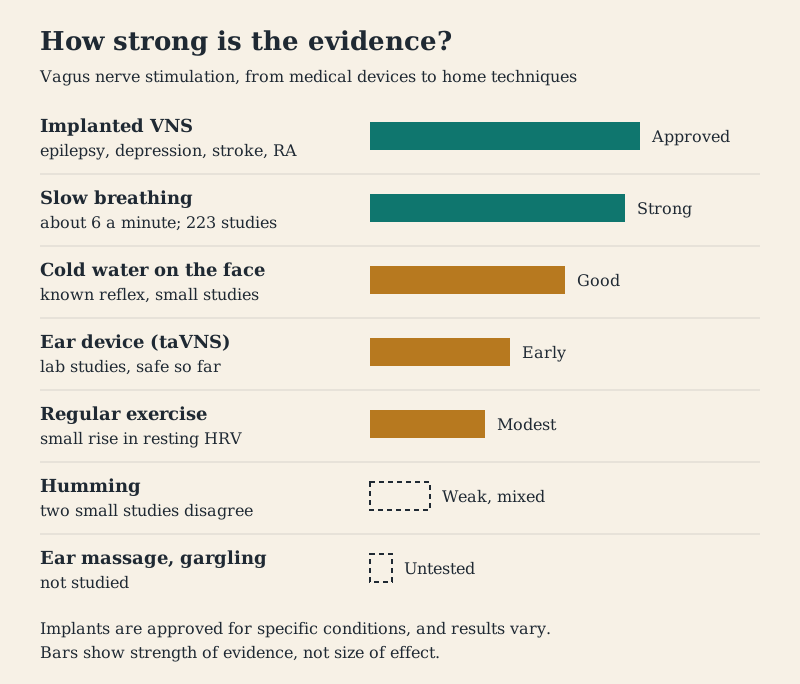
Vagus nerve stimulation means two things. In medicine, it's an electrical device, either implanted or held against the ear or neck, approved or cleared for epilepsy, depression, stroke rehabilitation, cluster headache, migraine and, since 2025, rheumatoid arthritis. At home, it means simpler ways to nudge the same nerve. Slow breathing has the most research behind it, cold water on the face sets off a well-known reflex, and most of the rest is thin.
What is the vagus nerve?
The vagus is the tenth cranial nerve and the longest. It runs from the brainstem through the neck and chest into the abdomen, and it's the main nerve of the parasympathetic nervous system. It helps control heart rate, digestion, immune responses and mood, and many of its fibres carry reports from your organs up to the brain.
"It's all about regulating your cardiovascular and respiratory functions," says Emad Estemalik, MD, a neurologist at Cleveland Clinic.
Vagal tone is how active the nerve is at rest. Researchers estimate it from heart rate variability (HRV), the small beat-to-beat changes in heart rate. A 2018 review links higher vagal tone with a better capacity to regulate stress.
Medical vagus nerve stimulation: devices and approved uses
Implanted VNS. Most systems have a pulse generator under the skin of the chest, wired to the left vagus nerve in the neck. In the US, implants are approved for:
- Epilepsy (1997, extended to age 4 and over in 2017): an add-on for focal seizures when medicines haven't worked.
- Depression (2005): adults who haven't responded to four or more treatments.
- Stroke rehabilitation (2021): paired with therapy for arm and hand weakness.
- Rheumatoid arthritis (2025): the SetPoint System, a 3-gram implant placed on the vagus nerve in the neck, when biologic or targeted drugs haven't worked. In its 242-patient trial, 35.2% met the standard 20% improvement measure at three months, against 24.2% with sham stimulation.
In one study of 454 epilepsy patients, 37% had their seizures halved or better after a year. For depression, 20% to 30% improved meaningfully after a year. Hoarseness, cough and a tickly throat are common and tend to fade.
Neck and ear devices. gammaCore, a handheld device pressed to the neck, was cleared in 2017 for cluster headache and in 2018 for migraine. Ear devices (taVNS) target the concha, the hollow just outside the ear canal, and the inner tragus, where a vagus branch reaches the skin. In a 2014 study of 48 healthy adults, one session of ear stimulation shifted HRV toward the vagal side, unlike sham, and cut sympathetic nerve activity in the 10 people tested. A 2022 review of 177 studies and 6,322 people found no more side effects than in control groups, though over half the studies didn't report side effects at all. Ear pain, headache and tingling were the usual ones.
Consumer devices have little direct evidence. Cleveland Clinic notes they can't match an implant's frequencies and voltages, and their long-term side effects aren't fully known. Devices are a decision to make with a specialist.
Three vagus nerve stimulation techniques you can do at home
UCLA Health says at-home methods lack rigorous research but are mostly safe. These three are ranked by evidence.
1. Slow breathing at about six breaths a minute
A 2022 meta-analysis of 223 studies found that slow breathing raises the vagal part of HRV during a session, straight after one, and after multi-session programmes.
A typical resting rate is 10 to 20 breaths a minute. At around six, the rise and fall of your heart rate with each breath lines up with your blood-pressure reflex, so both swing as widely as they can, though the best rate varies a little between people. In a 2014 study of 47 college students, 5.5 breaths a minute with equal in and out breaths gave higher HRV than three other slow patterns.
The protocol. Sit or lie down, breathe in through your nose for about 5 seconds, out for about 5, and keep going for 5 to 10 minutes. The coherent breathing guide paces it.
For a longer exhale, the physiological sigh (two inhales, one long exhale) has its own Stanford trial. Five minutes a day for a month improved mood more than mindfulness meditation, though HRV didn't differ between groups.
If you only do one, do this one.
2. Cold water on your face
Cold on the face sets off the diving reflex. The trigeminal nerve signals the brainstem, and the brainstem slows the heart through the vagus. Neurologists use cold compresses on the face to test that pathway; the forehead and eye area respond most.
In a 2010 study of 13 men, cold water on the face after hard exercise sped up the return of vagal activity. In 61 people, 16-second cold pulses on the side of the neck raised HRV and lowered heart rate. In divers, the reflex is strongest in the first moments of cold-water contact and fades fast.
The protocol:
- Fill a bowl with cold water.
- Take a breath and hold it.
- Put your forehead, eyes and cheeks under for 15 to 30 seconds.
- Come up, breathe normally, repeat once if needed.
No bowl? Splash your face, or hold a cold pack to your forehead or neck. Here are more ways to slow your heart rate quickly.
3. Humming with a long exhale
Humming stretches an exhale, but the vagal evidence is thin and mixed. Two pilot studies each tested 16 people doing 5 minutes of humming bee breath. In 2025, humming raised HRV as much as 5:5 breathing did. In 2017, heart rate rose and the vagal part of HRV fell during the practice. The vibration theory comes from a 12-person brain scan study of "om" chanting that didn't test it.
The protocol. Breathe in for 4 seconds, then hum on a 6 to 8 second exhale with your mouth closed. Repeat 5 to 10 times.
Techniques with weaker evidence
- Exercise. In sedentary people, regular training gives a small rise in resting vagal HRV, per a 2022 meta-analysis.
- Ear massage. The ear research is on electrical devices; nobody has shown that rubbing the concha does the same.
- Gargling. Often recommended; no study has measured its effect on the vagus.
- Probiotics. Preliminary evidence links gut bacteria to mood partly through the vagus.
When not to stimulate your vagus nerve
Slow breathing is low-risk for almost everyone. Cold water and breath holds need more care, because the diving reflex slows the heart, and in cold water both branches of the nervous system can fire at once, which has been linked to heart rhythm problems.
Talk to a doctor first if:
- you have a heart condition, an irregular rhythm or a pacemaker
- you have very low blood pressure or a history of fainting
- you have epilepsy or are pregnant (before cold exposure or breath holds)
- you have Raynaud's or cold urticaria (skip cold exposure)
Fast, forceful breathing such as Wim Hof is a different practice and can make you dizzy. For anxiety, depression or trauma, these techniques support care from a clinician; they don't replace it.
How to build a daily vagus nerve practice
Morning, 5 minutes. 5:5 breathing.
When stress spikes, 1 to 2 minutes. Cold water or a cold pack on the face, then 5 to 10 slow breaths.
Evening, 5 to 10 minutes. 4:6 breathing (4 seconds in, 6 out), then NSDR if you want to go further.
Start with the morning breathing and add one piece at a time.
Vagus nerve stimulation and NSDR
Non-sleep deep rest (NSDR) is 10 to 30 minutes of guided, awake rest. You lie still, follow a voice through your body, and your breathing slows.
In a 2026 trial of 102 active young adults, one 10-minute session lowered sleepiness, fatigue and stress more than a control session, and heart rate fell more. HRV didn't differ, so it doesn't show a vagal effect. The NSDR protocol guide covers how to start.
FAQ
How long does it take for vagus nerve stimulation to work?
At-home vagus nerve stimulation can take seconds to minutes to work. Cold water on the face slows the heart within seconds, and HRV rises during slow breathing itself. No study gives a reliable timeline for lasting change. Implanted VNS can take a year or more to show how well it works.
Can you overstimulate the vagus nerve?
Yes, you can overstimulate the vagus nerve, in the sense that a strong response can drop heart rate and blood pressure enough to cause lightheadedness, nausea or fainting. It's rare with slow breathing and more likely with cold water and long breath holds. If you feel dizzy, stop and sit down.
What's the best vagus nerve exercise for anxiety?
The best-studied vagus nerve exercise for anxiety is slow breathing at about six breaths a minute. Cold water on the face is a quick reset for a sudden spike. See a clinician if anxiety is getting in the way of life.
Do vagus nerve devices work?
Some vagus nerve devices work for specific conditions, though results vary. Implants are used for epilepsy, depression, stroke-related arm weakness and rheumatoid arthritis, and a neck device for cluster headache and migraine. Ear devices look safe, but consumer versions have little direct evidence.
How do I know if my vagal tone is low?
You can't know from symptoms alone if your vagal tone is low. Resting HRV from a wearable is a rough estimate, so compare it with your own baseline, not with other people.
Is vagus nerve stimulation the same as vagus nerve exercises?
Vagus nerve stimulation isn't quite the same as vagus nerve exercises. In clinics, the term means electrical pulses from a device. Breathing, cold water and humming are indirect ways to shift vagal activity.
Sources
- Breit S et al. (2018). Vagus Nerve as Modulator of the Brain-Gut Axis in Psychiatric and Inflammatory Disorders. Frontiers in Psychiatry. https://pubmed.ncbi.nlm.nih.gov/29593576/
- Laborde S et al. (2022). Effects of voluntary slow breathing on heart rate and heart rate variability: A systematic review and a meta-analysis. Neuroscience & Biobehavioral Reviews. https://pubmed.ncbi.nlm.nih.gov/35623448/
- Lin IM, Tai LY, Fan SY (2014). Breathing at a rate of 5.5 breaths per minute with equal inhalation-to-exhalation ratio increases heart rate variability. International Journal of Psychophysiology. https://pubmed.ncbi.nlm.nih.gov/24380741/
- Russo MA, Santarelli DM, O'Rourke D (2017). The physiological effects of slow breathing in the healthy human. Breathe. https://pubmed.ncbi.nlm.nih.gov/29209423/
- Balban MY et al. (2023). Brief structured respiration practices enhance mood and reduce physiological arousal. Cell Reports Medicine. https://pubmed.ncbi.nlm.nih.gov/36630953/
- Khurana RK et al. (1980). Cold face test in the assessment of trigeminal-brainstem-vagal function in humans. Annals of Neurology. https://pubmed.ncbi.nlm.nih.gov/7369721/
- Al Haddad H et al. (2010). Influence of cold water face immersion on post-exercise parasympathetic reactivation. European Journal of Applied Physiology. https://pubmed.ncbi.nlm.nih.gov/19882167/
- Jungmann M et al. (2018). Effects of Cold Stimulation on Cardiac-Vagal Activation in Healthy Participants: Randomized Controlled Trial. JMIR Formative Research. https://pubmed.ncbi.nlm.nih.gov/30684416/
- Lundell RV et al. (2021). Diving Responses in Experienced Rebreather Divers: Short-Term Heart Rate Variability in Cold Water Diving. Frontiers in Physiology. https://pubmed.ncbi.nlm.nih.gov/33897457/
- Woo M, Kim T (2025). Effects of slow-paced breathing and humming breathing on heart rate variability and affect: a pilot investigation. Physiology & Behavior. https://pubmed.ncbi.nlm.nih.gov/40482984/
- Nivethitha L, Manjunath NK, Mooventhan A (2017). Heart Rate Variability Changes During and after the Practice of Bhramari Pranayama. International Journal of Yoga. https://pubmed.ncbi.nlm.nih.gov/28546681/
- Kalyani BG et al. (2011). Neurohemodynamic correlates of 'OM' chanting: A pilot functional magnetic resonance imaging study. International Journal of Yoga. https://pubmed.ncbi.nlm.nih.gov/21654968/
- Casanova-Lizón A et al. (2022). Does Exercise Training Improve Cardiac-Parasympathetic Nervous System Activity in Sedentary People? A Systematic Review with Meta-Analysis. International Journal of Environmental Research and Public Health. https://pubmed.ncbi.nlm.nih.gov/36360777/
- Butt MF et al. (2020). The anatomical basis for transcutaneous auricular vagus nerve stimulation. Journal of Anatomy. https://pubmed.ncbi.nlm.nih.gov/31742681/
- Clancy JA et al. (2014). Non-invasive vagus nerve stimulation in healthy humans reduces sympathetic nerve activity. Brain Stimulation. https://pubmed.ncbi.nlm.nih.gov/25164906/
- Kim AY et al. (2022). Safety of transcutaneous auricular vagus nerve stimulation (taVNS): a systematic review and meta-analysis. Scientific Reports. https://pubmed.ncbi.nlm.nih.gov/36543841/
- Tesser JRP et al. (2025). Vagus nerve-mediated neuroimmune modulation for rheumatoid arthritis: a pivotal randomized controlled trial. Nature Medicine. https://pubmed.ncbi.nlm.nih.gov/41429981/
- US FDA (2025). SetPoint System, PMA P240039: Summary of Safety and Effectiveness Data (approved 30 July 2025). https://www.accessdata.fda.gov/cdrh_docs/pdf24/P240039B.pdf
- Boukhris O et al. (2026). Time course of perceptual, cognitive, physical and physiological responses to a single non-sleep deep rest session in physically active young adults. Applied Psychology: Health and Well-Being. https://pubmed.ncbi.nlm.nih.gov/42383502/
- Cleveland Clinic (2022). Vagus Nerve Stimulation (VNS): What It Is, Uses & Side Effects. https://my.clevelandclinic.org/health/articles/vagus-nerve-stimulation
- Cleveland Clinic Health Essentials. How To Reset Your Vagus Nerve Naturally. https://health.clevelandclinic.org/vagus-nerve-stimulation
- Barrow Neurological Institute. Vagus Nerve Stimulation (VNS). https://www.barrowneuro.org/treatment/vagus-nerve-stimulation-vns/
- UCLA Health (2025). Vagus nerve stimulation (VNS): What you need to know. https://www.uclahealth.org/news/article/vagus-nerve-stimulation-vns-what-you-need-know
- US FDA (2017). De Novo DEN150048: gammaCore non-invasive vagus nerve stimulator (episodic cluster headache). https://www.accessdata.fda.gov/cdrh_docs/reviews/DEN150048.pdf
- US FDA (2018). 510(k) K173442: gammaCore-S (acute treatment of migraine pain in adults). https://www.accessdata.fda.gov/cdrh_docs/pdf17/K173442.pdf
- Pharmacy Times (2017). FDA Approves Device for Drug-Resistant Pediatric Epilepsy. https://www.pharmacytimes.com/view/fda-approves-device-for-drugresistant-pediatric-epilepsy