The best-studied focus sound for ADHD is plain white noise, and you can get it free. A 2024 meta-analysis pooled 13 small studies, 12 of white noise and 1 of pink, in children and young adults with ADHD or high ADHD symptoms. The noise gave them a small boost on attention tasks. In people without ADHD, it slightly hurt. Brown noise hasn't been tested in ADHD, binaural beats haven't helped on attention tests in ADHD trials, and lyrics tend to hurt reading. Below are 7 kinds of focus music for ADHD ranked by that evidence, where to get each one free, and a simple way to check whether yours is helping.
Sound is something to try alongside ADHD treatment, not instead of it. Treatment means medication and behavioural therapy, often together, so any change there is a conversation for your doctor.
Why ADHD brains respond differently to sound
Some ADHD brains seem to work better with steady background sound. Two theories try to explain why.
Dopamine, arousal and the stimulation gap
The first theory is that an ADHD brain may need more stimulation than a quiet room offers. It starts with dopamine. Brain imaging of 53 unmedicated adults with ADHD and 44 controls found fewer dopamine markers in the ADHD group's reward pathway (Volkow 2009). The prefrontal cortex, which handles attention and self-control, is sensitive to dopamine and noradrenaline (Arnsten 2006).
The moderate brain arousal model says a dull, low-stimulation environment leaves people with ADHD under-aroused, and they make up for it by moving more (Sikström & Söderlund 2007). The evidence for under-arousal is mixed. On that model, background sound adds a little stimulation. Too little does nothing. Too much distracts.
Weaker filtering of background sound
Sensory gating is the brain turning down its response to repeated, unimportant sounds. A small EEG study of 24 adults with ADHD found it weaker, and they reported feeling "flooded" with sensory input (Micoulaud-Franchi 2015). Steady sound can mask sudden room noises, a plausible reason it helps. Nobody has shown it improves gating itself.
What the noise studies found
The meta-analysis, led by Joel Nigg at Oregon Health & Science University, pooled 13 small studies of 335 children and college-age young adults with ADHD or high ADHD symptoms. White and pink noise together gave a small boost on lab attention tasks compared with quiet (g = 0.25), in sessions lasting minutes. In people without ADHD, the same noise slightly hurt performance (g = -0.21).
One proposed reason is stochastic resonance. Adding some random noise to a sensory signal too faint to notice can make it easier to perceive, though a 2004 review urged caution in reading the evidence (Moss 2004). A computer model suggests ADHD brains need more noise for this to work (Sikström & Söderlund 2007). The meta-analysis authors say that is still unclear.
Focus music for ADHD, ranked by evidence
The 7 options below run from best evidence to none, whatever their popularity.
1. White noise: small benefit, best evidence
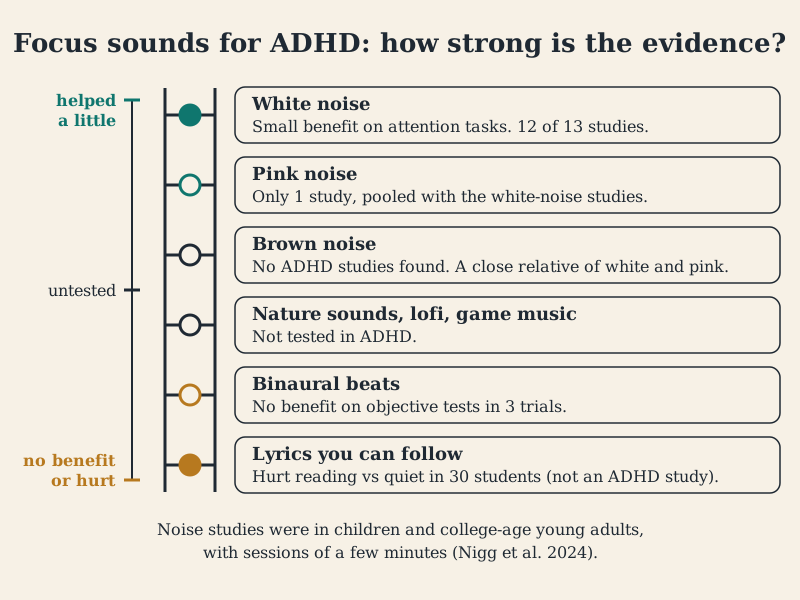
White noise has equal energy across all frequencies. It has the best evidence for ADHD: 12 of the 13 studies used it, and the authors rated their confidence in the small benefit "moderate". No study has compared how people with ADHD tolerate each colour, so if white sounds too hissy, move down the list to pink.
2. Pink noise: only one study
Pink noise drops about 3 dB per octave as pitch rises, so it sounds warmer, with more bass. Only 1 of the 13 studies used it, and the meta-analysis pooled that study with the white-noise ones.
3. Brown noise: popular, untested in ADHD
Brown noise went viral on TikTok in 2022 and sounds like a waterfall or a deep rumble. The meta-analysis says it plainly: "No studies of brown noise were identified." Because brown is mathematically close to white and pink, the authors think the findings are relevant. Many people who find white noise too sharp prefer brown's deeper sound, though that preference is anecdotal. If white grates on you, switch to brown at the same low volume then use it for 3 days and go without for 2, as in the test further down. More in brown noise explained.
4. Nature sounds: calming, not tested in ADHD
In a 2017 fMRI study of 17 healthy adults, people reacted about 10 milliseconds faster on a simple attention task with familiar natural sounds than with familiar artificial ones (Gould van Praag et al. 2017). Heart-rate measures showed rest-and-digest activity rising with natural sounds in people whose baseline was low, and falling in people whose baseline was high.
If you're anxious, rain or running water may feel better than noise, so start there. Anxiety often comes with ADHD (Maric 2018). If you're not, start with white noise, which has the evidence. Nature sounds haven't been tested in ADHD or compared with noise, so run each for 3 days and keep the one with better numbers.
5. Lofi and slow instrumental music: popular, untested
Lofi is one of the most popular kinds of study music. It's slow, steady and repetitive, with few surprises, and has no direct evidence behind it. A 2025 study found slow-beat music helped people ignore distractors on an attention test (De Francesco 2025), but it tested neither lofi nor ADHD. Skip tracks with vocal samples or sudden drops.
6. Video game soundtracks: designed to sit in the background
Game soundtracks are written to sit behind gameplay without pulling attention away, and they usually have no lyrics. Examples include the Zelda, Stardew Valley and Minecraft soundtracks. No study has tested them for ADHD. They're instrumental and steady, which makes them a fair swap for lofi.
7. Binaural beats: no benefit in ADHD trials so far
Binaural beats play two slightly different tones, one in each ear, so they need headphones. The idea is that brain activity falls into step with the beat. A 2023 review of 14 EEG studies found 5 that supported this and 8 that contradicted it.
Three trials in people with ADHD or attention problems found no benefit on objective attention tests. They were Kennel 2010, a pilot in 20 children and teens with ADHD; Alves-Castro 2025, in people with attention deficits; and Malandrone 2022, a pilot in adults with ADHD. In the Malandrone pilot, people felt they studied better.
Broader research is mixed. Garcia-Argibay and colleagues' 2019 meta-analysis of 22 studies found a medium average effect on memory, attention, anxiety and pain (g = 0.45). A 2022 test of 16 Hz beats found no reliable gain in sustained attention (Robison 2022). Neither focused on ADHD, so the three trials above are still the best guide for ADHD. If you have ADHD, treat binaural beats as an optional extra and keep them only if your own numbers improve. More on how binaural beats affect focus.
What tends to hurt focus (and why)
Music with lyrics you can follow
When a task depends on the meaning of words, such as reading, background lyrics or speech you can understand tend to lower your score. Studies of reading comprehension and word recall, reviewed by Perham and Currie, found this.
In a 2014 study by Perham and Currie, 30 students did worse on reading comprehension with lyrical music than in quiet, whether they liked the songs or not. Instrumental music didn't hurt. Your favourite songs hurt reading as much as disliked ones.
Podcasts and talk radio
Both are meaningful speech, the sound that most reliably disrupts reading. Save them for chores.
Classical music with big swings
Pieces with sudden loud passages can grab attention mid-paragraph. Steadier pieces are a sensible pick. Nobody has tested Baroque against Romantic for focus, so judge a piece by how even it stays, not by its era.
Silence, for some people
Quiet isn't always best. In lab studies, mostly with children, white noise gave a small edge over silence. Struggling in a silent room isn't a willpower failure. If silence works for you, keep it.
Building your ADHD focus music protocol
Step 1: Pick a base layer and keep the volume low
Start with white noise, which has the most ADHD evidence. If it sounds too harsh, switch to pink or brown. They're close relatives that many people find easier to listen to, though they're largely untested.
Set the volume to the quietest level you can still hear, and raise it only if a full session at that level does nothing. The effective volume for regular use is still unclear, and the meta-analysis authors warn that "sustained exposure to even moderate decibel levels can harm hearing" (Nigg et al. 2024). Take the headphones off in every break, such as the 5 minutes after each 25-minute block in Step 5.
Step 2: Add binaural beats only if you like them
Use stereo headphones and a comfortable beat level. There's no tested ratio, and ADHD trials haven't shown a benefit. If plain tones annoy you, put them under music or noise. The 2019 meta-analysis found masked and unmasked beats worked about the same.
Step 3: Or use lofi or nature sounds instead
Pick something instrumental and steady. There's no research on how long to give a new setup, so let the 3-day test at the end decide, not the first session.
Step 4: An optional NSDR reset before a focus block
A 10-minute NSDR session right before a focus block may help you settle. Lie down or sit back, follow the voice until the track ends, then start the timer for your first block. Nobody has tested NSDR for ADHD or before focus work, so treat it as an experiment, not a treatment, and keep it only if your numbers improve.
Step 5: Work in timed blocks
Try the Pomodoro pattern of 25 minutes on and 5 off, or longer blocks such as 50 and 10. Take the headphones off during breaks to rest your ears, which matters if you listen for hours.
The best free tools
Most of the focus music for ADHD above is free from one of these four.
| Tool | What you get | Cost |
|---|---|---|
| NSDR.co Focus Mode | Music with a binaural-beat layer, 4 modes with preset frequency arcs, layered ambient sounds (including white, pink and brown noise), a timer and a Pomodoro timer | Free, and there will always be a free plan |
| myNoise | Noise generators with sliders for low and high frequencies, plus white, pink and brown presets | Free, funded by donations |
| YouTube | 10-hour noise videos from popular channels such as Relaxing White Noise | Free with ads |
| Spotify | Focus and lofi playlists | Free ad-supported plan (Apple Music needs a subscription) |
NSDR.co Focus Mode runs in the browser and needs a connection. YouTube ads break focus unless you pay for Premium.
Brain.fm, a paid focus-music app, costs $14.99 a month or $99.99 a year (Brain.fm pricing, October 2026). Before paying, read about a free alternative to Brain.fm.
How to know if it's working
Why feelings mislead
Feeling focused is a poor guide. Perham and Currie's students rated their reading with liked songs on as highly as in quiet, though the lyrics lowered their scores. Children with ADHD are known to overrate how well they're doing (positive illusory bias; Owens 2007).
What to track
- Words written or pages read per session
- Tasks finished per day
- Minutes until the first distraction (phone check, tab switch)
- Focus blocks completed
A simple test
Run a few days with your setup and a few without, such as 3 and 2, then compare. If you see no difference, change the setup. The meta-analysis couldn't say whether some people respond more than others, so your own numbers are the best guide.
The bottom line
If you change one thing, put on white noise at the quietest level you can hear and work in 25-minute blocks. Do that for 3 days, then 2 days without it, and compare your numbers. If they improve, keep it. If they don't, swap to pink, brown or a nature track and run the same test. Whatever you pick, keep lyrics and podcasts off while you read or write. Binaural beats and a 10-minute NSDR session before work are extras to keep only if they move the numbers too. For the rest, see these focus techniques that don't depend on sound.
FAQ
What is the best focus music for ADHD?
The best-studied focus sound for ADHD is white noise. A 2024 meta-analysis pooled 13 small studies of children and young adults with ADHD or high ADHD symptoms, 12 of them on white noise, and found a small benefit on attention tasks. Only 1 study used pink noise, and brown noise is untested in ADHD.
Is brown noise or white noise better for ADHD?
White noise has more evidence than brown noise for ADHD. A 2024 review found no brown-noise studies, and a 2025 study of 31 listeners, not an ADHD study, found white, pink and brown noise didn't differ in pupil-linked arousal. Pick one you can ignore.
Do binaural beats help with ADHD?
Binaural beats haven't helped ADHD attention on objective tests. Three trials in people with ADHD or attention problems found no benefit, though in one adult pilot people felt they studied better. If you like them, try them with stereo headphones.
Is lofi good for ADHD focus?
Lofi hasn't been tested for ADHD focus. It's usually slow, steady and free of lyrics, which makes it reasonable to try. Skip tracks with vocal samples, since understandable words tend to hurt reading.
What BPM is best for ADHD focus?
No study has found a best BPM for ADHD focus. A 2025 study found slow-beat music helped people ignore distractors, but it wasn't an ADHD study. Steady, lyric-free music matters more than an exact tempo.
Can focus music replace ADHD medication?
Focus music can't replace ADHD medication. Treatment means medication and behavioural therapy, often together, and sound is an add-on to test. Talk to your doctor before changing anything.
Sources
- Nigg JT, Bruton A, Kozlowski MB, Johnstone JM, Karalunas SL. (2024). Systematic review and meta-analysis: do white noise or pink noise help with task performance in youth with attention-deficit/hyperactivity disorder or with elevated attention problems? Journal of the American Academy of Child & Adolescent Psychiatry, 63(8), 778-788. https://pubmed.ncbi.nlm.nih.gov/38428577/
- Volkow ND, Wang GJ, Kollins SH, et al. (2009). Evaluating dopamine reward pathway in ADHD: clinical implications. JAMA, 302(10), 1084-1091. https://pubmed.ncbi.nlm.nih.gov/19738093/
- Arnsten AF. (2006). Stimulants: therapeutic actions in ADHD. Neuropsychopharmacology, 31(11), 2376-2383. https://pubmed.ncbi.nlm.nih.gov/16855530/
- Sikström S, Söderlund G. (2007). Stimulus-dependent dopamine release in attention-deficit/hyperactivity disorder. Psychological Review, 114(4), 1047-1075. https://pubmed.ncbi.nlm.nih.gov/17907872/
- Micoulaud-Franchi JA, Vaillant F, Lopez R, et al. (2015). Sensory gating in adult with attention-deficit/hyperactivity disorder: event-evoked potential and perceptual experience reports comparisons with schizophrenia. Biological Psychology, 107, 16-23. https://pubmed.ncbi.nlm.nih.gov/25766264/
- Moss F, Ward LM, Sannita WG. (2004). Stochastic resonance and sensory information processing: a tutorial and review of application. Clinical Neurophysiology, 115(2), 267-281. https://pubmed.ncbi.nlm.nih.gov/14744566/
- Erfanian M, Chait M, Kang J. (2025). Pupil-linked arousal does not differ between 'white', 'pink' and 'brown' noises. International Journal of Psychophysiology, 218, 113271. https://pubmed.ncbi.nlm.nih.gov/41110471/
- Gould van Praag CD, Garfinkel SN, Sparasci O, et al. (2017). Mind-wandering and alterations to default mode network connectivity when listening to naturalistic versus artificial sounds. Scientific Reports, 7, 45273. https://pubmed.ncbi.nlm.nih.gov/28345604/
- Maric M, Bexkens A, Bögels SM. (2018). Is clinical anxiety a risk or a protective factor for executive functioning in youth with ADHD? A meta-regression analysis. Clinical Child and Family Psychology Review, 21(3), 340-353. https://pubmed.ncbi.nlm.nih.gov/29484581/
- De Francesco L, Schintu S, Mazza A, Ricci R, Dal Monte O. (2025). What you listen to makes a difference: the impact of music on attention and well-being. Annals of the New York Academy of Sciences, 1552(1), 273-283. https://pubmed.ncbi.nlm.nih.gov/40930507/
- Ingendoh RM, Posny ES, Heine A. (2023). Binaural beats to entrain the brain? A systematic review of the effects of binaural beat stimulation on brain oscillatory activity, and the implications for psychological research and intervention. PLOS ONE, 18(5), e0286023. https://pubmed.ncbi.nlm.nih.gov/37205669/
- Kennel S, Taylor AG, Lyon D, Bourguignon C. (2010). Pilot feasibility study of binaural auditory beats for reducing symptoms of inattention in children and adolescents with attention-deficit/hyperactivity disorder. Journal of Pediatric Nursing, 25(1), 3-11. https://pubmed.ncbi.nlm.nih.gov/20117669/
- Alves-Castro G, Bonnefond A, Pham BT, Hutt A. (2025). Sustained attention in attention-deficit subjects and the impact of binaural beat stimulation evaluated by behavior and EEG. Experimental Brain Research, 243(10), 211. https://pubmed.ncbi.nlm.nih.gov/40938421/
- Malandrone F, Spadotto M, Boero M, Bracco IF, Oliva F. (2022). A pilot add-on randomized-controlled trial evaluating the effect of binaural beats on study performance, mind-wandering, and core symptoms of adult ADHD patients (conference abstract). European Psychiatry, 65(Suppl 1), S274. https://pmc.ncbi.nlm.nih.gov/articles/PMC9564012/
- Garcia-Argibay M, Santed MA, Reales JM. (2019). Efficacy of binaural auditory beats in cognition, anxiety, and pain perception: a meta-analysis. Psychological Research, 83(2), 357-372. https://pubmed.ncbi.nlm.nih.gov/30073406/
- Robison MK, Obulasetty M, Blais C, Wingert KM, Brewer GA. (2022). The effect of binaural beat stimulation on sustained attention. Psychological Research, 86(3), 808-822. https://pubmed.ncbi.nlm.nih.gov/33978805/
- Perham N, Currie H. (2014). Does listening to preferred music improve reading comprehension performance? Applied Cognitive Psychology, 28(2), 279-284. https://pure.cardiffmet.ac.uk/en/publications/does-listening-to-preferred-music-improve-reading-comprehension-p/
- Owens JS, Goldfine ME, Evangelista NM, Hoza B, Kaiser NM. (2007). A critical review of self-perceptions and the positive illusory bias in children with ADHD. Clinical Child and Family Psychology Review, 10(4), 335-351. https://pubmed.ncbi.nlm.nih.gov/17902055/
Product pages: Brain.fm pricing, https://www.brain.fm/pricing ; myNoise, https://mynoise.net