Binaural beats for focus have a mixed record. A 2019 meta-analysis of 22 studies on memory, attention, anxiety and pain found a medium average effect (g = 0.45). A 2023 meta-analysis of 15 memory and attention studies also found a medium effect (g = 0.40). But single trials disagree, and several found nothing. A 2023 review found only 5 of 14 EEG studies showed the brainwave entrainment the idea depends on. This guide covers the research, the frequencies tested for focus, and a seven-day test to see whether they help you.
- Pooled studies show a medium average benefit for memory and attention, but single trials conflict, and a 1,000-person home study found beats lowered test scores.
- Nobody knows yet whether beats change your brainwaves at all. Of 14 EEG studies, 5 said yes and 8 said no.
- Beta (around 15-16 Hz) and gamma (40 Hz) have the most focus studies, with results on both sides. Theta and delta did worse than beta on a vigilance test.
- Use stereo headphones, start the beats a few minutes before the task and keep them going.
- Test them against silence or noise for a week and keep whatever helps you.
What binaural beats are (and what they're not)
Play a 200 Hz tone in your left ear and a 210 Hz tone in your right, and you hear a third sound pulsing at 10 Hz. That pulse is the binaural beat. It only forms when both tones sit below about 1,000 Hz.
The beat isn't in the audio file. Your brainstem makes it. The main structure involved is the superior olivary complex, the first part of the hearing pathway that receives input from both ears.
So you need headphones. Each ear has to get its own tone, and studies use headphones to guarantee that. Monaural beats (two tones mixed before the ear) and isochronic tones are different stimuli.
Research on beats and mental states rests on the brainwave entrainment hypothesis, the assumption that brain activity starts to oscillate at the beat frequency. It often gets called the "frequency following response", but that term describes a brainstem response at the frequencies of the two tones. Whether entrainment happens is the next question.
The research: what we know so far
The meta-analyses: a medium average effect
Garcia-Argibay and colleagues pooled 22 studies (35 effect sizes) in 2019, covering memory, attention, anxiety and pain. The overall effect was medium, g = 0.45, and its size depended on the frequency, how long people listened and when.
Basu and Banerjee followed in 2023 with 15 studies on memory and attention. Its effect was also medium, g = 0.40, and the results conflicted, especially for theta and beta.
g is a standardised effect size. Bigger means a larger difference between groups. These averages hide a lot of disagreement between studies.
Does the brain follow the beat?
Ingendoh and colleagues reviewed 14 EEG studies in 2023. Five supported entrainment. Eight contradicted it. One was mixed. They concluded that "the research question of whether brainwave entrainment in response to binaural beat stimulation can be assumed, remains open."
A single-blind, active-controlled study (Orozco Perez 2020) found binaural beats entrained the cortex only weakly, less than monaural beats, with no effect on mood.
Studies that found nothing, or worse
Robison 2022 tested 16 Hz beta beats across three experiments and found no consistent benefit for sustained attention. In Leistiko 2023, 58 healthy adults did an attention test once with 40 Hz beats and once with a control tone, and there was no difference in reaction time, errors, three attention networks or anxiety.
The largest study had the worst result. In Klichowski 2023, 1,000 people took a two-part fluid-intelligence test at home. Those who did the second part with binaural beats scored much worse, whatever they were told about the sounds. Silence and other sounds made no difference. No frequency was given, and an intelligence test differs from an hour of work. It still counts against treating beats as harmless background.
Why the evidence is hard to read
This research has four recurring problems.
- Small samples. The 14 studies in the 2023 EEG review used small samples of young adults. Four studies cited here had 29, 28, 24 and 20 people.
- Short sessions. In 13 of the 14 studies in the 2023 EEG review, beats played continuously for 1 to 30 minutes.
- Expectation. Lane 1998 kept participants blind to whether beats were playing, to control for expectation effects. Studies that skip this can't rule expectation out.
- People differ. In one study, baseline dopamine (estimated from blink rate) predicted whether alpha beats helped, did nothing or hurt creative thinking.
Which frequencies people use for focus
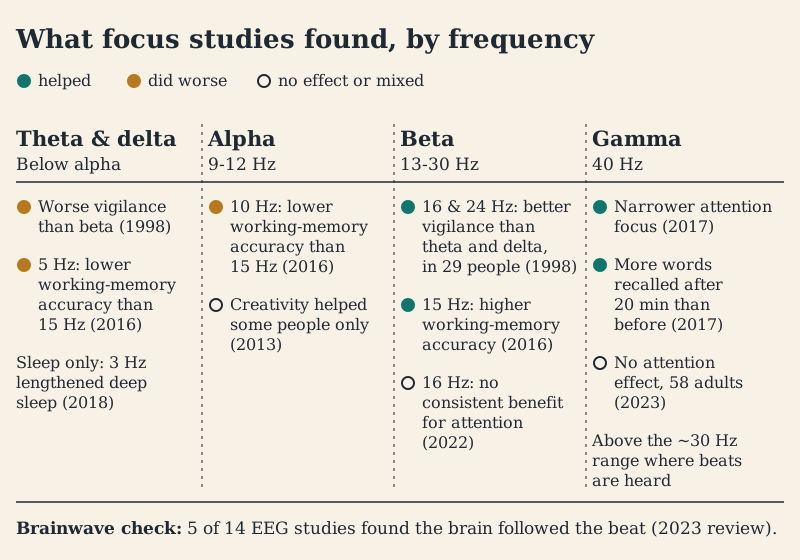
Each band has a handful of studies at most, and most bands have mixed results.
Beta (13-30 Hz): the most focus data, split results
In Lane 1998, beta beats at 16 and 24 Hz gave more correct detections, fewer false alarms and less negative mood than theta and delta beats, in 29 people. In Beauchene 2016, 15 Hz beats raised accuracy on a visuospatial working-memory task; 10 Hz, 5 Hz, a pure tone, classical music and no sound all did worse.
But Robison 2022 found no consistent benefit at 16 Hz. No study has tested coding or analytical work, so a frequency sold for programming is a guess.
Gamma (40 Hz): narrower attention in some studies, none in another
Colzato 2017 played 40 Hz beats for 3 minutes before and during a global-local task, and attention narrowed. In Jirakittayakorn 2017, people recalled more words from the working-memory part of a list after 20 minutes of a 40 Hz beat than before it. Leistiko 2023 found no attention effect.
People perceive beats from about 1 to 30 Hz. 40 Hz is above that range, yet researchers study it widely. The creativity result that people often credit to gamma (Reedijk 2013) held for alpha and gamma alike.
Alpha (9-12 Hz): popular, but little focus evidence
There is little direct evidence that alpha beats help sustained attention. The alpha result usually cited is about creativity, and it held only for some people. In Beauchene 2016, 10 Hz did worse than 15 Hz. To try it anyway, read more on alpha waves and binaural beats for studying.
Theta and delta: skip them for work
A 6 Hz theta beat produced a meditative EEG pattern within 10 minutes in one study. Frontal theta is also linked to working memory and sustained attention (Mitchell 2008), so the picture isn't simple. But in Lane 1998, theta and delta beats gave worse vigilance and mood than beta.
Delta is the deep-sleep band. A 3 Hz beat played during sleep lengthened N3, deep sleep. That is a sleep result. For work, pick beta or 40 Hz.
How to use binaural beats for focus
Each step says whether it comes from a study or is a practical suggestion.
- Use stereo headphones or earbuds. Any pair works as long as each ear gets its own channel. (From the research.)
- Start the beats a few minutes before the task and keep them going. In the 2019 meta-analysis, listening before, or before and during, a task gave better results than listening only during it. (From the research.)
- Match the session to one work block. Effects have appeared after as little as 3 minutes (Colzato 2017), and in the 2019 meta-analysis longer exposure gave bigger effects. The studies in the 2023 EEG review ran 1 to 30 minutes, so 60-90 minute sessions have little data. (Practical suggestion, based on these findings.)
- Keep the volume comfortable. No study has tested an ideal level. (Practical suggestion.)
- Layer with rain or noise only if pure tones annoy you. Masked and unmasked beats gave similar effects in the 2019 meta-analysis. For music, see pairing binaural beats with lofi music. (From the research, for noise.)
- Take short breaks between blocks. No study has tested this. (Practical suggestion.)
Binaural beats vs other focus sounds
| Binaural beats | Monaural beats | White or pink noise | Music | Silence | |
|---|---|---|---|---|---|
| How it works | Beat formed in the brainstem from two tones | Beat already in the sound | Masks background noise | Not covered in the studies here | Baseline |
| Headphones needed | Yes | No | No | No | n/a |
| Focus evidence | Mixed (medium pooled effect, conflicting trials) | Stronger cortical entrainment than binaural in one study; less mind-wandering than plain tones in people prone to it (Chaieb 2022; versus silence only in a subgroup) | Small benefit with ADHD in children and young adults (g = 0.25); slightly worse without | Classical music did worse than 15 Hz beats in one study | No effect on scores in the 1,000-person home study |
| ADHD | Not shown in the small trials so far | Little data | Small benefit | No studies here | n/a |
Pick the sound you can ignore, and compare it with silence. In a 2024 meta-analysis of studies in children and young adults (Nigg 2024), white or pink noise came out slightly worse than nothing for those without ADHD (g = -0.21 across 11 studies). Brown noise had no studies in that meta-analysis; here is how brown noise differs from white noise.
Binaural beats and ADHD
The interest in ADHD comes from dopamine. Imaging shows fewer dopamine transporters and D2/D3 receptors in the reward pathway of adults with ADHD (Volkow 2009, 53 adults against 44 controls). One model proposes that tonic dopamine is low in ADHD. That is a theory, not a measurement.
The moderate brain arousal model (Sikström and Söderlund 2007) proposes that moderate noise helps through stochastic resonance, and that ADHD raises the amount needed. The model is about noise, not binaural beats.
Kennel 2010 randomly assigned 20 children and teens with ADHD to binaural beats or a sham recording, 20 minutes three times a week for 3 weeks. On objective attention tests the beats group did no better than the sham group, though parents and teens reported fewer homework problems. Alves-Castro 2025 found no benefit in behaviour or EEG markers.
If you have ADHD, white or pink noise has the stronger evidence. Across 13 studies of children and college-age young adults with ADHD or ADHD symptoms, it gave a small benefit on task performance (g = 0.25). To try beats anyway, layer them over noise and judge by what happens to your work. See more free focus music options for ADHD. Binaural beats are not a treatment for ADHD and do not replace care from a clinician.
How NSDR and binaural beats fit together
No study has tested NSDR followed by binaural beats. Treat the pair as a reasonable experiment.
Yoga Nidra, the practice NSDR is based on, has some evidence. A 2002 PET study (Kjaer et al., Cognitive Brain Research) of eight yoga teachers estimated 65% more dopamine release in the ventral striatum during the practice itself. A 2025 randomised trial (Moszeik 2025) linked regular online Yoga Nidra to lower total cortisol, with small effects on well-being.
An order to try: 10 to 20 minutes of NSDR, then a beta or 40 Hz block, then a short break (a general suggestion; no study has tested the sequence). If you sit down tired or wired, rest first; more on using NSDR to reset before focused work. NSDR.co is free, and there will always be a free plan.
Common mistakes to avoid
- Theta or delta during work. In Lane 1998 they gave worse vigilance than beta.
- Judging after two minutes. In two EEG studies from one lab, brain responses showed up within 10-15 minutes. Give a session at least that long.
- Playing beats through speakers. Studies use headphones so each tone reaches only one ear.
- Using beats instead of rest. They don't replace sleep. If you're exhausted, rest first.
Getting started: your first week
No study has tested this schedule; it is a practical way to compare setups.
- Days 1-2: work one block in silence or your usual noise. Rate your focus 1 to 10 after each block. That is your baseline.
- Days 3-4: same kind of task, beta beats around 15-16 Hz, started a few minutes early. Rate it.
- Days 5-6: 40 Hz gamma, or beta layered over noise if pure tones grate. Rate it.
- Day 7: a 10-minute NSDR session, then whichever setup scored higher.
Keep what beat your baseline. Drop it if nothing did. Reedijk and colleagues concluded that binaural beats "are not suited for a one-size-fits-all approach", which is the best reason to run the test on yourself.
The bottom line
Binaural beats for focus are cheap and easy to try, with a medium but uneven average effect and an unproven mechanism. Give beta or 40 Hz one week against silence. If your ratings go up, keep them, with NSDR breaks and sensible work-rest cycles. If they stay flat, stop.
FAQ
What frequency of binaural beats is best for focus?
No frequency of binaural beats is proven best for focus. Beta around 15-16 Hz and gamma at 40 Hz have the most focus studies, with positive results and null ones (Robison 2022 at 16 Hz, Leistiko 2023 at 40 Hz). Theta and delta did worse than beta on a vigilance test, so skip them for focused work.
Do you need headphones for binaural beats to work?
Yes, you need headphones for binaural beats to work. Each ear has to receive its own tone, and studies use headphones to guarantee that. Any stereo headphones or earbuds will do, as long as left and right channels stay separate. Monaural beats work without headphones.
How long should you listen to binaural beats before studying or working?
Start listening to binaural beats before studying or working, and keep them playing through the task. In the 2019 meta-analysis, listening before, or before and during, a task gave better results than listening only during it, and longer exposure gave bigger effects. One 40 Hz study found narrower attention after 3 minutes of listening before and during a task. In two EEG studies from one lab, brain responses showed up within 10-15 minutes, so give a session at least that long before judging it.
Is brainwave entrainment from binaural beats real?
Whether brainwave entrainment from binaural beats is real is still an open question. A 2023 review of 14 EEG studies found five supported entrainment, eight contradicted it and one was mixed. A controlled 2020 study found only weak cortical entrainment, less than monaural beats. If binaural beats for focus help you, brainwaves are not yet the proven reason.
Do binaural beats help with ADHD?
The small trials so far haven't shown that binaural beats help with ADHD. Kennel 2010 (20 children and teens) found no objective drop in inattention, and Alves-Castro 2025 found no behaviour or EEG benefit. White or pink noise has better support, a small benefit (g = 0.25) in studies of children and young adults. Beats are not an ADHD treatment and don't replace a clinician's care.
Sources
- Ingendoh RM, Posny ES, Heine A (2023). Binaural beats to entrain the brain? A systematic review of the effects of binaural beat stimulation on brain oscillatory activity, and the implications for psychological research and intervention. PLoS One 18(5):e0286023. https://pubmed.ncbi.nlm.nih.gov/37205669/
- Garcia-Argibay M, Santed MA, Reales JM (2019). Efficacy of binaural auditory beats in cognition, anxiety, and pain perception: a meta-analysis. Psychological Research 83(2):357-372. https://pubmed.ncbi.nlm.nih.gov/30073406/
- Basu S, Banerjee B (2023). Potential of binaural beats intervention for improving memory and attention: insights from meta-analysis and systematic review. Psychological Research 87(4):951-963. https://pubmed.ncbi.nlm.nih.gov/35842538/
- Orozco Perez HD, Dumas G, Lehmann A (2020). Binaural beats through the auditory pathway: from brainstem to connectivity patterns. eNeuro 7(2). https://pubmed.ncbi.nlm.nih.gov/32066611/
- Robison MK, Obulasetty M, Blais C, et al. (2022). The effect of binaural beat stimulation on sustained attention. Psychological Research 86(3):808-822. https://pubmed.ncbi.nlm.nih.gov/33978805/
- Leistiko NM, Madanat L, Yeung WKA, Stone JM (2023). Effects of gamma frequency binaural beats on attention and anxiety. Current Psychology. https://pubmed.ncbi.nlm.nih.gov/37359672/
- Klichowski M, Wicher A, Kruszwicka A, Golebiewski R (2023). Reverse effect of home-use binaural beats brain stimulation. Scientific Reports 13(1):11079. https://pubmed.ncbi.nlm.nih.gov/37422545/
- Lane JD, Kasian SJ, Owens JE, Marsh GR (1998). Binaural auditory beats affect vigilance performance and mood. Physiology & Behavior 63(2):249-252. https://pubmed.ncbi.nlm.nih.gov/9423966/
- Beauchene C, Abaid N, Moran R, et al. (2016). The effect of binaural beats on visuospatial working memory and cortical connectivity. PLoS One 11(11):e0166630. https://pubmed.ncbi.nlm.nih.gov/27893766/
- Colzato LS, Barone H, Sellaro R, Hommel B (2017). More attentional focusing through binaural beats: evidence from the global-local task. Psychological Research 81(1):271-277. https://pubmed.ncbi.nlm.nih.gov/26612201/
- Jirakittayakorn N, Wongsawat Y (2017). Brain responses to 40-Hz binaural beat and effects on emotion and memory. International Journal of Psychophysiology 120:96-107. https://pubmed.ncbi.nlm.nih.gov/28739482/
- Jirakittayakorn N, Wongsawat Y (2017). Brain responses to a 6-Hz binaural beat: effects on general theta rhythm and frontal midline theta activity. Frontiers in Neuroscience 11:365. https://pubmed.ncbi.nlm.nih.gov/28701912/
- Jirakittayakorn N, Wongsawat Y (2018). A novel insight of effects of a 3-Hz binaural beat on sleep stages during sleep. Frontiers in Human Neuroscience 12:387. https://pubmed.ncbi.nlm.nih.gov/30319382/
- Reedijk SA, Bolders A, Hommel B (2013). The impact of binaural beats on creativity. Frontiers in Human Neuroscience 7:786. https://pubmed.ncbi.nlm.nih.gov/24294202/
- Mitchell DJ, McNaughton N, Flanagan D, et al. (2008). Frontal-midline theta from the perspective of hippocampal "theta". Progress in Neurobiology 86(3):156-185. https://pubmed.ncbi.nlm.nih.gov/18824212/
- Chaieb L, Krakau S, Reber TP, Fell J (2022). Modulation of mind wandering using monaural beat stimulation in subjects with high trait-level mind wandering. Frontiers in Psychology 13:815442. https://pubmed.ncbi.nlm.nih.gov/35769725/
- Nigg JT, Bruton A, Kozlowski MB, et al. (2024). Systematic review and meta-analysis: do white noise or pink noise help with task performance in youth with attention-deficit/hyperactivity disorder or with elevated attention problems? Journal of the American Academy of Child & Adolescent Psychiatry 63(8):778-788. https://pubmed.ncbi.nlm.nih.gov/38428577/
- Kennel S, Taylor AG, Lyon D, et al. (2010). Pilot feasibility study of binaural auditory beats for reducing symptoms of inattention in children and adolescents with attention-deficit/hyperactivity disorder. Journal of Pediatric Nursing 25(1):3-11. https://pubmed.ncbi.nlm.nih.gov/20117669/
- Alves-Castro G, Bonnefond A, Pham BT, et al. (2025). Sustained attention in attention-deficit subjects and the impact of binaural beat stimulation evaluated by behavior and EEG. Experimental Brain Research 243(10):211. https://pubmed.ncbi.nlm.nih.gov/40938421/
- Volkow ND, Wang GJ, Kollins SH, et al. (2009). Evaluating dopamine reward pathway in ADHD: clinical implications. JAMA 302(10):1084-1091. https://pubmed.ncbi.nlm.nih.gov/19738093/
- Sikström S, Söderlund G (2007). Stimulus-dependent dopamine release in attention-deficit/hyperactivity disorder. Psychological Review 114(4):1047-1075. https://pubmed.ncbi.nlm.nih.gov/17907872/
- Kjaer TW, Bertelsen C, Piccini P, et al. (2002). Increased dopamine tone during meditation-induced change of consciousness. Cognitive Brain Research 13(2):255-259. https://pubmed.ncbi.nlm.nih.gov/11958969/
- Moszeik EN, Rohleder N, Renner KH (2025). The effects of an online Yoga Nidra meditation on subjective well-being and diurnal salivary cortisol: a randomised controlled trial. Stress and Health 41(3):e70049. https://pubmed.ncbi.nlm.nih.gov/40373021/