L-theanine is an amino acid from tea that may help you settle into sleep by calming a busy mind. It doesn't sedate you. Many studies have used about 200 to 400 mg a day. In trials of L-theanine for sleep, the clearest gains were in how people rated their sleep, not in how long they slept.
Health note: check with your doctor before taking L-theanine if you take any medication, or if you're pregnant or breastfeeding.
TL;DR
- L-theanine is linked to better self-rated sleep rather than longer sleep. It isn't a sedative. A review by staff of Taiyo, which makes Suntheanine, says it doesn't cause daytime drowsiness, but Cleveland Clinic lists drowsiness and headaches among its usually mild side effects.
- Many studies used about 200 to 400 mg a day, and a 2025 review concluded that 200 to 450 mg a day appears safe and effective for sleep. Huberman's range is 100-400 mg, 30-60 minutes before bed.
- Five ways to use it: alone before bed, a daytime dose for stress, Huberman's stack, paired with NSDR, and in blocks with breaks.
- Buy pure, third-party-tested L-theanine. Suntheanine is the form most of the sleep trials cited here used.
- Skip it if you're pregnant or breastfeeding, and ask a doctor first if you take any medication. The safety section lists who else should skip it.
- Most of the sleep trials cited here were run, co-authored or supplied by Taiyo, the company that makes Suntheanine. An independent 2025 meta-analysis found small gains in self-rated sleep.
What is L-theanine (and why it's not a sedative)
Where L-theanine comes from
L-theanine is an amino acid found in tea leaves. A cup holds roughly 8 to 24 mg, depending on the tea and the brew (Keenan et al., 2011). To reach a 200 mg dose, you'd need about 8 cups of black tea, far more green, and all the caffeine that comes with them.
How it works in your brain
The clearest human evidence is on brain waves. In small EEG studies, 50 to 200 mg increased alpha waves compared with placebo. Alpha waves go with relaxed alertness. Several of those studies were reported by Taiyo staff, whose company makes Suntheanine, and one was run by Unilever.
In a 12-person lab study with Taiyo co-authors, theanine also blunted the rise in heart rate during a stressful maths task.
The evidence on neurotransmitters comes from animals. In rats, theanine raised brain serotonin and dopamine, and animal studies report effects on GABA.
Why it isn't a sedative
Most sleep drugs work by sedating you. A 2015 review by Taiyo staff argued that L-theanine may improve sleep quality "not by sedation but through anxiolysis", meaning by lowering anxiety. The same review says L-theanine "does not induce daytime drowsiness".
What the sleep research shows (and who paid for it)
The trials, by size
The first study gives the weakest evidence. A Japanese team gave 22 young men 200 mg of Suntheanine an hour before bed for six days. They felt less exhausted and more refreshed on waking, and 7 of the 10 students in the group also reported fewer nightmares. Total sleep time didn't change. It appeared only as a 2004 congress abstract and in trade press.
In 2019, Hidese and colleagues gave 30 healthy adults (average age 48) 200 mg a day for four weeks in a placebo-controlled crossover. Self-rated sleep scores improved, including time to fall asleep. Two authors worked for Taiyo, which supplied the tablets.
The largest of these trials gave 98 boys aged 8 to 12 with ADHD 400 mg a day for six weeks. Wrist trackers showed better sleep efficiency, with no change in time to fall asleep. Taiyo staff co-authored it.
What the reviews concluded
An independent meta-analysis (Bulman et al., 2025, University of Canberra) reviewed 19 studies with 897 people and pooled 18 of them. Every significant gain was self-rated: sleep onset, daytime functioning and overall sleep quality. The effects were small.
A second 2025 review (Cotter et al.) covered 13 trials and 550 people on theanine alone, at 50 to 900 mg a day. It concluded that 200 to 450 mg a day "appears to be a safe and effective way" to support sleep in adults. Three of its four authors work in R&D at British American Tobacco.
Some studies also used blends, such as a 2023 trial of 16 young adults given tryptophan, glycine, magnesium, tart cherry and L-theanine together. Jacob Hill, ND, a naturopathic medicine specialist at Cleveland Clinic, says "we don't have enough evidence to say it treats any specific condition."
Who funded the studies
Most of the sleep trials cited here were run, co-authored or supplied by Taiyo, the company that makes Suntheanine. Unilever ran the Nobre and Owen studies.
Industry money doesn't make a result wrong, but the independent meta-analysis deserves the most weight. Nobody has tested L-theanine in clinical insomnia, and the sleep trials cited here lasted six weeks at most.
5 ways to use L-theanine for sleep
Method 1: On its own, before bed
The approach: Take 200 mg, 30 to 60 minutes before bed. To start cautiously, take 100 mg, the bottom of Huberman's range.
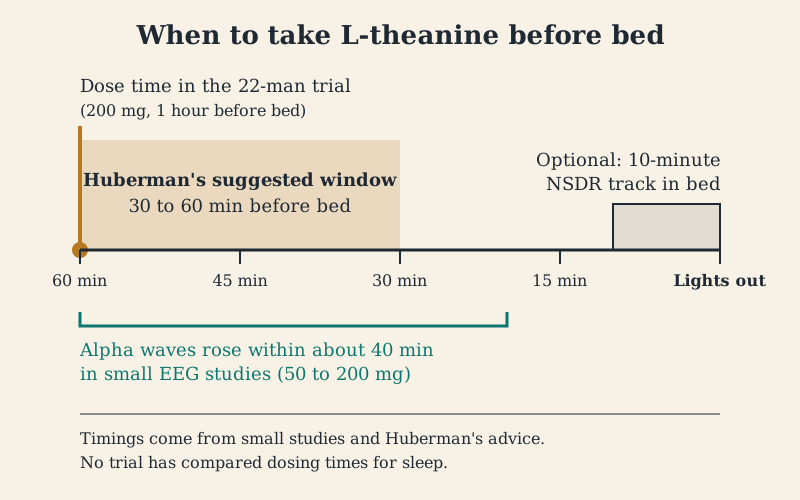
Two of the cited sleep trials dosed before bed. The 22-man study gave 200 mg an hour before bed, and Hidese gave 200 mg before sleep each night. Expect any change to show up in how you rate your nights.
Best for: A busy or tense mind at bedtime.
Method 2: A daytime dose for stress
The approach: Take a dose in the afternoon, when stress starts to build.
Treat this as an experiment. Daytime doses have been studied for stress, but none of the adult sleep trials cited here used one. A 2019 narrative review (Sakamoto et al.) found that 200 to 400 mg a day, for up to 8 weeks, appears safe and may ease stress and anxiety. In the ADHD trial, the boys dosed at breakfast and after school and still slept more efficiently.
In a 27-person Unilever study, 100 mg of theanine with 50 mg of caffeine improved attention-switching and reduced distractibility. That's a focus finding, so keep the caffeine well before bedtime.
Best for: Stress that builds through the afternoon and follows you into bed.
Method 3: Stacking with magnesium threonate and apigenin
The approach: Huberman's stack, from his Toolkit for Sleep newsletter: 145 mg magnesium threonate (or 200 mg magnesium bisglycinate), 50 mg apigenin and 100 to 400 mg theanine, 30 to 60 minutes before bed.
No trial has tested the combination. Huberman's own advice: "I would start with one supplement (or none!) and then add one at a time as needed." Leaving a week or two between additions is a rule of thumb. Nobody has studied the interval. For more on each ingredient, see Huberman's full supplement stack and magnesium threonate for sleep.
Best for: People who got partial results from theanine alone.
Method 4: Pairing with NSDR
The approach: Take theanine 30 to 60 minutes before bed, then play a 10-minute NSDR track once you're lying down.
Theanine works through biochemistry, and NSDR (non-sleep deep rest) works through attention and breathing, so the two can stack. Nobody has tested the pair. The nearest brain data comes from yoga nidra, a related practice. In a small 2002 study of experienced practitioners (Kjaer et al.), EEG showed more theta activity during a session, along with a dopamine rise. Those readings were taken mid-session in people who already knew the practice well, and they say nothing about theanine. Read more in NSDR for sleep.
Best for: Nights when your body is as wound up as your mind.
Method 5: Using it in blocks, with breaks
The approach: Take it for a few weeks, then stop for a stretch and notice whether your sleep changes.
No study has tested cycling theanine, so a break is an optional precaution. In his Sleep Toolkit episode, Huberman says he takes glycine and GABA only every third or fourth night, because more often makes his whole stack work less well. Inositol he takes every other night. He doesn't mention cycling theanine. Read more in glycine for sleep, and when to cycle it.
Best for: Anyone planning to take it most nights for months.
Which approach should you choose
If your main problem is a racing mind at bedtime
Start with Method 1. Two of the cited sleep trials dosed before bed, and a busy mind at bedtime is the problem it seems best suited to. As a rule of thumb, give it a couple of weeks of nightly doses before you decide, because the sleep trials cited here lasted days to weeks and a single night tells you little. Look at other ways to calm sleep anxiety too.
If stress follows you from the day into the night
Try Method 2 first. Theanine's daytime research is on stress, so an afternoon dose meets the tension before it reaches bedtime. None of the adult sleep trials cited here used a daytime dose, though, so add Method 1 if your evenings stay tense.
If theanine alone isn't enough
Move to Method 3 or Method 4. Change one thing at a time so you can tell what's helping.
If you've had insomnia for months
L-theanine hasn't been tested in clinical insomnia. See a doctor. The American College of Physicians recommends cognitive behavioural therapy for insomnia (CBT-I) as the initial treatment for chronic insomnia.
Dosage, timing, and what to look for on the label
Dose
- Start at 100 to 200 mg. Huberman's range begins at 100 mg.
- A 2025 review (Cotter) concluded that 200 to 450 mg a day appears safe and effective for sleep in adults.
- Cleveland Clinic: "Many studies use about 200 to 400 milligrams (mg) per day for just a few weeks."
- There's no official upper limit. Doses up to 900 mg a day have been studied, but long-term safety is unclear.
Timing
On his sleep supplements, Huberman says "the ideal time to take those is 30 to 60 minutes before bedtime." The 22-man trial dosed an hour before bed. In small EEG studies reported by Taiyo staff (Juneja 1999), alpha waves rose within about 40 minutes of a 50 to 200 mg dose, and a Korean study of 20 men found the effect only in the more anxious ones.
No trial has compared dosing times for sleep. Taking it 30 to 60 minutes ahead gives it time to kick in.
Reading the label
Look for "pure L-theanine". In a 2004 lab analysis of six L-theanine products, five contained significant amounts of D-theanine (Desai & Armstrong). In rats, the D-form was absorbed poorly and competed with the L-form. Suntheanine was the only product in that analysis that appeared to contain only L-theanine, and most of the sleep trials cited here used it.
US supplements aren't tightly regulated, so the label may not match the contents. Choose a third-party-tested product, such as one with NSF certification.
Side effects and safety: who should skip it
Jacob Hill of Cleveland Clinic says, "The safety profile looks fairly good, particularly in lower doses or when you're getting it from tea." A cup of tea holds roughly 8 to 24 mg, a small fraction of a 200 mg dose. Cleveland Clinic says side effects are usually mild and may include drowsiness and headaches. Some people should skip it or ask a doctor first.
Who should skip it or ask a doctor first
- Pregnant or breastfeeding: don't take it unless your doctor says so. Cleveland Clinic says there isn't enough safety data, and Memorial Sloan Kettering lists both as reasons not to take it.
- Sleepwalking or night terrors: Huberman, in his Toolkit for Sleep newsletter, says "Don't take theanine if you have overly intense dreams, sleep-walk, or have night terrors."
- Children: the only child trial cited here was in boys with ADHD, and there's no established child dose. Ask your child's doctor first.
Medication interactions
- Sedatives and sleep medication, such as lorazepam, diazepam or zolpidem: theanine may add to their effect and increase drowsiness. In animal studies it had additive effects with midazolam, another sedative.
- Blood pressure medication: Cleveland Clinic says L-theanine may increase its effects. The human evidence cited here is small. In a 14-person study, theanine blunted the blood-pressure rise during mental tasks in people who react strongly to stress.
If either applies, check with your doctor before you start.
Vivid dreams
In his Sleep Toolkit episode, Huberman says some people find their dreams on theanine vivid enough to be disruptive, and some leave it out of the stack. The trials cited here didn't report it, so nobody knows how common it is. In the 22-man trial, 7 of its 10 student participants reported fewer nightmares. If your dreams turn intense, lower the dose or stop.
Tea, caffeine and long-term use
Getting theanine from tea means getting caffeine too. Memorial Sloan Kettering notes that too much tea may cause headaches, nausea, irritability and trouble staying asleep.
In 2007 the FDA raised no objection to Taiyo's conclusion that its L-theanine is generally recognised as safe (GRAS) as a food ingredient at up to 250 mg per serving. That notice covers food use and sets no dose for supplements. Long-term use hasn't been studied, which is the reason for Method 5.
L-theanine vs. melatonin: why they're not the same thing
Different mechanisms
L-theanine is an amino acid. In small human studies, it increased alpha activity and blunted the heart-rate response to stress. Melatonin is a hormone your brain makes in response to darkness, and it helps time your body clock.
In his Sleep Toolkit episode, Huberman says he prefers his supplement stack to melatonin. He says most melatonin products are dosed far above what the body makes, and that melatonin interacts with other hormone systems, including in kids. He's comparing the whole stack with melatonin. See also melatonin's side effects.
When each one makes sense
Theanine fits when stress or a busy mind keeps you awake. Melatonin supplements may help with jet lag. For shift work, the studies are small or inconclusive.
Can you combine them?
A 2025 version of Cleveland Clinic's L-theanine page said they can be taken together. Start with one anyway, as Huberman suggests, so you know which is doing what.
Wind down your nervous system before bed
Theanine works on brain chemistry. A bad night is often physical as well, with a tense body and breathing that stays quick and shallow after the light goes off. NSDR is guided rest you do awake and lying down, following a voice through your body while your breathing slows. Played in bed after an evening dose, it can support the wind-down. NSDR.co is free, and a 10-minute track is an easy place to start.
FAQ
How long does L-theanine take to work for sleep?
How long L-theanine takes to work for sleep hasn't been measured directly. In small EEG studies, alpha waves rose within about 40 minutes of a 50 to 200 mg dose. Huberman suggests taking it 30 to 60 minutes before bed. As a rule of thumb, give it a week or two before judging.
Is it safe to take L-theanine every night?
Taking L-theanine for sleep every night hasn't been studied long term. A 2019 review found daily doses of 200 to 400 mg safe for up to 8 weeks, and Cleveland Clinic says long-term safety data are limited. Skip it if you're pregnant or breastfeeding, and check with a doctor first if you take any medication.
Does L-theanine make you drowsy the next day?
Whether L-theanine makes you drowsy the next day isn't settled. A 2015 review by Taiyo staff, whose company makes Suntheanine, says it doesn't cause daytime drowsiness. Cleveland Clinic lists drowsiness and headaches among its usually mild side effects. With sedatives or sleep medication, it may add to drowsiness.
Can you take L-theanine with melatonin?
You can take L-theanine with melatonin, according to a 2025 version of Cleveland Clinic's page. They do different jobs, so start with one at a time to see which helps.
Can L-theanine cause vivid dreams?
L-theanine may cause vivid dreams in some people. Huberman says some find them disruptive, and advises against theanine if you sleepwalk or have night terrors. The trials cited here didn't report it, so nobody knows how common it is. If it happens, lower the dose or stop.
Sources
- Bulman A et al. 2025. The effects of L-theanine consumption on sleep outcomes: a systematic review and meta-analysis. Sleep Medicine Reviews. https://pubmed.ncbi.nlm.nih.gov/40056718/ [independent, university grant]
- Cotter J et al. 2025. Examining the effect of L-theanine on sleep: a systematic review of dietary supplementation trials. Nutritional Neuroscience. https://pubmed.ncbi.nlm.nih.gov/41176609/ [British American Tobacco R&D authors]
- Hidese S et al. 2019. Effects of L-theanine administration on stress-related symptoms and cognitive functions in healthy adults: a randomized controlled trial. Nutrients. https://pubmed.ncbi.nlm.nih.gov/31623400/ [Taiyo employees; Taiyo supplied tablets]
- Lyon MR, Kapoor MP, Juneja LR. 2011. The effects of L-theanine (Suntheanine) on objective sleep quality in boys with attention deficit hyperactivity disorder (ADHD). Alternative Medicine Review. https://pubmed.ncbi.nlm.nih.gov/22214254/ [Taiyo co-authors]
- Rao TP, Ozeki M, Juneja LR. 2015. In search of a safe natural sleep aid. Journal of the American College of Nutrition. https://pubmed.ncbi.nlm.nih.gov/25759004/ [Taiyo authors]
- NutraIngredients. 2004. Green tea lulls brain into quality sleep. https://www.nutraingredients.com/Article/2004/03/17/Green-tea-lulls-brain-into-quality-sleep/ [Suntheanine, Taiyo]
- Juneja LR et al. 1999. L-theanine: a unique amino acid of green tea and its relaxation effect in humans. Trends in Food Science & Technology. https://doi.org/10.1016/S0924-2244(99)00044-8 [Taiyo authors]
- Nobre AC, Rao A, Owen GN. 2008. L-theanine, a natural constituent in tea, and its effect on mental state. Asia Pacific Journal of Clinical Nutrition. https://pubmed.ncbi.nlm.nih.gov/18296328/ [Unilever]
- Song CH et al. 2003. Effects of theanine on the release of brain alpha wave in adult males. Korean Journal of Nutrition 36:918-23.
- Kimura K, Ozeki M, Juneja LR, Ohira H. 2007. L-theanine reduces psychological and physiological stress responses. Biological Psychology. https://pubmed.ncbi.nlm.nih.gov/16930802/ [Taiyo co-authors]
- Yokogoshi H et al. 1998. Effect of theanine on brain monoamines and striatal dopamine release in conscious rats. Neurochemical Research. https://pubmed.ncbi.nlm.nih.gov/9566605/ [animal study]
- Nathan PJ et al. 2006. The neuropharmacology of L-theanine (N-ethyl-L-glutamine): a possible neuroprotective and cognitive enhancing agent. Journal of Herbal Pharmacotherapy. https://pubmed.ncbi.nlm.nih.gov/17182482/
- Keenan EK et al. 2011. How much theanine in a cup of tea? Effects of tea type and method of preparation. Food Chemistry. https://doi.org/10.1016/j.foodchem.2010.08.071
- Lopes Sakamoto F et al. 2019. Psychotropic effects of L-theanine and its clinical properties: a literature review. Pharmacological Research. https://pubmed.ncbi.nlm.nih.gov/31412272/
- Owen GN et al. 2008. The combined effects of L-theanine and caffeine on cognitive performance and mood. Nutritional Neuroscience. https://pubmed.ncbi.nlm.nih.gov/18681988/ [Unilever]
- Yoto A et al. 2012. Effects of L-theanine or caffeine intake on changes in blood pressure under physical and psychological stresses. Journal of Physiological Anthropology. https://pubmed.ncbi.nlm.nih.gov/23107346/
- Desai MJ, Armstrong DW. 2004. Analysis of derivatized and underivatized theanine enantiomers by high-performance liquid chromatography/atmospheric pressure ionization-mass spectrometry. Rapid Communications in Mass Spectrometry. https://pubmed.ncbi.nlm.nih.gov/14755608/ [lab analysis of six commercial products]
- Desai MJ et al. 2005. Pharmacokinetics of theanine enantiomers in rats. Chirality. https://pubmed.ncbi.nlm.nih.gov/15704209/ [animal study]
- Langan-Evans C et al. 2023. Nutritional modulation of sleep latency, duration, and efficiency. Medicine & Science in Sports & Exercise. https://pubmed.ncbi.nlm.nih.gov/36094342/
- Kjaer TW et al. 2002. Increased dopamine tone during meditation-induced change of consciousness. Cognitive Brain Research. https://pubmed.ncbi.nlm.nih.gov/11958969/
- Qaseem A et al. 2016. Management of chronic insomnia disorder in adults: a clinical practice guideline from the American College of Physicians. Annals of Internal Medicine. https://pubmed.ncbi.nlm.nih.gov/27136449/
- US Food and Drug Administration. 2007. GRAS Notice No. 209: L-theanine (notifier: Taiyo International). https://www.cfsanappsexternal.fda.gov/scripts/fdcc/index.cfm?set=GRASNotices&id=209 [Taiyo notice]
- National Center for Complementary and Integrative Health (NCCIH). Melatonin: what you need to know. https://www.nccih.nih.gov/health/melatonin-what-you-need-to-know
- Memorial Sloan Kettering Cancer Center. About Herbs: L-theanine. https://www.mskcc.org/cancer-care/herb/l-theanine
- Cleveland Clinic. 2026. What is L-theanine? (updated 28 May 2026). https://health.clevelandclinic.org/l-theanine
- Cleveland Clinic. 2025 version of the L-theanine page (archived 7 Jan 2025). https://web.archive.org/web/20250107025732/https://health.clevelandclinic.org/l-theanine
- Huberman Lab. Sleep Toolkit: Tools for Optimizing Sleep & Sleep-Wake Timing. https://www.hubermanlab.com/episode/sleep-toolkit-tools-for-optimizing-sleep-and-sleep-wake-timing
- Huberman Lab. Toolkit for Sleep (newsletter). https://www.hubermanlab.com/newsletter/toolkit-for-sleep