Alpha waves for studying get attention because alpha, the 8-12 Hz rhythm of an awake, resting brain, is tied to how your brain filters out distractions. Alpha binaural beats are a separate thing, a sound meant to nudge your brain toward that rhythm, and their record for studying is thin. One small 2021 pilot found 10 Hz beats improved a memory test. A 2016 study found 10 Hz did worse than 15 Hz, and in a home study of 1,000 people, beats lowered test scores. Quiet rest after studying has better evidence than any of them.
What alpha waves are
EEG (electroencephalography) measures your brain's electrical activity and sorts it into frequency bands. The boundaries vary by a hertz or so between labs:
- Delta (1-4 Hz): deep sleep
- Theta (4-8 Hz): drowsiness and the drift toward sleep
- Alpha (8-12 Hz): awake and resting
- Beta (13-30 Hz): alert, active thinking
- Gamma (30+ Hz): active processing in the areas doing a task
Alpha is strongest when you rest with your eyes closed. In a study of 28 university students, alpha fell when they opened their eyes, and the more aroused people were (measured by skin conductance), the less alpha they had. It also drops when you start a demanding mental task.
Hans Berger recorded the first human EEG in 1924 and named alpha and beta waves when he published in 1929. Alpha is still the strongest signal an EEG picks up.
Why alpha matters for learning
Alpha isn't a "learning frequency" you switch on. In memory research it rises in some brain areas and falls in others, and both matter.
Memory encoding
A 2010 model from Ole Jensen and Ali Mazaheri, called "gating by inhibition", proposes that alpha works as a filter. It rises in areas you don't need for the task, holding them quiet, and falls in the areas doing the work. It's a framework with supporting studies, still debated.
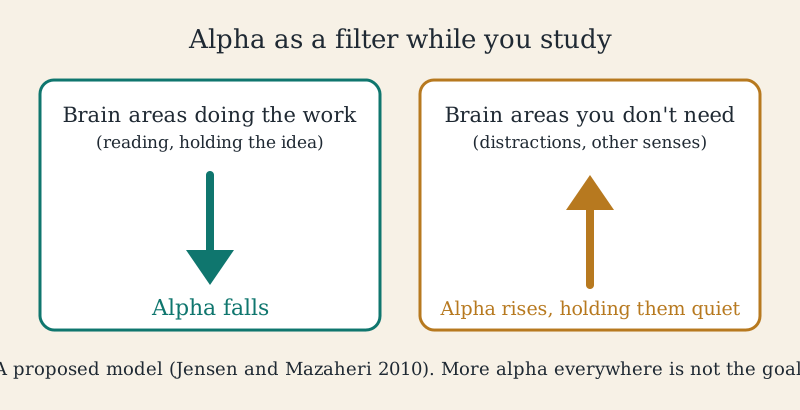
Reviews from Simon Hanslmayr's group (2012 and 2016) argue that drops in alpha and beta power in the cortex help memories form. Wolfgang Klimesch's 1999 review found a similar split: good performers have more alpha at rest and a large drop in alpha during the task.
So what seems to help is alpha in the right place: high where distractions get blocked, low in the areas handling what you're reading.
Working memory
Working memory holds information for a few seconds while you use it. In a 2009 study (Sauseng et al.), alpha activity around 10 Hz predicted how much people could hold in visual short-term memory, which tops out at about four items. The link ran through how well they ignored distracting items. Magnetic stimulation at alpha frequency changed that capacity.
The anxiety connection
Stress does get in the way of learning. A 2017 meta-analysis of 113 studies (6,216 people) found that stress just before or during learning usually impaired memory for the material. Higher arousal also goes with lower resting alpha, but no study has shown that stress hurts learning through alpha, so raising alpha isn't a proven fix for exam nerves. Lowering the stress is the more direct target.
How binaural beats might promote alpha states
Play a 200 Hz tone in your left ear and a 210 Hz tone in your right, and you hear a 10 Hz pulse, the binaural beat. Your brainstem makes it, so each ear needs its own tone through headphones, and both tones must sit below about 1,000 Hz.
The idea is that brain activity drifts toward the beat frequency (the brainwave entrainment hypothesis). A 2023 review of 14 EEG studies found 5 that supported it, 8 that contradicted it and 1 mixed. Whether entrainment happens "remains open", the authors concluded.
The evidence for alpha entrainment
The alpha studies point in different directions:
- Mujib 2021. In a pilot, 60 people heard 15 minutes of 10 Hz, 14 Hz or 30 Hz beats. Only the 10 Hz group improved on a digit span memory test, and their alpha power rose. There was no separate control group.
- Beauchene 2016. On a visuospatial working-memory task, 15 Hz beats raised accuracy. 10 Hz beats did worse, as did 5 Hz, a pure tone, classical music and silence.
- Reedijk 2015. In 24 students, 40 Hz beats removed the "attentional blink" (missing a second fast target), but only in people with low eye-blink rates. The 10 Hz beats didn't.
Across all frequencies, a 2019 meta-analysis of 22 studies on memory, attention, anxiety and pain found a medium average effect (g = 0.45), and its size depended on the frequency and on how long and when people listened. The largest single study pulls the other way. In Klichowski 2023, 1,000 people did a two-part intelligence test at home, and those who heard binaural beats during the second part scored much worse. Silence and other sounds made no difference.
So alpha beats for studying have one small pilot in their favour and an unconfirmed mechanism. The binaural beats for focus guide covers every frequency band.
The study protocol
Pre-study: NSDR reset (10 minutes)
If you sit down tired or wired, start with 10 minutes of NSDR. You lie still and awake while a voice guides you through your body. In a trial of 65 active adults, 10 minutes of NSDR beat 10 minutes of sitting quietly on a reaction-time test and on accuracy in a second task (Boukhris 2024). Nobody has tested it before studying, so this step is optional. More in a guide to non-sleep deep rest.
During study: alpha binaural beats
Use stereo headphones. Start the beats a few minutes before you open the book and keep them going. In the 2019 meta-analysis, listening before, or before and during, a task did better than listening only during it.
Volume. Keep it comfortable. No study has tested an ideal level.
Layering. Add rain, noise or instrumental music only if plain tones annoy you. Masked and plain beats worked about the same in the meta-analysis.
Duration. A 50-minute block is a practical choice. In a 2023 review, most EEG studies played beats for 1 to 30 minutes.
Post-study: another NSDR session (10-20 minutes)
This step has the best evidence in the plan. In a 2012 study of 33 adults aged 61 to 87 (Dewar et al.), people heard a story, then either rested quietly for 10 minutes or played a spot-the-difference game. They remembered more after rest, both 15 to 30 minutes later and a week later.
That was an older group, but a 2019 meta-analysis of 10 similar studies, including younger adults, found a small-to-moderate benefit for verbal memory (d = 0.38), though the authors' own replication fell short of significance.
No study has tested NSDR for this, but a guided session is one way to rest without reaching for your phone.
The full session structure
| Phase | Duration | What to do |
|---|---|---|
| Pre-study NSDR | 10 min | Guided NSDR session (optional) |
| Study block 1 | 50 min | 10 Hz alpha binaural beats (ambient optional) |
| Break | 10 min | Silence, movement, no screens |
| Study block 2 | 50 min | 10 Hz alpha binaural beats (ambient optional) |
| Post-study NSDR | 10-20 min | Guided NSDR session or quiet eyes-closed rest |
Total time: 2 hours 10 minutes to 2 hours 20 minutes, of which 100 minutes is active study.
Frequency guide for different study activities
No study has tested beats on specific study tasks, so treat this table as a starting point for your own test.
| Activity | Recommended frequency | Why |
|---|---|---|
| Reading textbooks | 10 Hz (alpha) | The one alpha memory pilot was positive |
| Taking notes | 10 Hz (alpha) or none | Untested |
| Practice problems | 15-16 Hz (beta) | 15 Hz beat 10 Hz on working memory |
| Memorizing flashcards | 10 Hz (alpha) | Closest to the pilot's memory test |
| Writing essays | None or 10 Hz | Untested |
| Group study/discussion | None (remove headphones) | You need to hear each other |
| Reviewing before exam | 10 Hz (alpha) or silence | Silence did no harm in the home study |
When not to use alpha binaural beats
- During lectures. You need to hear the speaker.
- When you're already settled and working well. There's no reason to add anything.
- When you're badly short on sleep. No audio tool makes up for lost sleep. A nap or an early night will do more.
Common student mistakes
Using theta binaural beats "for creativity"
In a 1998 study of 29 people, theta and delta beats gave fewer correct detections, more false alarms and worse mood on a 30-minute vigilance task than beta beats. Skip theta when you need to stay sharp.
Studying with lyrics
In a 2023 study of college students, music with lyrics lowered verbal memory, visual memory and reading comprehension. Instrumental lofi neither helped nor hurt. For reading, use instrumental sound, such as lofi with binaural beats.
Cramming without rest
Spaced sessions generally beat one long sitting. A 2006 review of 317 spacing experiments examined this, and the best gap between sessions grew the longer you need to remember the material.
Ignoring the post-study consolidation window
In the 2012 rest study, what people did right after learning changed how much they recalled a week later, and quiet rest beat a spot-the-difference game. Phones weren't tested, but scrolling is the demanding task most people reach for.
The science of study breaks
Good breaks include walking without your phone, gentle stretching, eyes-closed rest or a short NSDR session. Social media, email and videos pull your attention straight back in, though no study has compared them as study breaks. Nature has some direct support. In a 2008 study, walking in nature or looking at nature pictures improved attention scores more than the urban versions.
In a 2021 NIH study, as people learned a typing-style sequence, their brains replayed it about 20 times faster during short rests, and more replay predicted bigger gains. That was a motor skill, but it suggests rests are part of learning. For timed blocks, see Pomodoro rounds with binaural beats.
Getting started
Days 1-3: Study as normal in silence, with quiet rest after each session. Quiz yourself the next day and note your score.
Days 4-6: Same kind of material, with 10 Hz beats started a few minutes before each block. Quiz yourself the next day.
Day 7: Compare quiz scores, not how focused you felt.
Keep the beats if your scores went up. Keep the rest after studying either way.
The bottom line
Alpha binaural beats are a cheap experiment with thin evidence. Rest after studying, spaced sessions and avoiding lyrics have better support. NSDR.co is free, and there will always be a free plan.
Binaural beats aren't a treatment for attention or anxiety problems and don't replace sleep or care from a clinician.
FAQ
Do alpha waves help you study?
Your own alpha waves help you study, since alpha seems to hold unneeded brain areas quiet while others work. Playing alpha waves for studying is less proven. One small pilot found a memory benefit from 10 Hz beats, and another study found 10 Hz did worse than 15 Hz.
What Hz is best for studying?
No Hz is proven best for studying. 10 Hz beats helped a digit span test in one 2021 pilot, and 15 Hz beat 10 Hz on a working-memory task in 2016. Beta around 15-16 Hz and gamma at 40 Hz have the most focus data, with positive and null results.
Are alpha or beta binaural beats better for studying?
Beta binaural beats have more focus data than alpha: in Beauchene 2016, 15 Hz beat 10 Hz on working memory, and in Lane 1998 beta beat theta and delta on vigilance. Test both against silence for a week.
How long should you listen to alpha waves before studying?
Listen to alpha waves for a few minutes before studying and keep them on through the block. In the 2019 meta-analysis, beats before, or before and during, a task worked better than beats only during it, and the authors advised longer listening.
How can you increase alpha waves without headphones?
You can increase alpha waves without headphones by resting with your eyes closed, since alpha falls when you open them. Neurofeedback is another route. In a 2016 trial, 50 adults did 12 sessions over four weeks, and in the alpha training group alpha rose and working and episodic memory improved for many of them.
Sources
- Barry RJ, Clarke AR, Johnstone SJ, Magee CA, Rushby JA (2007). EEG differences between eyes-closed and eyes-open resting conditions. Clinical Neurophysiology 118(12):2765-2773. https://pubmed.ncbi.nlm.nih.gov/17911042/
- Vergani AA (2024). Hans Berger (1873-1941): the German psychiatrist who recorded the first electrical brain signal in humans 100 years ago. Advances in Physiology Education 48(4):878-881. https://pubmed.ncbi.nlm.nih.gov/39236103/
- Tudor M, Tudor L, Tudor KI (2005). Hans Berger (1873-1941): the history of electroencephalography. Acta Medica Croatica 59(4):307-313. https://pubmed.ncbi.nlm.nih.gov/16334737/
- Jensen O, Mazaheri A (2010). Shaping functional architecture by oscillatory alpha activity: gating by inhibition. Frontiers in Human Neuroscience 4:186. https://pubmed.ncbi.nlm.nih.gov/21119777/
- Hanslmayr S, Staudigl T, Fellner MC (2012). Oscillatory power decreases and long-term memory: the information via desynchronization hypothesis. Frontiers in Human Neuroscience 6:74. https://pubmed.ncbi.nlm.nih.gov/22514527/
- Hanslmayr S, Staresina BP, Bowman H (2016). Oscillations and episodic memory: addressing the synchronization/desynchronization conundrum. Trends in Neurosciences 39(1):16-25. https://pubmed.ncbi.nlm.nih.gov/26763659/
- Klimesch W (1999). EEG alpha and theta oscillations reflect cognitive and memory performance: a review and analysis. Brain Research Reviews 29(2-3):169-195. https://pubmed.ncbi.nlm.nih.gov/10209231/
- Sauseng P, Klimesch W, Heise KF, et al. (2009). Brain oscillatory substrates of visual short-term memory capacity. Current Biology 19(21):1846-1852. https://pubmed.ncbi.nlm.nih.gov/19913428/
- Shields GS, Sazma MA, McCullough AM, Yonelinas AP (2017). The effects of acute stress on episodic memory: a meta-analysis and integrative review. Psychological Bulletin 143(6):636-675. https://pubmed.ncbi.nlm.nih.gov/28368148/
- Ingendoh RM, Posny ES, Heine A (2023). Binaural beats to entrain the brain? A systematic review of the effects of binaural beat stimulation on brain oscillatory activity, and the implications for psychological research and intervention. PLoS One 18(5):e0286023. https://pubmed.ncbi.nlm.nih.gov/37205669/
- Mujib MD, Hasan MA, Qazi SA, Vuckovic A (2021). Understanding the neurological mechanism involved in enhanced memory recall task following binaural beat: a pilot study. Experimental Brain Research 239(9):2741-2754. https://pubmed.ncbi.nlm.nih.gov/34232346/
- Beauchene C, Abaid N, Moran R, Diana RA, Leonessa A (2016). The effect of binaural beats on visuospatial working memory and cortical connectivity. PLoS One 11(11):e0166630. https://pubmed.ncbi.nlm.nih.gov/27893766/
- Reedijk SA, Bolders A, Colzato LS, Hommel B (2015). Eliminating the attentional blink through binaural beats: a case for tailored cognitive enhancement. Frontiers in Psychiatry 6:82. https://pubmed.ncbi.nlm.nih.gov/26089802/
- Garcia-Argibay M, Santed MA, Reales JM (2019). Efficacy of binaural auditory beats in cognition, anxiety, and pain perception: a meta-analysis. Psychological Research 83(2):357-372. https://pubmed.ncbi.nlm.nih.gov/30073406/
- Klichowski M, Wicher A, Kruszwicka A, Golebiewski R (2023). Reverse effect of home-use binaural beats brain stimulation. Scientific Reports 13(1):11079. https://pubmed.ncbi.nlm.nih.gov/37422545/
- Boukhris O, Suppiah H, Halson S, et al. (2024). The acute effects of nonsleep deep rest on perceptual responses, physical, and cognitive performance in physically active participants. Applied Psychology: Health and Well-Being 16(4):1967-1987. https://pubmed.ncbi.nlm.nih.gov/38953770/
- Dewar M, Alber J, Butler C, Cowan N, Della Sala S (2012). Brief wakeful resting boosts new memories over the long term. Psychological Science 23(9):955-960. https://pubmed.ncbi.nlm.nih.gov/22829465/
- Humiston GB, Tucker MA, Summer T, Wamsley EJ (2019). Resting states and memory consolidation: a preregistered replication and meta-analysis. Scientific Reports 9(1):19345. https://pubmed.ncbi.nlm.nih.gov/31852988/
- Lane JD, Kasian SJ, Owens JE, Marsh GR (1998). Binaural auditory beats affect vigilance performance and mood. Physiology & Behavior 63(2):249-252. https://pubmed.ncbi.nlm.nih.gov/9423966/
- Souza AS, Leal Barbosa LC (2023). Should we turn off the music? Music with lyrics interferes with cognitive tasks. Journal of Cognition 6(1):24. https://pubmed.ncbi.nlm.nih.gov/37152835/
- Cepeda NJ, Pashler H, Vul E, Wixted JT, Rohrer D (2006). Distributed practice in verbal recall tasks: a review and quantitative synthesis. Psychological Bulletin 132(3):354-380. https://pubmed.ncbi.nlm.nih.gov/16719566/
- Berman MG, Jonides J, Kaplan S (2008). The cognitive benefits of interacting with nature. Psychological Science 19(12):1207-1212. https://pubmed.ncbi.nlm.nih.gov/19121124/
- Buch ER, Claudino L, Quentin R, Bönstrup M, Cohen LG (2021). Consolidation of human skill linked to waking hippocampo-neocortical replay. Cell Reports 35(10):109193. https://pubmed.ncbi.nlm.nih.gov/34107255/
- Hsueh JJ, Chen TS, Chen JJ, Shaw FZ (2016). Neurofeedback training of EEG alpha rhythm enhances episodic and working memory. Human Brain Mapping 37(7):2662-2675. https://pubmed.ncbi.nlm.nih.gov/27038114/