No study has tested Pomodoro binaural beats, meaning beats played through each 25-minute work round, though each half has some evidence on its own. Binaural beats show a medium average effect across memory, attention, anxiety and pain studies, with single studies that conflict. To combine them, start beta (15-16 Hz) or 40 Hz beats a few minutes before the timer, take the headphones off for every break, and compare a week of it against silence.
The Pomodoro problem: slow starts
The Pomodoro technique is 25 minutes of work and a 5-minute break, repeated. In Cirillo's own guide you take a longer break of 15 to 30 minutes after four rounds. Francesco Cirillo came up with it in the late 1980s, as a university student, and named it after his tomato-shaped kitchen timer.
The weak spot is the start of each round. "The first five to 10 minutes of that 90 minutes are a transition time," neuroscientist Andrew Huberman says in his Focus Toolkit episode. He meant 90-minute blocks, but a 25-minute round leaves even less time to recover from a slow start.
A common claim says deep focus takes 15 to 25 minutes to return after an interruption. The real figure comes from Gloria Mark at UC Irvine, whose team shadowed 36 office workers for three days. Most interrupted work (82%) was picked up again the same day, after 23 minutes and 15 seconds on average, usually with two other tasks done in between. That measures getting back to a task, not back into focus.
Does the timer itself help? Three small student trials compared Pomodoro-style breaks with breaks people chose themselves:
- Biwer 2023 (87 students). Fixed schedules (24 minutes on and 6 off, or 12 on and 3 off) left students less tired and distracted than choosing their own breaks, and they appeared to finish the same work in less time.
- Smits 2025 (94 students). Fatigue rose faster with Pomodoro, but productivity and flow came out the same.
- Göksu 2026 (176 students). No difference in performance, and self-chosen breaks gave better moods.
So the evidence for the timer is thin, and the trials disagree on mood. For longer blocks, see how long a focus session should be.
How binaural beats fit into a Pomodoro
Play a 200 Hz tone in one ear and a 210 Hz tone in the other, and you hear a pulse at 10 Hz. That pulse is the binaural beat. Your brain makes it from the two tones, so you need headphones.
The evidence is mixed. A 2019 meta-analysis of 22 studies on memory, attention, anxiety and pain found a medium average effect (g = 0.45). A 2023 review of 14 EEG studies found 5 that supported the idea that brainwaves follow the beat, 8 that contradicted it and 1 mixed. In the largest study, 1,000 people took a fluid-intelligence test at home. Those who heard binaural beats during the second half scored much worse, while silence or other sounds made no difference (Klichowski 2023). More is in what the research says about binaural beats for focus.
Nobody has measured whether beats shorten a Pomodoro warm-up. In the 2019 meta-analysis, listening before, or before and during, a task beat listening only during it. And in two EEG studies from one lab, brain responses showed up within 10 to 15 minutes. So put the beats on before the timer starts and keep them going through the round.
The Pomodoro binaural beats protocol
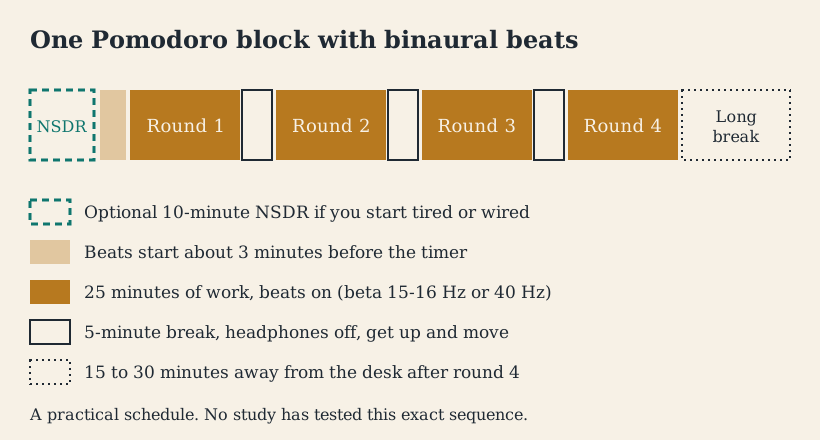
Each step says whether it comes from a study or is a practical suggestion. No study has tested the whole sequence.
Before the block: an optional 10-minute NSDR
If you sit down tired or wired, do a 10-minute NSDR session first. You lie still and follow a voice through your body while staying awake. In a trial of 65 active adults, 10 minutes of NSDR beat 10 minutes of sitting quietly on a reaction-time test and on accuracy in a second task (Boukhris 2024). Nobody has tested it before a Pomodoro block. More on what NSDR is and how to do it.
Round 1
- Start beta (15-16 Hz) or 40 Hz beats about 3 minutes before the timer. (Timing from the research; 3 minutes is a practical choice.)
- Keep the volume comfortable. No study has tested an ideal level.
- Layer the beats under noise or lofi only if pure tones annoy you. Masked and plain beats worked about equally in the 2019 meta-analysis. For music, see pairing binaural beats with lofi music.
- Start the 25-minute timer and work on one task.
Breaks
Take the headphones off for the 5 minutes and move. No study has tested beats during breaks, or a 5-minute version of this. The nearest evidence comes from longer breaks. In Berman 2008, a walk of about 2.8 miles through an arboretum, or even looking at nature pictures, improved attention scores more than the city versions did. So a short walk outside is a reasonable choice.
Rounds 2 to 4 and the long break
Keep the same beats, or switch to plain noise if the tones start to grate. After round 4, take 15 to 30 minutes away from the desk. Four rounds add up to 100 minutes of beats, while most studies in the 2023 review played them for 1 to 30 minutes.
Frequency selection by work type
Many Pomodoro beat tracks pair a frequency with a task, such as alpha for writing. No study has tested those pairings. Here is what each frequency was tested on.
| Frequency | What studies tested | What they found | Use it for |
|---|---|---|---|
| Beta, 15-16 Hz | Vigilance, working memory, sustained attention | Beat theta and delta, and beat 10 Hz and silence on working memory; no consistent benefit in Robison 2022 | Work rounds, first choice |
| Gamma, 40 Hz | Attention focus, word recall, attention tests | Narrower attention after 3 minutes; more words recalled; no effect in Leistiko 2023 (58 adults) | Work rounds, second choice |
| Alpha, 10 Hz | Creativity, working memory | Helped creative thinking only in some people; worse than 15 Hz on working memory | Little focus evidence |
| Theta and delta, 6 Hz and below | Vigilance, EEG | Worse vigilance and mood than beta; a meditative EEG pattern at 6 Hz | Skip for work |
| No beats | Silence or other sounds (Klichowski 2023) | No change in test scores | Your baseline |
Beta results come from Lane 1998, Beauchene 2016 and Robison 2022; gamma from Colzato 2017, Jirakittayakorn 2017 and Leistiko 2023. Nobody has tested coding, writing or email, so a frequency sold for programming is a guess.
Pomodoro, binaural beats and ADHD
A Pomodoro timer may help with ADHD because 25 minutes is easier to commit to than an open afternoon. A PubMed search turned up no ADHD trial of the Pomodoro technique.
Binaural beats have a weak record here. In Kennel 2010, 20 children and teens with ADHD heard beats or a sham recording for 20 minutes, three times a week, for 3 weeks. Attention tests showed no objective benefit, though families reported fewer homework problems. White or pink noise has better support. A 2024 meta-analysis found a small benefit (g = 0.25) across 13 studies of children and young adults with ADHD or attention problems.
So try the timer with white or pink noise first. More in free focus music for ADHD. Health note: binaural beats are not an ADHD treatment and don't replace care from a clinician.
Common mistakes
Playing beats through speakers
The beat forms only when each ear gets its own tone. Speakers mix the two.
Skipping breaks when it's going well
In Biwer 2023, students who chose their own breaks studied in longer stretches and reported more fatigue and distraction than students on a fixed schedule. Skip the breaks and you're no longer testing a Pomodoro.
Listening all day
Eight hours of beats is untested. Use them for your hardest block only.
Getting started this week
No study has tested this schedule.
- Days 1-2: Pomodoro rounds without beats. Count completed rounds and rate your focus 1 to 10 after each. That's your baseline.
- Days 3-4: the same kind of work with beta beats around 15-16 Hz, started 3 minutes early.
- Days 5-6: 40 Hz, or beta layered over noise.
- Day 7: a 10-minute NSDR session, then whichever setup scored higher.
Keep what beat your baseline, and drop the beats if nothing did. For more on attention, see other focus techniques.
Tools you need
- A timer. Any Pomodoro app, or a kitchen timer like Cirillo's.
- Binaural beats and stereo headphones. Any binaural track or generator that lets you pick the frequency.
- A noise layer (optional). White, pink or brown noise, or lofi.
- A 10-minute NSDR track. NSDR.co is free, and there will always be a free plan.
The bottom line
The beats are a cheap experiment with mixed evidence and one large study where they hurt. Run a week of Pomodoro rounds with beta or 40 Hz beats against a week without, and keep them only if your completed rounds go up. Binaural beats "are not suited for a one-size-fits-all approach", as Reedijk and colleagues put it.
FAQ
Do binaural beats work with the Pomodoro technique?
Binaural beats and the Pomodoro technique have never been tested together. Pomodoro breaks did about as well as self-chosen breaks in three student trials, and binaural beats show a medium average effect with conflicting single studies.
What binaural beat frequency is best for a Pomodoro session?
Beta around 15-16 Hz or 40 Hz is the best-studied binaural beat frequency for a work session, with positive and null results for both. Alpha at 10 Hz has little focus evidence.
Should you listen to binaural beats during Pomodoro breaks?
No study has tested binaural beats during Pomodoro breaks. Taking the headphones off and walking, ideally outside, is the simpler choice.
Is a 25-minute Pomodoro long enough for deep work?
A 25-minute Pomodoro is enough for many tasks; student trials found it about as productive as self-chosen breaks. For long writing or coding, blocks of up to 90 minutes mean paying the 5-10 minute warm-up less often.
Do you need headphones for Pomodoro binaural beats?
Yes. Binaural beats need headphones so each ear gets its own tone; speakers mix them. Any stereo pair works.
Sources
- Cirillo F (2006, v1.3 2007). The Pomodoro Technique. Author's guide. https://internal.ischool.umd.edu/wp-content/uploads/2020/12/ThePomodoroTechnique_v1-3.pdf
- Wikipedia. Pomodoro Technique. https://en.wikipedia.org/wiki/Pomodoro_Technique
- Huberman A (2022). Focus Toolkit: Tools to Improve Your Focus & Concentration. Huberman Lab podcast #88. https://www.hubermanlab.com/episode/focus-toolkit-tools-to-improve-your-focus-and-concentration
- Robison J (2006). Too many interruptions at work? Interview with Gloria Mark. Gallup Business Journal. https://news.gallup.com/businessjournal/23146/too-many-interruptions-work.aspx
- Biwer F, Wiradhany W, Oude Egbrink MGA, de Bruin ABH (2023). Understanding effort regulation: comparing 'Pomodoro' breaks and self-regulated breaks. British Journal of Educational Psychology 93 Suppl 2:353-367. https://pubmed.ncbi.nlm.nih.gov/36859717/
- Smits EJC, Wenzel N, de Bruin A (2025). Investigating the effectiveness of self-regulated, Pomodoro, and Flowtime break-taking techniques among students. Behavioral Sciences 15(7):861. https://pubmed.ncbi.nlm.nih.gov/40723645/
- Göksu A, Wiradhany W, de Bruin ABH (2026). When to take a break: comparing effects of systematic short (Pomodoro) and self-regulated breaks on subjective experience and actual learning. Behavioral Sciences 16(7):1158. https://pubmed.ncbi.nlm.nih.gov/42510279/
- Garcia-Argibay M, Santed MA, Reales JM (2019). Efficacy of binaural auditory beats in cognition, anxiety, and pain perception: a meta-analysis. Psychological Research 83(2):357-372. https://pubmed.ncbi.nlm.nih.gov/30073406/
- Ingendoh RM, Posny ES, Heine A (2023). Binaural beats to entrain the brain? A systematic review of the effects of binaural beat stimulation on brain oscillatory activity, and the implications for psychological research and intervention. PLoS One 18(5):e0286023. https://pubmed.ncbi.nlm.nih.gov/37205669/
- Klichowski M, Wicher A, Kruszwicka A, Golebiewski R (2023). Reverse effect of home-use binaural beats brain stimulation. Scientific Reports 13(1):11079. https://pubmed.ncbi.nlm.nih.gov/37422545/
- Jirakittayakorn N, Wongsawat Y (2017). Brain responses to a 6-Hz binaural beat: effects on general theta rhythm and frontal midline theta activity. Frontiers in Neuroscience 11:365. https://pubmed.ncbi.nlm.nih.gov/28701912/
- Jirakittayakorn N, Wongsawat Y (2017). Brain responses to 40-Hz binaural beat and effects on emotion and memory. International Journal of Psychophysiology 120:96-107. https://pubmed.ncbi.nlm.nih.gov/28739482/
- Boukhris O, Suppiah H, Halson S, et al. (2024). The acute effects of nonsleep deep rest on perceptual responses, physical, and cognitive performance in physically active participants. Applied Psychology: Health and Well-Being 16(4):1967-1987. https://pubmed.ncbi.nlm.nih.gov/38953770/
- Berman MG, Jonides J, Kaplan S (2008). The cognitive benefits of interacting with nature. Psychological Science 19(12):1207-1212. https://pubmed.ncbi.nlm.nih.gov/19121124/
- Lane JD, Kasian SJ, Owens JE, Marsh GR (1998). Binaural auditory beats affect vigilance performance and mood. Physiology & Behavior 63(2):249-252. https://pubmed.ncbi.nlm.nih.gov/9423966/
- Beauchene C, Abaid N, Moran R, et al. (2016). The effect of binaural beats on visuospatial working memory and cortical connectivity. PLoS One 11(11):e0166630. https://pubmed.ncbi.nlm.nih.gov/27893766/
- Robison MK, Obulasetty M, Blais C, et al. (2022). The effect of binaural beat stimulation on sustained attention. Psychological Research 86(3):808-822. https://pubmed.ncbi.nlm.nih.gov/33978805/
- Colzato LS, Barone H, Sellaro R, Hommel B (2017). More attentional focusing through binaural beats: evidence from the global-local task. Psychological Research 81(1):271-277. https://pubmed.ncbi.nlm.nih.gov/26612201/
- Leistiko NM, Madanat L, Yeung WKA, Stone JM (2023). Effects of gamma frequency binaural beats on attention and anxiety. Current Psychology. https://pubmed.ncbi.nlm.nih.gov/37359672/
- Reedijk SA, Bolders A, Hommel B (2013). The impact of binaural beats on creativity. Frontiers in Human Neuroscience 7:786. https://pubmed.ncbi.nlm.nih.gov/24294202/
- Kennel S, Taylor AG, Lyon D, et al. (2010). Pilot feasibility study of binaural auditory beats for reducing symptoms of inattention in children and adolescents with attention-deficit/hyperactivity disorder. Journal of Pediatric Nursing 25(1):3-11. https://pubmed.ncbi.nlm.nih.gov/20117669/
- Nigg JT, Bruton A, Kozlowski MB, et al. (2024). Systematic review and meta-analysis: do white noise or pink noise help with task performance in youth with attention-deficit/hyperactivity disorder or with elevated attention problems? Journal of the American Academy of Child & Adolescent Psychiatry 63(8):778-788. https://pubmed.ncbi.nlm.nih.gov/38428577/