Magnesium threonate may help some people feel more rested, but the evidence for magnesium threonate for sleep is thinner than the marketing suggests. Two small trials, both paid for by companies that sell the ingredient, found gains on some sleep measures and none on others. A 2026 trial of Huberman's three-supplement sleep stack found no significant difference in sleep disturbance. The usual dose is 2 g of magnesium L-threonate, which holds about 145 mg of magnesium, taken in the evening.
What is magnesium threonate, and why does it matter for sleep?
Magnesium threonate (full name magnesium L-threonate; the patented version is Magtein) is magnesium bound to threonate. Your body makes threonate when it breaks down vitamin C, and manufacturers make it from vitamin C too.
What makes threonate different from other magnesium forms
Threonate was developed to raise magnesium inside the brain, and that is still its main selling point. The 2010 rat study that launched it came from MIT.
You'll see sites claim threonate absorbs at 75% and glycinate at 80%. No study gives either number. The European Food Safety Authority (EFSA) reviewed threonate in 2024. It concluded that its magnesium is bioavailable, meaning your body can take it up, and gave no human absorption figure. The one form with a well-known figure is the cheap one. In a 2001 study, people absorbed only about 4% of the magnesium in magnesium oxide.
Threonate is also light on magnesium. By weight it's only 7 to 8% magnesium, so 2 g of powder gives you about 145 mg.
The blood-brain barrier question
The brain claim comes from rats. In a 2010 study in Neuron, rats given threonate in their drinking water saw magnesium in the fluid around the brain rise about 7% from baseline over 24 days, ending about 16% above untreated rats. They had a higher density of synapse markers in the hippocampus, a memory area, and did better on learning and memory tests.
No human study has measured brain magnesium after threonate, or compared it with other forms. Any label that calls threonate the form that crosses the blood-brain barrier is extrapolating from rats.
Why magnesium matters for sleep
Magnesium blocks NMDA receptors, which carry excitatory signals, and acts on GABA receptors, the brain's main calming system. That is the usual explanation for its link with sleep.
The human evidence for magnesium in general is small. In a 2012 trial of 46 older adults with insomnia, 500 mg of magnesium a day for 8 weeks lowered insomnia scores and blood cortisol compared with placebo. That trial used magnesium oxide, the poorly absorbed form. Neither effect has been measured for threonate.
What does the clinical research say?
Two randomised, placebo-controlled trials have tested magnesium threonate for sleep. A third tested it as part of a stack (covered in the stacking section).
The 2024 sleep trial: what improved and what didn't
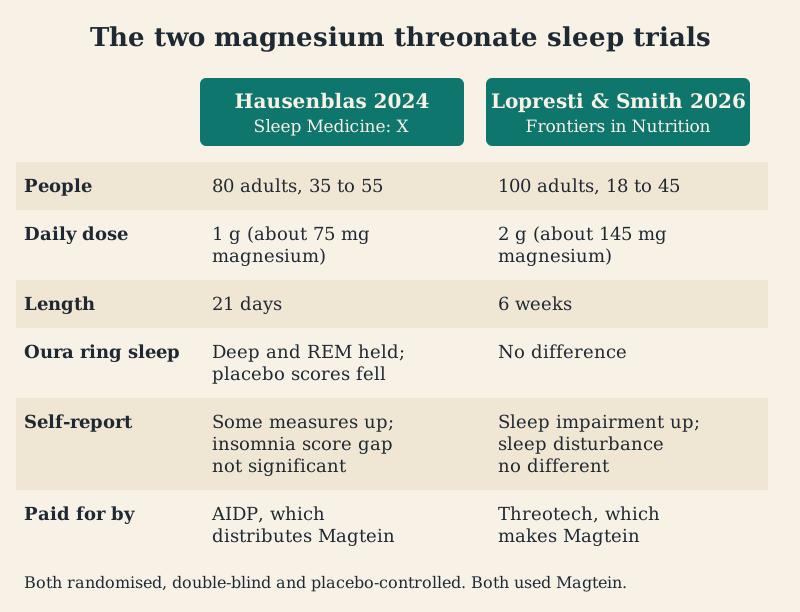
Hausenblas and colleagues (Sleep Medicine: X, 2024) gave 80 adults aged 35 to 55 with self-reported sleep problems either 1 g of magnesium L-threonate a day (about 75 mg of magnesium) or a placebo for 21 days. People took the capsules 2 hours before bed and wore an Oura ring.
Insomnia scores fell in both groups, from 12.32 to 7.86 on threonate and from 12.57 to 9.39 on placebo. The difference in how the two groups changed over the trial wasn't statistically significant (p = 0.39). The pattern differed, though. Placebo gains came in the first week and then levelled off, while the threonate group kept improving to day 21.
At the end, people answered yes or no to a few questions:
- "Is your sleep more refreshing/restoring?" 57% yes on threonate, 29% on placebo (p = 0.01)
- "Do you feel more rested upon awakening?" 62% vs 29% (p = 0.004)
- "Do you feel more alert during the daytime?" 59% vs 26% (p = 0.004)
- "Has the quality of your sleep improved?" 57% vs 42%, not a significant difference
The Oura ring added objective data. Deep sleep score (p < 0.001) and REM sleep score (p = 0.020) held steady on threonate while they fell on placebo. One result ran the other way. People on threonate took slightly longer to fall asleep. The authors concluded its benefits are about deeper sleep and waking refreshed rather than falling asleep faster.
The 2026 cognition trial: sleep as a secondary finding
Lopresti and Smith (Frontiers in Nutrition, published January 2026) gave 100 adults aged 18 to 45 with poor sleep either 2 g of Magtein a day (145 mg of magnesium) or a placebo for six weeks, as one capsule in the morning and one 2 hours before bed. Cognition was the main outcome.
Sleep results were mostly flat. Sleep-related impairment, a questionnaire about how poor sleep affects your day, improved more on threonate (p = 0.043). Sleep disturbance (p = 0.316) and restorative sleep (p = 0.439) did not, though in a subset with more severe sleep problems, sleep disturbance did differ (p = 0.031). On the Oura ring there was no difference in any sleep measure.
The ring did pick up something else. Heart rate during sleep fell by 1.32 beats per minute on threonate (p = 0.030), and heart rate variability rose (p = 0.036). The authors read that as more parasympathetic (rest-and-digest) activity.
Overall cognition scores also improved more than on placebo (p = 0.043), and reaction time got faster (p = 0.031). The headline 7.5-year cognitive age figure comes from converting a 2.24-point gap in test scores into an age estimate. The authors call it exploratory, and nothing in the brain was measured.
What the evidence doesn't tell us
Both trials were paid for by companies that sell Magtein. AIDP, which distributes it, funded the 2024 trial, and three of its six authors work for or consult for AIDP. That trial was registered after the fact, in April 2024. Threotech, which makes Magtein, funded the 2026 trial and helped design it.
The two trials also disagree on the Oura ring. In the 2024 trial, deep and REM sleep scores held steady on threonate and fell on placebo. The 2026 trial, which was longer and larger, found none.
Zoom out to magnesium in general and the picture stays modest. A 2026 systematic review found 12 trials of magnesium for sleep in adults and rated the evidence low to very low certainty. Its conclusion: "Current evidence does not support oral magnesium as a routine treatment for insomnia."
No trial has compared threonate with glycinate for sleep. Every "threonate beats glycinate" claim is reasoning from mechanism.
The right dosage and timing protocol
Labels cause most of the confusion here, because they mix up the weight of the compound and the weight of the magnesium in it.
How much to take (elemental vs. compound weight)
When a label says "2,000 mg magnesium L-threonate", that's the compound. The magnesium in it, called elemental magnesium, is about 145 mg. A 1 g dose holds about 75 mg.
2 g a day is the dose used in the 2026 trial and in the stack trial below. In his Sleep Toolkit episode, Andrew Huberman calls 145 mg "the dosage that most people will benefit from", adding: "Some people need to go a little higher, some people need to go a little bit lower."
145 mg sits well under the 310 to 420 mg a day adults need, depending on age and sex, but most of that comes from food. If you add a second magnesium supplement, keep the total from supplements at or under 350 mg a day, the US upper limit.
On safety, EFSA judged up to 3 g of magnesium L-threonate a day safe for adults in 2024. That's about 250 mg of magnesium. Its assessment excluded pregnant and breastfeeding women.
When to take it for sleep
Huberman suggests 30 to 60 minutes before bed, ideally when you haven't eaten for about three hours. That timing is his. Both trials had people take their evening dose about 2 hours before bed.
The 2026 trial's authors say Magtein is typically taken twice a day to keep magnesium levels steady, and their trial split the dose between morning and evening. No trial has compared morning with evening dosing, so if you're taking magnesium threonate for sleep, the simplest option is the whole dose in the evening.
How long before you notice results
Don't expect anything on night one. In the 2024 trial, a few measures pulled ahead of placebo within 7 to 14 days, including feeling mentally alert and the Oura deep sleep score. Mood and grouchiness only differed by day 21. The trials ran three to six weeks. Give it that long before you decide, and judge it on how you feel during the day as well as how you sleep, since that's where most of the positive results showed up.
Side effects and who should skip it
In the trials, threonate was well tolerated. The 2024 trial recorded 4 adverse events on threonate (one night waking, two leg cramps, one "sunken eyes") and 13 on placebo. None was rated as probably caused by the capsules.
Common side effects
Stomach upset is the one to watch for. Huberman estimates that about 5% of people get diarrhoea or gastric distress from magnesium threonate. In the 2026 trial, 2 of 50 people on threonate reported stomach problems, the same number as on placebo, and 2 of 50 had headaches (1 of 50 on placebo). Overall, 10% of the threonate group and 8% of the placebo group had a side effect that might have come from the capsules.
When to stop entirely
If it upsets your gut, Huberman's advice in the same episode is to stop rather than cut back: "The proper dosage for you, in other words, would be zero milligrams." For a supplement with modest benefits, that's sensible.
Who should not take magnesium threonate
- Kidney disease. Your kidneys clear excess magnesium. Dangerously high magnesium levels are seen almost only in people with poor kidney function taking magnesium supplements or antacids.
- Some medications. Quinolone and tetracycline antibiotics and osteoporosis drugs called bisphosphonates bind to magnesium. Take those antibiotics at least 2 hours before or 4 to 6 hours after magnesium, and keep bisphosphonates at least 2 hours apart. Diuretics and long-term acid-reflux drugs (PPIs) change your magnesium levels, so ask your pharmacist first.
- Pregnancy and breastfeeding. EFSA's safety assessment excluded both, so its verdict doesn't cover you.
- Severe insomnia or a diagnosed sleep disorder. Both trials excluded people with sleep disorders, and the 2026 review doesn't support magnesium as a routine insomnia treatment. See a doctor or sleep specialist.
Health note: this is general information, not medical advice. Check with a doctor or pharmacist before starting magnesium if you have a health condition or take regular medication.
How to stack magnesium threonate for better results
Threonate is one of three supplements in Huberman's sleep stack, which has now had one trial of its own.
The base stack: magnesium threonate + apigenin + theanine
Huberman's sleep newsletter lists 145 mg magnesium threonate, 50 mg apigenin and 100 to 400 mg theanine, taken 30 to 60 minutes before bed. In the Sleep Toolkit episode he says the three "together can really enhance the speed at which one falls asleep and people's ability to stay asleep and to really get into those deep stages of sleep that are particularly restorative."
Each works differently. Apigenin, a plant compound found in chamomile, binds the same brain receptor site as benzodiazepines in lab and mouse studies. Theanine, an amino acid from tea, increases alpha brain-wave activity in people. More on dosing in L-theanine for sleep.
The combination has now been tested once. In Mastrofini 2026 (J Int Soc Sports Nutr, funded by Momentous), 145 mg magnesium from threonate + 200 mg theanine + 50 mg apigenin for two weeks left sleep disturbance no different from placebo (p = 0.478). The 103 participants were healthy, physically active adults, so the result may not carry over to people who sleep badly. It does mean the stack's effect on sleep is unproven. The full breakdown is in Huberman's sleep cocktail.
Glycine, GABA and inositol nights
Huberman adds two things on some nights. Every third or fourth night he takes 2 g glycine and 100 mg GABA on top of the base stack. On other nights, every other night or so, he adds 900 mg myo-inositol, never on the same night as glycine and GABA.
He says taking glycine and GABA more often made the whole stack work less well for him, and that he doesn't know why. That's one person's report. No study has tested tolerance to threonate or to the stack.
His practical advice is easier to act on. Buy single-ingredient products rather than blends, so you can set each dose and drop what doesn't suit you, and start with one supplement at a time.
Falling asleep vs. staying asleep: different problems, different solutions
If you struggle to fall asleep, threonate isn't the obvious pick. In the 2024 trial it slightly lengthened the time to fall asleep, and its better results were on deep sleep scores and feeling rested.
If you wake in the night, Huberman's add-on is myo-inositol. Describing his own nights, he says: "if I wake up in the middle of the night, which I often do to use the bathroom, I find it very, very easy to fall back asleep." There's no trial behind that, so treat it as an anecdote. If early waking is your main problem, start with the usual causes covered in waking at 3am before adding supplements.
Magnesium threonate vs. glycinate: which one for sleep?
No trial compares them for sleep, so any answer rests on what each one is and how much magnesium it delivers.
Mechanism differences
Threonate's case is brain magnesium, based on the rat study above. Its human sleep data are the two industry-funded trials.
Glycinate (often labelled bisglycinate) is magnesium bound to the amino acid glycine. Glycine on its own, taken as 3 g before bed, shortened the time to fall asleep and to reach slow-wave sleep in a Japanese study. A 250 mg magnesium dose as bisglycinate carries about 1.5 g of glycine, half that amount, so don't count on the glycine doing much.
Neither form has a proven absorption percentage.
When to choose each
- Choose threonate if you want the form with sleep trials of its own, small and industry-funded as they are, or you're curious about the cognition data.
- Choose glycinate if you want more magnesium per capsule, or you're also trying to raise your overall magnesium intake.
Huberman's newsletter lists 200 mg magnesium bisglycinate as an alternative to threonate. He doesn't suggest taking both. For how glycinate compares with the other common form, see magnesium glycinate vs citrate.
Cost and practical considerations
Threonate is only 7 to 8% magnesium by weight, so most of what you swallow is threonate. That's fine if the brain-magnesium idea is why you're buying it. If you mainly want more magnesium, glycinate, at about 14% magnesium by weight, gets you there with fewer capsules. Without a head-to-head trial, decide on your budget and which evidence you find convincing.
Pair magnesium with NSDR for a complete sleep protocol
NSDR (non-sleep deep rest) is 10 to 30 minutes of guided, awake rest. You lie still and follow a voice through your body while your breathing slows. It may help you downshift before bed, and it's free to try. Nobody has tested magnesium and NSDR together, so treat them as two low-risk habits that may each help. Take your evening dose, then do a 10-minute NSDR session in bed. More in NSDR for sleep.
FAQ
Does magnesium threonate improve sleep quality?
Magnesium threonate improved some sleep measures in small trials, but not all of them. In the 2024 trial, more people on threonate said their sleep felt refreshing (57% vs 29%) and Oura deep and REM sleep scores held steady while they dipped on placebo, though insomnia scores also improved on placebo and the gap between groups wasn't significant. In the 2026 trial, Oura sleep data didn't change at all. Both trials were industry-funded, and a 2026 trial of the Huberman stack found no significant difference in sleep disturbance.
How much magnesium L-threonate should I take for sleep?
The usual dose is 2 g of magnesium L-threonate, which holds about 145 mg of magnesium. The 2024 sleep trial used 1 g (about 75 mg). If you're using magnesium threonate for sleep, take it in the evening. The trials used 2 hours before bed, and Huberman suggests 30 to 60 minutes. Keep magnesium from all supplements at or under 350 mg a day.
Is magnesium glycinate or threonate better for sleep?
Neither has been shown to be better, because no trial has compared them. Threonate has two small, industry-funded sleep trials with mixed results. Glycinate gives you about twice as much magnesium per gram. Huberman lists glycinate as an alternative to threonate and doesn't suggest taking both.
How long does magnesium threonate take to work for sleep?
In the 2024 trial, magnesium threonate pulled ahead of placebo within 7 to 14 days on a few measures, such as feeling alert and the deep sleep score, and only by day 21 on mood. The trials ran three to six weeks, so give it that long before you judge it.
What are the side effects of magnesium L-threonate?
The main side effect of magnesium L-threonate is stomach upset, which Huberman estimates affects about 5% of people. In the 2026 trial, stomach complaints (2 of 50) and headaches (2 of 50) were about as common as on placebo, and the 2024 trial logged fewer side effects on threonate than on placebo (4 vs 13). Skip it if you have kidney disease, are pregnant or breastfeeding, and check timing with a pharmacist if you take antibiotics, bisphosphonates, diuretics or PPIs.
Sources
- Hausenblas HA, Lynch T, Hooper S, Shrestha A, Rosendale D, Gu J. 2024. Magnesium-L-threonate improves sleep quality and daytime functioning in adults with self-reported sleep problems: a randomized controlled trial. Sleep Medicine: X. https://pubmed.ncbi.nlm.nih.gov/39252819/
- Hausenblas HA et al. 2025. Corrigendum/Erratum to "Magnesium-L-threonate improves sleep quality and daytime functioning in adults with self-reported sleep problems". Sleep Medicine: X. https://pubmed.ncbi.nlm.nih.gov/40567408/
- Lopresti AL, Smith SJ. 2026. The effects of magnesium L-threonate (Magtein) on cognitive performance and sleep quality in adults: a randomised, double-blind, placebo-controlled trial. Frontiers in Nutrition. https://pubmed.ncbi.nlm.nih.gov/41601871/
- Lopresti AL, Smith SJ, Drummond PD. 2026. Magnesium supplementation for sleep in adults: a systematic review of randomized controlled trials. Journal of Dietary Supplements. https://pubmed.ncbi.nlm.nih.gov/42661485/
- Mastrofini GF et al. 2026. Modulating stress and sleep through a multi-compound dietary supplement: a randomized, double-blind, placebo-controlled trial. Journal of the International Society of Sports Nutrition. https://pubmed.ncbi.nlm.nih.gov/42829807/
- Slutsky I et al. 2010. Enhancement of learning and memory by elevating brain magnesium. Neuron. https://pubmed.ncbi.nlm.nih.gov/20152124/
- EFSA Panel on Nutrition, Novel Foods and Food Allergens (Turck D et al.). 2024. Safety of magnesium L-threonate as a novel food pursuant to Regulation (EU) 2015/2283 and bioavailability of magnesium from this source. EFSA Journal. https://pubmed.ncbi.nlm.nih.gov/38481468/
- Firoz M, Graber M. 2001. Bioavailability of US commercial magnesium preparations. Magnesium Research. https://pubmed.ncbi.nlm.nih.gov/11794633/
- Abbasi B et al. 2012. The effect of magnesium supplementation on primary insomnia in elderly: a double-blind placebo-controlled clinical trial. Journal of Research in Medical Sciences. https://pubmed.ncbi.nlm.nih.gov/23853635/
- Van Laecke S. 2019. Hypomagnesemia and hypermagnesemia. Acta Clinica Belgica. https://pubmed.ncbi.nlm.nih.gov/30220246/
- Schuster J et al. 2025. Magnesium bisglycinate supplementation in healthy adults reporting poor sleep: a randomized, placebo-controlled trial. Nature and Science of Sleep. https://pubmed.ncbi.nlm.nih.gov/40918053/
- Yamadera W et al. 2007. Glycine ingestion improves subjective sleep quality in human volunteers, correlating with polysomnographic changes. Sleep and Biological Rhythms. https://doi.org/10.1111/j.1479-8425.2007.00262.x
- Viola H et al. 1995. Apigenin, a component of Matricaria recutita flowers, is a central benzodiazepine receptors-ligand with anxiolytic effects. Planta Medica. https://pubmed.ncbi.nlm.nih.gov/7617761/
- Nobre AC, Rao A, Owen GN. 2008. L-theanine, a natural constituent in tea, and its effect on mental state. Asia Pacific Journal of Clinical Nutrition. https://pubmed.ncbi.nlm.nih.gov/18296328/
- NIH Office of Dietary Supplements. Magnesium: Fact Sheet for Health Professionals. https://ods.od.nih.gov/factsheets/Magnesium-HealthProfessional/
- Huberman A. 2022. Sleep Toolkit: Tools for Optimizing Sleep & Sleep-Wake Timing. Huberman Lab podcast. https://www.hubermanlab.com/episode/sleep-toolkit-tools-for-optimizing-sleep-and-sleep-wake-timing
- Huberman A. 2021. Toolkit for Sleep. Huberman Lab newsletter. https://www.hubermanlab.com/newsletter/toolkit-for-sleep