NSDR and self-hypnosis are both guided practices you do lying down and awake, usually for 10 to 30 minutes. Andrew Huberman, who coined the term NSDR, counts hypnosis as one form of it. In NSDR vs hypnosis, the real difference is attention. Yoga nidra-style NSDR asks you to let focus go slack and rest. Hypnosis narrows focus onto one thing while your body relaxes, and it aims at a set goal, such as less pain or easier sleep. Want rest with no target? Use NSDR. Have a specific target and respond to hypnosis? Try a hypnosis script.
NSDR vs hypnosis: the short answer
In his Focus Toolkit episode, Huberman says "NSDR and yoga nidra are aimed at deep relaxation." Hypnosis, by contrast, "is a unique brain state because it's one in which you are deeply focused and yet deeply relaxed."
Both relax you. Only hypnosis asks you to concentrate.
What NSDR is
Non-sleep deep rest is an umbrella name Huberman gave to practices that relax you deeply without sleep. The one he describes in most detail is yoga nidra: you lie down for 10 to 30 minutes, sometimes 60, while an audio script takes you through a body scan and long exhales. More on how yoga nidra works and what its studies found.
What hypnosis is (and isn't)
Forget the stage act with the pocket watch. Huberman calls that the version with "people squawking like chickens." David Spiegel, a Stanford psychiatrist with more than 40 years of clinical and research work on hypnosis, dislikes it because it makes fools of people. "They think you're losing control; you're gaining control," he told Huberman.
Clinical self-hypnosis has a set shape. An induction narrows your attention, often with an eye or breathing exercise, and you relax more deeply. Then come suggestions aimed at one goal, and you bring yourself back out.
Spiegel's best-known trials put women with metastatic breast cancer in weekly support groups for a year, some also learning self-hypnosis. In a 1983 study of 54 women, the group that also got self-hypnosis training did best on pain. On Huberman's podcast, Spiegel said that by the end of the year, the treatment group (support group plus self-hypnosis) had half the pain of the controls. A 1989 follow-up reported longer survival in the group therapy arm (a mean of 36.6 months against 18.9), but a larger 2007 trial of 125 women didn't replicate it.
How they relate under the NSDR umbrella
When Huberman defines NSDR in his Daily Tools episode, he calls it "an umbrella term to encompass many protocols" and names three: meditation, yoga nidra and hypnosis.
Huberman's own day shows the overlap. After lunch and a walk, he does "a brief 10-minute hypnosis script" from Spiegel's Reveri app and counts it as his NSDR session. Reveri's research is Spiegel's, and Huberman says he isn't associated with it. More on Huberman's own NSDR routine.
NSDR vs hypnosis: at a glance
| NSDR (yoga nidra) | Self-hypnosis | |
|---|---|---|
| Focus | Spread out, then let go | Narrowed onto one thing |
| Brain findings | Yoga nidra EEG: awake, with more theta and some local slow waves | Linked to theta and gamma changes; less activity in a distraction-monitoring region |
| Primary goal | Rest and recovery, no target | A set target: pain, stress, sleep, focus |
| Session length | 10 to 30 minutes, sometimes 60 | App scripts mostly 10 to 15 minutes, some 1 to 5 |
| Guidance style | Body scan, breath cues | Induction, deepening, suggestion, exit |
| Best for | A daily reset, rest after hard work, winding down | One specific problem you want to work on |
| Who it suits | No screening needed; you follow a voice | Roughly two thirds of adults (Spiegel) |
NSDR vs hypnosis: 5 key differences
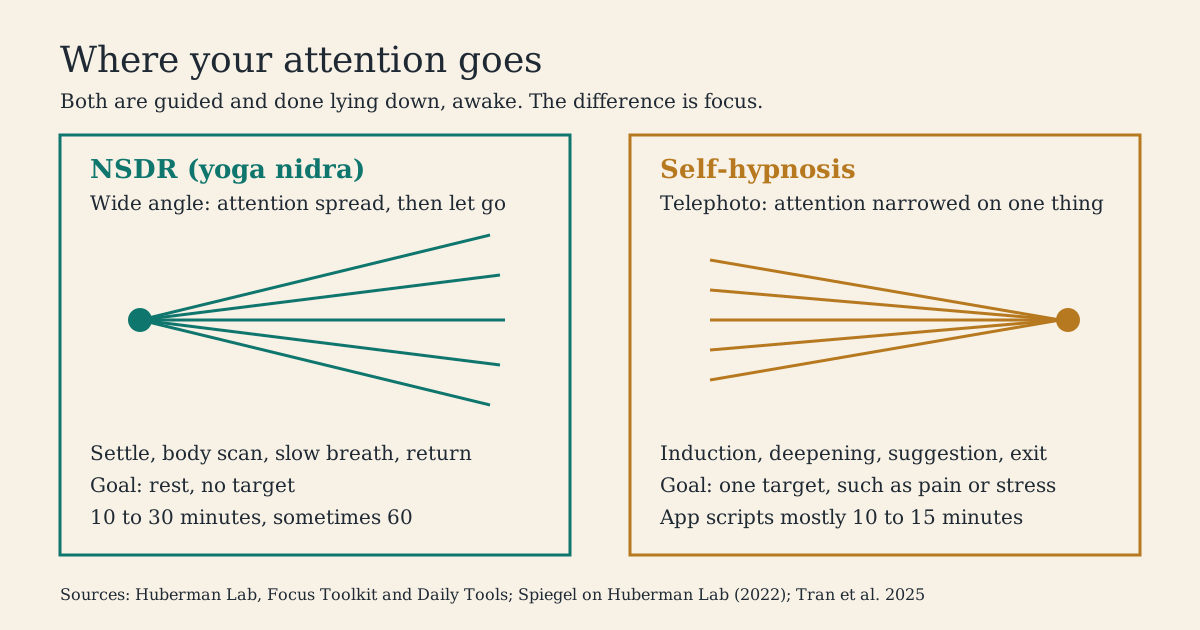
1. Focus: wide-angle vs telephoto
In NSDR and yoga nidra, Huberman says, "you're actually trying to defocus." The voice moves your attention around the body (right hand, forearm, shoulder), and some scripts pair opposite sensations like heavy and light.
Hypnosis works the other way. Spiegel's description: "It's something like looking through the telephoto lens of a camera in consciousness. What you see, you see with great detail, but devoid of context." You lock on to one image, sensation or idea while the rest of your body goes loose.
2. Brain activity: what the studies measured
The brain research on both is small, and none compares the two in the same people.
For yoga nidra, the clearest EEG study (Datta 2022) recorded 30 novices after two weeks of practice, and all 26 with scored recordings stayed awake throughout. Slow delta activity rose over the centre of the head and fell at the front, a pattern the authors called local sleep. In Kjaer's 2002 PET study, theta activity also rose during yoga nidra. They studied yoga nidra, not NSDR tracks. For the wider picture, see what the brain studies on NSDR measured.
For hypnosis, a 2015 review (Jensen et al.) concluded that it "has been most closely linked to power in the theta band and changes in gamma activity." The better scan comes from Spiegel's lab (Jiang 2017), which screened 545 people and scanned the 57 with very high or very low hypnotizability. During hypnosis, activity dropped in the dorsal anterior cingulate cortex, a region that flags conflict and distraction. The brain's planning network linked up more with the insula, which tracks signals from the body. The authors read these changes as the basis for hypnosis's focused attention and lack of self-consciousness.
3. Goal: rest vs a set target
NSDR has no target beyond the rest itself. Four trials use the NSDR name: Boukhris 2024 (65 active adults, 10 minutes), Wrzeciono 2024 (45 heart patients, eight 20-minute sessions), Boukhris 2026a (102 adults, 10 minutes) and Boukhris 2026b (60 adults, 10 minutes against a 25-minute nap, where the nap won on readiness and NSDR showed no effect). In the first, 10 minutes of NSDR beat 10 minutes of sitting quietly on grip strength, reaction time and accuracy, and people rated their stress and tension lower afterwards.
Hypnosis starts with a target. "The essence of hypnosis is for the person, you, to guide your brain toward a particular outcome or change," Huberman says. In a 2025 analysis of 84,395 Reveri users, stress ratings fell by about 1.6 points on a 10-point scale in a first session, from an average of about 5.6. That study had no control group, users rated themselves, and Spiegel co-founded the company.
4. Dopamine: one study each way, neither settled
The "65% more dopamine" figure comes from one 2002 PET study (Kjaer et al.). Eight male yoga teachers did a 72-minute guided yoga nidra session. Tracer binding in the ventral striatum fell by 7.9%, which the authors estimated as 65% more dopamine released during the session than during a control session of listening to speech with eyes closed. It measured release during one session, not baseline levels, and it studied yoga nidra, not NSDR.
Hypnosis has no equivalent headline number. Dopamine is one of several brain chemicals studied in how people respond to suggestion, and a 2021 review (Acunzo et al.) found results pointing at different chemical systems, with multiple limitations in the evidence. Treat any claim that hypnosis works "through dopamine" as a guess.
5. Guidance style: body scan vs induction and suggestion
A yoga nidra track is mostly instructions to notice. Bring your attention to your right hand, then your left, then both. Breathe out slowly. Notice the weight of your body on the floor.
A hypnosis script has more steps and asks more of you. After the induction and a deepening phase, it gives suggestions tied to your goal. Spiegel's stress technique is a good example. You picture the problem on an imaginary screen, "with the rule that no matter what you see on the screen, you keep your body comfortable."
Who hypnosis works for, and what for
This is the biggest practical difference. Hypnosis depends on a trait called hypnotizability, which varies a lot between people. Spiegel puts it this way: "about a third of adults are just not hypnotizable, two thirds are, about 15% are extremely hypnotizable." He also says the trait barely changes. Scores taken 25 years apart correlated at 0.7, which he calls more stable than IQ.
That shows up in the results. A 2019 meta-analysis of 85 lab trials (3,632 people) found hypnosis with direct pain-relief suggestions gave clinically meaningful pain reductions of 42% in highly suggestible people and 29% in the medium group, with minimal benefit for low scorers. Those were healthy volunteers and lab pain, not chronic pain patients.
The evidence is weaker for other goals:
- Smoking. A 2019 Cochrane review of 14 trials (1,926 people) found insufficient evidence that hypnotherapy beats other support or quitting unaided. If there's a benefit, it's small.
- Sleep. A 2018 systematic review of 24 studies found 58.3% reported a benefit, 12.5% mixed results and 29.2% none, from mostly small, low-quality studies.
NSDR's own evidence is thinner, but it asks nothing of you beyond lying still and following a voice.
When to use NSDR vs self-hypnosis
Choose NSDR (yoga nidra) when...
You're tired but don't want to nap. NSDR's sourced advantage over a nap is no grogginess, because you stay awake. If you're short on sleep and have the time, nap. In the one head-to-head trial, the nap group felt more ready to perform.
You've just finished hard focus or study. Huberman describes a study where 20 minutes of NSDR or a shallow nap straight after learning sped up learning, but no matching paper could be traced. The closest published test is small. In Immink 2016, 12 yoga-centre residents learned a key-pressing sequence. Three hours later, one group did 30 minutes of yoga nidra and the other did light work, and the yoga nidra group did better on the trained sequence. More on NSDR after learning.
You're wired and want to come down. NSDR may help you downshift. In Boukhris 2026a, heart rate fell more during NSDR than in the control group, a change the authors called modest.
You want a daily habit with no target. Ten minutes after lunch is an easy start, and the NSDR protocol by goal and session length covers longer sessions.
Choose self-hypnosis when...
You have one specific target. Pain is where hypnosis has the strongest evidence. Stress, sleep and focus scripts have weaker data.
You're preparing for something stressful. Spiegel's imaginary-screen exercise lets you run through the event while you practise keeping your body calm.
You respond to it. Try a few scripts. If nothing takes, you may be in the third who barely respond, and a body-scan track is the simpler choice.
Combine both in a daily routine
You don't have to pick one. Huberman's daily after-lunch NSDR is a 10-minute hypnosis script, and in his Focus Toolkit episode he says he uses Reveri's focus scripts "once every third or fourth day."
A workable split is 10 minutes of NSDR most afternoons, plus a hypnosis script on days you're working on one goal. Nobody has tested that combination, so drop whichever part you don't notice.
Neither practice treats a medical condition. For chronic pain, trauma or insomnia that won't shift, work with a doctor or a trained clinician.
FAQ
Is hypnosis a form of NSDR?
Yes, hypnosis is one of the practices Huberman puts under the NSDR umbrella, along with yoga nidra and meditation, so NSDR vs hypnosis compares two members of one family. What sets it apart, in his words, is that it's "very directed" toward a particular outcome.
Can you do NSDR and self-hypnosis on the same day?
Yes, both on the same day is fine. No study has tested the pair, so there's no rule for order. Ten minutes of NSDR after lunch and a 10-minute hypnosis script in the evening is an easy start.
Is NSDR better than hypnosis for sleep?
Neither has been shown to be better for sleep, because no trial has compared them. A 2018 review found a sleep benefit in 58.3% of 24 small hypnosis studies, and the yoga nidra sleep studies are small too. Try each for a week and keep the one that gets you to sleep.
Do you need a therapist for self-hypnosis?
You don't need a therapist for self-hypnosis. Spiegel teaches patients to do it themselves and built an app for that purpose. For trauma, chronic pain or anything heavy, see a trained clinician, who can test how hypnotizable you are and shape the suggestions with you.
How long does it take for NSDR or hypnosis to work?
Both can work within one session for short-term effects. In Boukhris 2024, a single 10-minute NSDR session improved reaction time and lowered self-rated stress. In the Reveri data, stress ratings dropped in the first session. Nobody has pinned down how long either takes to change a habit or ease long-term pain.
Sources
- Huberman Lab (2022, 5 Sep). Focus Toolkit: Tools to Improve Your Focus & Concentration. https://www.hubermanlab.com/episode/focus-toolkit-tools-to-improve-your-focus-and-concentration
- Huberman Lab. Maximizing Productivity, Physical & Mental Health with Daily Tools. https://www.hubermanlab.com/episode/maximizing-productivity-physical-and-mental-health-with-daily-tools
- Huberman Lab (2022, 21 Feb). Dr. David Spiegel: Using Hypnosis to Enhance Mental & Physical Health & Performance. https://www.hubermanlab.com/episode/dr-david-spiegel-using-hypnosis-to-enhance-mental-and-physical-health-and-performance
- Huberman Lab (2021, 8 Feb). How to Focus to Change Your Brain. https://www.hubermanlab.com/episode/how-to-focus-to-change-your-brain
- Spiegel D, Bloom JR (1983). Group therapy and hypnosis reduce metastatic breast carcinoma pain. Psychosomatic Medicine, 45(4), 333-339. https://pubmed.ncbi.nlm.nih.gov/6622622/
- Spiegel D, Bloom JR, Kraemer HC, Gottheil E (1989). Effect of psychosocial treatment on survival of patients with metastatic breast cancer. The Lancet, 2(8668), 888-891. https://pubmed.ncbi.nlm.nih.gov/2571815/
- Spiegel D, Butler LD, Giese-Davis J, et al. (2007). Effects of supportive-expressive group therapy on survival of patients with metastatic breast cancer: a randomized prospective trial. Cancer, 110(5), 1130-1138. https://pubmed.ncbi.nlm.nih.gov/17647221/
- Jensen MP, Adachi T, Hakimian S (2015). Brain oscillations, hypnosis, and hypnotizability. American Journal of Clinical Hypnosis, 57(3), 230-253. https://pubmed.ncbi.nlm.nih.gov/25928684/
- Jiang H, White MP, Greicius MD, Waelde LC, Spiegel D (2017). Brain activity and functional connectivity associated with hypnosis. Cerebral Cortex, 27(8), 4083-4093. https://pubmed.ncbi.nlm.nih.gov/27469596/
- Datta K, Mallick HN, Tripathi M, Ahuja N, Deepak KK (2022). Electrophysiological evidence of local sleep during yoga nidra practice. Frontiers in Neurology, 13, 910794. https://pubmed.ncbi.nlm.nih.gov/35903117/
- Kjaer TW, Bertelsen C, Piccini P, Brooks D, Alving J, Lou HC (2002). Increased dopamine tone during meditation-induced change of consciousness. Cognitive Brain Research, 13(2), 255-259. https://pubmed.ncbi.nlm.nih.gov/11958969/
- Acunzo DJ, Oakley DA, Terhune DB (2021). The neurochemistry of hypnotic suggestion. American Journal of Clinical Hypnosis, 63(4), 355-371. https://pubmed.ncbi.nlm.nih.gov/33999774/
- Boukhris O, Suppiah H, Halson S, et al. (2024). The acute effects of nonsleep deep rest on perceptual responses, physical, and cognitive performance in physically active participants. Applied Psychology: Health and Well-Being, 16(4), 1967-1987. https://pubmed.ncbi.nlm.nih.gov/38953770/
- Wrzeciono A, Cieślik B, Kiper P, Szczepańska-Gieracha J, Gajda R (2024). Non-sleep deep rest relaxation and virtual reality therapy for psychological outcomes in patients with coronary artery disease: a pilot randomized controlled trial. Journal of Clinical Medicine. https://pubmed.ncbi.nlm.nih.gov/39685636/
- Boukhris O, Suppiah H, Kerkeni M, Holt A, Driller M (2026). Time course of perceptual, cognitive, physical and physiological responses to a single non-sleep deep rest session in physically active young adults. Applied Psychology: Health and Well-Being. https://pubmed.ncbi.nlm.nih.gov/42383502/
- Boukhris O, Suppiah H, Driller M (2026). Comparing the effects of a short nap and non-sleep deep rest on perceptual, cognitive, and physical performance in active adults. Clocks & Sleep. https://pubmed.ncbi.nlm.nih.gov/42783005/
- Tran N, Saperia C, Neri E, et al., Spiegel D (2025). Effects of app delivered self hypnosis on stress management. npj Digital Medicine, 9(1), 11. https://pubmed.ncbi.nlm.nih.gov/41413254/
- Thompson T, Terhune DB, Oram C, et al. (2019). The effectiveness of hypnosis for pain relief: a systematic review and meta-analysis of 85 controlled experimental trials. Neuroscience & Biobehavioral Reviews, 99, 298-310. https://pubmed.ncbi.nlm.nih.gov/30790634/
- Barnes J, McRobbie H, Dong CY, Walker N, Hartmann-Boyce J (2019). Hypnotherapy for smoking cessation. Cochrane Database of Systematic Reviews, 6, CD001008. https://pubmed.ncbi.nlm.nih.gov/31198991/
- Chamine I, Atchley R, Oken BS (2018). Hypnosis intervention effects on sleep outcomes: a systematic review. Journal of Clinical Sleep Medicine, 14(2), 271-283. https://pubmed.ncbi.nlm.nih.gov/29198290/
- Immink MA (2016). Post-training meditation promotes motor memory consolidation. Frontiers in Psychology, 7, 1698. https://pubmed.ncbi.nlm.nih.gov/27847492/