Good caffeine timing for focus comes down to three numbers. Take your dose 20 to 30 minutes before your hardest block of work, keep it around 1 to 3 mg per kg of body weight, and stop at least 8.8 hours before bed. Waiting 90 to 120 minutes after waking is Andrew Huberman's habit, and you can try it, but a 2024 review found no evidence that it prevents an afternoon crash.
Below are five schedules built on those numbers, with the evidence for each.
TL;DR:
- Have caffeine 20 to 30 minutes before the work that needs it most.
- Blood levels peak anywhere from 15 minutes to 2 hours after a drink, and the effect lasts hours.
- The 90 to 120 minute delay after waking is optional. A 2024 review found nothing behind the crash claim.
- Huberman's dose range is 1 to 3 mg per kg. The FDA's ceiling is 400 mg a day for healthy adults.
- Last coffee at least 8.8 hours before bed, or 13.2 hours for a big pre-workout dose.
- For the afternoon dip, try coffee followed straight away by a short nap.
Why caffeine timing matters for focus
A wide range of doses sharpens alertness, so the bigger questions are which work the dose lands on and how close it sits to bedtime.
How fast caffeine works
Caffeine is about 99% absorbed within 45 minutes. Blood levels peak between 15 minutes and 2 hours after you drink it, mostly depending on how fast your stomach empties, according to a 2024 review in the Journal of the International Society of Sports Nutrition (Antonio et al.). In a lab study of 10 men who took caffeine as a drink, the peak came at about 30 minutes.
So a 20 to 30 minute lead time is enough. Trials have measured benefits anywhere from 20 to 90 minutes after a dose.
How long it lasts
In healthy adults, caffeine's half-life averages about 4 hours, with a range of 2 to 8, according to the European Food Safety Authority. Age, body weight, pregnancy, medication, liver health and genes all move that number. A 9 a.m. coffee is still working at lunch, and for a slow metaboliser some of it is still there at bedtime. More on that in how long caffeine stays in your system.
What it improves
A 2016 review by McLellan and colleagues found that doses from about 40 mg (0.5 mg per kg) to about 300 mg (4 mg per kg) improve alertness, vigilance, attention and reaction time. Effects on memory, judgement and decision making were less consistent. In practice it helps you stay alert and attentive more than it helps you reason.
The morning: the 90-minute delay, light and cortisol
Huberman's 90-minute rule
In his episode "Using Caffeine to Optimize Mental & Physical Performance", Huberman recommends delaying caffeine to 90 to 120 minutes after waking on most days. His reason is adenosine, the molecule that builds up while you're awake and makes you sleepy. He argues that coffee on waking blocks the adenosine still left from the night instead of clearing it, so a glut of it hangs around and brings on an afternoon crash as the caffeine wears off.
Other versions lean on cortisol, which typically peaks 30 to 45 minutes after you wake. The idea is that caffeine stacked on that peak adds jitters and no extra focus.
What the 2024 review found
The Antonio review checked both reasons against the literature and called them "questionable at best". Its verdict on the crash: "There is no evidence that caffeine ingestion upon waking is somehow responsible for an afternoon 'crash' or that delaying consumption would somehow prevent this if it did occur."
Caffeine still raises cortisol if you take it later in the morning, so waiting doesn't avoid the rise. In daily drinkers the morning rise mostly disappears. In a trial of 96 adults, five days at 300 or 600 mg a day wiped out the cortisol response to a 9 a.m. dose, though a 1 p.m. dose still raised it (Lovallo et al., 2005). The authors called the response "reduced, but not eliminated".
The delay does no harm, and nothing shows it helps. If you like your coffee at 7 a.m., keep it.
Light first
Morning light has more behind it. In a lab study of eight men kept awake overnight, three hours of bright light from 5 a.m. raised cortisol by more than 50% straight away, and the same light in the afternoon did nothing (Leproult et al., 2001). That's a small study in sleep-deprived men, so read it as mechanism.
Huberman's untested rule of thumb is 5 to 10 minutes outside on a sunny morning and 15 to 20 when it's overcast, outdoors rather than behind a window. The morning light protocol has the details.
If you do wait
Fill the gap with things that don't need a sharp brain:
- A short walk outside, which gets you the light at the same time.
- Cold water on your face. In one small Japanese study, face washing eased sleepiness straight away, but the effect was mild and short-lived.
- Inbox, calendar and admin, with the hard thinking saved for after your first cup.
5 caffeine timing protocols for different work schedules
Five schedules: a normal morning, a fixed work block, a long working morning, the afternoon dip and a tolerance reset. All assume you slept a normal night.
Protocol 1: the standard delay
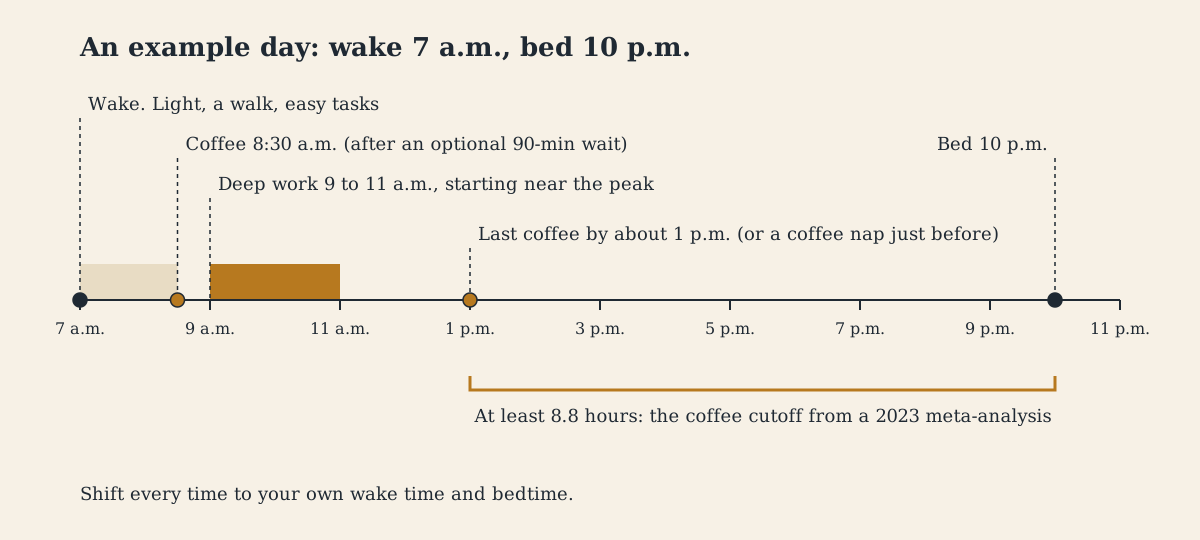
Wake, wait 90 minutes, have your caffeine, then start your hardest work about 30 minutes later, around when blood levels typically peak.
| Wake time | First caffeine | Deep work begins |
|---|---|---|
| 6:00 AM | 7:30 AM | 8:00 AM |
| 7:00 AM | 8:30 AM | 9:00 AM |
| 8:30 AM | 10:00 AM | 10:30 AM |
If the wait leaves you useless, Huberman's fallback is half your caffeine on waking and the other half about an hour later. To test the delay, do two weeks each way with the same wake time, rate your focus at 10 a.m. and 3 p.m., and keep whichever wins.
Protocol 2: the pre-session dose
For a fixed work block, count backwards. If the block starts at 10:00, have your caffeine at 9:30 or 9:40.
For most people this is the most useful of the five, because it ties the dose to the work instead of the clock. For sizing the block itself, see how long a deep work block should be.
Protocol 3: small repeated doses
Take 20 to 40 mg every 90 to 120 minutes through the working morning instead of one big dose. That's a quarter to half an 8-oz coffee, or a cup of tea at 30 to 50 mg.
The evidence comes from sleep-loss labs. In one study, 16 men kept awake for more than 28 hours took 0.3 mg per kg every hour, about 20 mg for a 70 kg man, and their performance held up much better than on placebo, though they felt sleepier (Wyatt et al., 2004). Nobody has tested it against one normal dose on an ordinary workday. Small doses still count toward your cutoff, so stop topping up by early afternoon.
Protocol 4: the caffeine nap
For the afternoon dip, drink your coffee and lie down straight away for a short nap. The caffeine lands around the time you get up.
Two small studies back it. In 12 sleepy drivers on a simulator, 200 mg of caffeine plus a nap of under 15 minutes cut driving incidents to 9% of placebo levels, against 34% for caffeine alone (Reyner & Horne, 1997). Dozing without proper sleep still counted. In 10 young adults, 200 mg before a 20-minute nap was the most effective of five conditions, and the effect lasted the full hour afterwards (Hayashi et al., 2003).
Both studies used about 200 mg, roughly two cups of coffee, so check that against your cutoff. Keep the nap short too. After a short night, a 10-minute nap helped people straight away, while a 30-minute nap left them groggy for a while first (Brooks & Lack, 2006).
If you'd rather skip afternoon caffeine, a 10-minute NSDR session is the other option. In the one head-to-head trial (Boukhris 2026b, 60 people), a 25-minute nap beat 10 minutes of NSDR on readiness, and NSDR showed no effect. Its advantage is that you don't wake up groggy. See NSDR versus a nap.
Protocol 5: the tolerance reset
Tolerance builds, but over weeks. In 11 active people taking 3 mg per kg a day, caffeine kept boosting cycling power for 15 to 18 days, with the boost shrinking along the way (Lara et al., 2019). That study measured exercise, not focus.
If your dose has crept up, cut back slowly to the bottom of your range rather than stopping dead. Withdrawal peaks between about 20 and 51 hours after your last dose, so a caffeine-free weekend puts the worst of it across Saturday and Sunday. Don't start a break in the days before something important. No trial has tested weekend-off or week-off schedules for focus.
How to find your dose and cutoff time
The body-weight formula
In Huberman's words, "ingesting 1 to 3 milligrams of caffeine per kilogram of body weight is going to be the range in which caffeine can have positive effects without making us feel overly anxious". That sits inside the 40 to 300 mg range studies have tested. If you don't drink caffeine daily, he suggests starting at the low end.
| Body weight | Low dose (1 mg/kg) | Moderate dose (2 mg/kg) | High dose (3 mg/kg) |
|---|---|---|---|
| 60 kg / 132 lb | 60 mg | 120 mg | 180 mg |
| 70 kg / 154 lb | 70 mg | 140 mg | 210 mg |
| 80 kg / 176 lb | 80 mg | 160 mg | 240 mg |
| 90 kg / 198 lb | 90 mg | 180 mg | 270 mg |
An 8-oz coffee has roughly 80 to 100 mg, though servings range from 58 to 259 mg. An 8-oz green or black tea has 30 to 50 mg, and a 12-oz can of cola 30 to 40 mg. The FDA advises staying at or under 400 mg a day for healthy adults, about four to five cups.
If you're pregnant, have a heart condition or an anxiety disorder, or take regular medication, ask your doctor how much caffeine suits you.
Fast vs slow metabolisers
A liver enzyme called CYP1A2 breaks down about 95% of the caffeine you drink, and common gene variants make it faster or slower (Nehlig, 2018). Variants in ADORA2A, the gene for caffeine's main brain target, change how strongly you feel it, including its effects on sleep and anxiety.
There's no reliable self-test. If even a late-morning cup shows up in your sleep, assume you're slow and move everything earlier.
Your cutoff time
A 2023 meta-analysis of 24 studies found caffeine cut total sleep by 45 minutes and sleep efficiency by 7%, made falling asleep take 9 minutes longer and took about 11 minutes off deep sleep (Gardiner et al.). To protect sleep time, the authors set the cutoff for a standard coffee at least 8.8 hours before bed, and for a 217.5 mg pre-workout serve at least 13.2 hours.
| Bedtime | Last coffee | Last pre-workout-size dose |
|---|---|---|
| 10:00 PM | about 1:00 PM | about 8:45 AM |
| 11:00 PM | about 2:00 PM | about 9:45 AM |
| Midnight | about 3:00 PM | about 10:45 AM |
Huberman's rule of no caffeine within 8 to 10 hours of bedtime lands in the same place.
L-theanine
L-theanine, an amino acid found naturally in tea, has been tested with caffeine in several small focus trials. They used about twice as much L-theanine as caffeine:
- 100 mg with 50 mg of caffeine made 27 people faster and more accurate at switching between tasks, and less distractible (Owen et al., 2008).
- 97 mg with 40 mg improved task-switching accuracy and alertness in 44 young adults, with no change on visual search or mental rotation (Giesbrecht et al., 2010).
- 250 mg with 150 mg sped up reaction time and working memory, and people rated themselves more alert and less tired (Haskell et al., 2008).
A 2014 meta-analysis of 11 studies found moderate effects for the combination on alertness and attention switching in the first two hours (Camfield et al.). Huberman suggests 100 to 200 mg of theanine with your coffee to take the edge off jitters, though the trials didn't measure jitters.
What daily caffeine does to its own effect
Caffeine works by blocking adenosine receptors, which holds off sleepiness for a while.
One influential review argues that in daily users, the first coffee mainly undoes the dip from a night without caffeine (James & Rogers, 2005). The 2024 Antonio review partly disagrees. Most of the evidence it found shows that regular caffeine use doesn't blunt the effect of a single dose on exercise performance. Either way, much of a daily drinker's morning lift may just be getting back to normal, so save the dose for the work that needs it.
Withdrawal is well mapped. A review of 66 studies found symptoms usually start 12 to 24 hours after your last dose, peak between about 20 and 51 hours, and last 2 to 9 days (Juliano & Griffiths, 2004). Headache, fatigue and poor concentration are common, and even 100 mg a day can bring them on. For a taper plan, see caffeine withdrawal: what to expect.
FAQ
How long does caffeine take to kick in for focus?
Caffeine can kick in as early as 20 minutes, the first point at which one caffeine-and-theanine trial measured a benefit. Blood levels peak between 15 minutes and 2 hours after you drink it, around 30 minutes in one lab study. So have it 20 to 30 minutes before you start.
Should you drink coffee immediately after waking up?
Drinking coffee immediately after waking is fine for most people. Huberman waits 90 to 120 minutes, but a 2024 review found no evidence that coffee on waking causes an afternoon crash or that waiting prevents one. What matters more for caffeine timing for focus is the gap before your hardest work and the gap before bed.
How much caffeine should you have per day for focus?
For focus, Huberman's range is 1 to 3 mg of caffeine per kg of body weight per dose. That works out at 70 to 210 mg for a 70 kg adult, or about one to two cups of coffee. Per day, stay at or under the FDA's 400 mg for healthy adults.
Does L-theanine make caffeine work better for focus?
L-theanine with caffeine improved attention switching and alertness in small trials, and a 2014 meta-analysis found moderate effects in the first two hours. The studies used about twice as much L-theanine as caffeine, such as 100 mg with 50 mg.
What is the best time to stop drinking coffee?
The best time to stop drinking coffee is at least 8.8 hours before bed, based on a 2023 meta-analysis. For an 11 p.m. bedtime, that's about 2 p.m. Stop earlier after strong pre-workout drinks or if caffeine lingers for you.
Sources
- Antonio J, Newmire DE, Stout JR, et al. (2024). Common questions and misconceptions about caffeine supplementation: what does the scientific evidence really show? Journal of the International Society of Sports Nutrition. https://pubmed.ncbi.nlm.nih.gov/38466174/
- Blanchard J, Sawers SJ (1983). The absolute bioavailability of caffeine in man. European Journal of Clinical Pharmacology. https://pubmed.ncbi.nlm.nih.gov/6832208/
- European Food Safety Authority (2015). Caffeine: EFSA explains risk assessment. https://www.efsa.europa.eu/sites/default/files/corporate_publications/files/efsaexplainscaffeine150527.pdf
- McLellan TM, Caldwell JA, Lieberman HR (2016). A review of caffeine's effects on cognitive, physical and occupational performance. Neuroscience & Biobehavioral Reviews. https://pubmed.ncbi.nlm.nih.gov/27612937/
- Huberman A. Using Caffeine to Optimize Mental & Physical Performance. Huberman Lab podcast. https://www.hubermanlab.com/episode/using-caffeine-to-optimize-mental-and-physical-performance
- Clow A, Hucklebridge F, Thorn L (2010). The cortisol awakening response in context. International Review of Neurobiology. https://pubmed.ncbi.nlm.nih.gov/20970005/
- Lovallo WR, Whitsett TL, al'Absi M, et al. (2005). Caffeine stimulation of cortisol secretion across the waking hours in relation to caffeine intake levels. Psychosomatic Medicine. https://pubmed.ncbi.nlm.nih.gov/16204431/
- Leproult R, Colecchia EF, L'Hermite-Balériaux M, Van Cauter E (2001). Transition from dim to bright light in the morning induces an immediate elevation of cortisol levels. Journal of Clinical Endocrinology & Metabolism. https://pubmed.ncbi.nlm.nih.gov/11231993/
- Hayashi M, Masuda A, Hori T (2003). The alerting effects of caffeine, bright light and face washing after a short daytime nap. Clinical Neurophysiology. https://pubmed.ncbi.nlm.nih.gov/14652086/
- Wyatt JK, Cajochen C, Ritz-De Cecco A, Czeisler CA, Dijk DJ (2004). Low-dose repeated caffeine administration for circadian-phase-dependent performance degradation during extended wakefulness. Sleep. https://pubmed.ncbi.nlm.nih.gov/15164887/
- Reyner LA, Horne JA (1997). Suppression of sleepiness in drivers: combination of caffeine with a short nap. Psychophysiology. https://pubmed.ncbi.nlm.nih.gov/9401427/
- Brooks A, Lack L (2006). A brief afternoon nap following nocturnal sleep restriction: which nap duration is most recuperative? Sleep. https://pubmed.ncbi.nlm.nih.gov/16796222/
- Boukhris O, Suppiah H, Driller M (2026). Comparing the effects of a short nap and non-sleep deep rest on perceptual, cognitive, and physical performance in active adults. Clocks & Sleep. https://pubmed.ncbi.nlm.nih.gov/42783005/
- Lara B, Ruiz-Moreno C, Salinero JJ, Del Coso J (2019). Time course of tolerance to the performance benefits of caffeine. PLoS One. https://pubmed.ncbi.nlm.nih.gov/30673725/
- Nehlig A (2018). Interindividual differences in caffeine metabolism and factors driving caffeine consumption. Pharmacological Reviews. https://pubmed.ncbi.nlm.nih.gov/29514871/
- Gardiner C, Weakley J, Burke LM, et al. (2023). The effect of caffeine on subsequent sleep: a systematic review and meta-analysis. Sleep Medicine Reviews. https://pubmed.ncbi.nlm.nih.gov/36870101/
- Owen GN, Parnell H, De Bruin EA, Rycroft JA (2008). The combined effects of L-theanine and caffeine on cognitive performance and mood. Nutritional Neuroscience. https://pubmed.ncbi.nlm.nih.gov/18681988/
- Giesbrecht T, Rycroft JA, Rowson MJ, De Bruin EA (2010). The combination of L-theanine and caffeine improves cognitive performance and increases subjective alertness. Nutritional Neuroscience. https://pubmed.ncbi.nlm.nih.gov/21040626/
- Haskell CF, Kennedy DO, Milne AL, Wesnes KA, Scholey AB (2008). The effects of L-theanine, caffeine and their combination on cognition and mood. Biological Psychology. https://pubmed.ncbi.nlm.nih.gov/18006208/
- Camfield DA, Stough C, Farrimond J, Scholey AB (2014). Acute effects of tea constituents L-theanine, caffeine, and epigallocatechin gallate on cognitive function and mood: a systematic review and meta-analysis. Nutrition Reviews. https://pubmed.ncbi.nlm.nih.gov/24946991/
- James JE, Rogers PJ (2005). Effects of caffeine on performance and mood: withdrawal reversal is the most plausible explanation. Psychopharmacology. https://pubmed.ncbi.nlm.nih.gov/16001109/
- Juliano LM, Griffiths RR (2004). A critical review of caffeine withdrawal: empirical validation of symptoms and signs, incidence, severity, and associated features. Psychopharmacology. https://pubmed.ncbi.nlm.nih.gov/15448977/