The autonomic nervous system is the part of your nervous system that runs your body without asking you: heart rate, blood pressure, breathing rate, digestion, sweating, the size of your pupils. It has three branches. The sympathetic branch gears you up for effort or threat, the parasympathetic branch slows things back down, and the enteric branch runs your gut from inside its walls. You can't switch any of them off. You can nudge them, and breathing is the easiest way in.
What is the autonomic nervous system?
The quick definition
The autonomic nervous system (ANS) is the network of nerves that controls unconscious processes. You don't decide to speed up your heart when a car horn goes off, or to make saliva when you smell toast. The ANS does it.
It sits in the peripheral nervous system, next to the somatic nervous system, which handles the movements you choose, like lifting your arm. The part of your brain that runs autonomic functions is the hypothalamus. The relay cells that carry its orders sit in the brainstem and spinal cord.
Where it fits in your nervous system
The central nervous system is the brain and spinal cord. The peripheral nervous system is everything else, and it splits into somatic (voluntary movement) and autonomic (involuntary control).
The ANS divides again. Many medical references, including the MSD Manual, list two divisions: sympathetic and parasympathetic. Cleveland Clinic and many physiology texts add a third, the enteric nervous system, which runs the gut and can work on its own. This page uses three.
What it controls
Nearly every organ gets autonomic input. The ANS sets how fast and hard your heart pumps and how wide your blood vessels are. It controls pupil size, tears, saliva, sweating, the width of your airways, stomach acid, the bladder, and sexual arousal.
The wiring runs through 4 of your 12 cranial nerves (III, VII, IX and X) and most of your 31 spinal nerves. Your autonomic nervous system is always active, including while you sleep.
The three branches of the autonomic nervous system
Each branch has its own job.
Sympathetic nervous system (the accelerator)
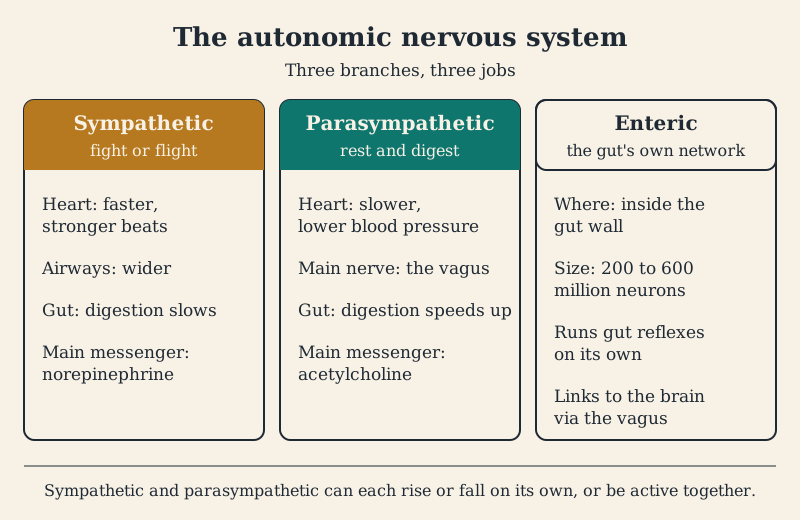
The sympathetic branch gets you ready for stress or an emergency, the response usually called "fight or flight". It raises your heart rate and the force of each beat, widens your airways, and has the liver turn stored energy into glucose. Digestion and urination slow down, and more blood goes to your muscles.
A threat doesn't have to be physical. A deadline, a hard conversation or a hard workout can all switch it on. Stanford neuroscientist Andrew Huberman, talking about public-speaking nerves, says of the sympathetic division: "let's just call it the alertness system."
How the sympathetic and parasympathetic branches differ compares the pair side by side.
Parasympathetic nervous system (the brake)
The parasympathetic nervous system conserves and restores. It slows your heart, lowers blood pressure and gets the digestive tract moving. This is "rest and digest".
Its main nerve is the vagus, the tenth cranial nerve and the longest. It runs from the brainstem through the neck and chest into the abdomen, and it helps control heart rate, digestion, immune responses and mood. Vagal tone, how active the nerve is at rest, is linked with how well people regulate stress responses. It's also the target of medical vagus nerve stimulation.
Enteric nervous system (the gut brain)
The enteric nervous system is a mesh of nerve cells inside the wall of your gut. Most of it sits in two layers, and one of them runs unbroken from the upper oesophagus to the anal sphincter. In humans it holds 200 to 600 million neurons, about as many as the spinal cord.
That's why it gets called the "second brain". In the small intestine and colon it runs complete reflex circuits on its own: it moves the muscle, controls fluid flow across the gut lining and adjusts local blood flow. Higher up, the brain does more of the work, steering the oesophagus and much of what the stomach does. Signals pass both ways between the gut and the brain, through the vagus nerve, the pelvic nerves and sympathetic pathways.
Much of the body's serotonin is made in the gut, where it works on digestion and blood platelets.
How the autonomic nervous system works
Both branches run at once
The two main branches don't work like a seesaw. Each can rise or fall on its own, and both can be active together, as Gary Berntson and colleagues set out in Psychological Review in 1991.
Huberman's "autonomic continuum", from very high alertness down to sleep, is a good description of how a state feels, but less so of the wiring underneath.
The vagus nerve is mostly a sensory line
The vagus nerve is usually described as the calming nerve, but most of it carries information the other way. About 80 to 90% of its fibres carry signals up from the gut, heart, lungs and liver to the brain. Only 10 to 20% carry commands down.
Your breathing shows the link to the heart. Heart rate rises a little on each in-breath and falls on each out-breath, a rhythm called respiratory sinus arrhythmia. Slow breathing makes those swings larger. Across 223 studies, slow breathing raised the vagal part of heart rate variability during a session, straight after one, and after multi-session programmes.
The chemical messengers
Two messengers do most of the work. Norepinephrine (noradrenaline) generally carries the sympathetic effects, like the faster heartbeat. Acetylcholine generally carries the parasympathetic ones: a slower heart and a busier gut. There are exceptions.
What happens when your autonomic nervous system is dysregulated
Everyday stress vs a diagnosis
"Dysregulated" isn't a diagnosis. In everyday use it means a stress response that switches on too easily or takes too long to settle. Trauma therapists describe it with the "window of tolerance" model: stuck "on", or shut down. It was built to describe the effects of severe trauma.
If the sympathetic response hangs around, you feel its normal effects: a faster heart, more sweating, a slower gut. Each of those has many possible causes. The full list is in signs of a dysregulated nervous system.
Low HRV as a marker
Heart rate variability (HRV) is the small beat-to-beat change in timing between heartbeats, and researchers use it to estimate vagal activity. In a 2022 meta-analysis of 32 studies and 38,008 people, lower HRV predicted higher mortality across ages, sexes and continents. That's an association. Low HRV is a warning light; nobody has shown that raising it adds years.
The gut connection
A stress response slows digestion, which is one reason a bad week can show up in your stomach. Traffic runs the other way too, since most vagus fibres report from the gut to the brain. A 2018 review describes preliminary evidence that gut bacteria affect mood and anxiety, partly through the vagus nerve.
When it's a medical autonomic disorder
Autonomic disorders are different from everyday stress. Their most common causes are diabetes, nerve disorders, ageing and Parkinson's disease, and less often certain infections, injuries and medicines. Unmanaged type 2 diabetes can damage autonomic nerves over time.
The typical symptom is dizziness or light-headedness when you stand up. Others include changes in sweating, dry eyes and mouth, feeling full early, and bladder or bowel problems. If you have these, or you faint, see a doctor. The breathing tools below support care; they don't replace it.
How to regulate your autonomic nervous system
You can't order your heart to slow down. You can change the inputs, and three have research behind them.
Breathing
Breathing runs on its own, but you can take it over whenever you like. That makes it the easiest handle on the ANS you have.
The physiological sigh. Breathe in through your nose, take a second smaller breath in on top, then breathe out slowly and fully through your mouth. Huberman says one to three sighs "will bring down your level of stress very, very fast". In a one-month Stanford trial he co-led, with 108 participants, 5 minutes a day of cyclic sighing improved mood and slowed resting breathing more than mindfulness meditation did. HRV didn't differ between groups, and the trial measured daily practice, not speed. Read more about how the physiological sigh works.
A longer out-breath. Breathe in for about 4 seconds and out for about 6, for 5 to 10 minutes. In a small lab study of 30 people, a longer exhale felt more relaxing, and at 6 breaths a minute it also gave more high-frequency HRV. You can follow a guided 4-6 breathing animation.
NSDR
Non-sleep deep rest (NSDR) is a short guided session of slow breathing and attention moved through the body while you lie still and stay awake. In a 2026 trial of 102 active young adults, one 10-minute session lowered sleepiness, fatigue and stress more than a control session, and heart rate fell more. HRV didn't differ, and the authors call the physiological findings modest.
Movement
In sedentary adults, regular exercise training gave a small rise in resting HRV, according to a 2022 meta-analysis. Walking is a fine place to start.
For the order to add these in, with doses and how to track progress, follow the step-by-step plan to reset your nervous system.
FAQ
What are the 3 parts of the autonomic nervous system?
The 3 parts of the autonomic nervous system are the sympathetic branch (fight or flight), the parasympathetic branch (rest and digest) and the enteric branch, the network in the gut wall. Some references count only the first two.
Can you control your autonomic nervous system?
You can't control your autonomic nervous system directly, but you can influence it. Breathing is the easiest route. Slow breathing raises vagal HRV during a session, and a 10-minute NSDR session lowered heart rate more than a control session.
What triggers autonomic nervous system dysfunction?
Autonomic nervous system dysfunction, in the medical sense, is most often triggered by diabetes, nerve disorders, ageing or Parkinson's disease. Infections, spinal cord injury, toxins such as alcohol and some medicines can also damage autonomic nerves. Everyday stress keeps the sympathetic branch busy too, which is a normal response, and the breathing tools above can help settle it.
What does the autonomic nervous system do in simple terms?
In simple terms, the autonomic nervous system runs everything you don't have to think about: heart rate, blood pressure, breathing rate, digestion, sweating and your pupils. It's always on, including while you sleep.
How long does it take to regulate a dysregulated nervous system?
No study gives a fixed timeline to regulate a dysregulated nervous system. Slow breathing raises HRV within a single session, and the baseline changes in the research came after repeated practice. In the month-long Stanford breathing trial, mood improved while HRV didn't differ between groups, so judge progress by how you sleep and feel as well as by the numbers.
Sources
- Cleveland Clinic (2022). Autonomic Nervous System: What It Is, Function & Disorders. https://my.clevelandclinic.org/health/body/23273-autonomic-nervous-system
- MSD Manual Consumer Version. Overview of the Autonomic Nervous System. https://www.msdmanuals.com/home/brain-spinal-cord-and-nerve-disorders/autonomic-nervous-system-disorders/overview-of-the-autonomic-nervous-system
- Furness JB, Callaghan BP, Rivera LR, Cho HJ (2014). The enteric nervous system and gastrointestinal innervation: integrated local and central control. Advances in Experimental Medicine and Biology. https://pubmed.ncbi.nlm.nih.gov/24997029/
- Breit S et al. (2018). Vagus Nerve as Modulator of the Brain-Gut Axis in Psychiatric and Inflammatory Disorders. Frontiers in Psychiatry. https://pubmed.ncbi.nlm.nih.gov/29593576/
- Yano JM et al. (2015). Indigenous bacteria from the gut microbiota regulate host serotonin biosynthesis. Cell. https://pubmed.ncbi.nlm.nih.gov/25860609/
- Berntson GG, Cacioppo JT, Quigley KS (1991). Autonomic determinism: the modes of autonomic control, the doctrine of autonomic space, and the laws of autonomic constraint. Psychological Review. https://pubmed.ncbi.nlm.nih.gov/1660159/
- Russo MA, Santarelli DM, O'Rourke D (2017). The physiological effects of slow breathing in the healthy human. Breathe. https://pubmed.ncbi.nlm.nih.gov/29209423/
- Laborde S et al. (2022). Effects of voluntary slow breathing on heart rate and heart rate variability: A systematic review and a meta-analysis. Neuroscience & Biobehavioral Reviews. https://pubmed.ncbi.nlm.nih.gov/35623448/
- Corrigan FM, Fisher JJ, Nutt DJ (2011). Autonomic dysregulation and the Window of Tolerance model of the effects of complex emotional trauma. Journal of Psychopharmacology. https://pubmed.ncbi.nlm.nih.gov/20093318/
- Jarczok MN et al. (2022). Heart rate variability in the prediction of mortality: A systematic review and meta-analysis of healthy and patient populations. Neuroscience & Biobehavioral Reviews. https://pubmed.ncbi.nlm.nih.gov/36243195/
- Balban MY et al. (2023). Brief structured respiration practices enhance mood and reduce physiological arousal. Cell Reports Medicine. https://pubmed.ncbi.nlm.nih.gov/36630953/
- Van Diest I et al. (2014). Inhalation/Exhalation ratio modulates the effect of slow breathing on heart rate variability and relaxation. Applied Psychophysiology and Biofeedback. https://pubmed.ncbi.nlm.nih.gov/25156003/
- Boukhris O et al. (2026). Time course of perceptual, cognitive, physical and physiological responses to a single non-sleep deep rest session in physically active young adults. Applied Psychology: Health and Well-Being. https://pubmed.ncbi.nlm.nih.gov/42383502/
- Casanova-Lizón A et al. (2022). Does Exercise Training Improve Cardiac-Parasympathetic Nervous System Activity in Sedentary People? A Systematic Review with Meta-Analysis. International Journal of Environmental Research and Public Health. https://pubmed.ncbi.nlm.nih.gov/36360777/
- Huberman A (2021). Tools for Managing Stress & Anxiety. Huberman Lab podcast. https://www.hubermanlab.com/episode/tools-for-managing-stress-and-anxiety
- Huberman A, Abrahams M (2021). Hacking Your Speaking Anxiety: How Lessons from Neuroscience Can Help You Communicate Confidently. Think Fast, Talk Smart, Stanford Graduate School of Business. https://www.gsb.stanford.edu/insights/hacking-your-speaking-anxiety-how-lessons-neuroscience-can-help-you-communicate